
A key coat is the last layer anyone can control before the finish goes on, and it is the one most often applied to a rule of thumb rather than to a data sheet. Every figure below is transcribed from the Ceresit CT 16 and Atlas Cerplast sheets fetched for this revision, and where the two disagree the difference is given with the product it belongs to rather than averaged into one site rule. The Renders World exterior render primers range holds both, alongside the consolidating primers that go on earlier in the build-up.
How a Quartz Key Coat Bonds the Basecoat to the Finish
Quartz primer application UK-wide rests on one documented figure per product: Ceresit CT 16 dries in approximately 3 hours, so a basecoat primed in the morning can take its thin-coat render the same afternoon. That interval is only worth having if the coat underneath is doing the jobs its sheet describes.
- It cuts substrate absorption. The CT 16 sheet credits priming with considerably decreasing absorption, which prevents the products applied over it from drying too fast — the mechanism behind most patchy thin-coat work.
- It adds mechanical key. Fine aggregates make the primed surface rough and scratch resistant, expanding the effective surface the render grips.
- It evens out the background. Cerplast is described as forming a chemical barrier between substrate and render, limiting colour penetration and the stains that follow it.
- It buys time if the programme slips. The dried Cerplast film protects a non-rendered façade against weather within half a year.
Check the Substrate Before the First Bucket Is Opened
Neither sheet publishes a curing figure for a mesh-reinforced basecoat, so the reliable checks are the ones the Atlas sheet gives for the substrates it does name, backed by a visual inspection. Working to those beats a number nobody can source.
- Stabilisation, where the sheet covers it: new cement plasters made of Atlas mortars need a minimum of one week per 1 cm of thickness, and concrete walls a minimum of 28 days.
- Even: irregularities and gaps are filled first, with repair areas primed with an emulsion before the key coat goes over them.
- Clean: free from dust, dirt, lime, oil, grease, wax and residues of oil and emulsion paints, with biologically contaminated areas washed with a biocidal agent first.
- Right family for the background: the CT 16 sheet routes absorptive substrates — gypsum renders, chipboards, non-impregnated plasterboard — to Ceresit CT 17 first, left approximately 2 hours, before CT 16 goes on top.
Mixed elevations are where this is decided, and the substrate-by-substrate guide to brick, block and painted walls sets out how each background behaves beforehand.
Stir the Mass, and Never Thin It
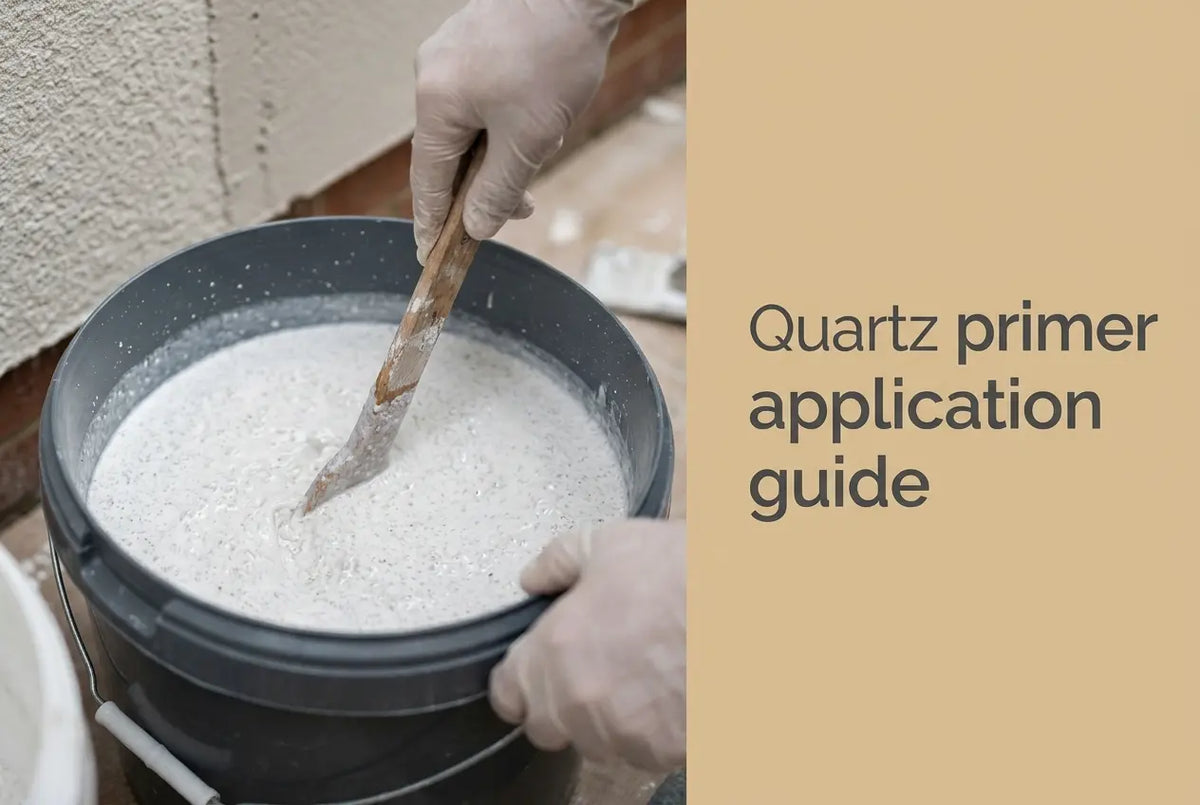
Both sheets are blunt on this point and neither sets a stirring time, so the target is a visual one. Do not dilute the paint is the CT 16 instruction verbatim, and Cerplast must not be mixed with other materials, thinned or thickened.
- Mix immediately before use. Cerplast is stirred to a uniform consistency just before application rather than the evening before.
- Judge it by eye and by resistance. No paddle speed or duration appears on either sheet, so uniform colour and consistent resistance from the bottom of the bucket upwards is the standard.
- Use no rusty containers or tools. The CT 16 sheet names this explicitly, and iron contamination is the kind of thing that appears on a pale finish months later.
- Wash tools in clean water directly after use, which both sheets instruct.
Apply by Roller, Brush or Machine — Check What the Sheet Permits
The two products do not license the same tools, which matters the moment an airless rig arrives on site. Ceresit CT 16 quartz primer is a roller and brush product on its own sheet, while Atlas Cerplast quartz top coat primer adds mechanical application.
| Method | Ceresit CT 16 | Atlas Cerplast |
|---|---|---|
| Roller | Named on the sheet | Named on the sheet |
| Brush | Named on the sheet | Named on the sheet |
| Machine or spray | Not named | Named on the sheet |
| Coat structure | One even layer | Uniform over the whole surface |
Read that as a purchasing instruction rather than a preference: on a machine-applied programme the Atlas bucket is the one whose manufacturer describes the method.
Temperature, Humidity and Drying Times, Read Per Product
Collapsing two products into one site rule is where a programme quietly loses a day. The windows overlap, but they are not the same window, so an elevation carrying both buckets is planned on the tighter of the two.
| Condition | Ceresit CT 16 | Atlas Cerplast |
|---|---|---|
| Application temperature | +5 °C to +25 °C, ambient and substrate | +5 °C to +30 °C, mass, substrate and ambient |
| Humidity | Below 80% | Not stated on the sheet |
| Drying before the next coat | Approx. 3 hours | 4 to 6 hours |
| While drying | Not stated on the sheet | Protect from direct sun, wind and precipitation |
| Storage | Protect from frost and direct sunlight | Below +30 °C; freezes irreversibly below 0 °C |
Where both are in use, plan on +5 °C to +25 °C and on the longer 4 to 6 hour wait, since the narrower limit and the longer interval keep both products inside their own instructions. Cold-weather work carries a warranty dimension as well: NHBC Standards 2026, which apply to registered homes whose foundations begin on or after 1 January 2026, have updated their guidance on rendering in cold weather — warranty guidance rather than Building Regulations, and worth reading alongside the sheets.
How Much Quartz Primer to Order for 100 m²
Order in the unit the container is sold in and the arithmetic stays honest. The CT 16 sheet gives consumption twice, in litres and in kilograms, and those are one rate expressed two ways rather than a single wide band.
- CT 16 by volume: 0.2–0.35 l/m² × 100 m² = 20 to 35 litres, depending on the smoothness and absorption of the substrate.
- CT 16 by weight: 0.3–0.5 kg/m² × 100 m² = 30 to 50 kg, the same rate — which is why quoting 0.2 to 0.5 as one band overstates the top by mixing units.
- Cerplast, product scope: 25 kg ÷ 0.3 kg/m² = 83 m² per bucket at the sheet's average consumption.
- Cerplast, system scope: BBA Agrément Certificate 13/5018 applies key coats at 0.25 to 0.35 kg/m², so 25 kg ÷ 0.35 = 71 m²; ordering against that figure inside a certified build-up leaves the elevation comfortable.
- Check the pack against the sheet. CT 16 is listed there in 5 kg and 15 kg buckets, while the container sold here is 10 l — approximately 15 kg at the stated density of about 1.5 kg/dm³. Confirm the label weight where a take-off depends on it.
Match the Key Coat to the Finishing Coat, Not to the Substrate
This is the correction that matters most to the previous version of this guide. Inside BBA Agrément Certificate 13/5018, Product Sheet 1 for the Atlas/Aval EPS external wall insulation system, key coats are named against specific finishing coats rather than against a render type in general.
- Atlas Cerplast (Aval KT 16) is named for use with Atlas Cermit Mineral, Atlas Acrylic Render and Atlas Acrylic-Silicone Render finishing coats.
- Atlas Silkon ANX is named for Atlas Silicone Render and Atlas Silicone-Silicate Render, so an Atlas silicone finish takes that key coat inside the certified build-up rather than Cerplast.
- Ceresit CT 16 is recommended on its own sheet for priming reinforced layers within Ceresit Ceretherm systems, and names acrylic, mineral, silicate-silicone, silicone and elastomeric renders among the finishes it keeps free of staining.
A key coat therefore carries no fire class or impact category of its own — those belong to the tested assembly of adhesive, board, basecoat, mesh, key coat and finish. Where the finish is still open, the ranked comparison in the primer selection guide for thin-coat systems settles the product choice, and the Renders World silicone render range shows which finishes are on the shelf to be matched.
Site Habits That Show Up Under the Topcoat
Three of these come off the sheets and one off the scaffold, and together they account for most of the gap between an even elevation and one that needs a second look in low sun.
- Mask aluminium and copper first. The Cerplast sheet lists aluminium, copper and their alloys as incompatible materials, which puts base tracks, beads and rainwater goods behind tape before the first roller stroke.
- Colour-match the key coat. The CT 16 sheet recommends the primer in the colour corresponding to that of the render. Cerplast is white as standard, with brown, clinker and graphite offered in the 15 kg and 25 kg packs only, and SAH tinting beyond that.
- Prime whole elevations rather than patches. Cerplast is applied uniformly over the whole surface, which equalises suction across a face and keeps drying speed, and therefore colour, consistent.
- Protect the drying film, following the shade around the building where the day allows it.
Key Takeaway: Take every quartz key coat figure from the bucket's own sheet. Ceresit CT 16 runs at 0.2–0.35 l/m², dries in approximately 3 hours and works from +5 °C to +25 °C below 80% humidity; Atlas Cerplast runs at approximately 0.3 kg/m², dries in 4 to 6 hours and works from +5 °C to +30 °C. Neither is diluted, and inside BBA 13/5018 the key coat is chosen by the finishing coat it will carry.
Next Step — Order the Key Coat Your Specification Names
Knowing how to apply quartz primer is largely knowing which sheet governs the bucket in your hand, which is what makes quartz primer application UK-wide a per-product exercise. Start from the finishing coat, take the key coat named for it, then check the two windows against the week ahead.
Both quartz key coats and the consolidating primers that precede them sit in the Renders World key coat and primer range, and the layer-by-layer context that a quartz primer for EWI systems belongs to — board, adhesive, mesh, key coat, finish — sits in the external wall insulation systems hub.
Written by Mariusz Saja. Technically reviewed by Rafał Wyrzykowski. Last reviewed Aug 2026.
FAQ — Coverage, Conditions and Key Coat Compatibility
How many containers does a 100 m² elevation take?
Two to four 10 l containers of CT 16, from 100 m² × 0.2–0.35 l/m² = 20 to 35 litres. In Cerplast, one 25 kg bucket covers 83 m² at the sheet's 0.3 kg/m² and 71 m² at the 0.35 kg/m² the certificate applies to key coats, so a 100 m² face is two buckets.
Can it be thinned, and what temperature does it need?
Neither product is thinned — CT 16 says so directly and Cerplast must not be thinned, thickened or mixed with anything. CT 16 works from +5 °C to +25 °C with humidity below 80%; Cerplast from +5 °C to +30 °C for mass, substrate and ambient together.
Does a quartz key coat replace a penetrating primer?
No — they sit at different stages and in different consumption bands. The CT 16 sheet sends absorptive substrates such as gypsum renders, chipboards and non-impregnated plasterboard to Ceresit CT 17 deep penetrating primer first, with approximately 2 hours drying, before the quartz coat goes over it.
What actually differs between CT 16 and Cerplast on site?
Drying time, working range and permitted tools. CT 16 dries in about 3 hours against 4 to 6 for Cerplast; CT 16 tops out at +25 °C against +30 °C; and only the Cerplast sheet names mechanical application. Cerplast also declares bonding to concrete of more than 1.0 MPa.
How should quartz primer be stored over a UK winter?
Frost-free, and that is the limit that matters. Cerplast freezes and irreversibly loses performance below 0 °C, with a shelf life of 12 months from the production date and storage below +30 °C; CT 16 is stored cool in undamaged packaging, protected from frost and direct sunlight, for up to 12 months.