

Description
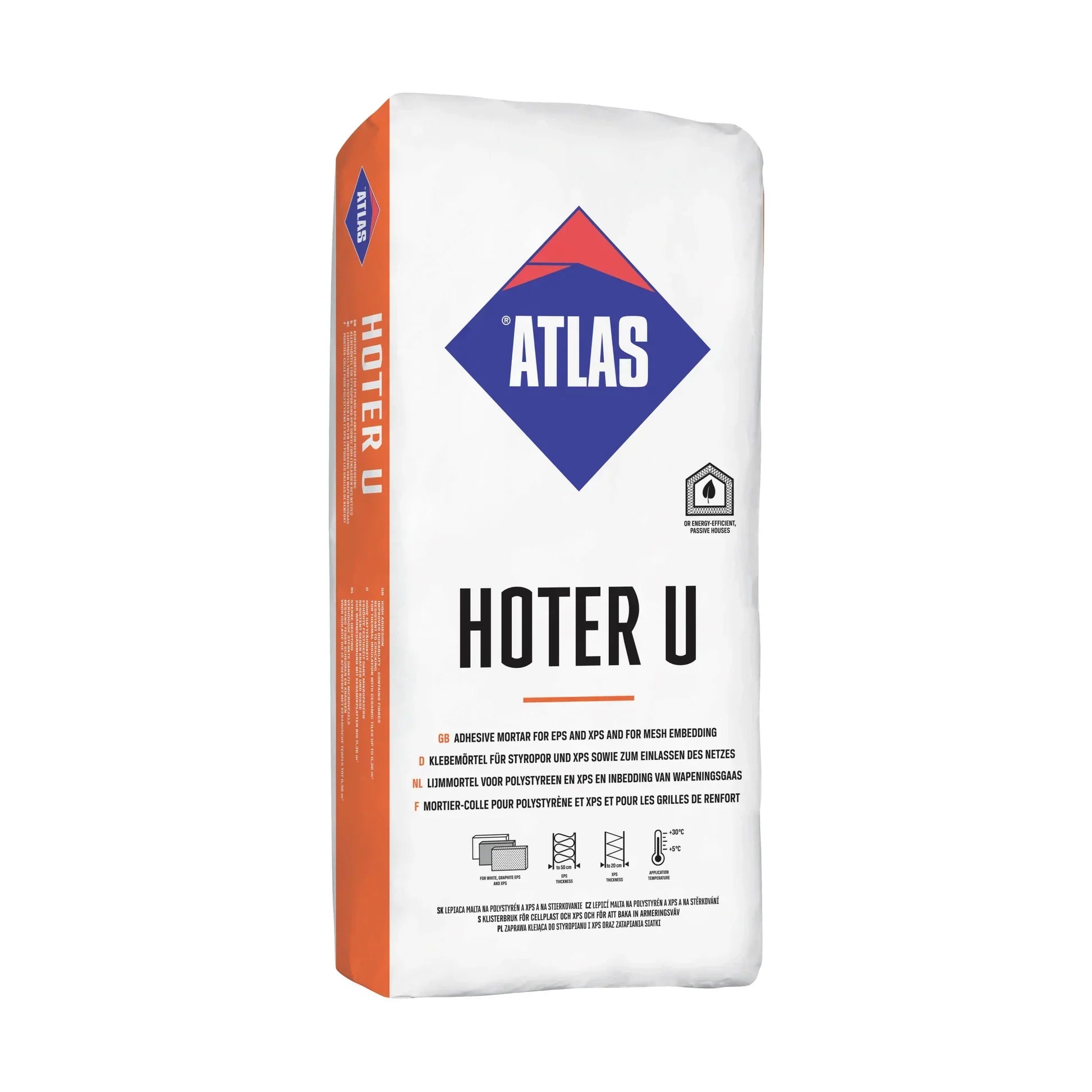
Atlas Hoter U White is the white-cement version of the fibre-reinforced mortar that does both structural jobs on an EPS facade: it bonds the boards to the wall, then forms the mesh-reinforced layer over them. The white binder is not a cosmetic choice — Atlas states that white cement raises the strength of the layer the adhesive forms — and this version carries its own documentation.
Atlas Hoter U White: the White-Cement Version, and Where It Parts From the Grey
The versions are often treated as one product in two shades. Their paperwork says otherwise. Atlas publishes a separate technical sheet for Atlas Hoter U White, updated 27 January 2026, and a separate safety data sheet, and they differ from the grey documents in four places that matter on a specified job.
- One national assessment, not two. The white sheet names ATLAS ETICS ITB-KOT-2020/1616, edition 5. The grey sheet names that assessment without an edition number and adds ATLAS CERAMIK ITB-KOT-2018/0385.
- Two build-ups routed elsewhere. A traditional wall finished with thin-coat render is covered; a renovation build-up over existing EPS goes to the ATLAS RENOTER system and a tiled build-up to ATLAS CERAMIK. The grey sheet marks all three as covered.
- A colour table with no counterpart in the grey sheet, tying the choice of adhesive to the light reflectance of the finish. It is set out below.
- Internal walls declared as well as external ones on the manufacturer's page for this version.
What does not differ is the technical table: nine cells — bulk density, water ratio, layer thickness, both adhesion figures, working temperature, maturing time, pot life and open time — are identical in the two documents. So the choice between the bags turns on binder, paperwork and colour, not on a performance gap either manufacturer document declares.
Why the White Bag
- Two stages, one product code: the same mortar bonds the boards at 4.0–5.0 kg/m² and forms the reinforced layer at 3.0–3.5 kg/m², so one order covers both days on the elevation.
- A stronger layer, on the manufacturer's own wording: white cement raises the strength of the layer the adhesive forms.
- Fibre reinforcement: structural fibres raise resistance to microcracking while the mortar sets and to cracking over the system's service life.
- ETA 06/0081 and ETA 07/0316 stand against its own name, so a specification asking for a European assessment is satisfied by the white bag.
- A bright base under pale finishes, where a grey reinforced layer would otherwise show through a thin coat.
- Vapour permeable, which keeps the drying route through an insulated solid wall open.
Boards, Walls and the Build-Ups It Covers
The mortar is written for expanded polystyrene in white and graphite grades and for extruded polystyrene. Atlas Hoter U White fixes EPS up to 50 cm thick and XPS up to 20 cm, and covers insulation finished with ceramic tiles up to 0.36 m² each. Mineral wool falls outside its scope in both fibre orientations: lamella and facade slabs go to the ATLAS ROKER system, so a stone-wool elevation takes the wool-and-EPS mortar and the slabs come from the mineral wool insulation range.
- Walls it bonds to: aerated concrete, silicate and ceramic brick or block, concrete block, stone masonry, cast in-situ and precast concrete, cement and cement-lime plasters, and walls carrying strongly adhering paint — the paint case needs an adhesion assessment every time.
- Heights and spaces it does not cover: buildings over 25 m, underground garages and soffits under heated rooms all go to the ROKER system. Buildings of up to eleven storeys handed over before 1 April 1995 may still be insulated with EPS.
Technical Data — Atlas Hoter U White, Edition of 27 January 2026
| Property | Value |
|---|---|
| Bulk density, dry mix | approx. 1.40 kg/dm³ |
| Water per 25 kg bag | 5.00–5.50 l (0.20–0.22 l/kg) |
| Reinforced layer thickness | min. 2 mm / max. 5 mm |
| Adhesion to concrete, air-dry | min. 0.25 MPa |
| Adhesion to polystyrene, air-dry | min. 0.08 MPa |
| Working temperature | +5 °C to +30 °C |
| Maturing time | approx. 5 minutes |
| Pot life | approx. 4 hours |
| Open time | min. 25 minutes |
| Consumption, bonding boards | 4.0–5.0 kg/m² |
| Consumption, reinforced layer | 3.0–3.5 kg/m² |
| Packaging | 25 kg paper bag |
| Shelf life | 12 months from the production date |
Pot life, open time and both adhesion figures are quoted by Atlas Hoter U White for application at about 20 °C and 55 % humidity. In buying terms one bag bonds 25 ÷ 4.0–5.0 = about 5.0–6.3 m² of board, or forms 25 ÷ 3.0–3.5 = about 7.1–8.3 m² of reinforced layer; the real figure moves with how level the wall is and with the bonding technique chosen.
The Colour Rule: Light Reflectance Decides Which Adhesive Is Allowed
This rule has no counterpart in the grey documentation, and on a dark scheme it decides whether Atlas Hoter U White may be used at all.
Atlas defines HBW as the light reflectance value in per cent — the share of sunlight a facade sends back. The lower it runs, the more radiation the surface absorbs and the hotter the layers beneath get; white is 100. The trigger is stated plainly: where a render colour with HBW below 10 covers more than 10 % of the elevation, the adhesive has to come from the manufacturer's table.
- The band this mortar sits in: HBW above 20, against any Atlas thin-coat render, where any Atlas adhesive for the reinforced layer is allowed.
- The darker bands: specific Atlas adhesives are named instead, and this one is not among them.
- Mosaic renders in dark colours over more than a tenth of the elevation: individual contact with an Atlas technical adviser is asked for.
What the table does not settle is how the trigger and the bands combine — the trigger speaks of colours below 10, the rows run above 10, above 15 and above 20, and nowhere are the two written into one instruction. That gap belongs to the specifier and the system holder, and Renders World names it here rather than guessing at it.
Approvals Named Against the White Version
The white documentation records Atlas Hoter U White as a component of two European Technical Assessments — ATLAS, ETA 06/0081 and ATLAS XPS, ETA 07/0316 — and of the national assessment ATLAS ETICS ITB-KOT-2020/1616, edition 5. Both ETA numbers stand against the white product's own name, so a specification asking for an adhesive that carries one is answered by this bag as well as by the grey.
- Not declared for this version: a reaction-to-fire class, a Declaration of Performance, a CE marking for the mortar alone, or a BBA certificate.
- What that means on site: under current Approved Document B guidance the item assessed is the complete external wall build-up, not a single component, so the adhesive is specified inside a system and the manufacturer's documents travel with the project file.
Applying It: Preparation, Bonding and the Reinforced Layer
Preparing the wall
Atlas Hoter U White goes on a wall that is unfrozen and dry, load-bearing, resistant to deformation, seasoned, level and clean of anything that weakens adhesion — dust, dirt, lime, oils, greases, wax and paint residue. Hollow-sounding plaster comes off without exception, and poorly bonded paint is removed mechanically, for instance by hydrodynamic washing. Where fungi, algae or lichen have taken hold, clean the face mechanically and then treat it with Atlas Mykos Plus; fill larger hollows first with Atlas ZW 330 or an Atlas rendering mortar.
Absorbent and unevenly absorbent walls are primed, as are weak cement and cement-lime plasters and walls of aerated concrete, silicate blocks or slag-concrete blocks. Three primers are named by trade name: Atlas Uni-Grunt, Atlas Uni-Grunt Ultra and Atlas Grunt NKP, the last ready to use without dilution. Fix and level the base track before the first board goes up.
Mixing and bonding the boards
- Pour the bag into a measured 5.00–5.50 litres of water, mix with a slow-speed paddle to a uniform consistency, leave it 5 minutes, scrape the vessel wall and remix. Use the batch within about 4 hours.
- Spread the mortar on the inner face of the board only, never on the wall: a perimeter band at least 3 cm wide, plus 6 to 8 dabs of at least 8 cm diameter across the rest of the face.
- Apply enough to give an effective bonding area of at least 40 %, keeping the bed under a pressed board no thicker than 10 mm. On level, smooth walls comb it over the whole face instead, with teeth no smaller than 10 × 10 mm.
- Set the boards with staggered vertical joints, offer each up immediately and beat it to line with a straightedge. Mechanical fixings go in no earlier than 24 hours after bonding, minimum 4 per m² and to the quantity the thermal design gives.
The reinforced layer
The second stage of the Atlas Hoter U White build-up starts no earlier than three days after bonding. The board face must be free of frost, level, clean, stable and dust-free, and graphite boards are sanded and dedusted first — a step asked for on graphite alone, and the same reason heated graphite EPS is kept out of the build-up.
Comb the mortar on with a trowel of 6–10 mm teeth, lay the Atlas 150 g/m² glass-fibre mesh into it and bed it in while smoothing flat in the same pass, with laps at least 10 cm wide, until the mesh is invisible and fully embedded. At the corners of openings add strips of at least 20 × 35 cm at 45° beneath the main layer. Sand off anything still proud once the mortar has dried, because it will otherwise stop the render going on correctly. Render after about three days, once the weather suits the render's own requirements and the reinforced layer has taken the key coat proper to it. The basecoat and mesh reinforcement guide sequences the whole wall; the boards sit in the EPS insulation boards range and the rolls in fibreglass mesh.
Site Conditions, a Doubtful Wall, and Handling the Powder
- Weather: no work during snow, rain or strong wind, and scaffold covers stay up while the works run.
- Testing a doubtful wall: bond polystyrene cubes of 10 × 10 × 10 cm at representative points and check after 3 days — or after 5 days below 10 °C and above 80 % humidity. If the polystyrene tears, the wall carries; if a cube lifts with the mortar and a layer of wall behind it, the remedy belongs in the thermal design.
- Cleaning: wash tools with clean water straight after use. Hardened residue comes off with Atlas Szop.
Unopened sacks keep for twelve months from the production date when they are stored closed, dry, cool and ventilated, preferably palletised, out of direct sun and stacked stably; moisture hardens the powder irreversibly, which is why a torn sack on a damp floor is a sack lost. Like any cement mortar, the powder is hazardous until it is in the wall. Atlas Hoter U White is classified Skin Irrit. 2 (H315), Skin Sens. 1 (H317), Eye Dam. 1 (H318) and STOT SE 3 (H335) under the signal word Danger, on Portland cement clinker at 20–35 % by mass, so gloves, protective clothing and eye and face protection are worn, the dust is not breathed, and the sacks stay away from children.
White or Grey: Which Bag the Job Takes
| Version | What its own documents say | When it is the right bag |
|---|---|---|
| Atlas Hoter U White 25 kg | Stronger layer; one assessment; colour table | Pale and mid schemes above the colour threshold |
| Atlas Hoter U Grey 25 kg | Same table; two assessments; in a BBA certificate | Dark schemes, tiled build-ups, BBA-quoted specifications |
Both bags sit in the Renders World EWI adhesive range, and the grey version is the one to reach for where a certificate quoted against the build-up names it by trade name.
Ordering, Delivery and Returns
- Dispatch: orders placed while the bag is in stock leave Renders World the same working day.
- Returns: goods supplied in paper sacks, this mortar included, sit outside the 14-day return window — so the quantity is worth calculating before the pallet is booked, not after.
FAQ
How many bags does 100 m² of EPS take?
- Bonding the boards at 4.0–5.0 kg/m²: 400–500 kg, or 16–20 bags.
- Reinforced layer at 3.0–3.5 kg/m²: 300–350 kg, or 12–14 bags.
- Both stages: 28–34 bags of bare arithmetic, before whatever allowance the wall itself demands.
Which boards does Atlas Hoter U White bond, and how thick?
White EPS, graphite EPS and XPS — up to 50 cm for EPS and 20 cm for XPS. Mineral wool is outside its scope in either orientation.
What temperature does the work need?
Mortar, wall and surroundings all between +5 °C and +30 °C, with nothing applied during rain, snow or strong wind. The starred figures describe about 20 °C and 55 % humidity, so a cold damp day runs slower than the table suggests.
Does the finish colour affect which adhesive is allowed?
Yes, and only the white version's documentation says so. Where a colour with light reflectance below 10 covers more than a tenth of the elevation, the adhesive is taken from the manufacturer's table; the band covering this mortar is the one above 20, against any Atlas thin-coat render.
Is Atlas Hoter U White covered by the same European assessments as the grey?
ETA 06/0081 and ETA 07/0316 are both named against this product. The versions part company on the national assessments — one here, two on the grey side — and on the BBA system certificate, which names the grey product by trade name and is not extended to this one.
How long does an unopened bag keep?
Twelve months from the production date printed on the sack, stored closed and dry. Moisture sets the powder for good, so a bag that has stood in a damp store is not rescued by drying it.
Technical Documentation