
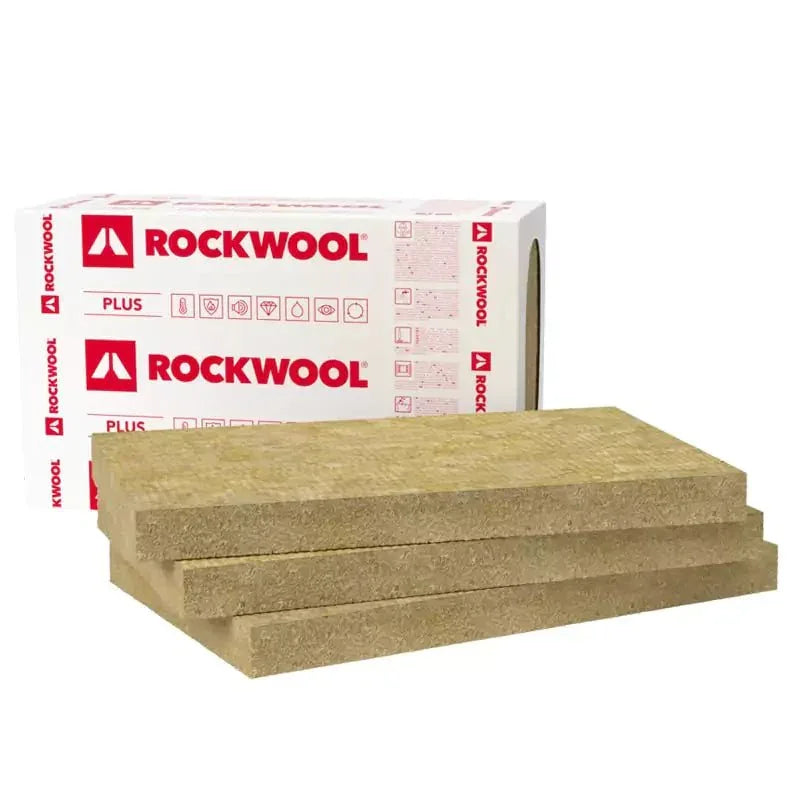
ROCKWOOL PLUS 80mm MINERAL SLAB 3m2/5pcs


Price:
Sale price£58.00

Shipping calculated at checkout

Stock:
Sold out

Pickup currently unavailable at Renders World Southampton

Description

Rockwool Frontrock Plus 80 mm is the standard-domestic full-wall slab in our Plus range — a Euroclass A1 stone wool board supplied 5 slabs per pack covering 3.0 m², the largest pack coverage in our facade mineral wool range. It is specified primarily on detached, semi-detached, and terraced UK homes where the project brief calls for non-combustible insulation across full elevations and the facade is not subject to ground-floor impact exposure or mid-rise wind-load conditions.

What Rockwool Plus 80 mm Does in a UK EWI System

Cost-effective full-wall coverage on standard domestic properties with Euroclass A1 fire safety, vapour permeability, and acoustic improvement in a single board is the outcome Rockwool Frontrock Plus 80 mm is engineered to deliver at λ 0.035 W/mK and R 2.29 m²K/W. It sits in the broader mineral wool insulation range as the workhorse for detached, semi-detached, and terraced UK homes, supplied 5 slabs per pack covering 3.0 m² with a uniform 90 kg/m³ density throughout the board profile. The 3.0 m² pack coverage is the practical advantage at this thickness: fewer packs per elevation than any Super variant, faster boarding tempo, and a uniform density that gives a consistent bonding surface for adhesive and base coat across the full slab face.

Why Specifiers Choose Rockwool Plus 80 mm for UK Walls

  • A1 fire classification at standard-domestic price point: Non-combustible stone wool with the highest reaction-to-fire rating, delivered at a lower per-square-metre material cost than the dual-density Super range — the practical specification choice on sheltered domestic facades where impact resistance is not the driver.
  • Largest pack coverage in the facade mineral wool range: 3.0 m² per pack at 5 slabs covers a typical semi-detached front elevation in roughly 8–10 packs, versus 14–17 packs of the Super range at 1.8 m² — a workflow advantage that reduces scaffold loading and boarding time on domestic-scale projects.
  • Practical full-wall thermal upgrade: R 2.29 m²K/W delivers a meaningful heat-loss reduction on solid and cavity walls, contributing to whole-wall U-value improvements under current Approved Document L guidance subject to project-specific calculation.
  • Vapour-open construction protects historic masonry: μ ≈ 1 keeps the dew-point profile inside the insulation rather than at the wall interface — particularly valuable on the pre-1919 solid brick that defines most UK domestic retrofit work.
  • Uniform density gives predictable handling: 90 kg/m³ throughout means cleaner, more predictable cuts than dual-density boards because the blade meets consistent resistance through the slab depth.
  • Acoustic uplift on urban facades: The dense fibrous core absorbs airborne sound, supporting noise reduction on properties facing roads, railway lines, or communal areas — a benefit closed-cell EPS alternatives cannot match at the same level.
  • Recyclable mineral composition: Manufactured from naturally abundant volcanic basalt, supporting BREEAM and circular-economy criteria on regulated projects.

Thermal Specifications — λ, R-Value, Reaction to Fire

Property Value Standard
Thermal conductivity (λD) 0.035 W/mK EN 12667
R-value at 80 mm 2.29 m²K/W EN 13162
Reaction to fire Euroclass A1 EN 13501-1
Water vapour resistance factor (μ) ≈ 1 EN 12086
Specific heat capacity ≈ 1030 J/kgK

At λ 0.035 W/mK the Plus range delivers fractionally better thermal conductivity than the dual-density Super range at λ 0.036 W/mK — a small edge that translates into a slightly higher R-value at the same thickness, useful where every fraction of a U-value point counts on tight refurbishment calculations.

Physical Specifications — Density, Strength, Dimensions

Physical numbers below set the handling reality on scaffold — the 3.0 m² pack format is the defining workflow advantage at this thickness, lifting boarding tempo and reducing pack count per elevation compared with the dual-density Super alternative.

Property Value
Thickness 80 mm
Slab dimensions 1000 × 600 mm
Nominal density ≈ 90 kg/m³ (uniform)
Tensile strength perpendicular to faces (TR) ≥ 10 kPa
Compressive stress at 10% deformation (CS(10)) ≥ 10 kPa
Slabs per pack 5
Pack coverage 3.0 m²
Pack weight ≈ 21.6 kg
Weight per m² ≈ 7.2 kg

Where Rockwool Plus 80 mm Performs Best — Properties & Wall Types

The Plus 80 mm is the default specification thickness for UK domestic EWI — the housing typologies that account for the majority of full-wall mineral wool installations across the country.

  • Standard domestic full-wall EWI: Detached, semi-detached, and terraced homes where the brief calls for A1-rated insulation across complete elevations rather than detail-zone application.
  • Sheltered domestic facades: Walls not subject to heavy ground-floor pedestrian impact or extreme wind exposure, where the uniform 90 kg/m³ density provides adequate mechanical performance without the cost premium of dual-density construction.
  • Solid-wall domestic retrofit: Pre-1919 brick and stone homes where the breathable build-up protects historic masonry from trapped moisture — see the Victorian solid-wall retrofit guide for whole-elevation detailing context.
  • Cavity-wall thermal upgrade: External insulation on cavity-wall properties where the existing cavity contributes limited thermal performance and the 80 mm external layer brings the whole-wall U-value toward current Building Regulations targets.
  • Mid-range domestic thermal step: Where the project needs more thermal depth than the 50 mm reveal-and-junction slab but the U-value brief does not require the deeper 100–160 mm profiles typically specified for high-rise or near-zero work.

How Rockwool Plus 80 mm Fits Into a Full EWI System

Build-up runs fully vapour-open from substrate to render finish. Bond each slab to prepared masonry with Roker U grey adhesive for mineral wool and EPS, a cementitious formulation specified for stone wool fibres and doubling as the reinforcement base coat. The uniform 90 kg/m³ density provides a consistent bonding surface across the full slab face. Mechanical fixings from the EWI fixing accessories range apply at a minimum 8 per m² through 60–90 mm washer plates.

  • Adhesive + base coat: Roker U grey (cementitious, vapour-permeable) — same product bonds the slab and reinforces the base layer with embedded fibreglass mesh.
  • Mechanical fixings: 60–90 mm disc washer plugs at 8 per m² baseline; shaft length minimum 120 mm on standard brick to achieve 25–40 mm embedment beyond the 80 mm board.
  • Reinforcement mesh: Alkali-resistant fibreglass mesh embedded fully in the wet Roker U base coat distributes mechanical loads and resists cracking across the slab face.
  • Render finish: Silicone or silicate topcoats keep the system vapour-open from substrate through to surface, in line with the breathing-wall rationale for mineral wool — acrylic finishes are not suitable over stone wool because they trap moisture within the system.

How Rockwool Plus 80 mm Compares to the Super Range and Sibling Slabs

Specification Plus 50 mm Plus 80 mm (this product) Super 80 mm Super 100 mm
Range Frontrock Plus Frontrock Plus Frontrock Super Frontrock Super
Thickness 50 mm 80 mm 80 mm 100 mm
λ (W/mK) 0.035 0.035 0.036 0.036
R-value (m²K/W) 1.43 2.29 2.22 2.78
Density ≈ 90 kg/m³ ≈ 90 kg/m³ 80/150 kg/m³ dual 80/150 kg/m³ dual
Fire rating A1 A1 A1 A1
Pack coverage 3.6 m² (6 pcs) 3.0 m² (5 pcs) 1.8 m² (3 pcs) 1.8 m² (3 pcs)
Compressive strength ≥ 10 kPa ≥ 10 kPa ≥ 20 kPa (top ≥ 40) ≥ 20 kPa (top ≥ 40)
Typical use Reveals, soffits, junctions Standard domestic full-wall Exposed/impact-prone facades Mid-rise specification

For the wider material decision against EPS at the same thickness, our mineral wool vs polystyrene comparison sets out the trade-offs on cost, U-value per millimetre, and fire performance — the most common decision point for sheltered domestic specifications where the Plus 80 mm sits.

How Rockwool Plus 80 mm Performs in UK Weather — Moisture, Frost, Wind Loads

UK domestic properties — the core specification context for this slab — face wind-driven rain, seasonal freeze-thaw cycles, and the temperature swings typical of the maritime climate. Frontrock Plus 80 mm handles all three: the factory hydrophobic treatment sheds rain during the install window, the open-cell fibre structure dries outward rapidly once the render is on, and dimensional stability across the typical UK service range of −10 °C to +35 °C keeps thermal movement out of the base coat at board junctions.

On solid-wall domestic retrofit in particular, the μ ≈ 1 vapour resistance keeps the dew-point profile inside the insulation rather than at the brick interface — the known long-term risk where vapour-closed materials are placed externally on traditional masonry. The Building Safety Act 2026 facade-fire briefing sets out the wider context for non-combustible specification, though the Plus 80 mm is most often specified on domestic properties below the relevant-building threshold where the A1 classification is a project preference rather than a regulatory driver.

Handling and Storage of Rockwool Plus 80 mm on UK Sites

  • Best pack format in the range: 3.0 m² per pack at 5 slabs means fewer trips up scaffold per square metre of facade than any Super variant — the standout workflow advantage on full-elevation domestic boarding.
  • Predictable cutting: Uniform 90 kg/m³ density gives consistent blade resistance through the full slab depth, producing cleaner straight edges than dual-density boards where the blade transitions between density layers mid-cut.
  • Standard fixing shaft length: 120 mm plugs cover most domestic substrates, providing full board penetration plus 25–40 mm minimum embedment — confirm at survey stage for non-standard substrates.
  • Orient correctly: Branded face outward toward the render — installing the slab reversed reduces adhesive bond and fixing performance.
  • Store dry: Opaque waterproof cover on site; saturated packs slow boarding tempo even though the hydrophobic treatment recovers thermal performance after drying.

Get these five right and the slab arrives at the wall in the same condition it left the pallet — domestic programmes typically run on tighter timing than commercial work, so pack handling efficiency feeds directly through to the day-rate calculation.

Pro Tips From UK Installers Using Rockwool Plus 80 mm

A few details separate the cleanest standard-domestic installs from average — the points below come from EWI installers working on detached, semi-detached, and terraced retrofit projects across the UK.

  • Specify silicone or silicate render, not acrylic: Acrylic finishes trap moisture within the system and defeat the vapour-permeable rationale for stone wool — silicone or silicate topcoats keep open diffusion from substrate to surface throughout the building's lifetime.
  • Plan reveal slabs with Plus 50 mm: Mix the 80 mm main-wall slabs with 50 mm slabs at window reveals, soffits, and lintels for continuous A1 wrap around openings without crushing frame visibility.
  • Full-bed adhesive across the slab face: Uniform density rewards full-bed adhesive application — dot-and-dab leaves a 90 kg/m³ slab vulnerable to drumming under base coat, particularly noticeable on long unbroken elevations.
  • Stagger vertical joints between courses: Brick-pattern bond reduces continuous joint lines that could otherwise concentrate movement stress in the base coat over time.
  • Order the right number of packs up front: 3.0 m² per pack means a typical semi-detached front elevation needs 8–10 packs; order plus 5–10% for cuts at reveals, returns, and parapets to avoid mid-job top-ups.

Certifications & Compliance — A1, EN 13162, REACH

  • EN 13162: Factory-made mineral wool products for buildings — declared λ 0.035 W/mK, dimensional tolerances, and mechanical properties.
  • EN 13501-1: Euroclass A1 reaction-to-fire — the highest reaction-to-fire classification, indicating non-combustible material with no contribution to fire at any stage.
  • BS EN ISO 9001: Rockwool manufactures under certified quality management (BSI FM 02262), supporting batch-to-batch consistency.
  • UK REACH compliant: No hazardous classifications associated with the stone wool composition.

Specifiers routinely cite these certificates as the baseline for non-combustible domestic facade build-ups — the material-level credential homeowners and trade contractors increasingly look for on rendered EWI quotes.

Is Rockwool Plus 80 mm Right for Your Project?

  • Choose this slab if: You are insulating a standard UK domestic property — detached, semi-detached, or terraced — where Euroclass A1 fire safety and vapour permeability matter, the facade is not subject to heavy impact exposure, and the 3.0 m² pack coverage will speed up your boarding programme across full elevations.
  • Need thinner coverage for reveals and junctions? The Rockwool Plus 50 mm slab at R 1.43 m²K/W and 3.6 m² pack coverage fits neatly into window reveals, soffits, and junction details where 80 mm exceeds the available depth.
  • Need enhanced mechanical resistance at this thickness? The Rockwool Super 80 mm slab with 80/150 kg/m³ dual-density construction provides a hardened outer face (≥ 40 kPa compressive top) for ground-floor impact zones, exposed elevations, and taller buildings.
  • Need more thermal depth? The Rockwool Super 100 mm slab at R 2.78 m²K/W steps up the U-value contribution where the calculation requires more than 80 mm.
  • Low-rise where fire strategy permits combustible insulation? Browse the graphite EPS board range at λ 0.032 W/mK for higher thermal resistance per millimetre at lower material cost.

All values stated are based on manufacturer-declared data from Rockwool and remain subject to confirmation through project-specific assessment. Specifications may be updated by the manufacturer without prior notice — verify against the current Declaration of Performance before specifying.

What to Order Next — Pack Sizes, Lead Times, Compatible Components

Each pack of Rockwool Plus 80 mm covers 3.0 m² (5 slabs at 1000 × 600 mm). For full-system ordering, pair the slab quantity with a matched run of Roker U adhesive, 120 mm-shaft mechanical fixings, and a vapour-permeable silicone or silicate render finish.

  • Adhesive & base coat: Roker U grey adhesive 25 kg — calculate 4–5 kg/m² bonding plus 3–4 kg/m² for the reinforcement layer.
  • Mechanical fixings: Select from the EWI fixing accessories collection at 120 mm shaft length to achieve 25–40 mm embedment beyond the 80 mm board, at a baseline 8 per m².
  • Order quantity guide: Typical semi-detached front elevation = 8–10 packs (24–30 m²); add 5–10% for cuts at reveals, returns, and parapets.
  • Lead time: Full-pack orders confirmed before the daily cut-off ship on the next UK working day.

FAQ — Rockwool Plus 80 mm Coverage, Compatibility, Ordering

How many square metres does one pack of Rockwool Plus 80 mm cover?

Each pack contains 5 slabs of 1000 × 600 mm and covers 3.0 m² laid flat — the largest pack coverage in the facade mineral wool range at this thickness. A typical semi-detached front elevation works out at roughly 8–10 packs, with a 5–10% allowance added for cuts at reveals, returns, and parapets.

How does Plus 80 mm differ from Super 80 mm at the same thickness?

Both share thickness and Euroclass A1 fire classification. Plus uses uniform 90 kg/m³ density with λ 0.035 W/mK, providing a slightly higher R-value (2.29 vs 2.22 m²K/W) and larger pack coverage (3.0 vs 1.8 m²) at lower material cost — the practical choice for sheltered domestic facades. Super adds dual-density construction with a 150 kg/m³ outer face delivering ≥ 40 kPa compressive resistance, justifying the cost premium where ground-floor impact, exposed elevations, or taller buildings require enhanced mechanical performance.

What U-value does 80 mm Rockwool Plus typically achieve?

At R 2.29 m²K/W, the slab contributes meaningfully to whole-wall U-value calculations, with the achievable figure depending on the substrate construction. On a typical 215 mm dense block refurbishment wall, 80 mm Plus typically delivers a wall U-value in the region of 0.30 W/m²K, subject to project-specific assessment. The U-value calculation guide walks through the thickness selection method against current Approved Document L guidance.

How does Rockwool Plus 80 mm compare with EPS at the same thickness?

Mineral wool at 80 mm carries a higher material cost per square metre than 80 mm graphite EPS, reflecting the volcanic-rock manufacturing process and the enhanced fire and acoustic properties of stone wool. EPS achieves slightly better thermal resistance per millimetre (λ 0.032 vs 0.035 W/mK), while mineral wool delivers A1 non-combustible classification, vapour permeability, and acoustic absorption that EPS cannot match. The choice typically comes down to whether the project fire strategy requires non-combustible insulation, with the wider trade-offs covered in the mineral-wool-versus-EPS comparison guide.

Does Rockwool Plus 80 mm meet A1 fire requirements?

The slab carries Euroclass A1 reaction-to-fire under EN 13501-1 — the highest classification, indicating non-combustible material. While most standard domestic properties sit below the relevant-building threshold where current Approved Document B guidance mandates A1, the classification is increasingly specified as a project preference on rendered EWI work for both occupant safety and long-term resale credentials.

Will Plus 80 mm reduce noise from a busy road?

The dense fibrous structure of stone wool absorbs airborne sound rather than reflecting it. EWI systems incorporating Rockwool slabs demonstrate improvements of up to 8 dB Rw on the weighted sound reduction index, depending on the substrate. For properties near roads, railways, or flight paths, the acoustic benefit is a meaningful advantage over closed-cell EPS alternatives that reflect rather than absorb sound energy.

Can I use an acrylic render over Plus 80 mm?

Acrylic finishes are not suitable over stone wool because they trap moisture within the system and defeat the vapour-permeable rationale for the build-up. For best long-term performance, always specify silicone or silicate-based render topcoats that maintain open diffusion from substrate to surface, allowing the mineral wool to release moisture outward through every layer.

Technical Documentation — Rockwool Plus 80 mm TDS & Datasheets

You may also like

Recently viewed