
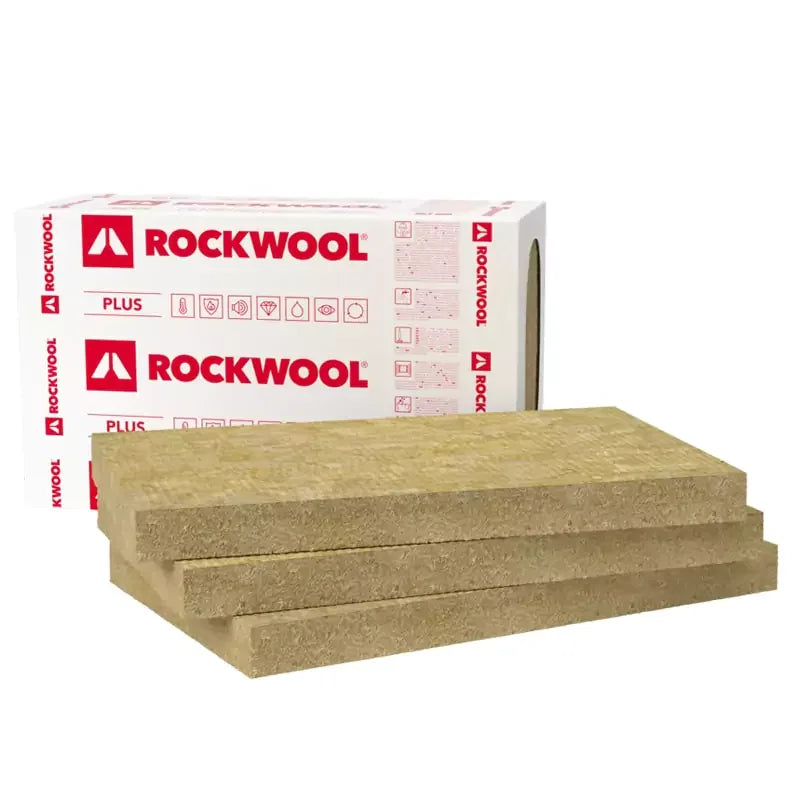

Description
A thin stone wool slab for the parts of an insulated wall where a thick board will not fit: window and door reveals, soffits under lintels and the edges where the insulation turns a corner. It is non-combustible, stays open to water vapour so the wall can keep drying, and takes a mineral render system straight on top.
Where 50mm Mineral Wool Fits on a Rendered Wall
This 50mm mineral wool slab is FRONTROCK PLUS from ROCKWOOL, a single-density facade slab made for external wall insulation finished with thin render. At 50 mm it declares a thermal resistance of 1.40 m²K/W, so on a full elevation it is normally the thin partner to a deeper slab rather than the main layer. It is the thinnest slab in the Renders World mineral wool insulation range.
- Window and door reveals: the return between the frame and the line of the main insulation, where depth runs out first. The render detailing around windows and doors covers the bead and mesh work that follows.
- Soffits and lintel undersides: overhead strips that still need insulating so the layer does not stop at the opening.
- Junctions and closures: places where the main insulation meets another material or a boundary and would otherwise leave a cold, uninsulated band.
It also suits tight build-ups, where a deeper slab would push the finished face past a sill, a roof edge or a neighbour’s line. If 50 mm is the whole thickness the wall can take, work out the result before you order: the U-value calculation guide takes a wall through layer by layer, and the declared 1.40 m²K/W is the figure to put in.
Why Choose Frontrock Plus at 50 mm
- Non-combustible slab. ROCKWOOL declares Euroclass A1 for the slab and states that the fire performance of stone wool does not deteriorate with time.
- Open to water vapour. The declared class MU1 means the slab barely slows vapour, so a solid masonry wall behind it can keep drying outwards.
- The lower conductivity of the two lines. Frontrock Plus declares λD 0.035 W/mK against 0.036 for Frontrock Super, which is why Plus gives more resistance at the same thickness.
- Low water uptake. Short-term absorption is declared at no more than 1.0 kg/m² and long-term at no more than 3.0 kg/m² — useful on a reveal that takes run-off before the render goes on.
- Holds its size. Dimensional stability DS(70,90) is declared, so the joints between reveal strips and main slabs stay closed under the base coat.
- Firm enough to render. CS(10)20 and TR10 mean 20 kPa in compression and 10 kPa pulling away from the face, the load a render system puts on the slab.
- Six slabs to a pack. Each pack holds six 1000 × 600 mm slabs, 3.6 m² in all, so long runs of narrow strips come out of very few packs.
Frontrock Plus 50 mm Specification
| Property | Declared value |
|---|---|
| Product | ROCKWOOL FRONTROCK PLUS, 50 mm |
| Slab build | Stone wool, single density |
| Slab size | 1000 × 600 × 50 mm |
| Declared thermal conductivity λD | 0.035 W/mK |
| Declared thermal resistance RD | 1.40 m²K/W |
| Reaction to fire (the slab) | Euroclass A1 |
| Compressive strength at 10 % deformation | CS(10)20 — 20 kPa |
| Tensile strength perpendicular to faces | TR10 — 10 kPa |
| Short-term water absorption | WS — up to 1.0 kg/m² |
| Long-term water absorption | WL(P) — up to 3.0 kg/m² |
| Water vapour diffusion resistance | MU1 |
| Dimensional stability | DS(70,90) |
| Thickness tolerance | T5 |
| Pack | 6 slabs, 3.6 m² |
| Maker's pallet | 16 packs, 57.6 m² |
| Standard and declaration | EN 13162:2012+A1:2015 · DoP RW-CEE-DoP-0238/BCM/23/w1 |
Performance figures are declared in DoP RW-CEE-DoP-0238/BCM/23/w1, issued by ROCKWOOL Polska at Cigacice under EN 13162 with notified body 1023. In a U-value calculation use the declared 1.40 m²K/W, not a figure worked out from the conductivity.
How Many Packs to Order
Reveals are measured in running metres, so turn them into area first: multiply the length by the reveal depth, then divide by the 3.6 m² in each pack. Narrow strips waste more of each slab than plain wall, so round up generously. For larger orders, ROCKWOOL ships this thickness 16 packs, or 57.6 m², to a pallet.
Fitting the Slab with Roker U Adhesive
Stone wool is bonded with a cement-based adhesive. Roker U grey adhesive is made for mineral wool boards up to 30 cm thick and also forms the reinforced layer, so one bag covers both jobs. Its data sheet sets the sequence:
- Skim, then comb. Rub a thin coat of adhesive into the slab face, then apply the bonding layer and comb it with a 10 × 10 mm notched trowel — about 4.5 to 5.5 kg of adhesive per m².
- Press and tap into place, staggering the vertical joints between slabs.
- Anchor the next day at the earliest, using anchors with a galvanised metal pin: at least four per m², with the exact number set by the insulation design. The guide to installing insulation fixings covers drilling and setting.
- Mesh after three days. Lay about two thirds of the mortar with a notched trowel, bed the glass-fibre mesh tight into it, then add the last third and smooth.
- Reinforce the corners of openings with mesh strips of at least 20 × 35 cm set at 45° under the main mesh.
Frontrock Plus and Super: All Six Slabs
| Slab | Density | Declared RD | Pack |
|---|---|---|---|
| Frontrock Plus 50 mm (this slab) | single | 1.40 m²K/W | 6 slabs · 3.6 m² |
| Frontrock Plus 80 mm | single | 2.25 m²K/W | 5 slabs · 3.0 m² |
| Frontrock Super 80 mm | dual | 2.20 m²K/W | 3 slabs · 1.8 m² |
| Frontrock Super 100 mm | dual | 2.75 m²K/W | 3 slabs · 1.8 m² |
| Frontrock Super 120 mm | dual | 3.30 m²K/W | 3 slabs · 1.8 m² |
| Frontrock Super 160 mm | dual | 4.40 m²K/W | 2 slabs · 1.2 m² |
Plus is a single-density slab with the lower conductivity. Super is built in two densities, with a harder top layer that ROCKWOOL describes as protecting the rendered facade from knocks during fitting and in use; both declare the same compressive and tensile classes. For the choice between stone wool and EPS, see the mineral wool against polystyrene comparison.
Is 50 mm the Right Slab?
- Yes for reveals, soffits, junctions and any build-up where 50mm mineral wool is all the depth there is.
- Take the Frontrock Plus 80 mm where the wall can take 80 mm: it declares 2.25 m²K/W from the same declaration.
- Take a Frontrock Super slab of 100 mm or more for the main elevation when the U-value calculation asks for depth.
FAQ — 50 mm Mineral Wool Slab
How much does one pack cover?
Six slabs of 1000 × 600 mm, which is 3.6 m² laid flat. For reveals, multiply the running length by the depth to get the area, divide by 3.6 and round up.
Which adhesive goes with stone wool?
Roker U grey: its data sheet covers bonding mineral wool facade slabs and building the reinforced mesh layer on them, so the same bag serves both stages.
Does A1 apply to the finished wall?
A1 is declared for the slab. A rendered wall is classified as a complete system, and the facade fire requirements briefing explains where that difference starts to drive the specification.
Can 50 mm be the only insulation layer?
At 1.40 m²K/W it adds real resistance, but whether it is enough depends on the whole wall. Run the U-value calculation first; on most full elevations a deeper slab carries the main layer.
What if the slabs get wet before rendering?
ROCKWOOL declares low water uptake: up to 1.0 kg/m² short term and up to 3.0 kg/m² long term. Let a wet slab dry out before the base coat, and keep packs covered on site.
Does the insulating value drop over time?
ROCKWOOL’s declaration states that the thermal conductivity of stone wool does not change with time: the fibre structure is stable and the pores hold nothing but air.