
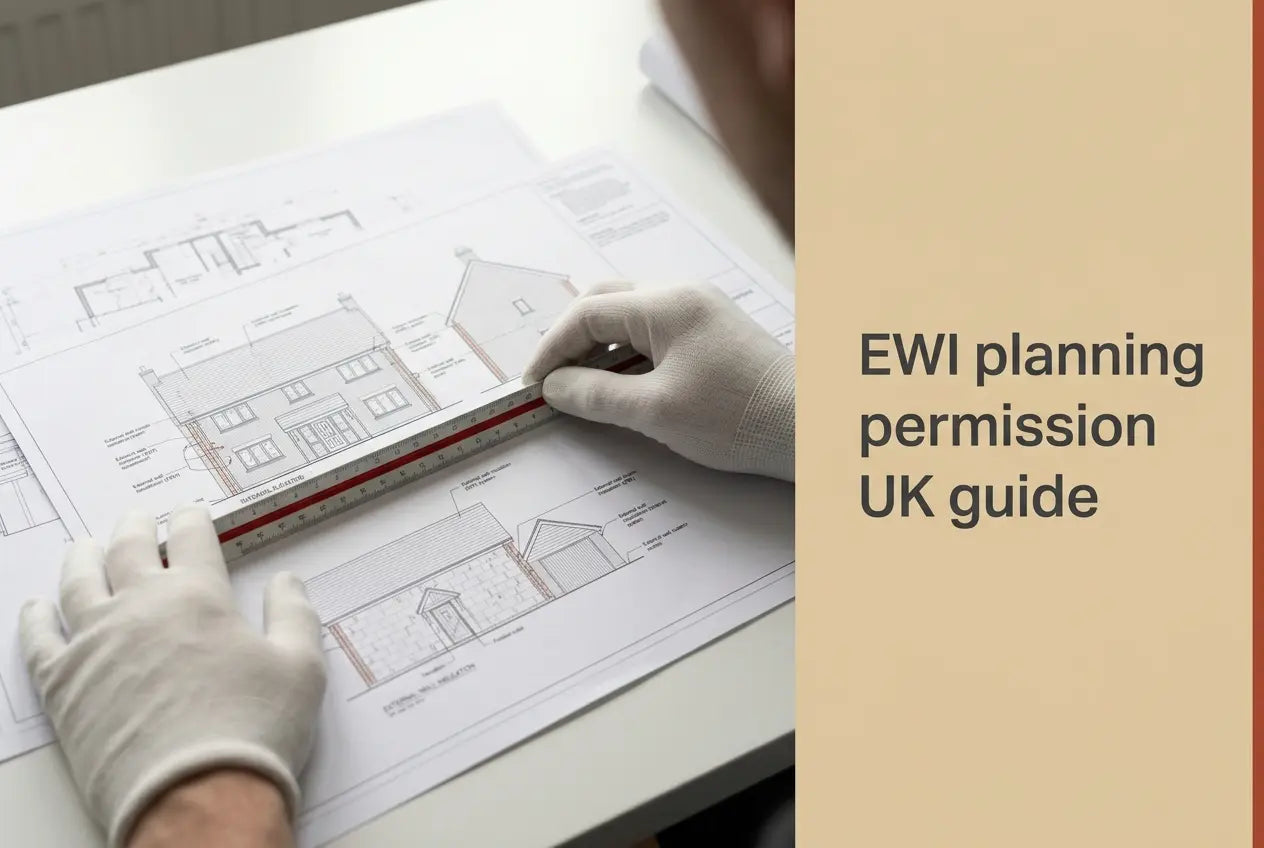
Consent for external wall insulation turns on two separate instruments, and treating them as one is what usually delays a start on site. The first is the permitted development order that decides whether a planning application is needed at all; the second is the Building Regulations, which apply either way. Both are settled at design stage in a few days, and the render finish specified is often what keeps a project inside permitted development. Renders World supplies the complete external wall insulation build-up that sits behind those decisions.
Does EWI Need Planning Permission in England?
EWI planning permission is not normally needed on a dwellinghouse in England: Class A of Schedule 2, Part 1 of the GPDO 2015 permits the work where finished materials are of similar appearance. That condition — paragraph A.3(a) of the Order — carries more weight than any other line in the framework, because it ties the consent route directly to the finish on the material schedule. Routing by layer starts at the EWI system components hub, which sends each part of the build-up to the collection that owns it.
Two readings of the Order are worth separating. The Planning Portal's insulation guidance states that planning permission is not normally required for fitting insulation where there is no change in external appearance, and that listed buildings and conservation areas should be referred to the local planning authority. The Order itself goes further, and its structure is instructive.
The Similar-Appearance Condition That Decides the Route
Paragraph A.2(a) of Schedule 2, Part 1 of the GPDO 2015 withdraws Class A where the work would consist of or include cladding the exterior with stone, artificial stone, pebble dash, render, timber, plastic or tiles — but only on article 2(3) land. The drafting proves the wider point: rendered cladding must sit inside Class A everywhere else, or A.2(a) would have nothing to carve out. Off article 2(3) land, therefore, the binding test is A.3(a) alone.
In practice that makes the finish a consent decision as much as an aesthetic one. A colour-matched thin-coat render over insulation on an already-rendered elevation reads as similar appearance comfortably. A move from fair-faced brick to smooth render, or a strongly contrasting plinth zone, is the case where formal confirmation is the calmer route — and there is a mechanism for exactly that, covered further down.
Property Designations to Check Before You Specify
| Designation | Consent position | Provision relied on |
|---|---|---|
| No designation | Class A permitted development, subject to the similar-appearance condition | Sch 2 Pt 1 Class A, condition A.3(a) |
| Conservation area, National Park, AONB, the Broads | Rendered cladding withdrawn from Class A — apply for planning permission | Paragraph A.2(a) with article 2(3) |
| Listed building | Listed building consent needed for works affecting character | P(LBCA) Act 1990, section 7 |
| Area under an article 4 direction | The named right may be withdrawn — confirm the direction's terms | Article 4, GPDO 2015 |
| Flat or maisonette | Part 1 rights do not apply — apply for planning permission | Article 2(1), definition of dwellinghouse |
Where Permitted Development Rights Fall Away
Three designations account for almost every EWI project that needs a formal application, and each is checked from public records before a survey is booked. Identifying the category early is what keeps the material order and the scaffold dates aligned.
Designated Land and Listed Buildings
Article 2(3) of the Order defines the land A.2(a) bites on as that described in Part 1 of Schedule 1 — National Parks, areas of outstanding natural beauty and conservation areas among them. The common shorthand that "conservation areas need permission" is right but incomplete; the same exclusion covers National Park and AONB addresses, which is where specifiers are most often caught out.
For listed buildings, section 7 of the Planning (Listed Buildings and Conservation Areas) Act 1990 prohibits works of alteration or extension affecting the building's character as one of special architectural or historic interest unless authorised under section 8. Engaging the conservation officer before specification work begins is the step that keeps a heritage project on a secure footing, and internal insulation is frequently the more sensitive answer on this stock.
Article 4 Directions
- Area-specific by design: a direction under article 4 withdraws a named permitted development right across a defined area, and can differ street by street inside one borough.
- Confirmed with the authority: the direction's wording decides whether external alteration is among the rights removed, so the local planning authority is the single reliable source.
- Live effect on certificates: an article 4 direction taking away the relevant right counts as a material change, which is why the check comes before any certificate is relied on.
The Consent Pathway, Fees and Formal Confirmation
Where an application is needed, the householder route is a fixed fee rather than a calculated one, and the numbers below are the current published figures. Where permitted development applies, a certificate is available for owners who want the position recorded in writing.
- Householder planning application, England: £548, as published by the Planning Portal in August 2026.
- Lawful development certificate for proposed works: half the fee for permission for that development under regulation 11(3)(c) of the 2012 Fees Regulations, so £548 ÷ 2 = £274 on a householder scheme.
- Online submission service charge: £75.83 + VAT, applied by the Planning Portal to applications attracting a fee over £100 — a line most cost plans miss.
- Annual indexation: fees rise each 1 April by CPI from the preceding September, capped at 10%, so a figure quoted in a tender is checked against the current schedule.
A certificate under section 192 of the Town and Country Planning Act 1990 is not a permission; it confirms that proposed works would be lawful. Once granted, the development must be presumed lawful unless there is a material change before it begins. That is a durable record for a future sale, a lender or a surveyor, and it is the sensible spend on any facade changing from brick to render. Full fee detail sits in the GOV.UK planning fees guidance.
Key Takeaway: Most domestic EWI in England proceeds under Class A of the GPDO 2015 provided finished materials are of similar appearance, while Building Regulations apply in every case. Designated land, listed buildings and flats need consent, and a lawful development certificate at £274 records a borderline position in writing.
Building Regulations Run Alongside EWI Planning Consent
Planning and Building Regulations are separate approvals, and clearing one leaves the other untouched. Regulation 23 of the Building Regulations 2010 is the operative provision for insulation work: where the renovation of an individual thermal element amounts to more than 50% of the element's surface area, or is a major renovation, the whole element must be brought into compliance with paragraph L1(a)(i) of Schedule 1, so far as that is technically, functionally and economically feasible. A whole-elevation EWI job passes that threshold as a matter of course.
- Notification: a Building Notice or Full Plans submission goes to the local authority body or an approved inspector before work starts on site.
- Stage inspection: the inspector reviews the specification and the detailing that carries it, and the NHBC render detailing standards are the reference for warranty-level junction work.
- Completion record: the completion certificate is the document solicitors ask for later, so it belongs in the property file alongside component declarations.
The feasibility qualifier in regulation 23 is why compliance is a calculation rather than a thickness. The Part L thickness calculation guide and the Future Homes Standard 2026 insulation guide set out how the target is arrived at, and the facade fire safety requirements guide covers the strategy questions that sit above material choice on taller buildings.
Choosing EWI Materials That Fit the Consent Route
The similar-appearance condition makes the finish the first specification decision, and the core is the second. Colour and texture matched to the existing elevation is the direct route to Class A; declared thermal figures are what the Building Regulations submission runs on.
On the core, the graphite EPS insulation boards Renders World stocks are declared at λD 0.032 W/mK to EN 13163:2012+A1:2015, with a declared thermal resistance of 3.10 m²K/W at 100 mm read from the manufacturer's own row rather than derived from thickness and lambda. Reaction to fire is declared as class E at board scope, which describes the board and not the finished rendered wall — that rating is assessed as an assembly by the project's fire engineer. Where the fire strategy calls for a non-combustible core instead, stone wool slabs take a dedicated adhesive and their declared class is read from the slab's own declaration of performance.
A wall U-value is a build-up figure and never a board property, so the compliance calculation combines declared resistances across the whole assembly. For projects that want one specification line rather than seven, the complete EWI system bundle gathers board, adhesive, mesh, basecoat, primer and finish priced per square metre, which is also the cleanest documentation set to hand a Building Control inspector.
Written by Mariusz Saja. Technically reviewed by Rafał Wyrzykowski. Last reviewed Aug 2026.
FAQ — EWI Consent and Compliance Questions
What does a householder planning application for EWI cost in England?
£548 on the figure published by the Planning Portal in August 2026, with a further £75.83 + VAT where the application is submitted online and attracts a fee over £100. Fees are indexed every 1 April by CPI from the preceding September, capped at 10%, so the current schedule is worth checking before a tender goes out. Building Regulations charges are set locally and separately, and this page states no figure for them because none was published by the sources read.
How long can a council act if EWI went up without the consent it needed?
Ten years in England. Section 115 of the Levelling-up and Regeneration Act 2023 amended section 171B of the Town and Country Planning Act 1990, replacing the old four-year limit with ten years beginning with the date the operations were substantially completed. Wales retains four years. Confirming the designation before materials are ordered is a short task that puts the question to bed permanently.
Does this framework apply in Scotland, Wales and Northern Ireland?
The Order discussed here is the England GPDO 2015, and each devolved administration operates its own permitted development legislation with different thresholds and drafting. Owners outside England should take the position from their national planning portal or local authority, because the similar-appearance condition and the article 2(3) cladding exclusion described above are England provisions. No comparable figures for the other nations are stated on this page, as none were read from source.
Can EWI go on a flat or maisonette under permitted development?
Article 2(1) of the Order defines dwellinghouse, for the purposes of Part 1 of Schedule 2, as excluding a building containing one or more flats and a flat within such a building. Householder rights in Part 1 therefore do not reach multi-occupancy residential buildings, and a planning application is the route regardless of designation or finish. Consent under the lease is a parallel conversation with the freeholder or managing agent, best opened at the same time.
If planning permission is not needed, does Building Regulations approval still apply?
Yes — the two run independently, and regulation 23 of the Building Regulations 2010 is triggered by the extent of the thermal element being renovated rather than by the planning position. Renovating more than 50% of an element's surface area brings the whole element into scope of paragraph L1(a)(i) of Schedule 1, so far as technically, functionally and economically feasible. Preparing the specification and the U-value calculation before submission is what keeps the inspection stages uneventful.