
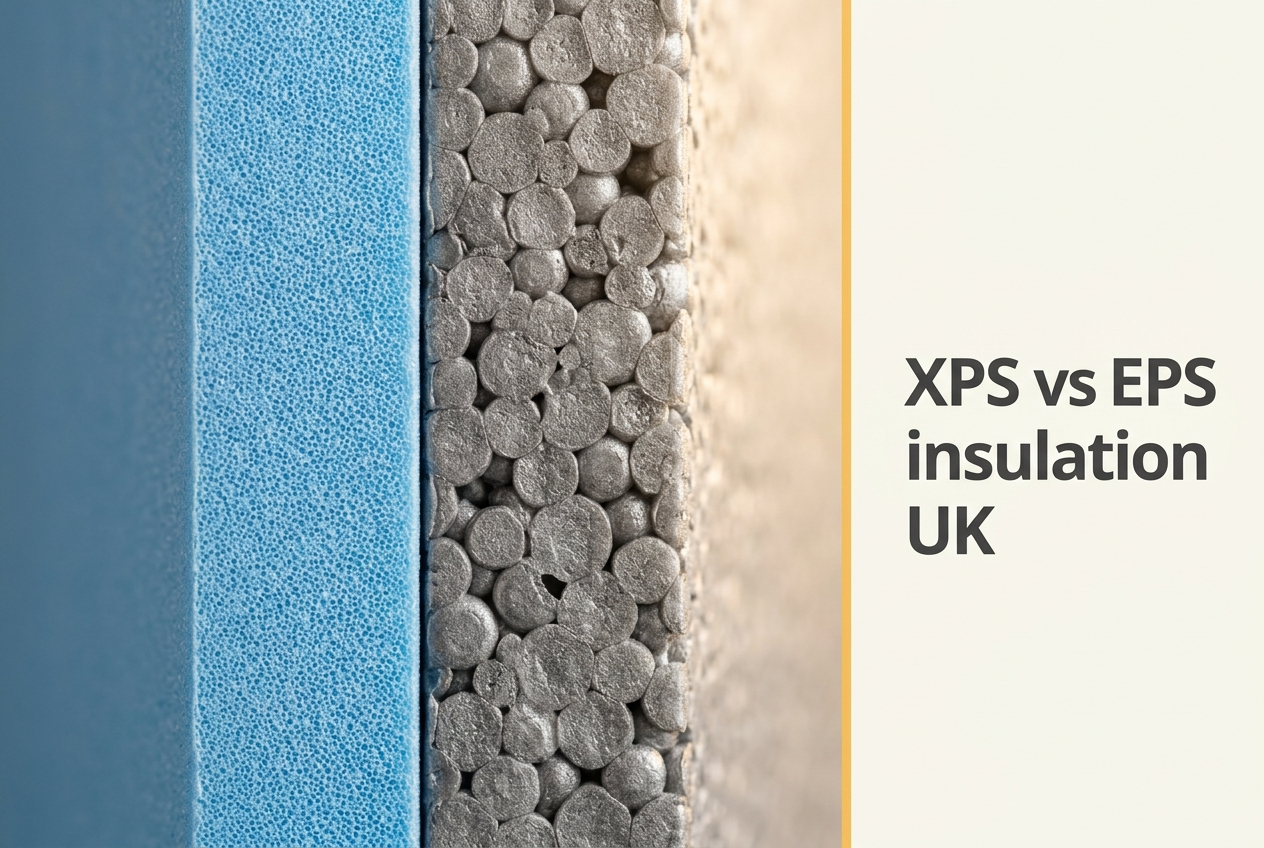
Two questions hide inside the XPS and EPS comparison: which material physics suits which zone of a wall, and which material you are actually buying for that zone. This audit-corrected guide answers both, because the boards Renders World sells for plinths and below-DPC work are EPS 038 to EN 13163, declared on the manufacturer's technical card, not extruded polystyrene. The plinth and below-DPC insulation boards stocked here are described on this page as what their declaration says they are.
What the XPS vs EPS Insulation Decision Actually Turns On
The XPS vs EPS insulation decision turns on declared performance under two separate standards — EN 13164 for extruded boards, EN 13163 for expanded ones — where compressive stress separates them by an order of magnitude and thermal conductivity barely separates them at all. Getting that the right way round is what keeps a plinth detail out of trouble.
Four criteria decide the zone, and only one of them is thermal. The wider sequence these boards sit inside — adhesive, insulation, basecoat, mesh, primer, finish — belongs to the EWI system build-up layers guide, which owns the build-up itself.
- Load. Compressive stress at 10% deformation, against backfill, screed and traffic. This is the criterion with the widest gap between the two materials.
- Water. Declared absorption by immersion, by diffusion and after freeze–thaw cycling, each a separate declared property rather than one number.
- Thickness available. Declared thermal resistance per thickness, read from the card rather than divided out of lambda.
- What the detail requires around the board. Separating layers, waterproofing and adhesive type, which differ by material and are stated on the card.
The Expanded Boards Sold Here for Plinths and Below-DPC Zones
The five plinth boards stocked at Renders World are declared as EPS 038 Dach-Podłoga on manufacturer technical card W38DP, conforming to EN 13163:2012+A1:2015 with the designation code T2-L3-W3-Sb5-P10-BS125-CS(10)80-DS(N)5. Their declared intended uses include plinth insulation in external render systems, walls below ground level with waterproofing under normal loading, and floors on ground — which is exactly the work the collection sells them for.
What that card declares, and what the live pages had wrong, is worth setting out plainly.
- λD 0.038 W/mK, so a plinth board needs more thickness than a graphite facade board for the same resistance — the reason the two zones use different products.
- Compressive stress at 10% deformation ≥ 80 kPa, with bending strength ≥ 125 kPa and a uniformly distributed design load of ≤ 24 kN/m² at which creep deformation stays under 2%.
- Declared thermal resistance of 0.75 at 30 mm, 1.30 at 50 mm, 2.10 at 80 mm, 2.35 at 90 mm and 2.60 m²K/W at 100 mm. The figures previously published across this silo — 0.79, 1.32, 2.11, 2.37 and 2.63 — were thickness divided by lambda, which is not the declared value and reads high.
- Reaction to fire class E, the same class the extruded comparison carries.
- 1000 × 500 mm standard packs at 0.50 m² per board, with 1000 × 1000 mm and 1000 × 1500 mm available by arrangement. Two boards make a square metre, so a 0.6 m plinth strip around a 40 m perimeter is 24 m² × 2 = 48 boards before cutting allowance.
The card also carries the installation requirement that matters most below ground, and it is the opposite of what a closed-cell story implies: these boards must be separated from direct contact with the ground environment by a reinforced layer with damp-proofing or waterproofing, or by a dimpled membrane, and floor applications need a damp-proof layer laid over the concrete base. That separating layer is not optional detailing — it is the condition under which the declared performance applies, and it is bought alongside the boards with the cement-based and polyurethane adhesives the card names as the permitted bonding routes.
Where Extruded Polystyrene Genuinely Outperforms Expanded
The material case for XPS is real, and it is strongest where load and standing water meet. The figures below come from BASF Styrodur technical data declared to DIN EN 13164, which is a manufacturer's own document for its extruded range and is cited here as such.
Load, Depth and Standing Water
Declared compressive stress across that range runs from 200 kPa to 700 kPa by type, against ≥ 80 kPa for the expanded plinth board — a genuine order-of-magnitude difference that decides whether a board sits under a load-bearing slab or beside a foundation wall. Permissible installation depth for perimeter insulation reaches 10 to 24 m without pressing water, depending on type, and 3.5 to 7.0 m in long-term or permanent groundwater.
The same document's remarks on expanded polystyrene in perimeter use are the honest boundary of what your plinth boards should be asked to do: installation depth limited to 3 or 6 m, a minimum 3 m distance from stationary or moving loads, not approved where pressing water is permanent or long-term, and a ΔU of 0.05 W/(m²·K) added to account for increased moisture absorption. Those are a competitor's stated limits, so treat them as the cautious end of the range and confirm any deep or wet application with the board manufacturer.
Water, and What Moisture Does to Lambda
Declared water absorption for that extruded range is 0.7% by volume under long-term immersion to DIN EN 12087, 3% in the diffusion test to DIN EN 12088 and 1% after freeze–thaw cycling to DIN EN 12091. Neither EPS card fetched for this page declares a water absorption figure at all, so no comparative percentage for the expanded boards is published here — the previously published 2–5% had no document behind it.
Why that matters shows up in the same document's moisture table: thermal conductivity rises from 0.035 W/mK dry to 0.041 W/mK at 10% moisture by volume for a 60 mm board, so about a sixth of the thermal performance goes with the water. That is the mechanism behind the separating layer requirement above, and it applies to any foam that takes water on — which is why the membrane, not the material name, is what protects a plinth.
XPS and the EPS Boards Compared, Property by Property
Each column below is scoped to the document it came from. The extruded column is a manufacturer range, not a single board, and the two expanded columns are the products Renders World actually stocks for each zone.
| Declared property | Extruded XPS (Styrodur, DIN EN 13164) | EPS 038 plinth board (card W38DP) | EPS 031 facade board (card W31FEP) |
|---|---|---|---|
| Declared λD | 0.033–0.038 W/mK by type and thickness | 0.038 W/mK | 0.031 W/mK |
| Compressive stress at 10% deformation | 200–700 kPa by type | ≥ 80 kPa | Not declared on the card |
| Water absorption, long-term immersion | 0.7% by volume | Not declared | Not declared |
| Reaction to fire | Euroclass E | Class E | Class E |
| Declared R at 80 mm | 2.30–2.40 m²K/W by type | 2.10 m²K/W | 2.55 m²K/W |
| Standard board format | 1250 × 600 or 1265 × 615 mm | 1000 × 500 mm, 0.50 m² | 1000 × 500 mm, 0.50 m² |
| Perimeter installation depth | 10–24 m without pressing water | 3–6 m per the DIN 4108-10 remarks above | Above-DPC product |
Read the thermal row across and the marketing collapses: 150 mm of the graphite facade board declares R 4.80 m²K/W, and reaching the same declared resistance in that extruded range takes 160 mm of its uniform-lambda type. Ten millimetres separates them. What separates them properly is 80 kPa against 200–700 kPa, and a declared immersion figure against none — load and water, not lambda.
Choosing the Board for Each Zone of a UK Wall
Specify by zone and the XPS vs EPS insulation argument mostly dissolves. Below the damp-proof course, use a board declared for below-ground and plinth use, over a separating waterproof layer, at the compressive stress the detail needs: the 80 mm plinth board at R 2.10 m²K/W is the common domestic specification. Above it, graphite EPS insulation boards earn the facade on lambda alone, with the 80 mm graphite board at R 2.55 m²K/W doing the same job 0.45 m²K/W better per board.
Three routes to the rest of the decision, none of them owned here: thickness against a target U-value is a build-up calculation set out in the U-value and insulation thickness guide; the cold bridge at the plinth-to-wall transition is detailed in the plinth thermal bridge and mould prevention guide; and where a project fire strategy calls for a non-combustible core, the graphite EPS and mineral wool comparison is the material route rather than either polystyrene.
Key Takeaway: extruded and expanded boards differ decisively on load and water, not on thermal conductivity — 200–700 kPa against ≥ 80 kPa, and a declared 0.7% immersion figure against none. The boards sold here for plinths and below-DPC work are declared EPS 038 to EN 13163, and their declared performance depends on the separating waterproof layer the card requires, whichever material sits behind it.
Two things the vapour and fixing sides add, both living elsewhere in this cluster: closed-cell boards restrict vapour movement, which is why above-DPC choices are made against the moisture behaviour of the whole wall in the interlayer condensation guide, and no fixing density per square metre is published on this page because that figure is issued with a system, as the fixing pattern and spacing guide now sets out. Where each collection sits layer by layer belongs to the external wall insulation hub.
Written by Mariusz Saja. Technically reviewed by Rafał Wyrzykowski. Last reviewed Aug 2026.
FAQ — Specification, Placement and Ordering
Are the plinth boards sold here XPS or EPS?
They are expanded polystyrene. Manufacturer card W38DP declares them as EPS 038 Dach-Podłoga to EN 13163:2012+A1:2015, and the product handles and collection describe foundation and below-DPC use, which is what the card's declared applications cover. They remain the correct product for plinth and perimeter work with the required waterproofing layer; the material name on the collection title is what needs correcting, not the specification of the goods.
What thickness should I use below the DPC?
Work back from the declared resistances rather than a rule of thumb: 50 mm gives R 1.30, 80 mm gives R 2.10 and 100 mm gives R 2.60 m²K/W on card W38DP. Which of those satisfies your project is a build-up calculation including the substrate, adhesive and finish, so take the target from the energy assessment and the method from the U-value guide. Depth of burial and the presence of standing water also bear on the choice.
How much water do these boards absorb?
Neither expanded board's card declares a water absorption figure, so no percentage is published here. What the plinth card does state is the requirement that decides the outcome: separate the boards from direct ground contact with a reinforced and waterproofed layer or a dimpled membrane, and lay a damp-proof layer beneath floor applications. Specify that layer properly and absorption stops being the governing variable.
How many boards do I need per square metre?
Two. Every board is 1000 × 500 mm covering 0.50 m², across all five thicknesses, so area in square metres doubled gives boards before waste. The card lists both smooth and rebated formats with different pack coverage — 3.50 m² against 3.29 m² per pack at 80 mm — so confirm which format is being supplied before converting packs to area on a large order.
Can I use the facade board below the DPC, or the plinth board above it?
Neither swap is a good idea, and the cards say why. The graphite facade board declares no compressive stress figure and its declared uses are wall, reveal and soffit insulation, not below-ground work; the plinth board at λD 0.038 W/mK needs more thickness on a facade for the same resistance, which costs reveal depth. Specify each to the zone it is declared for and both perform as declared.
Which adhesive suits these boards below ground?
Card W38DP names cement-based adhesives, polyurethane foams and water-dispersion bituminous compounds for foundation wall applications, and requires the separating layer described above. It also asks for boards to be laid in staggered courses so joints do not align, with a movement joint where a slab meets a wall or column. Match the adhesive to the substrate condition and the season, since foam cure slows in cold weather.
Order Plinth and Facade Boards by Zone
Ordering is two lines rather than one: plinth area at the declared resistance the detail needs, facade area at the thickness the U-value calculation returns, plus the waterproofing and adhesive the plinth card requires. Renders World holds both ranges in the same 1000 × 500 mm format, which keeps the arithmetic identical on either side of the DPC.
- Confirm the plinth strip height and perimeter, then double the square metres for board count.
- Check whether smooth or rebated boards are being supplied before converting packs to area.
- Specify the separating and waterproofing layer with the boards, not after them.
Browse the boards declared for plinth, perimeter and below-DPC zones to build the lower half of the order, and pair it with graphite thicknesses for everything above the damp-proof course.