
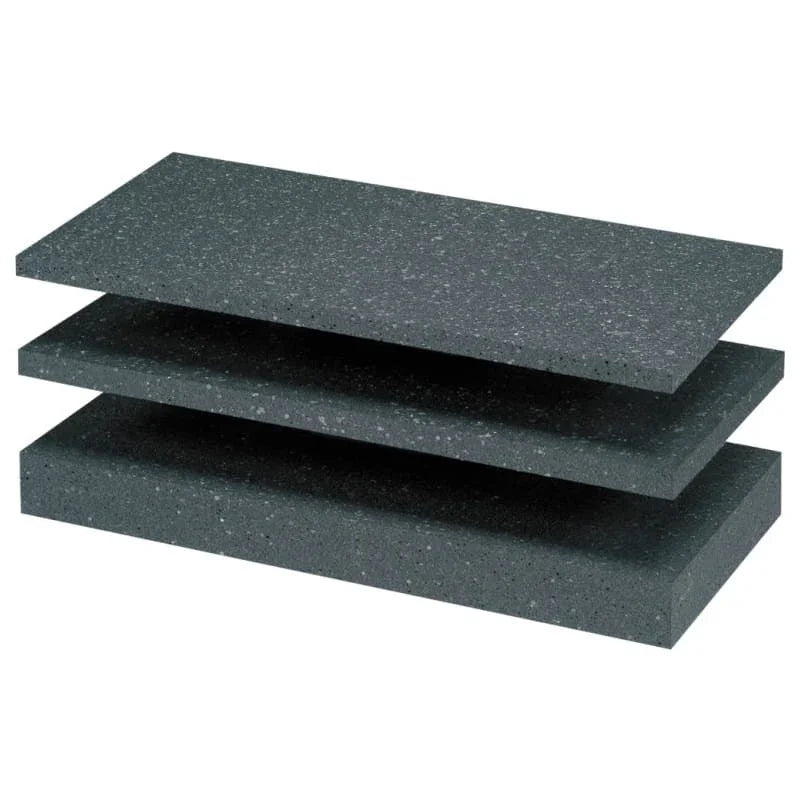
Description
Maximum depth in the Genderka EPS 031 range — 200 mm graphite EPS at λD 0.031 W/mK delivers RD 6.45 m²K/W, the only single-layer thickness that meets the Passive House Institute's ≤ 0.15 W/m²K wall fabric target on standard UK masonry without compensation from glazing or airtightness. Three boards per pack, 1.5 m² coverage, dispatched next working day from our Southampton warehouse.
What EPS Grafit 200 mm Does in a UK EWI System
The Genderka EPS 031 Fasada Extra Plus 200 mm is a graphite-enhanced expanded polystyrene insulation board with declared thermal conductivity λD 0.031 W/mK and thermal resistance RD 6.45 m²K/W. Certified to EN 13163, it serves as the primary insulation layer in the highest-performance EWI build-ups on certified Passive House, Energiesprong, and net-zero operational carbon projects up to 18 m in height. It sits within the wider graphite EPS insulation board range as the maximum-depth specification — the only single-layer board that meets the ≤ 0.15 W/m²K Passive House wall target independently on virtually all UK brick types.
Specifiers reach for 200 mm when the wall element must perform independently rather than borrow margin from glazing, airtightness, or MVHR within a Passive House energy-balance model. This is the thickness that removes external walls from the list of compromises on certified Passive House projects and underpins the 30-year performance guarantees that define Energiesprong industrialised retrofit contracts.
Why Specifiers Choose EPS Grafit 200 mm for UK Walls
- Independent Passive House wall pass on all UK brick types — assembly U-value lands at 0.13–0.15 W/m²K on standard 215 mm solid brick, meeting the ≤ 0.15 W/m²K wall target without compensation from other fabric elements.
- RD 6.45 m²K/W from a 200 mm depth — graphite bead chemistry matches roughly 250 mm of white EPS, saving 50 mm of total build-up depth and protecting planning consent, boundary distances, and architectural proportions.
- Energiesprong-grade thermal backbone — the consistent λD 0.031 W/mK across the production range underpins the 30-year guaranteed-performance contracts that characterise UK industrialised retrofit delivery.
- Supports space-heating demand below 15 kWh/m²/year — combined with high-performance glazing, comprehensive junction detailing, and MVHR, the 200 mm wall element enables the Passive House Institute's primary energy criterion.
- Maximum rigidity in the range — BS100 bending strength keeps the board flat and self-supporting during staged fixing operations, resistant to flexing even in on-site wind conditions.
- Compatible with the same EWI adhesives and meshes as thinner variants — only fixing strategy changes, with countersunk plug-and-cap methods commonly specified at this depth.
- Direct from Southampton warehouse — pallet quantities for Passive House and Energiesprong programmes typically dispatched next working day, with consolidated EWI system orders shipped on a single delivery.
Thermal Specifications — λ, U-Value, Reaction to Fire
| Property | Value |
|---|---|
| Declared thermal conductivity (λD) | 0.031 W/mK |
| Thermal resistance (RD) at 200 mm | 6.45 m²K/W |
| Indicative wall U-value (215 mm solid brick + 200 mm) | 0.13–0.15 W/m²K, subject to calculation |
| Reaction to fire (EN 13501-1) | Euroclass E |
| Classification string | EPS EN 13163 T1-L2-W2-Sb2-P5-BS100-DS(N)2-DS(70,-)2-TR100 |
Under current Approved Document B guidance, Euroclass E EPS is permitted within EWI build-ups on residential buildings below 18 m where the project fire strategy specifies horizontal mineral wool fire barriers at each floor level and around openings. For buildings above 18 m or where the project fire strategy requires non-combustible insulation throughout, switch the specification to the mineral wool insulation range — the trade-offs between graphite EPS and mineral wool at maximum thicknesses are set out in the graphite EPS vs mineral wool 2026 facade guide.
Physical Specifications — Density, Strength, Dimensions
| Property | Value |
|---|---|
| Manufacturer | Genderka Sp. z o.o. |
| Range | EPS 031 Fasada Extra Plus |
| Thickness | 200 mm |
| Board size | 1000 mm × 500 mm |
| Coverage per board | 0.50 m² |
| Boards per pack | 3 |
| Pack coverage | 1.5 m² |
| Density | 15 kg/m³ |
| Bending strength | ≥ 100 kPa (BS100) |
| Tensile strength perpendicular to faces | ≥ 100 kPa (TR100) |
| Dimensional stability (normal) | ± 0.2 % (DS(N)2) |
| Standard | EN 13163:2012+A1:2015 |
Where EPS Grafit 200 mm Performs Best — Wall Types and Build-Up
The 200 mm graphite EPS board is the maximum-depth specification for projects where wall-element performance must satisfy the most demanding UK and European fabric criteria. Three project types account for the majority of UK use cases at this depth.
Certified Passive House New-Build
Projects pursuing full Passive House certification reach for 200 mm of graphite EPS to deliver wall U-values of 0.13–0.15 W/m²K — meeting the ≤ 0.15 W/m²K fabric target independently on virtually all UK brick types. Combined with thermally broken fixings and optimised junction detailing, this layer provides the thermal backbone of a certified Passive House envelope without forcing compensating performance elsewhere.
Energiesprong Industrialised Retrofit
UK Energiesprong programmes specifying factory-precision EWI panels and 30-year guaranteed-performance contracts favour 200 mm for its combination of maximum R-value and consistent declared λ across the production range. The reliable thermal characteristics support the contractual confidence that defines this delivery model, where measured post-installation performance must match calculated values within tight margins.
Net-Zero Operational Carbon New-Build
Developers designing to net-zero operational carbon standards reach for 200 mm to reduce the wall heat-loss contribution to the absolute minimum achievable in single-layer graphite EPS. The resulting space-heating demand allows a small air-source heat pump or solar thermal system to meet the remaining load without supplementary fossil-fuel heating, simplifying the services design and protecting long-term running-cost predictability.
How EPS Grafit 200 mm Fits Into a Full EWI System
Boards bond to the prepared substrate with a circumferential-and-spot adhesive bead from the EPS adhesives and basecoats range, aiming for a minimum 40 % contact area to satisfy wind-load design under BS EN 1991-1-4. At 200 mm board depth adhesive consistency is paramount: maintain a continuous perimeter bead at least 30 mm wide and three central spots each at least 100 mm in diameter to provide full support across the board face, preventing any deflection under negative wind pressure on exposed elevations.
After a minimum 24-hour adhesive cure, secure with 6–8 mechanical fixings per m² from the insulation fixing accessories range. At 200 mm depth the standard LTX plug range (maximum 220 mm) provides limited substrate embedment after accounting for board thickness and adhesive layer — countersunk fixing is the preferred method. Use an EPS hole cutter to recess each fixing head 20–30 mm below the board surface, install the plug, and cap with a matching EPS disc. This recovers embedment depth while maintaining a flush outer surface for basecoat application. Rasp the outer face to create an adhesion key, then apply reinforcing basecoat with embedded fibreglass mesh and finish with the project's specified render system. The full layer-by-layer sequence is mapped in the EWI system build-up layers explained guide.
How EPS Grafit 200 mm Compares to Sibling EPS Boards
| Property | 160 mm Grafit (deep renovation) | 180 mm Grafit (near-Passive) | 200 mm Grafit (this board) |
|---|---|---|---|
| Thickness | 160 mm | 180 mm | 200 mm |
| λD | 0.031 W/mK | 0.031 W/mK | 0.031 W/mK |
| RD | 5.15 m²K/W | 5.80 m²K/W | 6.45 m²K/W |
| Indicative U-value (215 mm brick) | 0.17–0.19 W/m²K | 0.15–0.17 W/m²K | 0.13–0.15 W/m²K |
| Passive House wall element | Below target | Reaches target on low-conductivity brick | Meets target on all UK brick types |
| Standard fixing approach | LTX 200 mm direct | LTX 220 mm direct | Countersunk with EPS hole cutter |
| Typical specification | PAS 2035 band A | Near-Passive, Energiesprong | Certified Passive House, net-zero |
Choose 200 mm when the wall element must independently meet the Passive House ≤ 0.15 W/m²K target on any UK brick type, or when Energiesprong guaranteed-performance contracts demand maximum thermal margin. Step down to 180 mm when the energy-balance model allows the wall to sit marginally above the threshold compensated elsewhere; step down to 160 mm when the brief is PAS 2035 deep renovation rather than Passive certification. The calculation method behind these U-value bands sits in the U-value calculation and wall insulation thickness guide.
How EPS Grafit 200 mm Performs in UK Weather — Moisture, Frost, Wind Loads
Graphite EPS has a closed-cell structure with very low water absorption (W2 classification under EN 13163), allowing the board to maintain declared thermal performance through the wet UK heating season when installed within a correctly detailed render or EWI system. Freeze-thaw cycling does not degrade the bead structure, and the material is unaffected by typical UK winter temperatures.
Wind-load resistance at 200 mm depth depends substantially on the combined adhesive and mechanical fixing specification rather than the board itself. On standard UK exposure zones the recommended 6–8 plugs per m², combined with full-perimeter adhesive contact and countersunk fixing where specified, delivers reliable retention to BS EN 1991-1-4 design pressures. On exposed coastal or upland sites, increase fixing density to 8–10 per m² and verify with the project structural engineer — any deflection under wind load is amplified by the board's substantial depth, so adhesive coverage and substrate embedment matter substantially more than at standard retrofit thicknesses. Condensation risk on solid-wall retrofits at maximum insulation depths is covered in the dew point and condensation risk guide, where the physics behind thicker insulation actually lowering interstitial risk on most masonry constructions is set out in full.
Handling and Storage on Site
At 200 mm and 15 kg/m³ density each board weighs roughly 1.5 kg, still comfortable for single-handed positioning at scaffold height. This is the thickest and bulkiest board in the Genderka range, however, and the installation workflow benefits from disciplined site management more than any thinner variant. The pro-tips below capture the workflow adjustments that pay back across a Passive House or net-zero programme.
- Cover packs immediately on delivery — at 200 mm depth the thermal mass means the steel-grey graphite face can reach bead-softening temperatures within an hour of direct summer sun. Opaque sheeting from the moment the pallet leaves the lorry protects every board.
- Use a long-blade hot-wire cutter — handsaws struggle at this depth — a long-blade hot-wire is the only practical option for clean, consistent cuts through 200 mm of graphite EPS. A fine-tooth handsaw generates excessive dust and struggles to maintain a straight cut face.
- Plan countersunk fixing at design stage, not on scaffold — the LTX 220 mm plug provides limited embedment at this board depth. Confirm the countersunk fixing method, hole-cutter diameter, and EPS cap specification with the system designer before the first delivery arrives.
- Widen scaffold platforms to 900 mm minimum — standard 600 mm scaffold boards leave no comfortable working space once a 200 mm board is propped against the wall. A 900 mm platform or double-board configuration provides room for adhesive application, countersunk fixing operations, and EPS cap installation.
Certifications and Compliance — BBA, EN, Reaction to Fire
- EN 13163:2012+A1:2015 — harmonised European standard for factory-made expanded polystyrene products, covering declared thermal conductivity, dimensional tolerances, and mechanical strength properties.
- Reaction to fire — Euroclass E (EN 13501-1) — suitable for EWI systems on residential buildings below 18 m where the project fire strategy specifies horizontal fire barriers at each floor level, under current Approved Document B guidance.
- CE marking and Declaration of Performance — every pack traceable to the originating Genderka facility, supporting Building Control evidence packs, PAS 2035 retrofit coordinator records, and Passive House certifier documentation.
- Passive House and net-zero contribution — at RD 6.45 m²K/W the board typically delivers wall U-values of 0.13–0.15 W/m²K on 215 mm solid brick, meeting or surpassing the ≤ 0.15 W/m²K Passive House wall target on virtually all UK masonry substrates. The wider regulatory trajectory is set out in the Future Homes Standard 2026 guide.
All thermal values stated are declared (λD, RD) per EN 13163 and manufacturer technical data sheet (Genderka karta techniczna nr W31FEP, July 2024). Actual installed U-values depend on wall construction, adhesive coverage, fixing thermal bridging, and the complete EWI system build-up. At 200 mm board depth, fixing design and embedment verification are critical — always confirm the fixing specification with the system designer and Building Control body before proceeding.
Is EPS Grafit 200 mm Right for Your Project?
- Best fit: certified Passive House new-build, Energiesprong industrialised retrofit, net-zero operational carbon design, or exemplar local authority demonstration projects on standard masonry constructions.
- Near-Passive alternative: energy models that allow wall element to sit marginally above 0.15 W/m²K compensated by glazing or airtightness favour the 180 mm Grafit board at reduced material cost.
- Deep-renovation alternative: PAS 2035 band A targets without Passive certification favour the 160 mm Grafit board at a more practical build-up depth.
- Fire-strategy alternative: buildings above 18 m or projects requiring non-combustible insulation throughout — specify from the mineral wool insulation range.
- Bundle route: Passive House and net-zero programmes benefit from sourcing all components — including the EPS hole cutter and matching caps — through a single EWI system order with consolidated delivery.
What to Order Next — Pack Sizes, Lead Times, Compatible Components
Confirm the surveyed wall area in m², divide by 1.5 m² per pack, and add 5–10 % for cutting waste. Passive House projects typically require an additional 10–15 % for thickened reveal and soffit insulation — factor in this margin when ordering. Pair each pallet of 200 mm boards with adhesive and basecoat from the adhesives and basecoats range (typical demand 4–5 kg/m² for the adhesive layer and 4 kg/m² for the basecoat layer), plus the countersunk fixing kit (LTX 220 mm plug at 6–8 per m², EPS hole cutter, matching EPS caps).
For Passive House designers, Energiesprong delivery partners, and net-zero programme managers, consolidated take-off sheets, per-m² pricing, fixing-design support, and split deliveries phased to scaffold rotation are available on request via the trade desk before the first pallet leaves the warehouse.
FAQ — EPS Grafit 200 mm Thickness, Coverage, Installation
How many packs does a typical detached Passive House new-build require?
A three-bedroom detached new-build with approximately 100–120 m² of external wall area (after deducting windows and doors) requires roughly 70–85 packs of 3 boards, plus an additional 10–15 % for thickened reveal and soffit zones that Passive House detailing typically demands. Order quantities scale proportionally against the measured survey, and the trade desk supports phased delivery for projects with limited on-site storage at this board depth.
Does 200 mm achieve the Passive House wall target on all UK brick types?
On a typical 215 mm solid brick wall with standard conductivity (0.77 W/mK), 200 mm of graphite EPS brings the assembly U-value to approximately 0.14–0.15 W/m²K, meeting the Passive House Institute's ≤ 0.15 W/m²K wall target. On lower-conductivity brickwork (≤ 0.70 W/mK) the result improves to approximately 0.13 W/m²K. On higher-conductivity substrates such as dense engineering brick (≥ 1.0 W/mK), the assembly may sit marginally above 0.15 W/m²K, though Passive House energy-balance modelling typically accommodates this when compensated by high-performance glazing and airtightness. Verify the system-level U-value with a Passive House energy assessor during the design stage.
How are mechanical fixings specified at 200 mm board depth?
The standard LTX plug range (maximum 220 mm) provides limited substrate embedment after accounting for board depth and adhesive layer. The preferred approach is countersunk fixing: use an EPS hole cutter to recess each fixing head 20–30 mm below the board surface, install the plug, then cap with a matching EPS disc. This recovers embedment depth while maintaining a flush outer surface for basecoat application and minimising thermal bridging through the fixing shank. Confirm fixing design, plug length, and embedment requirements with the system specifier during planning.
When is 200 mm worth specifying over 180 mm?
The additional 20 mm adds 0.65 m²K/W of thermal resistance and shifts the wall U-value from 0.15–0.17 W/m²K down to 0.13–0.15 W/m²K. The decisive factor is whether the wall element must independently meet the ≤ 0.15 W/m²K Passive House target regardless of brick conductivity. For certified Passive House new-build, Energiesprong guaranteed-performance contracts, and net-zero operational carbon design where the wall cannot borrow margin from other fabric elements, 200 mm is the safe specification. Where the energy-balance model allows compensation through glazing or airtightness, the 180 mm board delivers near-Passive performance at reduced cost and depth.
What is the expected service life within an EWI render system?
Within a correctly detailed render system with intact basecoat and finish, graphite EPS maintains its declared thermal performance throughout the EWI system's typical 30+ year design life. Periodic visual inspection of the render surface for impact damage and prompt repair of any breaches preserves long-term insulation performance — a discipline particularly worthwhile on Energiesprong contracts where 30-year energy guarantees depend on intact fabric.
Is the 200 mm board suitable for buildings above 18 m?
For residential buildings above 18 m, current Approved Document B guidance and Building Safety Act 2022 provisions typically call for non-combustible (Euroclass A2-s1,d0 or A1) insulation throughout the façade. Switch the specification to the mineral wool insulation range for these projects, subject to the project fire strategy.

