

Description
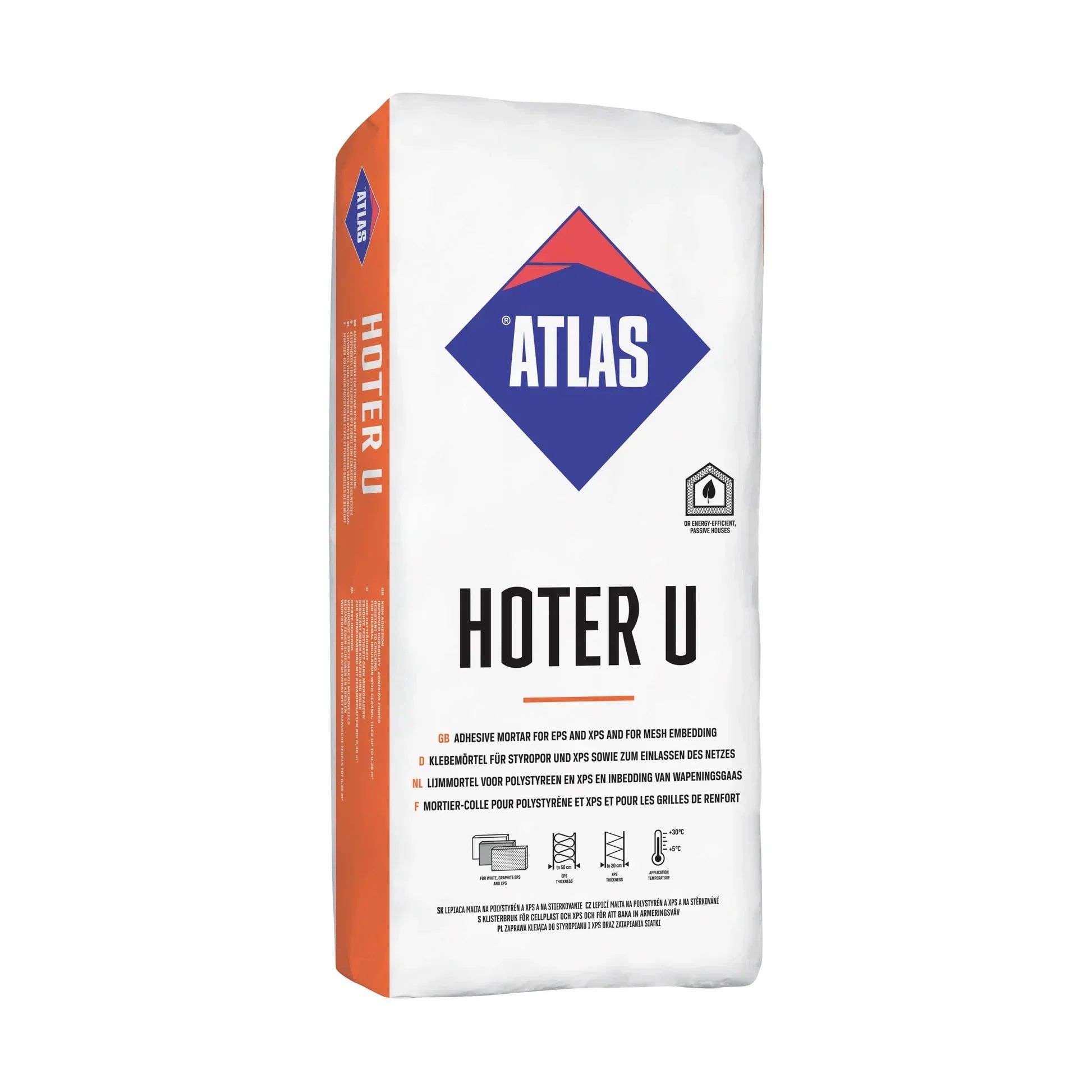
Atlas Hoter U Grey is the fibre-reinforced cement mortar in the Renders World range of EPS adhesives basecoats that does two jobs from one bag — bonding the insulation boards, then forming the mesh-reinforced layer over them once the boards have had their three days.
Where Atlas Hoter U Grey Performs Best on UK Insulated Facades
Atlas Hoter U Grey EPS adhesive basecoat 25kg bonds EPS and XPS boards at 4.0–5.0 kg/m² and forms the mesh-reinforced layer at 3.0–3.5 kg/m², so one bag code covers both ETICS stages on an elevation.
Atlas builds it from cement binder, graded aggregates and modifiers, with structural fibre reinforcement through the mix. The fibres are credited with two specific things rather than a general claim: resistance to microcracking during the initial set, and resistance to cracking later in the system's service life. That second one is what a facade is actually bought on.
The sheet is unusually explicit about where the mortar belongs, and the boundaries are as useful as the permissions:
- Board types it takes: white EPS, graphite EPS and XPS, with EPS fixed up to 500 mm thick and XPS up to 200 mm.
- Board types it does not: mineral wool, both lamella and standard facade slabs — Atlas directs those to the Roker system instead.
- Substrates: aerated concrete, silicate and ceramic brick or block, concrete blocks, stone, cast and precast concrete, and cement or cement-lime plasters. Walls with strongly adhering paint coatings are permitted, subject to an adhesion assessment each time.
- System types: traditional thin-coat finishes, renovation over existing EPS insulation, and ceramic-tiled finishes using tiles up to 0.36 m².
- Buildings: housing, public, commercial, industrial and agricultural, and both passive and low-energy construction.
Matching mortar to board type is the whole decision at this stage, and the adhesive selection guide for EPS boards works through it by board and substrate.
Why Specifiers Choose Atlas Hoter U Grey
- One mortar, two stages: Atlas states both functions in the system — fixing the thermal insulation, and forming the reinforced layer beneath all Atlas thin-coat renders — so procurement and stock-keeping run off a single bag code.
- Bond strength on both faces: minimum 0.25 MPa to concrete and minimum 0.08 MPa to polystyrene in the air-dry state, which is the pair of figures a wind-load calculation actually rests on.
- Around four hours of working time: long enough to mix a station batch and run a bay continuously rather than restarting at the mixer, with 25 minutes of open time governing the mesh work itself.
- Fibre reinforcement with a stated purpose: resistance to microcracks during initial setting and to cracking in service, which is why it holds a thin reinforced layer together across a tall elevation.
- Vapour permeable and documented in certified systems: named as an adhesive and a basecoat in the Atlas/Aval EPS system covered by BBA Agrément Certificate 13/5018, and as a component of the ATLAS and ATLAS XPS systems under ETA 06/0081 and ETA 07/0316.
The fibre question is worth understanding rather than taking on trust, and the benefits of fibre-enhanced basecoats sets out what the reinforcement changes in the cured layer.
Technical Specifications From the Atlas Hoter U Sheet
| Property | Value as published by Atlas |
|---|---|
| Composition | Dry mix of cement binder, aggregates and modifiers, reinforced with fibres |
| Bulk density, dry mix | Approx. 1.40 kg/dm³ |
| Mixing ratio | 0.20–0.22 l water per kg; 5.00–5.50 l per 25 kg bag |
| Maturation time | Approx. 5 minutes, then remix |
| Working time of mixed mortar | Approx. 4 hours |
| Open time | Minimum 25 minutes |
| Adhesion to concrete, air-dry | Minimum 0.25 MPa |
| Adhesion to polystyrene, air-dry | Minimum 0.08 MPa |
| Reinforced layer thickness | 2 mm minimum, 5 mm maximum |
| Consumption, bonding boards | 4.0–5.0 kg/m² |
| Consumption, reinforced layer | 3.0–3.5 kg/m² |
| Temperature, mortar, substrate and surroundings | +5 °C to +30 °C |
| Board thickness supported | EPS up to 500 mm; XPS up to 200 mm |
| Packaging | 25 kg paper bags |
| Shelf life | 12 months from the production date on the packaging |
| Soluble chromium (VI) | ≤ 0.0002 % in the finished product |
| System approvals named | ETA 06/0081 (ATLAS), ETA 07/0316 (ATLAS XPS), and four Polish national approvals |
| Sheet edition | Updated 19 February 2021 |
Two figures published here previously have come off. The performance values quoted in the table above are stated at roughly 20 °C and 55 % relative humidity, which is the condition Atlas ties them to.
How to Apply Atlas Hoter U Grey — Bonding, Then the Reinforced Layer
Empty the bag into measured water, mix with a low-speed paddle until uniform, stand it for about five minutes, scrape the unmixed material off the vessel wall and remix. Use the batch within roughly four hours, working between +5 °C and +30 °C.
Bonding the boards
- Prepare and level the base track first, then check the wall is unfrozen, dry, stable, seasoned and clean of dust, lime, oils, grease, wax and paint residue. Larger irregularities are filled with a levelling mortar beforehand.
- Prime where suction demands it: Atlas names Uni-Grunt or Uni-Grunt Ultra for absorbent or unevenly absorbent substrates, and requires priming on weak cement and cement-lime plasters and on aerated concrete, silicate block and slag-block walls.
- Apply to the board, never to the wall: a perimeter band at least 3 cm wide along the board edge, plus 6 to 8 dabs of at least 8 cm diameter across the remaining face.
- Hit the coverage figure: at least 40 % of the board face, rising to a minimum 60 % once the board is pressed home. Keep the mortar bed under a pressed board to no more than 10 mm.
- Set out in staggered vertical joints, offer the board up immediately after buttering, and beat it into position with a straightedge. On flat, smooth substrates a notched trowel of at least 10 × 10 mm across the whole board face is permitted instead.
- Mechanical fixings come no earlier than 24 hours after bonding, with plastic or steel pins to the thermal design and never fewer than 4 per m².
Fixing quantity is a design output rather than a rule of thumb, and the fixing pattern and spacing guide covers how the layout is arrived at. The boards themselves sit in the graphite EPS insulation boards range.
Forming the reinforced layer
The reinforced layer starts no earlier than three days after the boards were bonded — this is the single most misquoted interval on this product, and the published page had it at 24 hours. Boards must be free of frost, flat, clean, stable and dust-free before anything goes over them.
Lay the mortar out evenly with a notched trowel of 6–10 mm, roll the Atlas 150 reinforcing mesh into it and bed it in with the trowel, smoothing flat in the same pass. The mesh must finish completely invisible and fully embedded, with laps of at least 10 cm. At the corners of openings, additional strips of at least 20 × 35 cm go in at 45 degrees, beneath the main reinforcing layer. Any remaining unevenness is sanded once the mortar has dried, since it will otherwise show through the render. Method detail sits in the basecoat and mesh reinforcement layer guide, and the sequencing that keeps a wet edge across a full bay is in the top-to-bottom mesh embedding technique.
Site Conditions, Graphite Boards and Testing a Doubtful Wall
Three instructions on this sheet carry more weight on site than anything in the data table, and all three are worth building the programme around.
- Never bond heated graphite EPS. Atlas is explicit: do not let graphite boards warm during installation or during the adhesive's initial set, because heating at either stage can debond the board from the mortar. Sequencing dark boards to follow the shade is the practical answer.
- Sheet the scaffold. Covers are required during the works, and no work is carried out in snow, rain or strong wind.
- Test a wall you are unsure of. Where a substrate is weak, dusting or hard to clean, bond 10 × 10 × 10 cm polystyrene cubes at representative points and check after three days, or after five days below 10 °C and above 80 % humidity. If the polystyrene tears when pulled by hand, the substrate is sound; if the cube comes away carrying mortar and a layer of the wall with it, it is not, and the remedy belongs in the thermal design.
Rendering follows once the reinforced layer has dried, about three days, and the layer is coated with the key coat matched to the chosen render before any finish goes on. Tools wash out in clean water immediately after use.
Fire Classification and Certification Scope — Read It as a System
Atlas Hoter U is named in BBA Agrément Certificate 13/5018 as both an adhesive and a basecoat within the Atlas/Aval EPS External Wall Insulation System, and every performance figure in that certificate belongs to a complete assembly rather than to the bag. No product here is BBA certified; a system is.
Constructions in that certificate built with Atlas Hoter U as adhesive and basecoat, over EPS to a maximum 250 mm, may achieve a reaction to fire classification of B-s2, d0 or B-s1, d0 to EN 13501-1:2010, depending on which key coat, finishing coat and paint complete the build-up — the stricter of the two applies to the silicone-render construction, and the certificate's own table is the reference. The EPS insulation in isolation is classified E. Under the same certificate the system should not be used in England, Wales and Northern Ireland on buildings with a storey more than 18 m above ground level, and in Scotland not on buildings with a storey 11 m or more above ground level or within 1 m of a boundary, subject to the conditions the certificate sets out.
Impact resistance is also certified per construction rather than per component, and the categories differ by finishing coat and by whether one or two layers of mesh are used. Those rows could not be resolved unambiguously against a single build-up from the retrieved copy, so no category is stated here.
Grey or White Hoter U, and Where Mineral Wool Changes the Answer
Both versions share the same fibre-reinforced formulation and the same technical sheet; the cement is the variable. Atlas states that using white cement increases the strength of the layer formed from the adhesive.
| Your project | Best system | Standout spec |
|---|---|---|
| EPS or XPS facade, mid or dark finish | Atlas Hoter U Grey 25 kg | Grey cement, min. 0.25 MPa to concrete |
| EPS or XPS facade where layer strength leads | Atlas Hoter U White 25 kg | White cement, stronger adhesive layer |
| Mineral wool slabs, any elevation | Mineral wool insulation on the Roker system | Hoter U is not rated for wool |
The wool row is a hard boundary rather than a preference: the sheet routes both lamella and standard facade wool slabs to the Atlas Roker system, and the wool-compatible Roker U adhesive is stocked in the same collection at Renders World.
Ordering Atlas Hoter U Grey — Bags per 100 m² and Material Cost
Because the mortar is consumed at two different rates, quantities are worked stage by stage. The arithmetic below shows its operands for a 100 m² elevation.
- Bonding: 100 m² × 4.0–5.0 kg/m² = 400–500 kg ÷ 25 kg = 16–20 bags.
- Reinforced layer: 100 m² × 3.0–3.5 kg/m² = 300–350 kg ÷ 25 kg = 12–14 bags.
- Total: 700–850 kg, or 28–34 bags, before any allowance for uneven substrates and offcuts.
- Material cost: 28 × £12.90 = £361.20 and 34 × £12.90 = £438.60, giving £3.61–£4.39/m² for the adhesive and basecoat only. Labour, boards, fixings, mesh, key coat and render are all outside that figure.
Renders World listed Atlas Hoter U Grey EPS adhesive basecoat 25kg at £12.90 per 25 kg bag and in stock when the product data was read in August 2026. No VAT treatment was displayed, so none is stated here. Store bags closed, dry, cool, ventilated and ideally palletised, out of direct sun, because the product hardens irreversibly on contact with moisture.
FAQ — Quantities, Compatibility, Timing and Handling
How many bags cover a 100 m² elevation?
Between 28 and 34, split across the two stages: 16–20 bags to bond the boards at 4.0–5.0 kg/m², and 12–14 to form the reinforced layer at 3.0–3.5 kg/m². Atlas ties actual consumption to how flat the substrate is and to the bonding method chosen, so the upper end suits older, uneven masonry.
Can it bond mineral wool slabs?
No. The sheet covers white EPS, graphite EPS and XPS, and routes both lamella and standard facade mineral wool to the Atlas Roker system. Specifying the wool-rated adhesive keeps that build-up inside the system it was assessed as, which matters most on the projects where wool was chosen for its fire performance in the first place.
How soon after bonding can the reinforced layer go on?
Three days at the earliest, and mechanical fixings can go in from 24 hours after bonding. Rendering then follows once the reinforced layer has dried, roughly a further three days, with the key coat for the chosen render applied first. Cool or humid weather extends both waits.
Anything different about graphite EPS?
Yes, and it is the one condition worth planning the day around. Atlas instructs that heated graphite boards are not bonded, and that the boards are kept from warming during installation and while the adhesive takes its initial set, because heating at either point can separate the board from the mortar. Following the shade around the building handles it.
What does handling the powder involve?
It contains cement, so it can irritate the respiratory tract and skin, causes serious eye damage and may cause an allergic skin reaction. Avoid breathing the dust and wear protective gloves, clothing, eye and face protection. On eye contact, rinse cautiously with water for several minutes, removing contact lenses if easily done, and continue rinsing. Soluble chromium (VI) is declared at no more than 0.0002 %.
Technical Documentation for Atlas Hoter U Grey