


Description
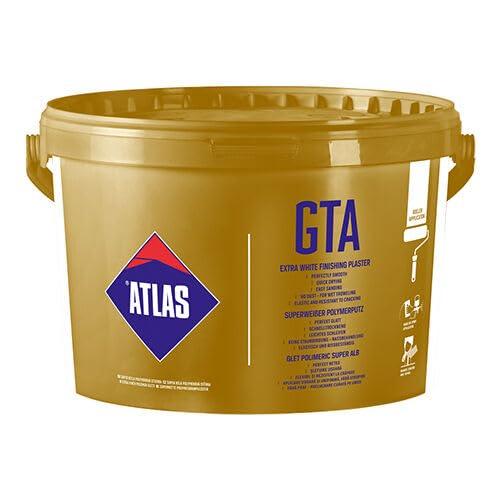
Atlas GTA is a ready-mixed, extra-white polymer finish for walls and ceilings indoors. It fills and tapes plasterboard joints, levels small dips up to 3 mm and skims whole walls to a smooth, paint-ready face — by trowel, by roller or by spraying machine. This 18 kg tub covers about 18 m² per coat.
What Atlas GTA Does on a Wall or Ceiling
Atlas GTA comes ready to use: open the tub, stir and work. The mass is made from resin binders, mineral fillers and modifying additives, and Atlas picks snow-white fillers of a fine, even grain so the surface comes out white and smooth without a second round of corrections.
One tub covers three jobs:
- Jointing plasterboard with tape — fill the joint, bed the tape, cover it, and fill the screw heads with the same mass.
- Levelling small faults — dips and unevenness up to 3 mm deep in one layer.
- Skimming the whole surface — a thin top coat over plasterboard, gypsum plaster, cement and cement-lime plaster or concrete, ready for paint or wallpaper.
Atlas GTA is rated for every plasterboard finishing level from Q1 (joints and screw heads only) to Q4 (the full-surface finish for gloss paint and glancing light). It is an indoor product for homes, offices, schools, healthcare buildings and shops — walls and ceilings that stay dry in use.
Why Plasterers and Decorators Pick It
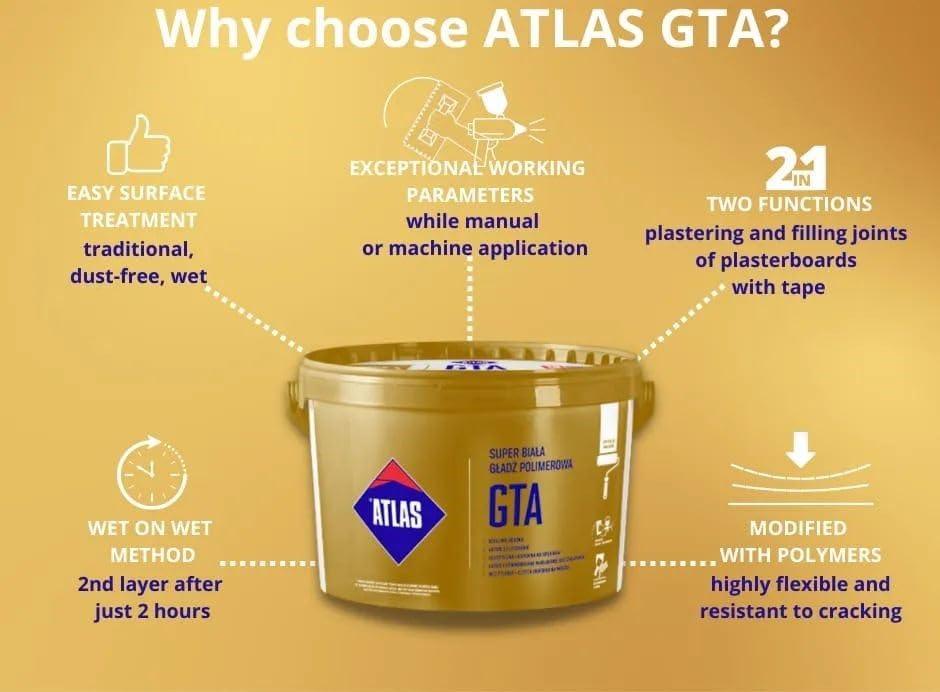
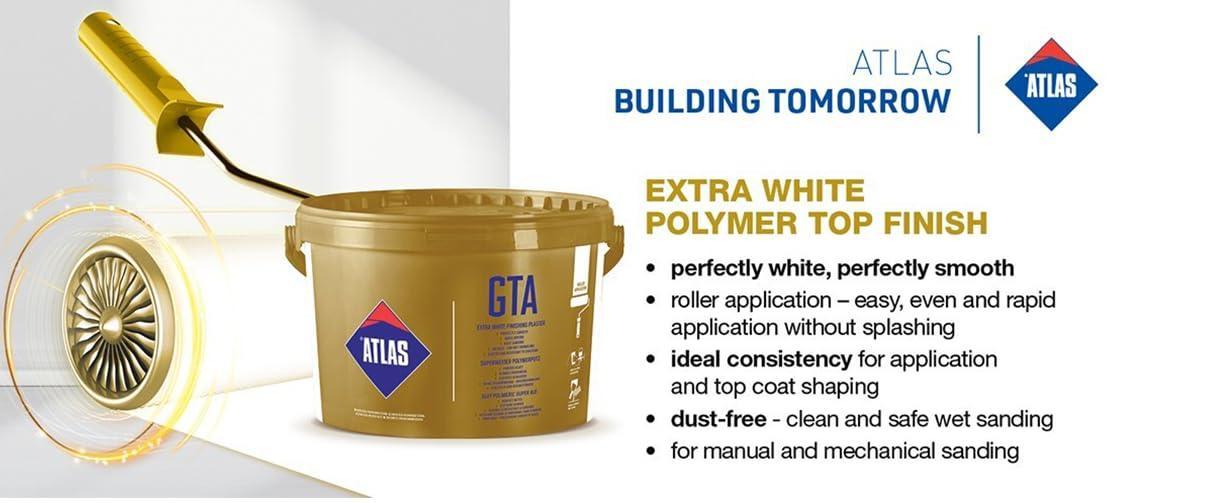
- Bright white and smooth from the first pass. The fine white fillers leave a surface that rarely needs touching up before sanding.
- Made for the roller. Its consistency and long open time let you roll it on quickly and evenly without spatter, then flatten it with a stainless steel float.
- Joints and skim from one tub. Atlas classes it as a dual-purpose joint compound (type 3A), so the same product beds the tape and finishes the wall.
- Second coat the same day. The next layer can go on while the first is still dull and slightly damp — usually about two hours at 20 °C — so the wait between coats is short and blistering is kept at bay.
- Flexible and well bonded. Polymer binders give an adhesion of 0.3 MPa and a flexible finish that holds together without cracking on a sound background.
- Dust-free option. Once hard, the surface can be misted with water and rubbed smooth with a sponge float instead of dry sanding — a clean, dust-free way to finish.
- Hard enough to sand well. When you do sand, it works by hand or by machine with 150–220 grit.
Technical Data
| Property | Atlas GTA |
|---|---|
| Type | Extra-white polymer top finish, ready-mixed |
| Pack | 18 kg tub |
| Coverage | About 18 m² per coat (1.0 kg/m²) |
| Jointing | About 36 m of joint (0.5 kg/m) |
| Maximum layer | 3 mm |
| Drying time | Up to 6 hours for a 1 mm layer at 20 °C and 60 % humidity |
| Next coat | Wet-on-wet after about 2 hours at 20 °C |
| Working temperature | +5 °C to +25 °C — product, wall and room |
| Room humidity | Up to 70 % |
| Adhesion | 0.3 MPa |
| Reaction to fire | A1 |
| Finishing levels | Q1 to Q4 |
| Application | Trowel, roller (pile 11 mm or longer), spraying machine |
| Sanding | Grit 150–220, by hand or machine, or wet with a sponge float |
| Shelf life | 12 months from the production date |
GTA, GO! or Goldband: Which One Does the Job?
These three sit side by side on the same shelf and do different jobs. Goldband builds the wall; GTA and GO! finish it.
| Job | Atlas GTA | Atlas GO! | Knauf Goldband |
|---|---|---|---|
| What it is | Ready-mixed polymer finish | Ready-mixed polymer finish for the roller | Dry gypsum plaster, mixed with water |
| Layer | Up to 3 mm | Up to 3 mm | 8–50 mm, usually 15 mm |
| Taping plasterboard joints | Yes | No — Atlas sends this job to GTA | No |
| Levelling before the skim | Yes | No — Atlas sends this job to GTA | Yes, as the base coat |
| Finishing levels | Q1–Q4 | Q2–Q4 | — |
| Coverage | About 1.0 kg/m² per coat | About 1.5 kg/m² per coat | About 13 kg/m² at 15 mm |
| Pack | 18 kg or 5 kg tub | 25 kg bucket | 30 kg bag |
Choose Atlas GTA when the job includes taped joints or levelling as well as the skim. For a full-surface skim over boards that are already taped, Atlas GO! 25 kg bucket dries a little faster — 4 to 4.5 hours for 1 mm. For walls that need a proper plaster coat first, start with Knauf Goldband 30 kg bag and finish over it with Atlas GTA once it has dried. For a small repair or one ceiling, the Atlas GTA 5 kg tub is the same product in a smaller pack.
Preparing the Surface
The surface must be sound, dry and clean — no dust, dirt, lime, oil, grease, wax, old paint residue or release agent. New backgrounds need time to dry out first:
- new gypsum, cement or cement-lime plaster — about one week per centimetre of thickness;
- concrete walls and floors — 28 days.
Those times assume about 20 °C and 55 % humidity; cold or damp rooms take longer.
Then match the primer to the surface:
- Very absorbent surfaces — Atlas NKP primer used neat, Atlas Uni-Grunt or Atlas Uni-Grunt Ultra concentrate.
- Smooth, low-absorption surfaces such as concrete — a bonding coat of Atlas Ultragrunt bonding primer.
The full range is in primers.
How to Apply Atlas GTA
- Stir the tub. A little liquid on top after storage is normal — mix it back in with a paddle that does not whip in air. By hand, use it as it comes; for roller or machine work you may add up to 2 % clean water.
- Tape the joints first. Press the mass into the gap between boards, let it start to set, lay a thin coat, press the tape in without folds, and cover it thinly. Fill the screw heads at the same time.
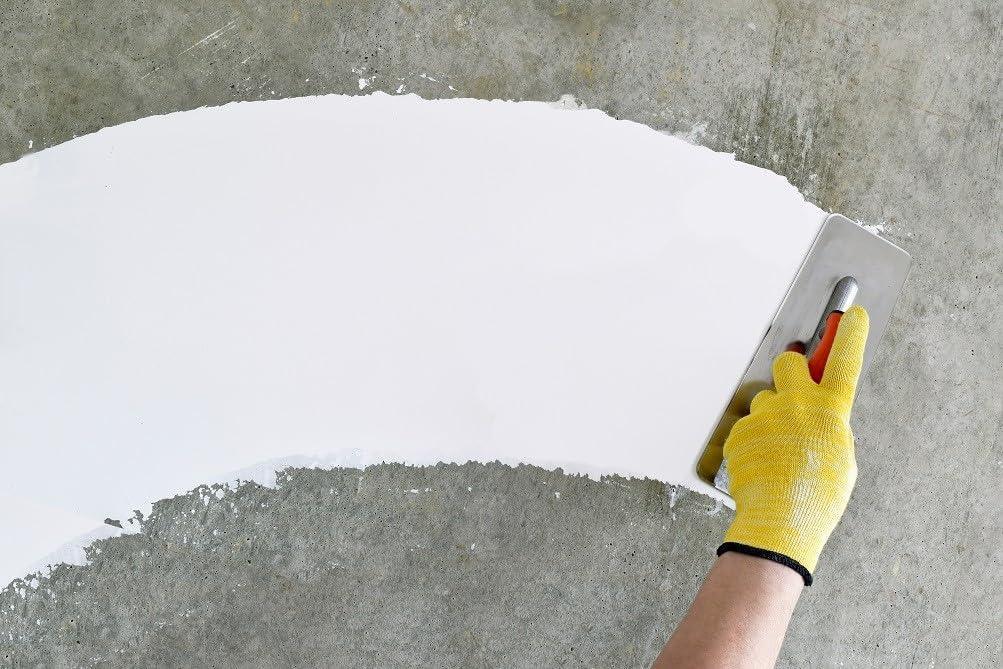
- Roll or trowel the skim. With a roller of 11 mm pile or longer, spread an even coat and flatten it straight away with a stainless steel float. With a trowel, press the mass firmly onto the surface. Keep each layer to 3 mm or less.
- Add the second coat. Either wet-on-wet once the first coat turns dull and slightly damp, or later on the hardened coat after misting it with water so it does not blister.
- Finish the surface. When it is completely dry, sand with 150–220 grit — or mist it and rub it smooth with a sponge float for a dust-free finish.
- Prime before decorating. Remove the sanding dust and prime as the paint or wallpaper maker asks. Acrylic and latex paints both suit the finish.
Work with Atlas GTA between +5 °C and +25 °C, keep draughts and strong sun off the wall while it dries, and do not use it on surfaces that get wet in use. Hand tools from skimming blades and spatulas clean up with water straight after use.
Standards and Declarations
Atlas GTA meets EN 15824:2017 for internal plasters and EN 13963 as a type 3A joint compound: dual-purpose, for jointing plasterboard with tape and as a finishing coat, applied by hand, with a long setting time. It is covered by Atlas Declaration of Performance No. 175/2/CPR. With Q FOLATAPES jointing tape, the joint reaches a flexural strength of 350 N. Reaction to fire is class A1.
Ordering, Delivery and Collection
- Dispatch: orders go out the same day when the tubs are in stock.
- Delivery: after the order, the team contacts you with the most cost-effective way to send it. Parcels up to 25 kg can go next day; pallets go next day or in two working days on the economy option. Every delivery is kerbside.
- Collection: pick it up from the counter at Unit 9A, Central Trading Estate, Southampton SO14 5JP — Monday to Friday 7am to 5pm, Saturday 7am to 12pm.
Changed your mind? Tubs bought from Renders World can come back in their original condition within 14 days — the details are on the cancellations and returns page. Renders World keeps GTA in two sizes, this 18 kg tub and the 5 kg tub. Store the Atlas GTA tub between +5 °C and +35 °C and use it within 12 months of the production date. Cover any leftover with foil and close the lid tight. Plasterboard, adhesive and accessories for the same job are in drylining, and other finishes are in top coat plasters and fillers.
Atlas GTA: Questions Before You Buy
How many tubs of Atlas GTA do I need?
Allow about 1.0 kg of Atlas GTA per m² for each coat. One 18 kg tub skims about 18 m² once, so two coats over a 3 × 3 m ceiling (9 m²) take about one tub. For taping, allow about 0.5 kg per metre of joint.
Can I put Atlas GTA over old gypsum plaster or a painted wall?
Gypsum, cement and cement-lime plasters and concrete are all listed surfaces. Old paint that flakes, and any grease, wax or dust, has to come off first; very absorbent plaster gets a primer, and smooth concrete gets a bonding coat.
What roller do I need for Atlas GTA?
A roller with a pile of at least 11 mm. Roll an even coat and flatten it with a stainless steel float straight away. For rolling, you can loosen the mass with up to 2 % clean water.
How long before I can sand and paint?
A 1 mm layer dries in up to 6 hours at 20 °C and 60 % humidity; thicker layers, cold and damp take longer. Sand only when it is completely dry, then dust off and prime before painting.
How thick can one coat of Atlas GTA be?
Up to 3 mm per layer. Deeper dips need levelling in more than one layer, or a plaster coat such as Goldband first.
Can I use Atlas GTA in a bathroom or kitchen?
It is an indoor finish for rooms that stay below 70 % humidity for most of the time. Do not use it on surfaces that get wet in use, such as inside a shower.
What if the tub has frozen?
Short frosts in transport are allowed. Let the tub thaw fully at room temperature, then mix it thoroughly; if it will not come back to an even, smooth paste, do not use it.