
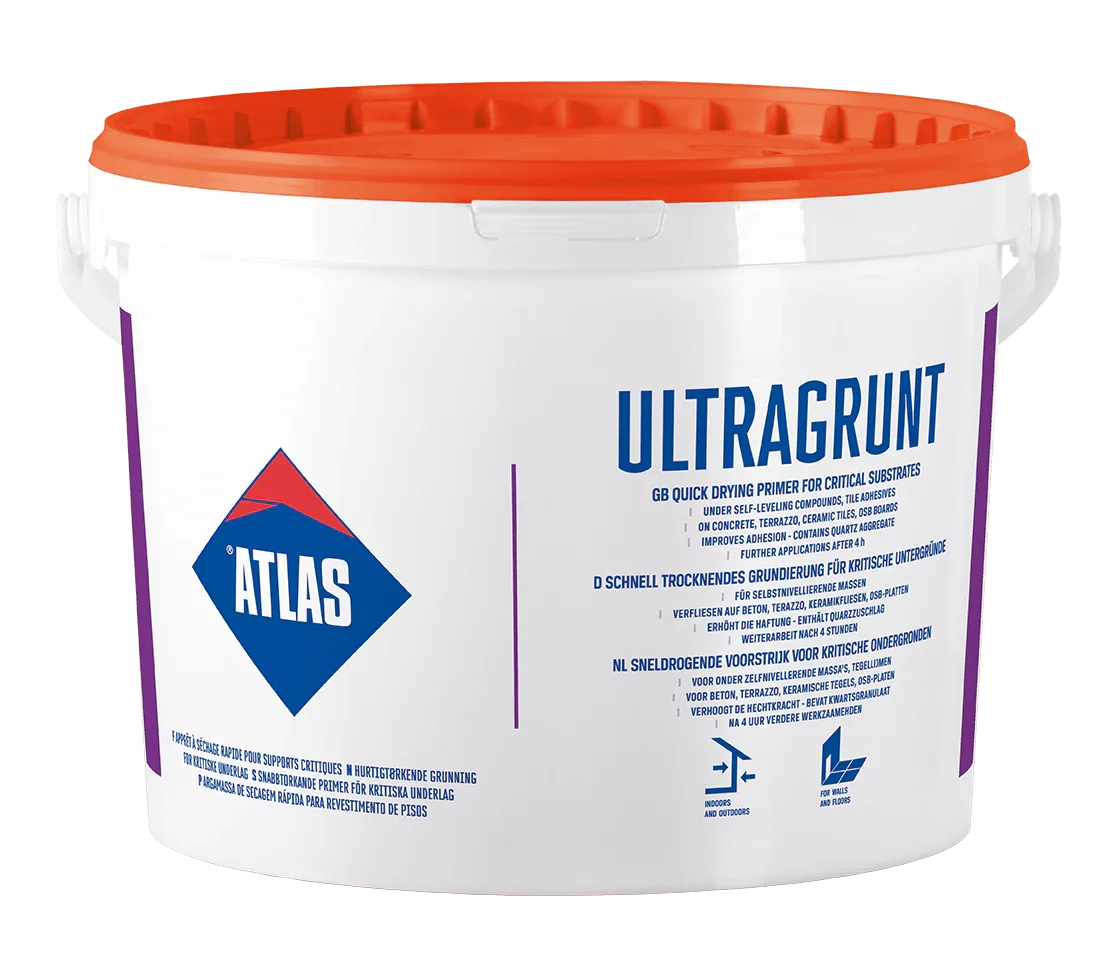

Description
Atlas Ultragrunt is a ready-to-use grip primer in a 5 kg bucket for smooth surfaces that soak up nothing — existing tiles, terrazzo, OSB boards, concrete and plasterboard. Instead of soaking in, it leaves a rough layer of quartz on the surface, so tile adhesive, screed, plaster or skim has something to hold on to. It works inside and outside, on floors and walls, and the next layer can go on after about 4 hours. Atlas Ultragrunt sits in the Renders World render primer range.
How Atlas Ultragrunt Works
Atlas makes it from polymer resins with selected quartz aggregate mixed in. The quartz grains stay on the surface and form a rough coat. That rough coat gives the next layer far more contact area than a flat, sealed surface, which is what raises adhesion.
It is a different job from a penetrating primer. A primer such as the Atlas NKP gel primer soaks into porous walls and strengthens them. Atlas Ultragrunt is for surfaces where there is nothing to soak into — it builds grip on top instead.
Atlas tested the bond it gives on hard surfaces. The results are below.
- Concrete — more than 1.0 MPa.
- Terrazzo — more than 1.0 MPa.
- Ceramic tiles — more than 1.0 MPa.
- OSB board — more than 0.8 MPa, with the break inside the board itself, not at the primer.
Why Choose This Grip Primer
- Tile over tile — primes old ceramic and stone tiles so new tiles can be fixed straight on top.
- Screed over terrazzo — prepares terrazzo for a self-levelling screed.
- Grip on boards — works on unsanded OSB, structural wood-based boards, plasterboard and fibre-gypsum boards.
- Fast — tiles and skim can follow after about 4 hours.
- Ready to use — stir and apply, with nothing to mix in.
- Warm-weather friendly — made for work up to +35 °C, inside and outside.
Which Surfaces It Suits
Atlas lists these difficult surfaces as suitable, on walls and floors:
| Group | Surfaces |
|---|---|
| Concrete | Monolithic and hardened concrete floors |
| Concrete | Reinforced concrete, wet-poured slabs |
| Heated floors | Cement or anhydrite screeds with underfloor heating |
| Hard finishes | Terrazzo, old ceramic and stone tiles |
| Timber and boards | Unsanded OSB, structural wood-based boards |
| Timber and boards | Stable timber floors |
| Boards | Plasterboard, fibre-gypsum boards |
| Other | Steel, plastics, stable plastic floor coverings |
| Other | Dado coatings in solvent-based paint |
The Uni-Grunt Ultra sheet also sends tiles, terrazzo, OSB, linoleum and PVC, concrete varnish and oil paint here by name. For ordinary absorbent brick, block and plaster, a penetrating primer is the right choice — the substrate matrix for brick, block and painted walls explains each wall type.
Atlas Ultragrunt Technical Data
| Property | Value |
|---|---|
| Type | Ready-to-use polymer resin mass with quartz |
| Consumption | About 0.3 kg per m² |
| Density | Approx. 1.5 g/cm³ |
| Working temperature | +5 °C to +35 °C, air and surface |
| Next layer | After about 4 hours |
| Screed on terrazzo | After about 24 hours |
| Bond to concrete, terrazzo, tiles | More than 1.0 MPa |
| Bond to OSB | More than 0.8 MPa |
| Application | Roller or brush |
| Where it can go | Inside and outside, floors and walls |
| Shelf life | 12 months from production |
The waiting times apply at about 20 °C and 50–60 % humidity.
How to Apply the Grip Primer
- Prepare the surface. It should be dry and, as far as possible, clean of dust, dirt, oil, grease and wax. Remove every loose layer that is not firmly bonded.
- Degrease terrazzo. Terrazzo must always be degreased, and any paste or sealer it was treated with must come off.
- Stir, do not thin. It comes ready to use. Do not dilute it, thicken it or mix it with anything else — just stir it to even out the mix.
- Spread it evenly. Use a roller or brush and cover the whole area.
- Protect it while it dries. Keep the primed surface out of direct sun, wind and rain, during the work and while it dries.
- Wait, then carry on. Tiles and skim after about 4 hours; self-levelling screed on terrazzo after about 24 hours.
Wash tools in clean water straight after use. The full order of work on a wall is in the wall preparation method guide.
What Can Go On Top
Atlas lists five kinds of layer as suitable over Atlas Ultragrunt. They are listed below.
- Ceramic and stone tiles fixed with cement adhesive.
- Gypsum cladding and mouldings fixed with gypsum adhesive.
- Cement floors and screeds, and anhydrite screeds.
- Cement, cement-lime and gypsum plasters.
- Gypsum and cement skims.
Paint is not on the list: the rough quartz surface is made for grip, not for a smooth paint finish. Before priming, check what the maker of the next layer recommends for priming under it.
How Much Atlas Ultragrunt to Order
Atlas Ultragrunt uses about 0.3 kg per m², so one 5 kg bucket covers about 16–17 m².
- A small bathroom floor and walls, 15 m² — one bucket.
- A 30 m² tiled kitchen floor — two buckets.
- A 50 m² terrazzo floor — three buckets.
Which Atlas Primer to Choose
The primers overlap on some surfaces, such as concrete and plasterboard. What separates them is how they work:
| Primer | Choose it when |
|---|---|
| Ultragrunt | The surface is smooth and does not absorb |
| NKP gel | Porous walls and ceilings, no drips |
| ATLAS UNI-GRUNT | Classic emulsion for absorbent masonry |
| Atlas Uni-Grunt 5 kg | The same emulsion for a smaller job |
| Atlas Uni-Grunt Ultra | A concentrate to mix with water for large areas |
On a rendered façade, the textured key coat that goes on a cured base coat before a silicone render is a different job, done by CERPLAST quartz top coat primer. For a wider look at primers in render work, see the primer comparison for thin-coat systems.
Storage and Safety
- Storage — in tightly closed buckets, somewhere cool, dry and well ventilated, between +5 °C and +30 °C. Stir before use.
- Frost — protect it from frost, flames, sparks and overheating.
- Keep away from — strong acids, strong alkalis and oxidising substances.
- Label — not classified as hazardous; keep out of reach of children. Contains isothiazolinones, which may cause an allergic reaction.
- Waste — leftover product and dirty buckets go to an authorised waste company.
FAQ — Surfaces, Mixing and Timing
Should I use it on a plain concrete wall?
It depends on the concrete. Smooth, dense concrete that nothing sticks to needs grip, which is this primer's job. Dusty, porous concrete needs strengthening, which is a job for a penetrating primer such as the NKP gel.
Can I thin it to make it go further?
No. Atlas Ultragrunt comes ready to use, and Atlas says not to dilute it, thicken it or mix it with other materials.
How long before a self-levelling screed?
About 4 hours on most surfaces. On terrazzo, wait about 24 hours before pouring a screed such as Atlas SMS 15 or SMS 30.
Does it work on OSB?
Yes, on unsanded OSB. Atlas measured a bond of more than 0.8 MPa, with the break inside the board rather than at the primer, so the board must be sound and well fixed.
Can it go on steel or plastic?
Yes. Steel, plastics and stable plastic floor coverings are on the suitable list. The surface must be dry, clean and free of grease and loose layers.
Can I paint over it?
No. It leaves a rough quartz surface for tiles, screed, plaster and skim, not for paint. For a wall you will paint, use a penetrating primer instead.
Ordering, Delivery and Collection
- Dispatch — orders are processed the same day when the stock is there.
- Delivery — the Renders World team quotes the best delivery method after the order.
- Collection — in person from the Renders World counter in Southampton during opening hours.
Technical Documentation