


Description
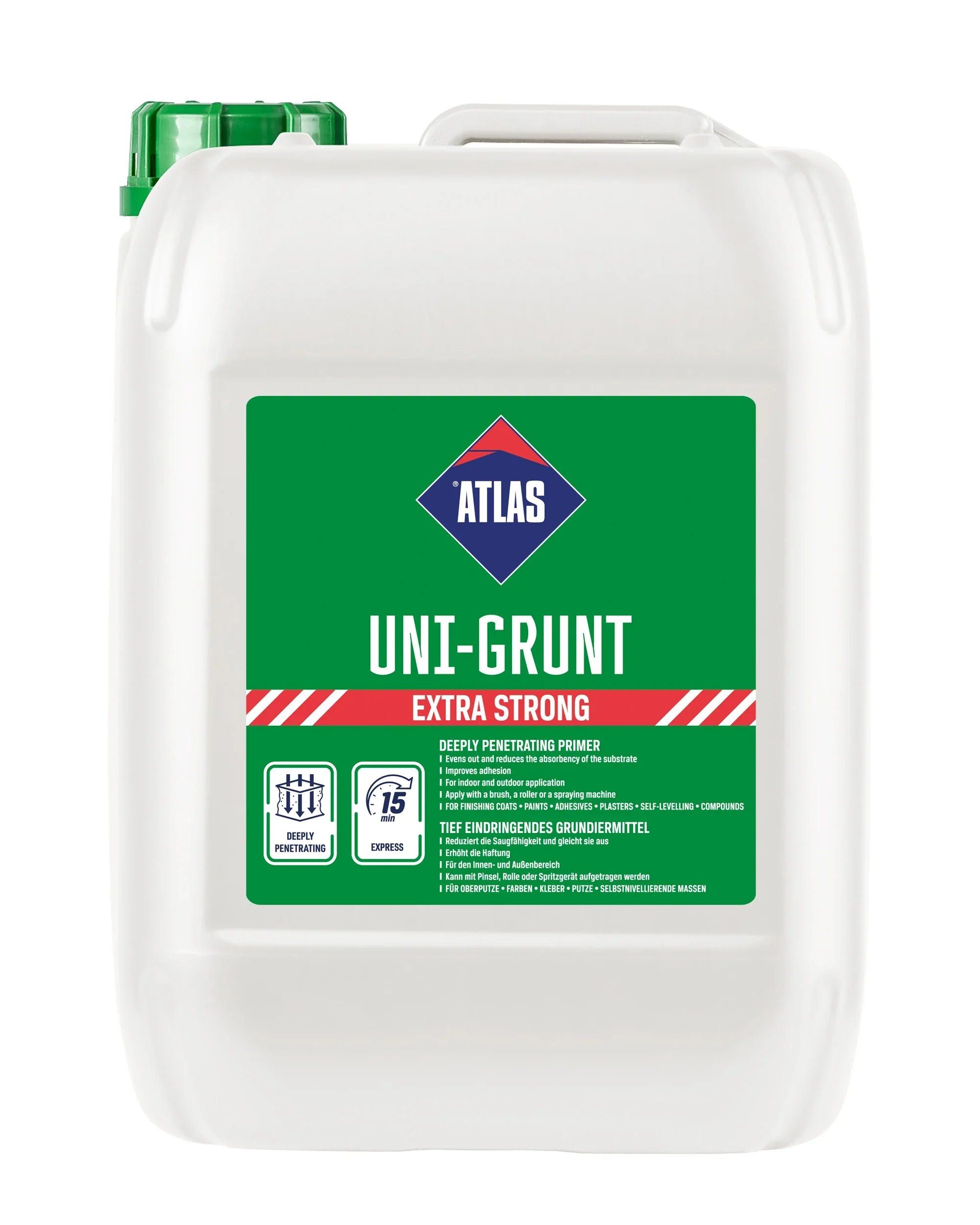
Atlas Uni-Grunt 5 kg is the smaller container of Atlas's deep-penetrating primer: a water-based polymer emulsion that soaks into a porous wall, binds the surface and evens out how fast it drinks. The 5 kg container suits one elevation, an extension or a few interior rooms. It primes up to 100 m² neat on weak, very absorbent backgrounds, up to 200 m² at 1:1 and up to 400 m² at 1:3 under top finishes and adhesives.
Why Choose Atlas Uni-Grunt 5 kg
- Stops a wall drinking the next coat. On porous backgrounds the emulsion penetrates, binds loose grains and lowers suction, so render, adhesive or skim keeps its water long enough to set properly. That is the job Atlas Uni-Grunt 5 kg does on every background it suits.
- One emulsion, three strengths. Use it neat, at 1:1 or at 1:3 with clean water, matched to the background and the layer that follows.
- Quick to the next job. Atlas adhesive mortars can follow after about 15 minutes; renders, screeds, paint and wallpaper after about 2 hours.
- Easy to see where you have been. It dries to a matt film, and a splash of water on the dry surface shows straight away whether a patch needs a second coat.
- A container you finish in time. It keeps for 12 months from the date of manufacture, so on a single wall the 5 kg size is used up while it is fresh.
What One 5 kg Container Primes
Both containers hold the same emulsion; only the quantity changes. Atlas puts average consumption at 0.05 to 0.2 kg per m², depending on how absorbent the background is. Set that against the area you are priming, and against a 12-month shelf life, before you pick a size.
| Mix | Typical use | 5 kg container | 10 kg container |
|---|---|---|---|
| Neat (or two coats at 1:1) | Weak, very absorbent backgrounds: cement-lime plaster, aerated concrete, silicate brick | up to 100 m² | up to 200 m² |
| 1:1 with water | Standard backgrounds under floor screeds and plasters | up to 200 m² | up to 400 m² |
| 1:3 with water | Standard backgrounds under top finishes, paints, waterproofing, tile adhesives and insulation adhesives | up to 400 m² | up to 800 m² |
5 kg or 10 kg: Which Container Fits the Job
Worked the other way round for Atlas Uni-Grunt 5 kg: at 0.05 to 0.2 kg per m², 5 kg of neat emulsion covers 25 to 100 m², and diluted it goes further. When the wall area runs past what one container covers at your mix, take the 10 kg Atlas Uni-Grunt instead.
- Atlas Uni-Grunt 5 kg — one elevation, an extension or a few rooms, used up well within its shelf life.
- Atlas Uni-Grunt 10 kg — a whole house, or several walls primed in one go.
Renders World stocks both containers, so you can match the quantity to the wall.
Where Uni-Grunt Works, and Where to Use Another Primer
Uni-Grunt is made for absorbent mineral backgrounds, inside and outside: cement-lime plaster, aerated concrete block, silicate brick and mixocret screeds take it neat or as two coats at 1:1, wet on wet. Standard, load-bearing backgrounds take it at 1:1 under plasters and screeds and at 1:3 under finishes, paint, waterproofing and adhesives, including the adhesive for insulation boards.
Some backgrounds need a different product:
- Tiles, terrazzo, OSB, stable lino or PVC, varnished concrete and oil paint. These are smooth or non-absorbent, so a penetrating emulsion has nothing to soak into. Use Atlas Ultragrunt, a quartz-filled primer for critical substrates.
- Gypsum plaster and gypsum blocks, anhydrite screeds and dense monolithic concrete. Prime these with Atlas Uni-Grunt Ultra, the stronger concentrate. It is the cautious choice on the backgrounds where a weak bond matters most.
- Under a coloured thin-coat render. A penetrating primer controls suction, but it leaves the render no key and the colour of the background uncovered. For that, finish with a quartz key coat such as Atlas Cerplast, tinted towards the render colour.
Gypsum backgrounds that are going to be painted follow the paint maker's own priming instructions. If you are not sure which primer your wall needs, the Renders World counter in Southampton can help you choose.
How to Apply Atlas Uni-Grunt
- Prepare the background. It should be sound, clean and free of dust, grease and anything that stops adhesion. Work between +5 °C and +30 °C, for both the air and the wall.
- Mix only with water. Uni-Grunt comes ready to use. Dilute it with clean water to the ratio in the table, and never mix it with other materials or thicken it.
- Apply one thin, even layer. Use a roller, brush or sprayer and work until the background is saturated, without leaving puddles or runs. On very weak backgrounds, apply two coats at 1:1, wet on wet.
- Let it dry to matt. Allow about 2 hours. Ceramic tiles on dry cement or cement-lime backgrounds can start 15 minutes after priming.
- Test it with water. Wet a patch of the dried surface and watch how quickly it soaks in. If it still drinks fast, prime again.
- Clean up straight away. Wash tools in clean water as soon as you finish. Dried splashes come off with Atlas Szop 2000.
Jobs Uni-Grunt Does in a Render Build-Up
- Solid wall before render. Atlas Uni-Grunt 5 kg is the first layer: it consolidates the masonry and evens its suction before the base coat goes on.
- Insulated façade. It goes on the wall at 1:3, before the insulation adhesive.
- Under a coloured thin-coat finish. Where a silicone render follows, the last layer under it is a quartz key coat, not a second penetrating primer.
Our guide to preparing a wall before rendering takes you through each background step by step, and the article on choosing a primer under silicone render sets out the order of layers.
Specification
| Property | Atlas Uni-Grunt |
|---|---|
| Type | Deep-penetrating primer, water dispersion of polymer resins |
| Container | 5 kg plastic container |
| Density | approx. 1.0 g/cm³ |
| Average consumption | 0.05–0.2 kg/m², depending on absorbency |
| Coverage, 5 kg | up to 100 m² neat · up to 200 m² at 1:1 · up to 400 m² at 1:3 |
| Application temperature | +5 °C to +30 °C (background and air) |
| Drying | approx. 2 hours, matt finish |
| Next layer | after approx. 15 minutes for Atlas adhesive mortars; after approx. 2 hours for screeds, wallpaper and paint on cement-lime plaster, silicate brick and aerated concrete |
| VOC | Cat. A/h/FW, max. 1.92 g/l (limit 30 g/l) |
| Shelf life | 12 months from the date of manufacture |
| Tools | roller, brush or sprayer |
Frequently Asked Questions
How much wall does a 5 kg container of Uni-Grunt prime?
Up to 100 m² neat, up to 200 m² at 1:1 and up to 400 m² at 1:3. Very porous walls sit at the lower end, because they take more emulsion per square metre.
Should I dilute it?
It depends on the background and the next layer. Weak, very absorbent walls take it neat or as two coats at 1:1. Standard walls take 1:1 under plaster and screed, and 1:3 under finishes, paint, tile adhesive and insulation adhesive. Dilute with clean water only.
Can render go straight onto the primed wall?
Yes, once the primer has dried to a matt surface, after about 2 hours; Atlas adhesive mortars can go on after about 15 minutes. Under a coloured thin-coat render, add a quartz key coat first.
Is this the same primer as the 10 kg container?
Yes. Both containers hold the same Atlas Uni-Grunt emulsion, with the same mixes and drying times; only the quantity changes.
Can I use it on gypsum plaster?
For gypsum plaster, gypsum blocks and anhydrite screeds, take Atlas Uni-Grunt Ultra. Gypsum that is going to be painted follows the paint maker's instructions.
How long does an opened container keep?
It keeps for 12 months from the date of manufacture printed on the container, so buy the size you will use within that time.
Technical Documentation
Want to see every primer side by side? The Renders World range of render and wall primers compares penetrating primers and quartz key coats.