

Description
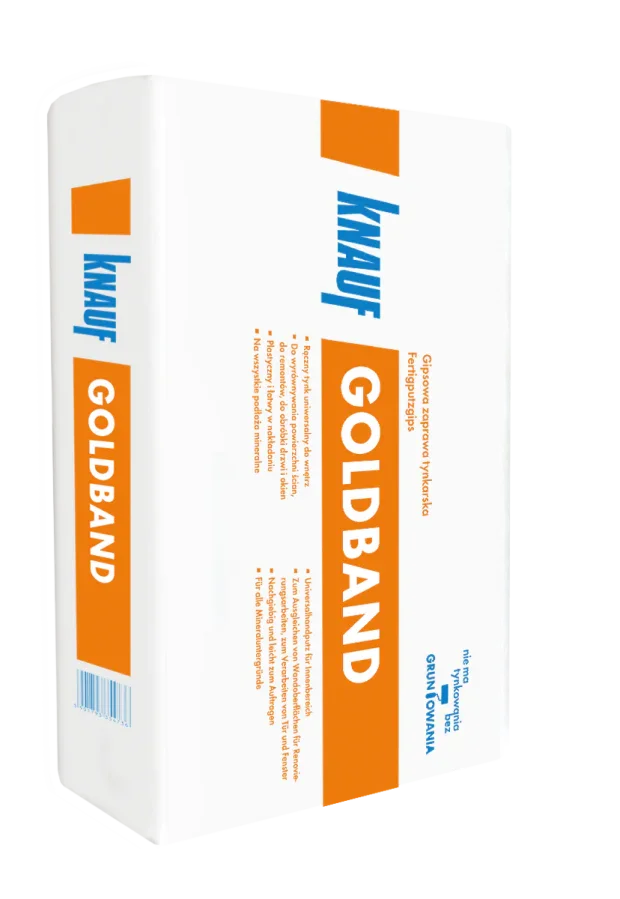
Knauf Goldband is a dry gypsum plaster for one-coat plastering by hand on interior walls and ceilings. Mix the 30 kg bag with about 18 litres of water and lay it from 8 mm up to 50 mm on brick, block or concrete to get a flat, smooth surface ready for paint, wallpaper, tiles or a skim coat. One bag covers about 2.3 m² at the usual 15 mm.
What Knauf Goldband Plaster Is
Knauf Goldband is a factory-made gypsum plaster in powder form, classed B1/20/2 under EN 13279-1. You mix it with clean water on site and apply it by hand in a single coat. Knauf makes it for every kind of mineral background and describes it as light to work, giving smooth surfaces.
It is the plaster coat itself — the layer that straightens a wall. This bag is not to be confused with Knauf Goldband Finish, a different Knauf product: a ready-mixed skim sold in a tub.
Knauf lists these uses:
- smooth, textured or floated finishes on walls and ceilings indoors;
- one-coat plaster on all kinds of background, from cellar to loft;
- rooms up to 70 % air humidity, including kitchens and bathrooms in ordinary use;
- a base for paint, wallpaper, ceramic tiles, finishing plasters and skim coats.
Why Plasterers Choose Goldband
- One coat from 8 to 50 mm. The usual thickness is 15 mm; on walls it can go up to 50 mm where the background is badly out of line.
- Time to work it. Knauf gives about 90 minutes of working time, depending on the background.
- A mineral, breathable wall. Gypsum takes up and gives back moisture and lets water vapour through (vapour resistance factor μ 10), which keeps the indoor climate comfortable.
- Non-combustible. Reaction to fire class A1, and Knauf gives fire-protection equivalents to concrete cover.
- Takes tiles as well as paint. Laid at least 10 mm thick and left rough, it carries ceramic tiles; Knauf's product page puts the limit at 25 kg per m².
- Low emissions. It carries the EMICODE EC1 PLUS rating for very low emissions.
Knauf Goldband Technical Data
| Property | Knauf Goldband |
|---|---|
| Type | Hand-applied gypsum plaster, B1/20/2 to EN 13279-1 |
| Pack | 30 kg paper bag |
| Water | About 18 litres per 30 kg bag |
| Consumption | About 13 kg per m² at 15 mm |
| Coverage per bag | About 2.3 m² at 15 mm; about 3.5 m² at 10 mm |
| Yield | 100 kg of powder makes about 115 litres of plaster |
| Thickness | Usually 15 mm; 8 to 50 mm on walls |
| Concrete ceilings | One coat, up to 15 mm |
| Working time | About 90 minutes |
| Drying | About 14 days for 10 mm with good ventilation |
| Compressive strength | 2.0 N/mm² or more |
| Flexural strength | 1.0 N/mm² or more |
| Adhesion | 0.1 N/mm² or more |
| Thermal conductivity | 0.34 W/mK |
| Vapour resistance factor μ | 10 |
| Reaction to fire | A1 |
| pH | 10–12 |
| Storage | Dry, on timber pallets, up to 6 months |
Preparing the Background
Clean off dust and loose particles and knock off large lumps. Concrete should be no wetter than 3 % residual moisture and never wet on the face. Then treat the background by type:
- Smooth or untreated concrete: remove release agent and efflorescence, then apply a bonding primer.
- Brick and block with high or uneven suction: prime to even out the suction.
- Old gypsum or gypsum-lime plaster: remove efflorescence and old coatings, then apply a deep-penetrating primer.
Where brick meets concrete, or two other backgrounds meet, bed glass-fibre mesh into the plaster at two thirds of its depth, lapped 100 mm and running at least 100 mm onto each side, for a total thickness of at least 15 mm.
Primers for each background are in primers.
How to Apply Goldband by Hand
- Mix. Add one 30 kg bag to about 18 litres of clean water and mix to a workable mortar. Add nothing else.
- Lay on and rule off. Apply the plaster and spread it with an H-section straightedge, vertically and horizontally, to the line of the wall.
- Level as it sets. When setting starts, level with a trapezoid straightedge and form the internal corners. Feather out small hollows with a wide blade.
- Raise the cream. Dampen the surface and work it with a sponge float to bring up a gypsum cream.
- Smooth. Once lightly set, polish the face with a smoothing blade or trowel.
- Movement joints. Carry the building's movement joints through the plaster with a trowel cut or a profile.
Cover pipes and cables with at least 5 mm of plaster. Above 35 mm, lay two coats: comb the first, let it dry fully and prime it before the second. Do not plaster below +5 °C, and keep fresh plaster from frost. Blades and floats are in skimming blades and spatulas.
Decorating, Skimming and Tiling Over It
Let Knauf Goldband dry — a 10 mm coat takes about 14 days with good ventilation, longer in cold or damp rooms. Then:
- Paint: the dry, sound, dust-free plaster takes all paints except alkaline paints, after a primer chosen for the paint.
- Wallpaper: give the wall a coat of wallpaper paste first.
- A smooth, paint-ready face: Knauf's sheet puts a skim coat on top. Atlas GO! 25 kg bucket rolls on as a full-surface skim, and Atlas GTA 18 kg tub fills, levels and skims — both list gypsum plaster as a background.
For tiles, plaster in one coat at least 10 mm thick and leave it rough. Wait until the residual moisture is 1 % or less, apply a deep-penetrating primer and fix the tiles with a cement-based or dispersion tile adhesive.
For plasterboard walls, boards and fixings are in drylining.
Ordering, Delivery and Collection
- Dispatch: the same day when the bags are in stock.
- Delivery: after the order, the team contacts you with the most cost-effective way to send it; pallets go next day or in two working days on the economy option. Every delivery is kerbside.
- Collection: from the Renders World counter at Unit 9A, Central Trading Estate, Southampton SO14 5JP — Monday to Friday 7am to 5pm, Saturday 7am to 12pm.
Renders World sells Knauf Goldband in 30 kg paper bags, and goods in paper bags are outside the 14-day change-of-mind return — so work out the number of bags the job needs before you order; the rules are on the cancellations and returns page. Renders World can also deliver the finishing skim in the same order. Keep the bags dry, off the floor on timber pallets, and use them within 6 months; close an opened bag tightly and use it first. Other plasters and fillers are in top coat plasters and fillers.
Knauf Goldband: Questions Before You Buy
How many bags of Goldband do I need?
At 15 mm, allow about 13 kg per m², so one 30 kg bag covers about 2.3 m². A 10 m² wall at 15 mm needs about 130 kg — five bags. At 10 mm, one bag covers about 3.5 m².
Is this the same as Knauf Goldband Finish?
No. Knauf Goldband Finish is a separate Knauf product, a ready-mixed skim in a tub. This is Goldband plaster, a dry powder in a bag that you mix with water and lay 8–50 mm thick.
Can I use Goldband in a bathroom or kitchen?
Yes, in kitchens and bathrooms in ordinary domestic use, as long as the room stays at or below 70 % air humidity. In a shower or splash zone, tile over it with a liquid waterproofing membrane and a highly flexible tile adhesive.
Can I plaster a ceiling with it?
Yes. On concrete ceilings, lay one coat no thicker than 15 mm.
Can I paint Goldband without skimming it?
Knauf lists it as a base for all paints except alkaline paints, once it is dry and primed. For a smooth, paint-ready face, Knauf's sheet adds a skim coat on top — Atlas GO! is the one built for the roller.
How much water goes into one bag?
About 18 litres of clean water per 30 kg bag, with no additives.