


Description
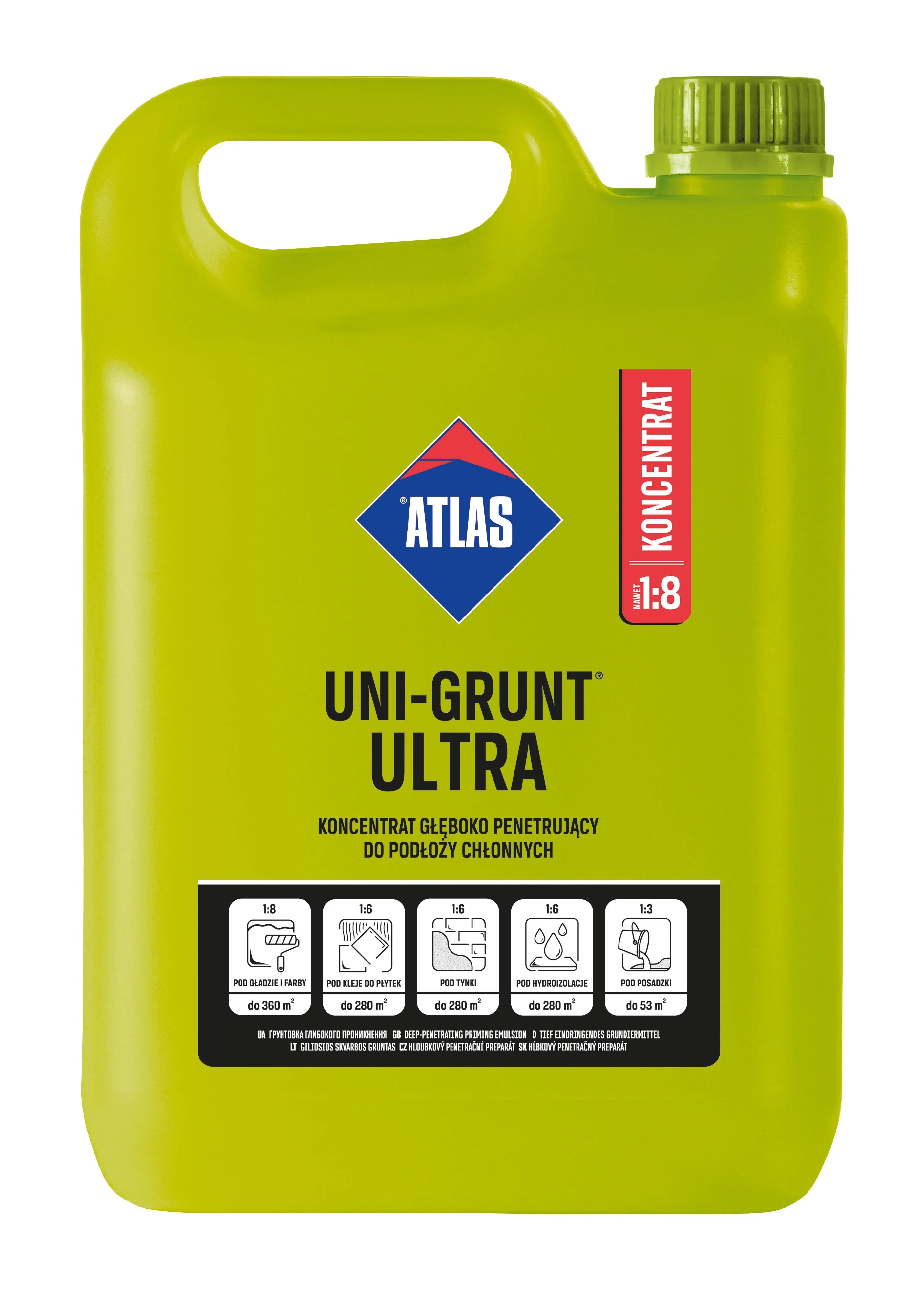
Atlas Uni-Grunt Ultra is a deep-penetrating primer concentrate in a 4 kg tub. You mix it with water on site — it is never used neat — so one tub makes a lot of primer: enough for up to 280 m² of plaster or masonry, or 360 m² of wall ready for paint. It soaks into absorbent walls, floors and ceilings, binds loose grains and evens out suction, inside and outside. Atlas Uni-Grunt Ultra sits in the Renders World render primer range.
Which Walls and Floors Atlas Uni-Grunt Ultra Suits
The concentrate is made for absorbent surfaces, on walls and floors, indoors and out. Atlas lists standard and difficult substrates it can handle, and sends some surfaces to a different primer:
| Surface | Atlas Uni-Grunt Ultra? |
|---|---|
| Cement and anhydrite screeds | Yes, a standard substrate |
| Cement, lime and gypsum plaster or skim | Yes, a standard substrate |
| Brick, block and aerated concrete | Yes, a standard substrate |
| Gypsum blocks, polymer top coats | Yes, a standard substrate |
| Concrete, heated screeds | Yes, a difficult substrate |
| Old interior acrylic paint | Yes, a difficult substrate |
| Renovated filler and paint | Yes, a difficult substrate |
| Old tiles, terrazzo, OSB | No — use Ultragrunt |
| Linoleum, PVC, varnish, oil paint | No — use Ultragrunt |
Those last surfaces do not soak anything up, so a penetrating primer has nothing to work with. Atlas names Atlas Ultragrunt for those surfaces — except where the next layer is paint, because Ultragrunt leaves a rough surface.
Not sure what your wall is made of or how it behaves? The substrate matrix for brick, block and painted walls goes through each type, and the wall preparation method guide covers the checks that come before any primer.
Why Choose This Concentrate
- A lot of primer from one tub — 4 kg of concentrate makes about 28 kg of primer at 1:6, enough for 280 m² of plaster.
- Three strengths from one product — 1:3 for floors, 1:6 under adhesives, waterproofing, plasters and skims, 1:8 under paint and wallpaper.
- You can see where you have been — a special pigment colours the surface while wet and when dry, so missed patches show. It does not reduce the covering power of the paint on top.
- Stronger, evener surface — the emulsion soaks in, binds loose grains and evens out suction, so the next layer bonds better.
- Low emissions — VOC below 1.9 g/l, against a limit of 30 g/l, and the product holds a Hygienic Attest.
- Keeps between jobs — 18 months from the production date on the tub.
Technical Data and Mixing Ratios
| Property | Value |
|---|---|
| Type | Deep-penetrating primer concentrate |
| Pack | 4 kg plastic tub |
| Density | Approx. 1.0 g/cm³ |
| Working temperature | +5 °C to +30 °C, air and substrate |
| Application | Roller, brush or spray, in a thin, even coat |
| Next layer on walls | After 15 minutes |
| Next layer on floors | After 2 hours |
| VOC content | Below 1.9 g/l (limit 30 g/l, Cat. A/h/FW) |
| Shelf life | 18 months from production |
Dilution and Coverage
| Mix (concentrate : water) | Use it under | Concentrate per m² | One 4 kg tub primes |
|---|---|---|---|
| 1 : 3 | Self-levelling floors and screeds | Approx. 0.075 kg | 53 m² |
| 1 : 6 | Plaster, skim, tiles, insulation | Approx. 0.014 kg | 280 m² |
| 1 : 8 | Paint and wallpaper | Approx. 0.011 kg | 360 m² |
Measured as mixed primer, you use about 0.3 kg per m² on screeds and about 0.1 kg per m² at 1:6 and 1:8.
How to Apply the Concentrate
- Prepare the surface. It must be dry and free of dust, dirt, oil, grease and wax. Remove any loose, poorly bonded layer. On gypsum plaster and anhydrite screed, clear away the dust left by sanding.
- Protect what is nearby. Cover glass, woodwork and flashings — the pigment is made to colour surfaces.
- Mix with water only. Pick the ratio from the next layer: 1:3, 1:6 or 1:8. Do not mix it with any other material and do not thicken it.
- Apply thin and even. Use a roller, brush or sprayer. The colour shows which areas are done.
- Prime weak or very absorbent walls again, the second coat going on while the first is still wet.
- On floors, pour and spread. Spread the mix evenly and do not leave puddles.
- Check it once dry. The surface should look matt. Wet it with water and watch how fast it soaks in — if it still drinks fast, prime again.
Wash tools with clean water straight after use. Dried primer marks come off with Resin Away Szop 2000, the cleaner Atlas names for it.
How Much Atlas Uni-Grunt Ultra to Order
Start from the layer that goes on next, not just from the wall area. With a density of about 1.0, one 4 kg tub makes roughly 16 kg of primer at 1:3, 28 kg at 1:6 and 36 kg at 1:8.
- Plaster or masonry before skim, tiles or render, at 1:6 — up to 280 m² per tub; a 150 m² house elevation needs one.
- Floor before self-levelling compound, at 1:3 — 53 m² per tub; a 100 m² floor needs two.
- Wall before paint or wallpaper, at 1:8 — up to 360 m² per tub.
- Weak, very absorbent walls — allow for a second coat, so about half the area per tub.
Orders are processed the same day when the stock is there, and the Renders World team quotes delivery after the order. You can also collect in person from the Renders World counter in Southampton during opening hours.
Where It Sits in the Build-Up
Atlas Uni-Grunt Ultra goes on the bare wall or floor at the very start. What follows decides the mix:
- Before bonding insulation boards — at 1:6, the ratio Atlas gives for fixing thermal insulation.
- Before plastering or a skim coat — at 1:6; carry on after about 15 minutes on plaster and block walls.
- Before tiles or waterproofing — at 1:6.
Under paint or wallpaper, mix it at 1:8 — for example on a masonry wall before a silicone paint for masonry.
It is not the textured key coat that goes on a cured base coat just before a thin coat silicone render — that is a separate stage, set out in the quartz primer application guide. Work only between +5 °C and +30 °C; for planning around the UK seasons, see render application temperatures through the UK year.
Which Atlas Primer to Choose
Atlas makes several primers with similar names. They are different products, not pack sizes of one product:
| Primer | Choose it when |
|---|---|
| Uni-Grunt Ultra concentrate | Large absorbent areas, mixed with water |
| Atlas Uni-Grunt | Classic emulsion, 10 kg |
| Atlas Uni-Grunt 5 kg | Classic emulsion, smaller job |
| Ultragrunt | Smooth surfaces that do not absorb |
For a wider look at primers in render work, see the primer comparison for thin-coat systems.
Is This the Right Primer for Your Job?
- Yes — for large absorbent walls and floors: whole houses, several elevations, floor preparation.
- Yes — before insulation boards, tiles, plaster or skim on block, brick or concrete.
- Yes — before paint or wallpaper on plaster and masonry, at 1:8.
- No — on tiles, terrazzo, OSB, varnish or oil paint: use Ultragrunt.
FAQ — Mixing, Coverage and Use
Do I mix it with water?
Yes, always. Atlas Uni-Grunt Ultra is a concentrate and is never applied neat. Mix 1 part concentrate with 3, 6 or 8 parts water, depending on what goes on next, and do not add anything else.
Does a second coat change how much I need?
Yes. Weak, very absorbent walls take a second coat, wet on wet, which roughly halves the area one tub covers. The render coverage calculator helps with the rest of the material list.
Can I use it before bonding insulation boards?
Yes, at 1:6 — Atlas lists fixing thermal insulation under that ratio, with 280 m² per tub.
What temperature does it need, and when can I carry on?
Use Atlas Uni-Grunt Ultra between +5 °C and +30 °C, in the air and on the surface. Carry on after about 15 minutes on plaster and block walls, and after about 2 hours on self-levelling floors.
Is Uni-Grunt Ultra the same as Ultragrunt?
No. Uni-Grunt Ultra soaks into absorbent surfaces. Ultragrunt is a ready-to-use mass with quartz that builds grip on smooth, non-absorbent surfaces such as tiles, terrazzo and OSB.
Is it low in emissions?
Yes. Its VOC content is below 1.9 g/l, against a permitted 30 g/l, and it holds a Hygienic Attest.
Technical Documentation