
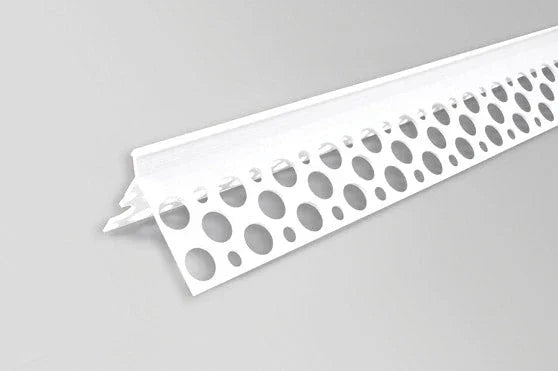
Description
A flush corner across a heavy traditional render — where the dubbing-out coat takes the wall back to plumb and the build-up reaches 15 mm or more in total — starts with a corner bead sized to the finished depth. The 15 mm PVC Render Corner Bead No Mesh 2.5 m is the deepest no-mesh PVC profile in the range, designed for thick render systems where total finished depth reaches 14–17 mm and the 10 mm nose would stand proud of the topcoat. It is supplied as part of the render corner beads range at Renders World.
Where the 15 mm No-Mesh Corner Bead Performs Best on UK Heavy-Build Renders
The 15 mm PVC corner bead no mesh is a rigid uPVC L-profile with a 15 mm nose, 4 mm visible arris, and 40 mm perforated arms, sized for UK thick-coat render systems running at 14–17 mm total finished depth — heavy sand-and-cement, multi-coat traditional renders, monocouche at the upper end of its application range, and re-rendering scenarios where a new coat over a retained existing coat accumulates to 15 mm or more at the corner. The nose sets the minimum render depth at the corner: at 14–17 mm total finished thickness the arris sits flush with or just below the topcoat surface, giving a clean integrated edge rather than a proud trim line.
This profile answers two recurring site problems the 10 mm bead cannot resolve cleanly. The first is significant wall irregularity — when substrate plumb deviation requires a dubbing-out coat before the scratch coat, total render depth climbs past 15 mm and only a bead sized for that depth finishes flush. The second is re-rendering — when an existing render coat of 5–8 mm is retained as a key, the new coat over the top regularly reaches 15 mm or more at the corners. In both situations the 15 mm profile is the straight-through specification, removing the additional dubbing-out operation that a shallower bead would force on the corner detail.
Why UK Installers Choose the 15 mm No-Mesh Profile for Thick Coats
- 15 mm nose for heavy render depth: sized for total finished thickness of 14–17 mm — covering thick sand-and-cement, multi-coat traditional systems, heavy monocouche, and re-rendering scenarios where accumulated depth exceeds the 10 mm profile's range.
- Single-step corner geometry on dubbed-out walls: accommodates the full dubbing-out plus scratch-and-finish build-up without requiring a secondary operation to bring the corner depth back to a shallower bead's range — one bead, one fixing pass, finished flush.
- Re-render specification without extra dubbing: when a new coat over a retained existing render reaches 14 mm or more at the arris, the 15 mm profile takes the depth straight through rather than forcing a localised dub-down at every corner.
- 40 mm perforated arms for mechanical lock: render keys positively through the perforations along the full arm length, holding the bead in a heavy build-up under the weight and shrinkage stresses that a thinner profile would resist less reliably.
- Rigid uPVC body resistant to creep under thick coats: the profile holds its set geometry from fixing through to the cured finish without bowing, deflecting, or creeping mid-span — relevant on heavy-coat applications where bead weight-bearing is meaningful.
- Discreet 4 mm visible arris: the narrow exposed nose reads as a shadow line at the corner rather than a structural fitting, even at the deepest no-mesh nose depth in the range.
- BS EN 13914-1&2:2016 class: meets the current British Standard for external rendering, with BS 476 fire testing at Class 1Y — subject to confirmation against the specific system specification in use.
Technical Specifications — 15 mm PVC Corner Bead Data
| Property | Value |
|---|---|
| Length | 2,500 mm |
| Nose depth | 15 mm |
| Visible arris | 4 mm |
| Arm width | 40 mm (per arm) |
| Internal angle | 90° |
| Suitable render depth | 14–17 mm total finished depth |
| Material | Exterior-grade rigid uPVC · alkali-resistant · lead-free · UV-stabilised |
| Mesh | None — perforated arms for mechanical render keying |
| Weight | 19.1 kg per 100 m |
| Colour | White |
| Fire classification | Class 1Y — self-extinguishing on removal of flame (BS 476, subject to system confirmation) |
| Standard reference | BS EN 13914-1&2:2016 (subject to system confirmation) |
| Application temperature | +5 °C to +30 °C (air and substrate) |
| Storage | Dry, supported along full length, out of direct sunlight |
| Pack size | Single 2.5 m length (trade packs also available) |
Specification data is drawn from industry technical references for 15 mm uPVC corner bead profiles in this class. Confirm against the current manufacturer's datasheet for warranty-critical or specification-governed applications.
How to Apply the 15 mm Corner Bead — Dubbed-Out Walls and Heavy Build-Ups
Dub out any significant wall irregularities and allow that coat to set firm before fixing the bead — bedding into soft green dub allows the nose to shift as the substrate moves, locking in depth variation that cannot be corrected once the scratch coat follows. The discipline is straightforward: dub first, check plumb, let the dub firm up until it resists thumb pressure without yielding, then fix the bead into a set surface with a fresh render bed. Apply a continuous bed of adhesive mortar or render down each arm face, press the PVC arris square to the corner so render squeezes through every perforation along both arms, and check verticality with a long spirit level at one-metre intervals.
On heavy build-ups applied in multiple passes, fix the bead before the scratch coat rather than after, so the nose depth is set at the correct finished level from the start of the build-up. Trim ends with bead-cutting scissors or a fine-tooth saw, butt cut ends tightly at joints, and render continuously across the join so the finish reads as a single uninterrupted line. Where additional security is needed on exposed or high-load corners, pin through the perforations with stainless or galvanised lost-head nails — two per metre per arm — with the render bed always applied first. For the full corner installation sequence across system types and bead profiles, see the corner bead installation step-by-step guide.
Installation Notes — Thick-Coat Cure Discipline and Re-Render Sequencing
Work within the +5 °C to +30 °C window for both air and substrate, and bed the bead into the same render mix that will form the surrounding scratch coat so the bedding and the coat cure as a single mass. On thick build-ups the cure is slower and the early shrinkage is greater than on a thin coat — any disconnect between the bedding mortar around the bead and the scratch coat applied a day later produces a hairline ring around the perforated arms that telegraphs through the finish at first thermal cycling. Same-mix, same-session bedding-and-scratch is the discipline that keeps the corner zone moving as one piece through the initial cure.
On re-rendering scenarios, confirm the existing coat is clean, stable, and well-keyed before fixing the bead and applying the new render over it. A soft, friable, or chalky existing coat is not a substrate the 15 mm profile can save — that situation requires the existing render to be hacked back to the masonry and the corner rebuilt from the substrate up. Where the corner work also requires field reinforcement — typically only on the transition zones between traditional render and adjacent EWI elevations — pair with Ceresit CT325 fibreglass field mesh across the transition. The render detailing around windows and doors guide covers profile selection at each termination type across the full elevation.
Pro Tips From UK Installers on Heavy-Build Render Corners
The re-rendering scenario deserves particular attention at the corner-bead selection stage. Many contractors reach for a 10 mm bead by habit and then dub out the corners to bring the depth down to match — which adds a step and a drying wait that a 15 mm bead would have avoided entirely. When the existing coat is sound and is being retained as a key, measure the depth at the corners before ordering: if the new coat over the existing surface will reach 14 mm or more at the arris, the 15 mm profile is the straight-through specification without any additional dubbing operation at the corner detail.
- Measure before you order: on re-render and dubbed-wall projects, hold a straight edge against the corner and measure to plumb at three heights per storey — the deepest reading sets the bead specification, not the average.
- Dub first, fix second: the dub coat must be firm enough to resist thumb pressure before the bead goes on — anything softer locks substrate movement into the arris line permanently.
- Bed in the same mix as the scratch coat: same-session bedding-and-scratch keeps the corner zone moving as one piece through cure; mixed batches a day apart shrink at different rates and telegraph as a hairline.
- Allow 5–10% for cuts on heavy builds: one 2.5 m length per external corner per storey plus 10% on jobs where multiple short returns or stepped reveals are present — the heavier profile produces slightly more wastage at angled cuts.
- Store flat or fully supported: at 19.1 kg per 100 m this is the heaviest no-mesh PVC profile in the range, and lengths left unsupported on edge for any length of time will take a permanent sag.
Is the 15 mm No-Mesh Corner Bead Right for Your Project?
- Thick traditional renders at 14–17 mm total depth (multi-coat sand-and-cement, heavy monocouche, systems with dubbing-out coats): the primary use case — the 15 mm nose finishes flush across the full depth range where the 6 mm and 10 mm profiles would stand proud.
- Re-rendering over an existing sound coat where accumulated render depth reaches 14 mm or more: the correct specification to avoid an additional dubbing-out operation at the corners, provided the existing coat is clean, stable, and adequately keyed.
- Lighter traditional builds at 10–12 mm total depth: the 10 mm PVC corner bead no mesh is the closer match — a 15 mm nose at 10 mm render depth is buried rather than flush and harder to line through accurately.
- Shallow renders at 6–8 mm or lime finishes: use the 6 mm PVC corner bead no mesh — the slimmest profile in the no-mesh range, sized for heritage and shallow traditional systems.
- Thin-coat silicone or acrylic EWI systems with reinforced basecoat: the corner PVC render bead with mesh is the correct specification — fibreglass wings integrate the corner into the field reinforcement layer rather than relying solely on the perforated-arm key.
- High-impact ground-floor corners on commercial or institutional elevations: the 3 m aluminium corner bead provides substantially greater dent resistance regardless of render depth, and the 3 m length covers full storey height in one piece.
Stocked for next-working-day despatch in trade quantities. Calculate one 2.5 m bead per external corner per storey plus 5–10% for cuts and joints — and measure the expected finished render depth at the corners before ordering to confirm the 15 mm nose is the correct selection for the depth the system will actually achieve.
FAQ — 15 mm Corner Bead Coverage, Compatibility, Ordering
What render thickness does the 15 mm nose suit?
The 15 mm nose is designed for a total finished render depth of 14–17 mm. At 14 mm the arris sits just below flush; at 15–17 mm it reads as a clean integrated edge. Below 14 mm the nose begins to stand proud of the surface — for those depths, the 10 mm or 6 mm no-mesh profiles are the closer specification depending on the actual system thickness.
Is this bead suitable for re-rendering over an existing coat?
For re-rendering scenarios where the new coat over an existing sound render brings total depth to 14–17 mm at the corners, this is the most direct specification — it avoids an additional dubbing-out operation at the arris and allows the new coat to be applied in one continuous pass to the correct finished depth. Confirm the existing coat is clean, stable, and well-keyed before applying the new render over it.
Should I fix the bead before or after dubbing out?
Fix the bead after the dubbing-out coat has set firm. Bedding into soft dub allows the nose to shift as the green mortar moves, locking in depth variation that cannot be corrected once the scratch coat follows. Allow the dub to set until it resists thumb pressure without yielding before applying the render bed and fixing the bead.
How many 15 mm beads do I need per corner?
One 2.5 m length per external corner per storey is the standard take-off, plus 5–10% for cuts and joints on regular elevations. On heavy-build projects with multiple stepped reveals, dubbed-out returns, or feature corners, allow closer to 10–12% wastage because the heavier profile produces slightly more offcuts at angled cuts and joint trims.
Do I need separate reinforcement mesh alongside a no-mesh bead at this depth?
For traditional thick-coat renders the perforated arms provide the mechanical key and a separate corner mesh layer is not normally specified. If the system uses a reinforced basecoat — as in thin-coat EWI — the corner bead should be a mesh-wing profile that embeds directly into the field reinforcement, not this no-mesh profile, regardless of render depth.
Is this profile suitable for plinth corners or horizontal sill returns?
Standard corner profiles at any nose depth — including this one — do not provide water drainage and can trap moisture at horizontal edges. Bellcast and drip-bead profiles are the correct selection for plinths and sill returns, and the render detailing guide covers the right profile for each termination location across the full elevation.

