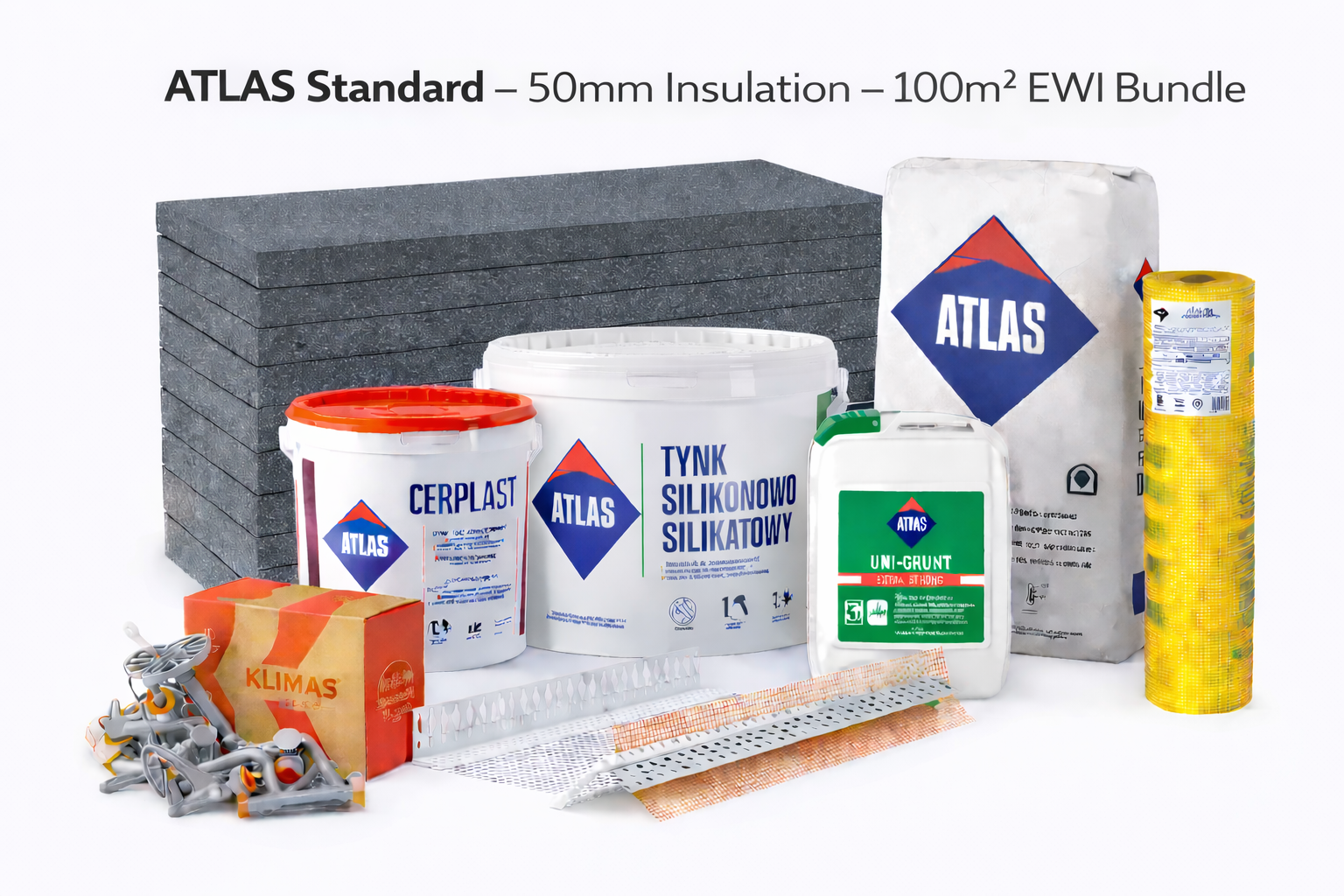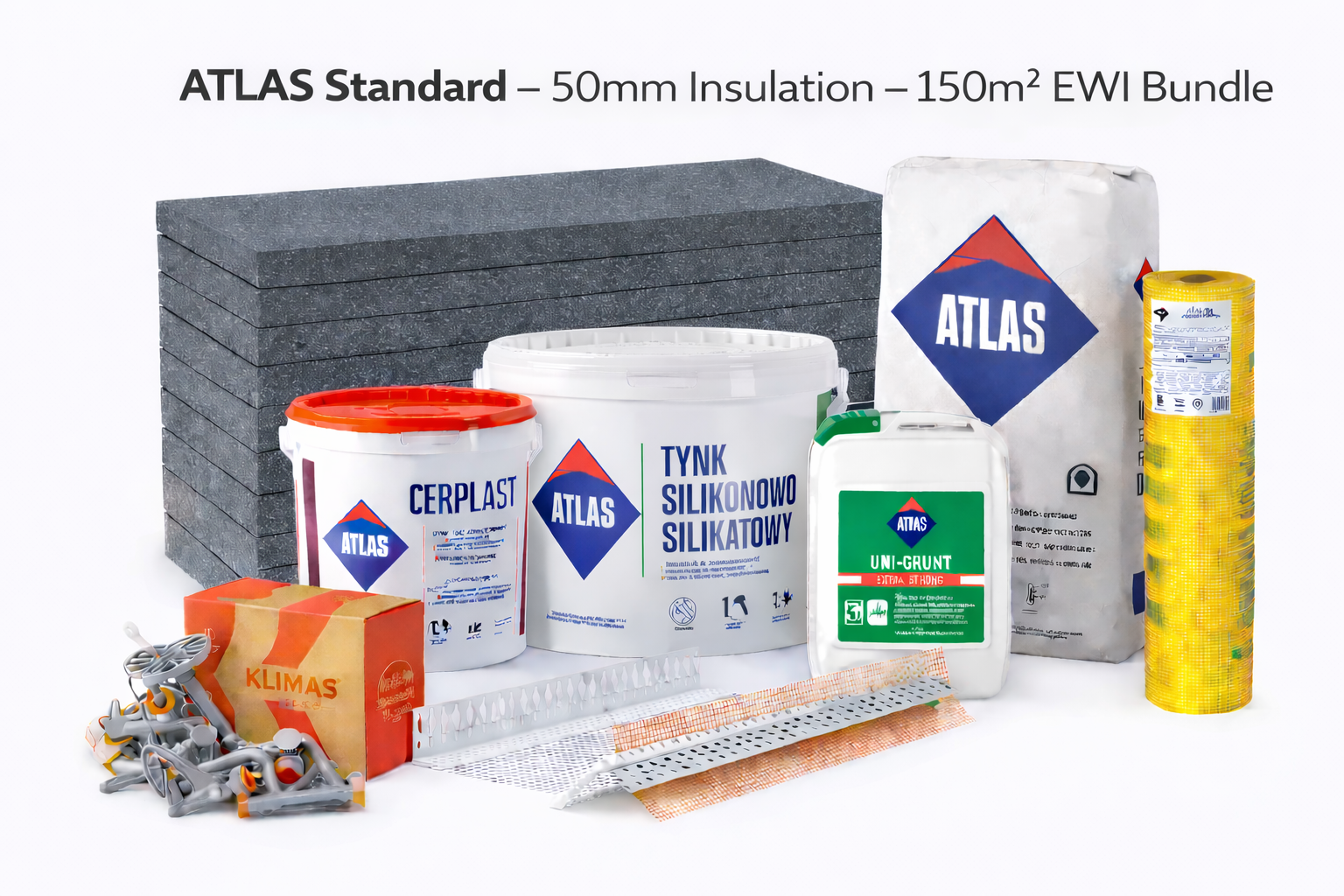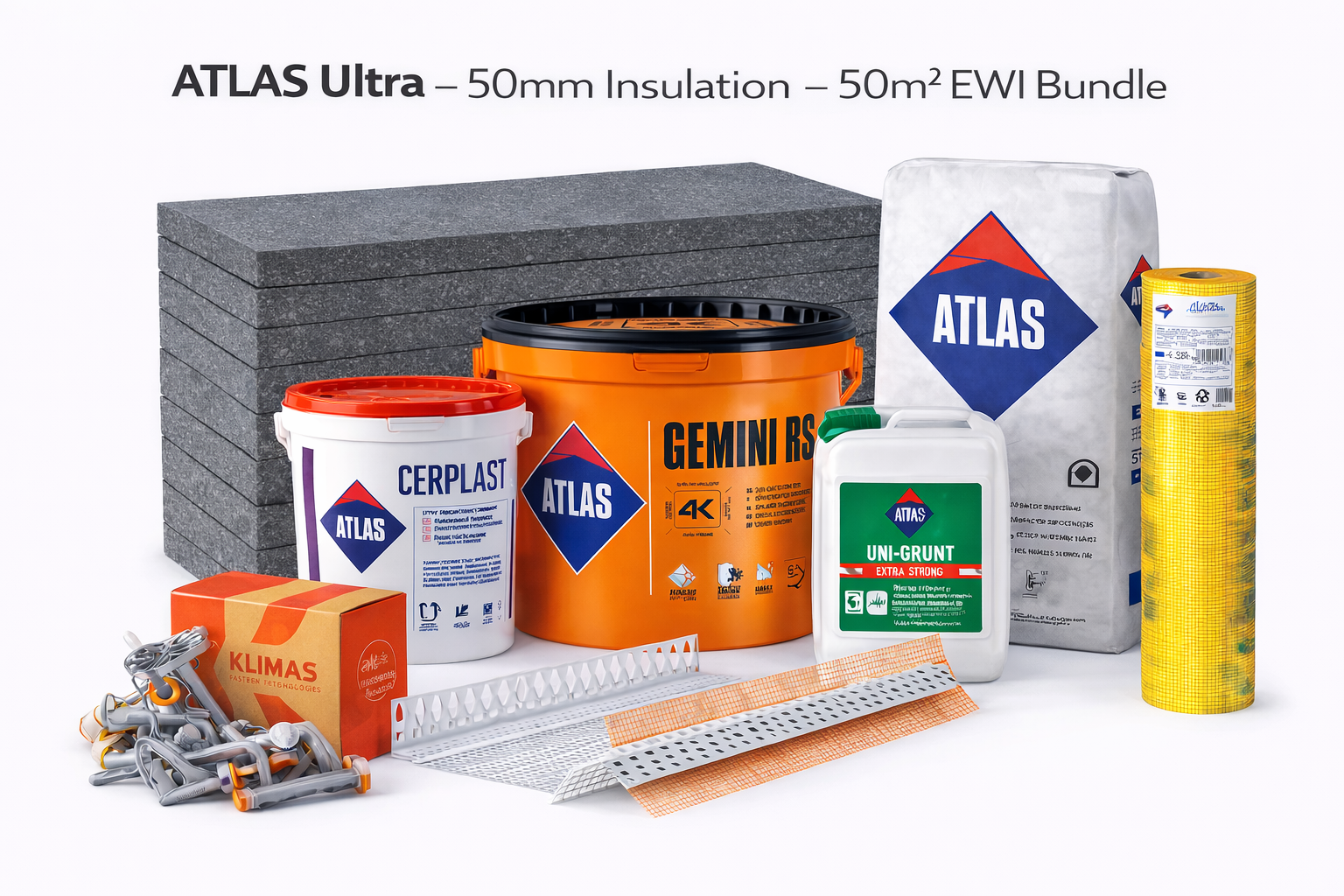
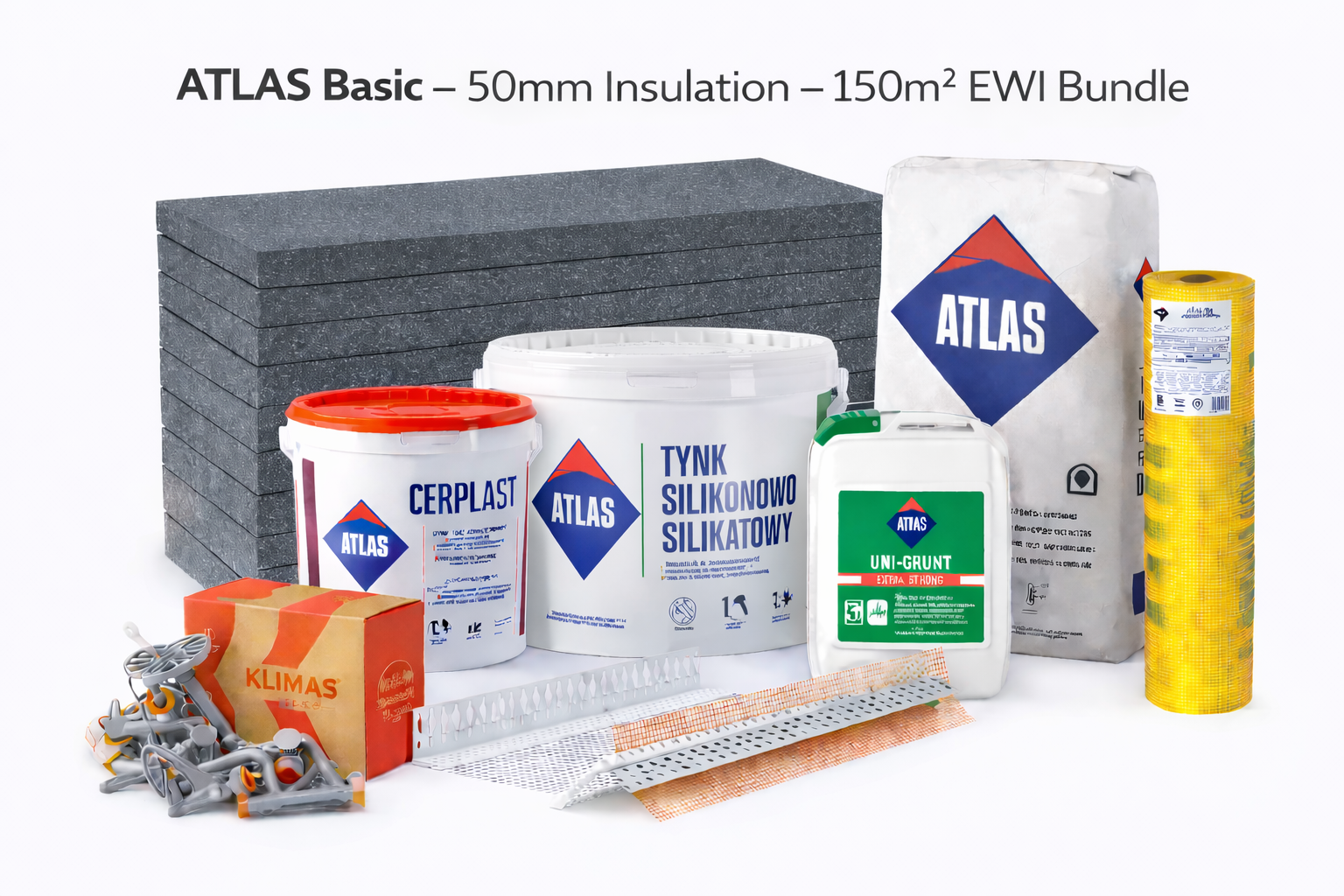
Complete EWI System Bundle
7 products
Showing 1 - 7 of 7 products
Every tier is sized by wall area and carries the materials from base track to topcoat in one order, so a specifier can plan an elevation from drawings, before the scaffold contract is signed, and order the package that matches the measured area.
How to Specify a Bundle by Wall Area
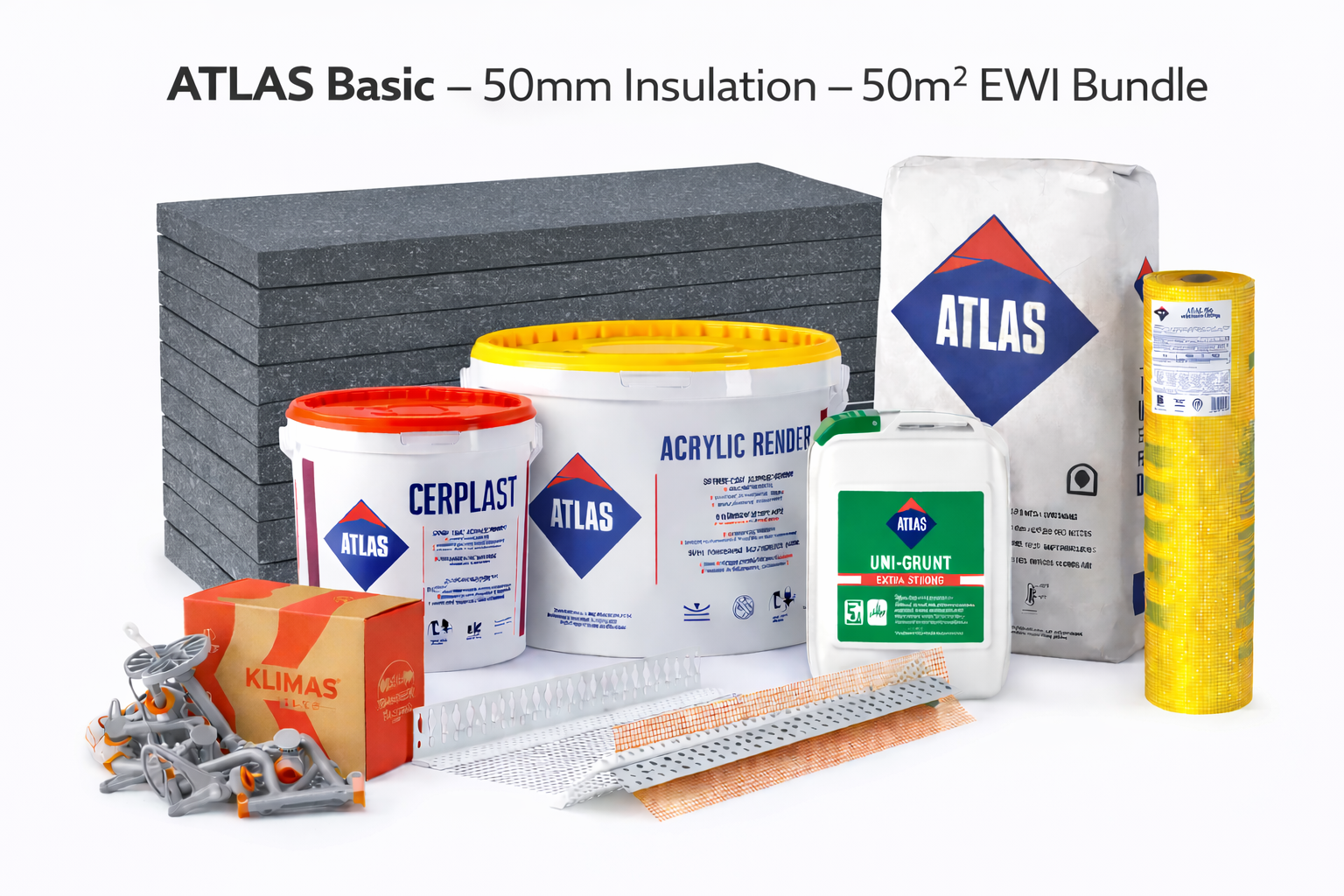
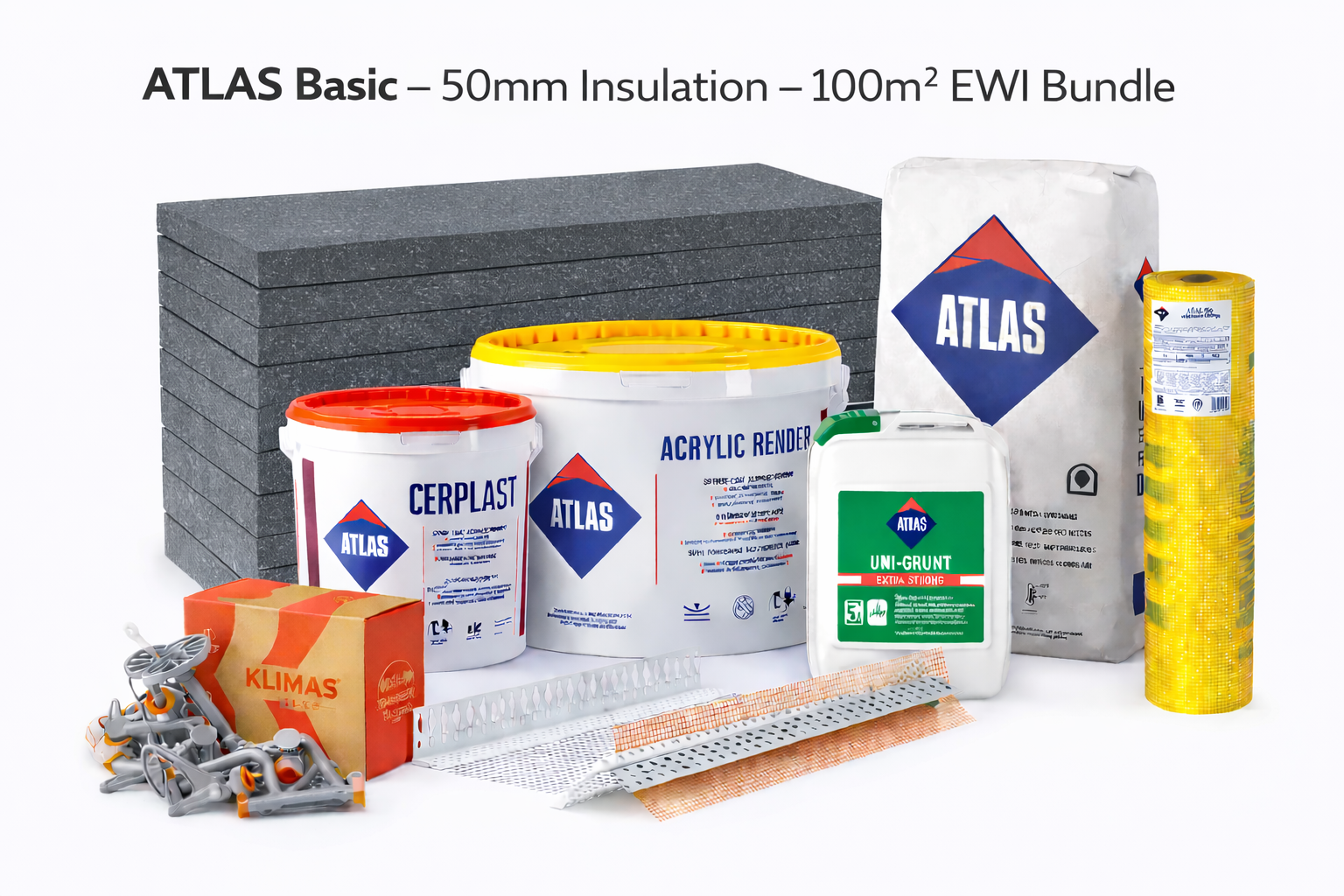
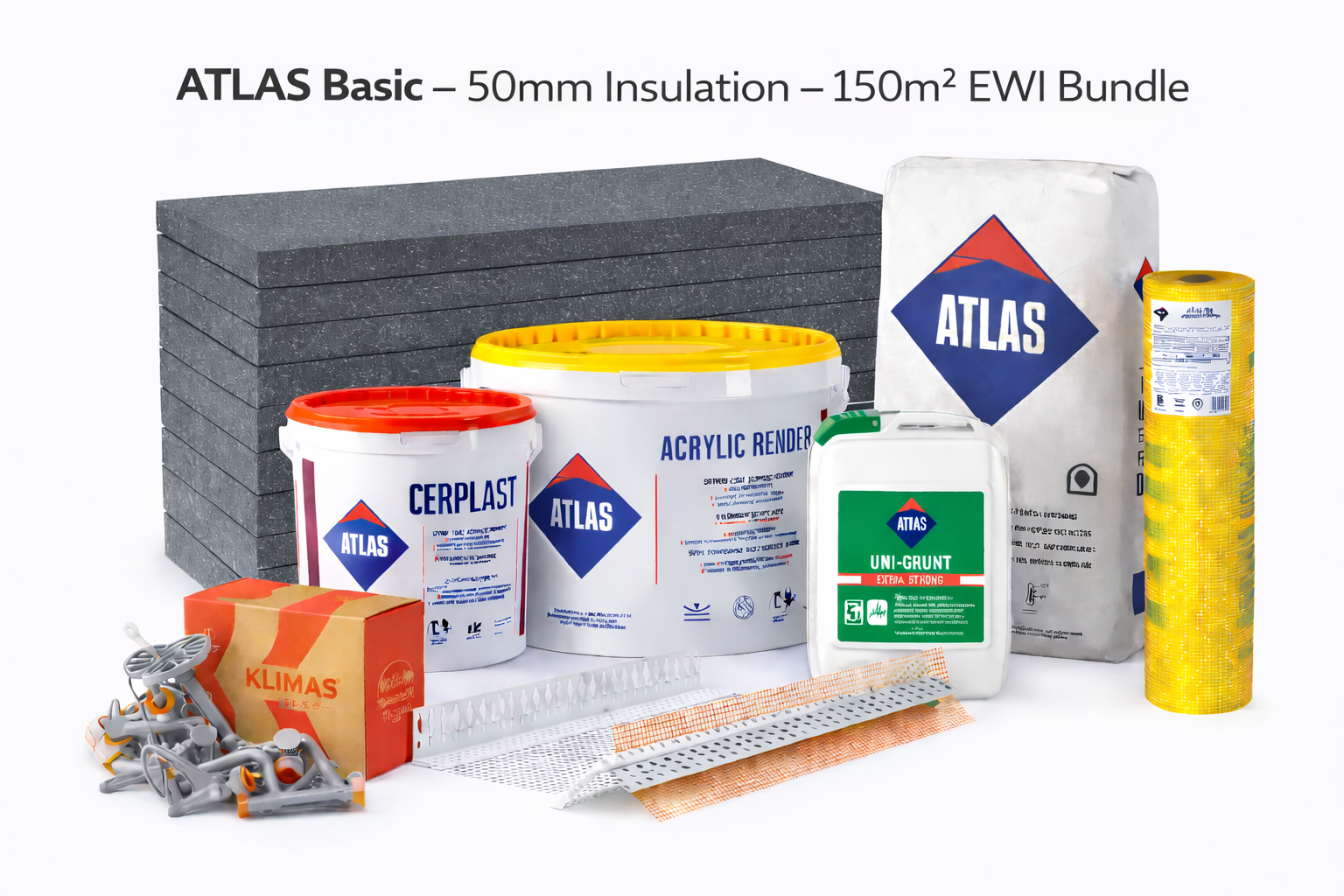
Specifying a complete EWI system bundle starts with wall area: the 50 m² Atlas Basic package carries 100 graphite EPS boards at 50 mm, twenty 25 kg adhesive bags and one mesh roll, enough for a small semi.
Renders World prices each tier against the area you declare, so the take-off runs forwards from drawings rather than backwards from a pallet count. These packages sit inside the wider external wall insulation programme, where each layer is also stocked on its own.
- Insulation — 100 graphite EPS boards at 50 mm, declared thermal conductivity 0,032 W/mK and a declared thermal resistance of 1,55 m²K/W at that thickness, so a thinner build-up reaches a given U-value than a white board would.
- Adhesive and basecoat — twenty 25 kg bags of Atlas Hoter U grey, one material doing both jobs.
- Reinforcement — one Atlas 150 g/m² roll, 50 m long by 1,0 m wide.
- Fixings — two packs of 200 LTX 110 mm plugs, plus 400 grey caps.
- Profiles — six 53 mm base track lengths and ten mesh-winged corner beads.
- Primer and finish — one 15 kg Cerplast quartz key coat, one 5 kg Uni-Grunt and five 25 kg pails of Atlas Acrylic Render.
Reading that list against the wall area is where a specification either holds or needs a top-up, which the quantity checks further down set out line by line. The layer sequence itself belongs to the EWI build-up guide, which takes each stage with its cure window.
Why Specifiers Choose a Bundled Package
- One quantity per elevation. Each bundle is fixed against a declared area, so a materials list can be built without a separate take-off.
- Certificate-named fixings. The LTX Φ8 anchor family supplied here is one of the anchors listed by name in BBA Agrément Certificate 13/5018 for the Atlas/Aval EPS system, which shortens the conversation with a warranty provider.
- A basecoat and adhesive in one bag. Atlas Hoter U grey bonds boards and takes the mesh, so one product covers two stages and one storage footprint.
- Compatible profiles already counted. Corner beads arrive with integral mesh wings, so those corners need no separate roll cut into strips.
- Three tiers on one backbone. Boards, adhesive, mesh and fixings stay the same across tiers, so a change of mind about the finish does not restructure the wall.
Tier Selection Guide — Basic, Standard and ULTRA
| Your Project | Best System | Standout Spec |
|---|---|---|
| Budget retrofit, rental and portfolio stock | Basic, finished in Atlas Acrylic Render | Entry tier |
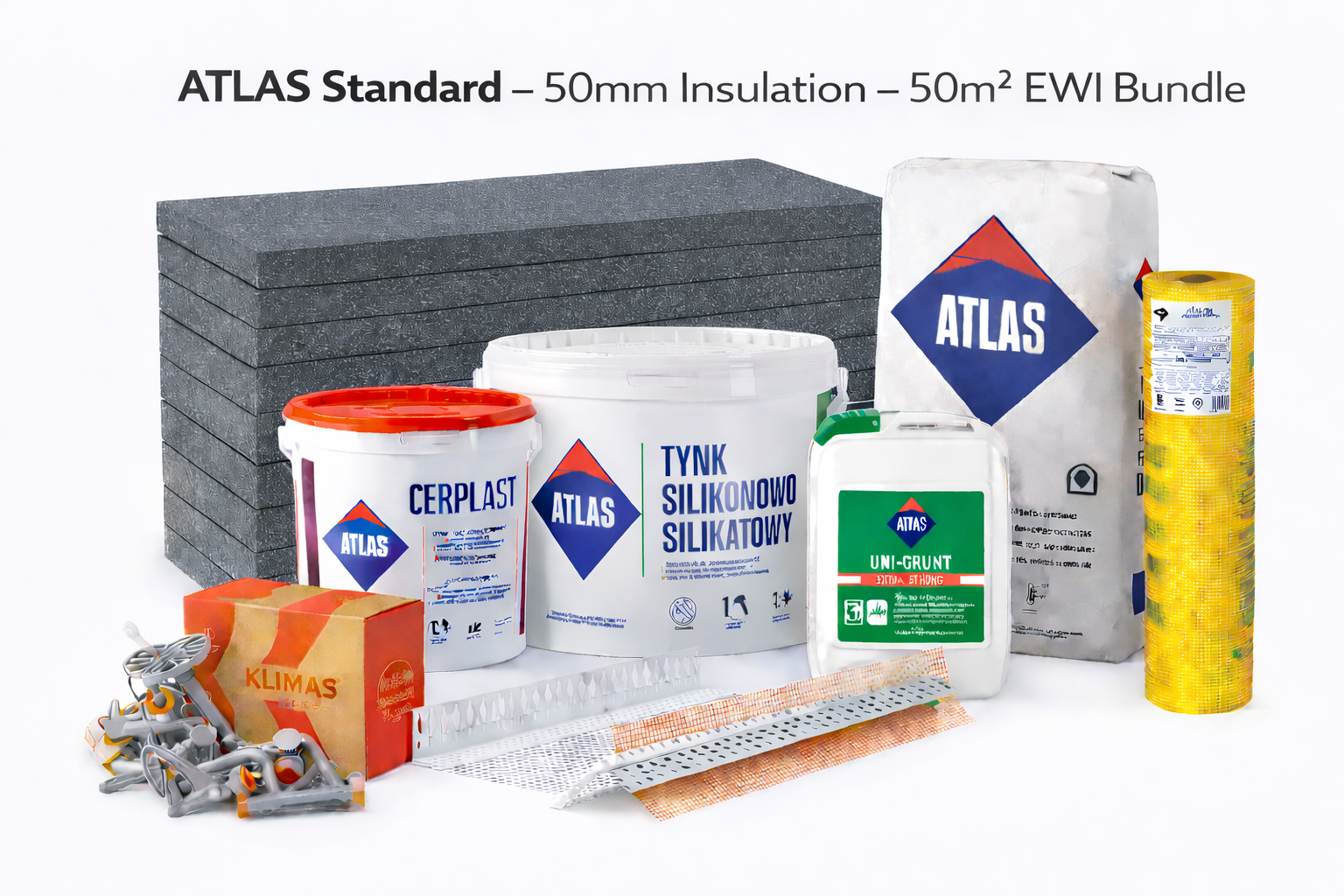
| Owner-occupied retrofit, the common case | Standard, finished in Atlas Silicone-Silicate Render | 2,5–3,0 kg/m² certified coverage |
| Exposed elevations, long colour life | ULTRA, finished in Gemini RS silicone render | From 2,3 kg/m² by hand, 406 shades |
Every complete EWI system bundle here shares one backbone, and only the render changes: graphite EPS insulation boards, fibre-enhanced EPS adhesives basecoats, an Atlas 150 g/m² reinforcing roll, insulation fixing accessories and a quartz key coat from the exterior render primers range.
ULTRA is where Gemini RS earns its place, on a south or seaward wall. What sits inside each tier is set out in the bundle tier comparison; the Renders World specification desk will price a thickness or colour outside the standard tiers.
What the Certification Covers, and Where It Stops
A complete EWI system bundle is assembled from components that carry real assessments, and reading their scope precisely is what makes a Building Control conversation straightforward. BBA Agrément Certificate 13/5018 covers the Atlas/Aval EPS External Wall Insulation System and states that system will remain effective for at least 30 years when installed and maintained to its terms.
- The insulation supplied here is a GENDERKA EPS 032 board, not the 1200 by 600 mm Atlas board the certificate describes, so the assembly as packed is a compatible specification rather than the certified one. Where a project needs the certified build-up named on paper, the desk will quote it with Atlas boards.
- Board reaction to fire is class E to EN 13501-1, declared on the GENDERKA technical card for the board itself. A finished wall classifies as an assembly, not as its board.
- The certified system's classes are B-s1,d0, B-s2,d0 or C-s2,d0 depending on which adhesive, key coat and finishing coat are used, and the certificate restricts use above 18 m in England, Wales and Northern Ireland, and at 11 m or more in Scotland.
- Gemini RS carries Polish national assessments — ICiMB-KOT 2022/0180 and ITB-KOT-2020/1616 — and its own EN 15824 declaration 280/CPR, with vapour permeability class V2 and adhesion 0,35 MPa. It is not named in BBA 13/5018, so no BBA scope reaches the ULTRA tier.
- Certified coverages, at system scope: board bonding 4,0–5,0 kg/m², quartz key coat 0,25–0,35 kg/m², Atlas Silicone-Silicate Render 2,5–3,0 kg/m² and Atlas Acrylic Render 2,5–5,0 kg/m², each as a component of the certified Atlas/Aval EPS system.
How to Check Quantities and Delivery Before Ordering
Four checks turn a packed quantity into a specification that finishes the wall, and each one comes out of the documents rather than habit.
- Add a mesh roll for overlaps. One Atlas roll is 50 m by 1,0 m — 50 m² of roll for 50 m² of wall, with nothing left for laps. The comparable Ceresit CT 325 sheet states approximately 1,1 m of mesh per m² of wall at a 10 cm overlap, so plan a part roll on top for corners, reveals and diagonal patches.
- Treat the render allowance as a floor. Five 25 kg pails across 50 m² is 125 kg ÷ 50 = 2,5 kg/m², which sits at the bottom of the certified 2,5–5,0 kg/m² band for the acrylic finish. An uneven or heavily textured substrate takes more, and a test area settles it.
- Confirm the fixing pattern with the designer. The packs give 400 plugs across 50 m², eight per square metre as supplied, while the certificate's sample U-value calculations assume four per m² and leave the number and spacing to the system designer. The generous count is deliberate headroom, not a specification.
- Check deep shades against the reinforced layer. Gemini RS in intense colours above a light reflectance of 15 is stated for reinforced layers made with Stopter K-50, Stopter K-20 or Grawis U at a minimum 5 mm with double Atlas 150 mesh — not the Hoter U grey and single mesh packed here, so confirm a dark colour with Atlas before ordering.
Renders World delivers kerbside from Southampton, with free local delivery in the company van on larger orders up to 15 miles. Pallet loads to 1200 kg run next day, or two business days on the economy option, and delivery cost is confirmed by the team after the order rather than at checkout. Pallets are wrapped but not weatherproof, so plan covered storage for the boards and renders. Job-level costs, including labour, are worked through in the 2026 EWI cost guide.
Is a Bundle Right for Your Project?
- Masonry and concrete retrofits, standard thicknesses: the packaged route is the quickest to price and the easiest to check, with Basic for rental stock, Standard for owner-occupied work and ULTRA for exposed elevations.
- Fire strategy calling for non-combustible insulation: the packages are built around EPS, and stone wool from the mineral wool insulation range is the route to price instead, as a specified alternative rather than a swap on site.
- Bespoke thickness, mixed finishes or partial elevations: component buying wins, and every layer above is stocked separately at the same trade pricing.
- Timber or steel frame: the render and basecoat carry over, the fixing strategy does not, so bring the frame details to the desk and the fixing schedule is specified for the substrate.
Ordering an external wall insulation kit by area is the fastest route for a standard masonry retrofit, and Renders World stocks each layer separately for everything that is not standard. Declare the wall area, pick the tier by finish, and the boards range is the place to confirm the thickness a U-value calculation asks for.
FAQ — Bundle Contents, Cost and Compliance
How much wall does a 50 m² package actually finish?
Boards, adhesive, fixings and profiles are counted to 50 m² with working headroom, while the single mesh roll is exactly 50 m² of roll area and the render allowance lands at the bottom of its certified band. Adding a part roll of mesh and one spare render pail covers laps and substrate texture comfortably.
Can the insulation thickness or the render be changed?
Thickness and finish are both specified to order. A U-value calculation asking for 90 mm or 160 mm board, a different grain, or a colour outside the standard palette is quoted by the desk against the same per-square-metre model, and the graphite EPS board range shows the thicknesses held in stock.
What separates Basic, Standard and ULTRA?
Only the finishing coat. Basic closes with an acrylic render, Standard with a silicone-silicate render certified at 2,5–3,0 kg/m² as a finishing coat of the Atlas/Aval EPS system, and ULTRA with Gemini RS, whose own sheet claims a hydrophobic, self-cleaning surface across 406 shades. Boards, adhesive, mesh and fixings are identical.
What weather suits application?
The Atlas render sheets set +5 °C to +30 °C for material, substrate and surroundings, with relative humidity below 80% during application and setting, and roughly 24 hours drying at 20 °C. Shoulder-season work is where the Atlas Eskimo accelerator earns its place, and freshly rendered elevations want protection from direct sun, wind and rain.
Is the package certified for UK Building Control?
Its components carry assessments worth naming: BBA Agrément Certificate 13/5018 for the Atlas/Aval EPS system, with a stated effective life of at least 30 years, plus EN 15824 declarations for the renders. Because the boards packed here are a GENDERKA EPS 032 rather than the Atlas board the certificate names, submit the assembly as a specification and ask the desk for the fully certified build-up where a project requires it.
How is the finish maintained or recoated later?
Washing down handles ordinary soiling, and both Atlas sheets name a silicone masonry paint — Salta N for the silicone render, Salta, Salta N or Salta N Plus for Gemini RS — as the documented renovation route for an aged facade. Recoating a sound render is a straightforward repaint rather than a stripped system.