
Two decorative techniques share a page here because buyers compare them, but only one of them is documented end to end. Atlas publishes the full timber sequence for Cermit WN — mixing ratio, coat thickness, the texturing window, the mould discipline and the wait before colour — and everything written below about stamping comes from that sheet, fetched this session. The stencil half is set out honestly for what it is: a technique the collection supports, without a manufacturer method behind the render it was previously written around.
Both techniques sit in the Renders World concrete effect render range, and both are decorative finishing operations carried out on a prepared, primed substrate. What separates them is not difficulty but predictability, and that is worth knowing before a facade is committed.
How Timber Stamping and Brick Stencilling Actually Differ
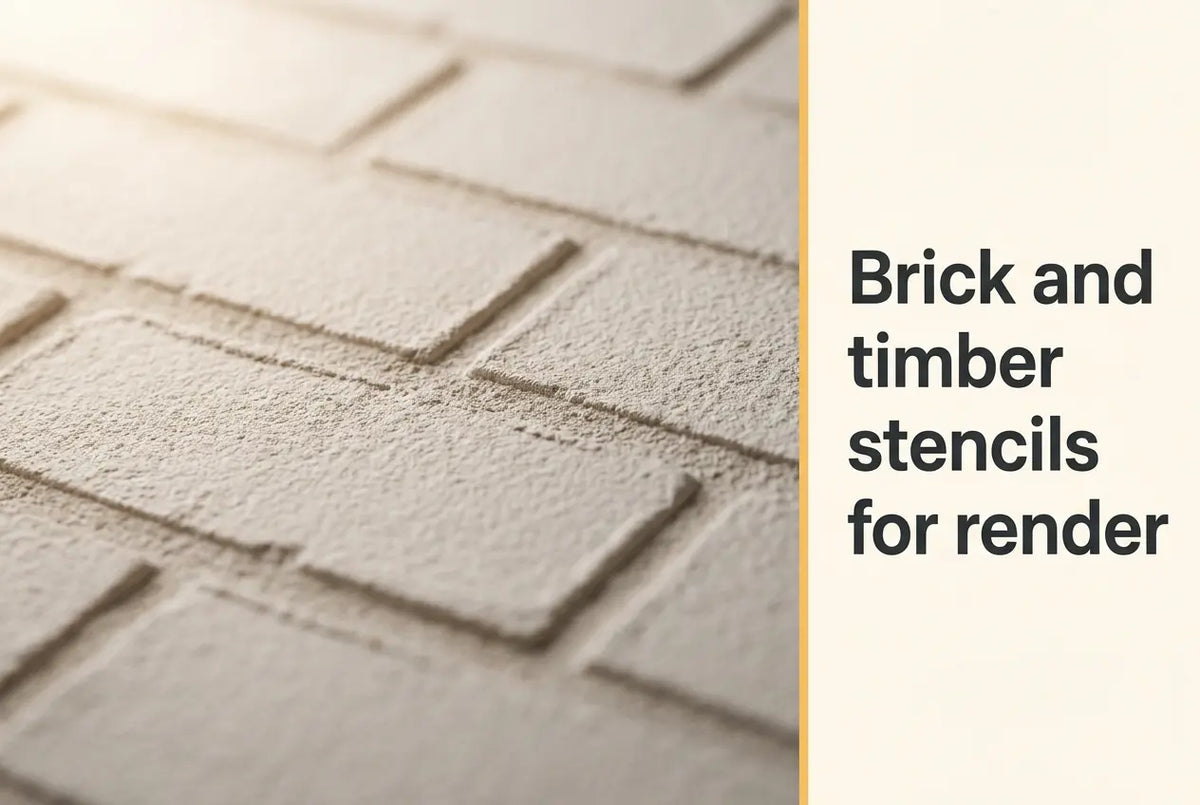
Wood and brick stencils for render UK projects use work on opposite principles: a silicone mould presses grain into a single 4 mm coat of mineral render, while a stencil masks a base colour so a second coat reads as brick against it. One displaces material, the other separates two colours.
That difference decides the whole job. Stamping is a single-render operation where timing governs everything — the impression has to land inside a window the manufacturer puts at 20 to 60 minutes. Stencilling is a two-coat operation where the base colour becomes the visible mortar joint, so the colour decision is made before the first trowel touches the wall.
It also decides the crew. Atlas specifies a two-person operation for its wood mould, one pressing while the other rolls the mould back so it does not tear away from the surface. A stencil pass can be worked single-handed, but the peel has to keep pace with the set across the whole bay.
The Atlas Timber Sequence, Start to Finish
This is the documented route, and the figures below are transcribed from the Cermit WN sheet rather than from trade habit. The render itself is a white cement and lime mix with dolomite aggregates and quartz flours, reinforced with microfibres, and its stated purpose is a surface imitating wood texture imprinted with a silicone mould.
- Prepare and prime. The substrate must be stable, dry, even and clean. On a reinforced ETICS layer built with Atlas Stopter K-50 or other Atlas adhesive mortars the sheet requires no primer under the render; on new cement or cement-lime plaster, seasoned a minimum of seven days at 4% moisture, it specifies Atlas Cerplast, and concrete needs 28 days at under 4% structural moisture. Where biological growth is present it is removed first with a treatment intended for the job.
- Mix to the ratio. 5.25 to 6.0 litres of water per 25 kg bag, or 0.21–0.24 litres per kilo. Mix mechanically to a homogeneous mass, stand it for five minutes, remix, and use it within one hour without adding further water.
- Lay at 4 mm. Apply evenly with a smooth float to about 4 mm, comb through with a 10 mm notched trowel held at an angle to even the thickness, then smooth flat again. Work wet-on-wet and never let a smoothed section dry before the next is pulled into it, or the join will show.
- Wait for the set. The surface must stiffen and dry slightly on top before it will hold an impression — 20 to 60 minutes depending on the weather, and the sheet asks for that time to be controlled closely.
- Coat the mould and press. Thoroughly coat the silicone mould with the anti-adhesion agent before use, press the grain in, and clear any render left in the mould recesses before the next impression.
- Harden, then colour. The render is hard after 24 hours and can take the tinted impregnate after three days, both figures quoted at +20 °C and 50% humidity.
Two conditions sit across the whole operation. The working temperature for substrate and surroundings is +5 °C to +30 °C, and the rendered surface is protected during work and while drying from direct sun, wind and rainfall. Planning technological breaks in advance — at corners, at changes of plane, under downpipes — is what keeps an unavoidable join out of the middle of an elevation.
Mould Care, Quantities and What a Facade Actually Takes
Consumption is on the sheet and converts cleanly. Cermit WN averages 2.5–3.0 kg/m², supplied in 25 kg paper bags, and the manufacturer notes that an exact figure comes from a trial on the substrate being rendered.
- Bag yield: 25 kg ÷ 3.0 kg/m² = 8.3 m², and 25 ÷ 2.5 = 10 m² — so roughly 8 to 10 m² per bag.
- A 40 m² gable: 40 ÷ 8.3 = 4.8 bags at the heavy end, 40 ÷ 10 = 4 at the lean end. Ordering to the heavy figure, five bags, is the safe read.
- Mixing water for five bags: 5 × 5.25 to 5 × 6.0 = 26.25 to 30 litres.
- Impressions with the long mould: the Atlas mould measures 2.00 m × 0.20 m, so 2.00 × 0.20 = 0.4 m² per press, and 40 ÷ 0.4 = 100 impressions as an absolute floor before any overlap.
Mould discipline carries its own instruction, and it is the one most easily skipped. After every session the silicone mould is washed thoroughly to remove all traces of the release agent, using water with a detergent added. The sheet is direct about the consequence: a mould that is not properly cleaned can deform permanently, and the correct texture becomes difficult to achieve. Tools are cleaned with water immediately after use.
The Atlas silicone wood stamp at £162.90 covers the long plank runs, and the Fox hand stamp at £11.40 reaches the reveals and returns the two-metre mould cannot. Atlas Cermit WN is £24.80 per 25 kg bag and the anti-adhesive agent £40.70 per 5 litres, all read from the product pages in August 2026 with no VAT figure displayed. Colour follows three days later, from the teak Bejca tint at £69.00 per 4 litres or its walnut and birch siblings.
What the Mineral Render Declares, and Why It Suits This Job
Cermit WN carries a declaration of performance to EN 998-1 as a factory-made one-coat external rendering mortar, and four declared values explain why a stamped facade holds up.
| Declared property | Value on the Cermit WN sheet |
|---|---|
| Reaction to fire | A1 |
| Water absorption | Wc1 |
| Water permeability after seasoning cycles | ≤ 1 ml/cm² after 48 h |
| Water vapour permeability | μ ≤ 30 |
| Diffusion, equivalent air layer | 0.14 m < Sd < 1.4 m |
| Vapour permeability category | V2, medium — stated with the tint applied |
| Adhesion after seasoning cycles | 0.3 N/mm², FP:B |
| pH | 12 |
| Aggregate | max. 1.0 mm |
| Shelf life | 12 months from production, dry storage |
The A1 line is a property of this render as declared under EN 998-1, and it is not a rating for a finished wall — an external wall's fire performance is an assembly question governed by the build-up as a whole. Cermit WN is separately named as a component of Atlas ETICS and Atlas Roker insulation systems under their own technical approvals, and those describe assemblies rather than the bag.
Two more sheet lines matter to a decorative facade specifically. The high alkalinity and water repellence are described as natural protection against mould fungi and algae, which the manufacturer ties to buildings near greenery, water and shaded urban settings — the exact locations where a textured surface would otherwise be expected to colonise. And the microfibre reinforcement is credited with resistance to micro-cracking, which is what keeps a pressed grain line intact through thermal cycling. Vapour behaviour sits alongside a smooth silicone render on the main elevations without a mismatch in the build-up.
The Brick Stencil Route and Where It Currently Stands
The stencil sets remain in the range and the technique is sound: a base coat in the mortar colour, the sheets pressed onto it, a second colour trowelled over, and the sheets peeled while the topcoat is firm but still pliable. Each London Brick stencil set and its Boston Brick counterpart is listed at £116.70 for a 15-sheet pack, August 2026.
The honest position on materials is this. The render these stencil sets were previously specified against is discontinued, and no manufacturer method sheet for a current stencil render was retrieved this session — so no coat thickness, peel window, coverage rate or colour count is published here for the brick route. Those figures were on this page before and none of them had a document behind it.
What can be said without a sheet is the part that comes from the Atlas guidance already in hand: on a stencilled brick method the priming layer shows through as the mortar joint, so the primer colour is chosen to match the joint rather than the brick. That single point saves a repaint. Renders World will confirm the current render pairing against a specific scheme before a stencil order is placed, which is the right sequence while the pairing is being re-established.
Key Takeaway: The timber route is fully documented — 5.25–6.0 litres per 25 kg bag, 4 mm coat, a 20–60 minute texturing window, colour after three days — so it can be planned to the hour. The brick stencil technique still works, but confirm the current render pairing with the trade desk rather than assuming the discontinued one.
Planning a Stamped Elevation Around the Texturing Window
Everything on a stamped facade is organised around one number: the span between laying render and pressing it. Size each section so two people can lay, comb, smooth and press it comfortably inside 20 to 60 minutes, and let the weather set the section size on the day rather than the programme.
- Work to a marked datum. A level line struck before the first press keeps plank courses true across the elevation, and every subsequent impression references it.
- Keep the mould width in mind. The mould is 200 mm deep, and where the pattern is meant to read wider than that, the Atlas guidance is not to press the upper edge of the mould — the instruction that stops a plank facade reading as a grid.
- Recoat before every press. A fresh coat of the anti-adhesion agent on the mould face is what lifts a clean grain; residue in the recesses is cleared as you go rather than at the end.
- Roll the colour with the grain. The tinted impregnate goes on in the direction of the pressed rings, in a uniform thin coat with no recess left uncoated, and the surface stays off direct sun, dust and rain until fully dry.
The concrete effect render application guide carries the substrate and system side in more depth, and the Bejca sealer guide works through shade selection once the grain is on the wall. For a first stamped panel, one bag of Cermit WN, a hand stamp and a small tin of tint is a low-cost way to see how the grain reads on your own substrate before the scaffold goes up — and the render systems range at Renders World holds the primer and the smooth render for the elevations around it.
Written by Mariusz Saja. Technically reviewed by Renders World Team. Last reviewed Aug 2026.
FAQ — Quantities, Timing and Compatibility
How many bags of Cermit WN does a 40 m² elevation take?
The sheet gives an average consumption of 2.5–3.0 kg/m² from 25 kg bags, so one bag covers 8.3 to 10 m². At the heavy end, 40 ÷ 8.3 = 4.8, so five bags is the sound order, needing 26.25 to 30 litres of mixing water in total. Atlas notes that an exact consumption figure comes from a trial on the actual substrate, which is worth doing on anything above a single panel.
How long is the window between laying the render and pressing the grain?
Twenty to sixty minutes, depending on the weather, measured from when the render is laid and smoothed to when it has stiffened and dried slightly on the surface. The sheet asks for that time to be controlled closely, which in practice means sizing each section to what the crew can lay and press comfortably inside it, and letting a warm or breezy day shrink the section rather than rush the press.
Which substrates take Cermit WN, and does it need a primer?
Reinforced layers within Atlas ETICS systems on polystyrene or mineral wool, concrete, and traditional cement and cement-lime renders on brick, block or aerated masonry. Reinforced layers made with Atlas Stopter K-50 or other Atlas adhesives need no primer under the render and are ready after three days; new cement plasters need seven days at 4% moisture and Atlas Cerplast; concrete needs 28 days at under 4%.
Can a stamped wood finish go on an internal wall?
The Cermit WN sheet scopes this product to the exterior of buildings and directs interior walls and ceilings to other products in the same family, so an internal feature wall is a different specification rather than the same bag used indoors. Ask the trade desk to confirm the right interior product against the finish you want, since the stamping technique itself transfers.
When does the colour go on, and can the render be left bare?
The render is hard after 24 hours and ready for the tinted impregnate after three days at +20 °C and 50% humidity, with the tint rolled or brushed in the direction of the pressed rings. Note that the sheet states the V2 vapour category with the tint applied, so the coloured surface is the finished condition the declaration describes — the colour step is part of the system rather than an optional extra.