


Description
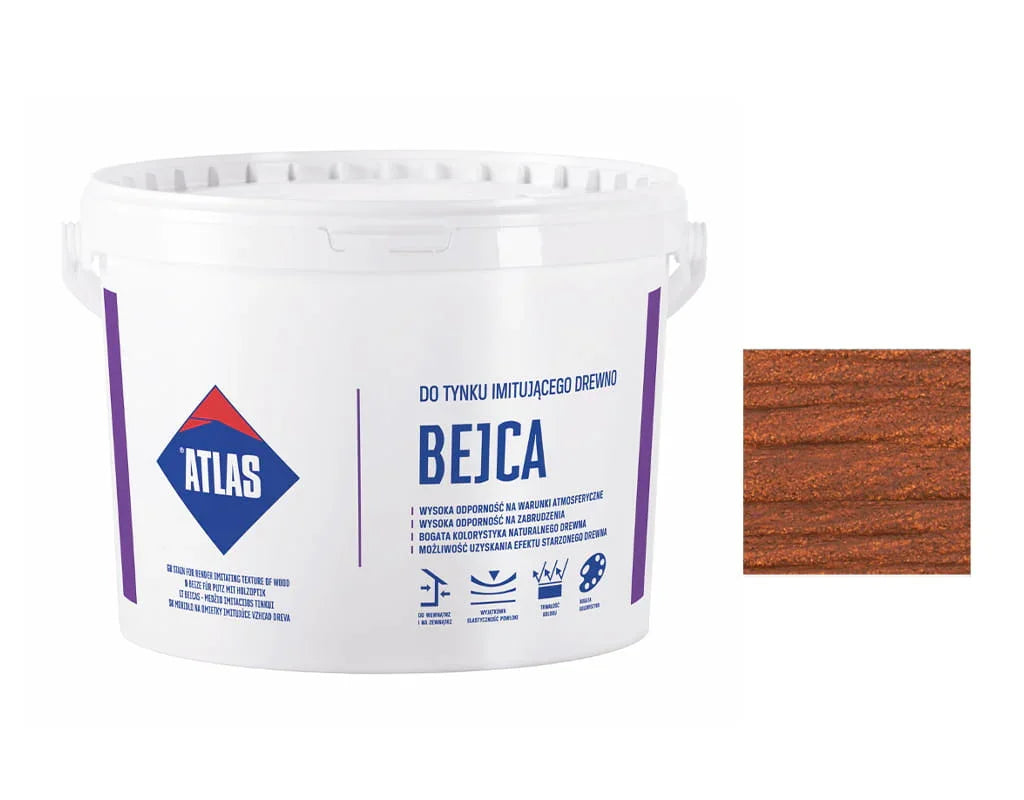
Atlas Bejca Teak is shade 06 of the ten-colour Atlas Bejca range, the warm mid tone among the birch, teak, walnut and ebony shades Renders World keeps on the shelf. It is a semi-transparent tinted impregnant for Cermit WN wood-texture render, supplied in a 4-litre pack that covers 16–20 m² a coat.
What Atlas Bejca Teak Is
Bejca has one job: a thin coloured protective coating on Cermit WN decorative render, the surface pressed into the texture of natural timber. Semi-transparent pigments chosen for high UV resistance carry the colour, with small additions of inorganic pigments, so the pressed grain still reads through the tone rather than disappearing under it. The binder is a blend of low-molecular polymer dispersions and silicone resins.
- Where it belongs: over Cermit WN, as the colour and the protective film in one pass.
- Where else it is allowed: concrete, mineral renders of every kind, smooth or textured, gypsum plasters and fillers, and plasterboard.
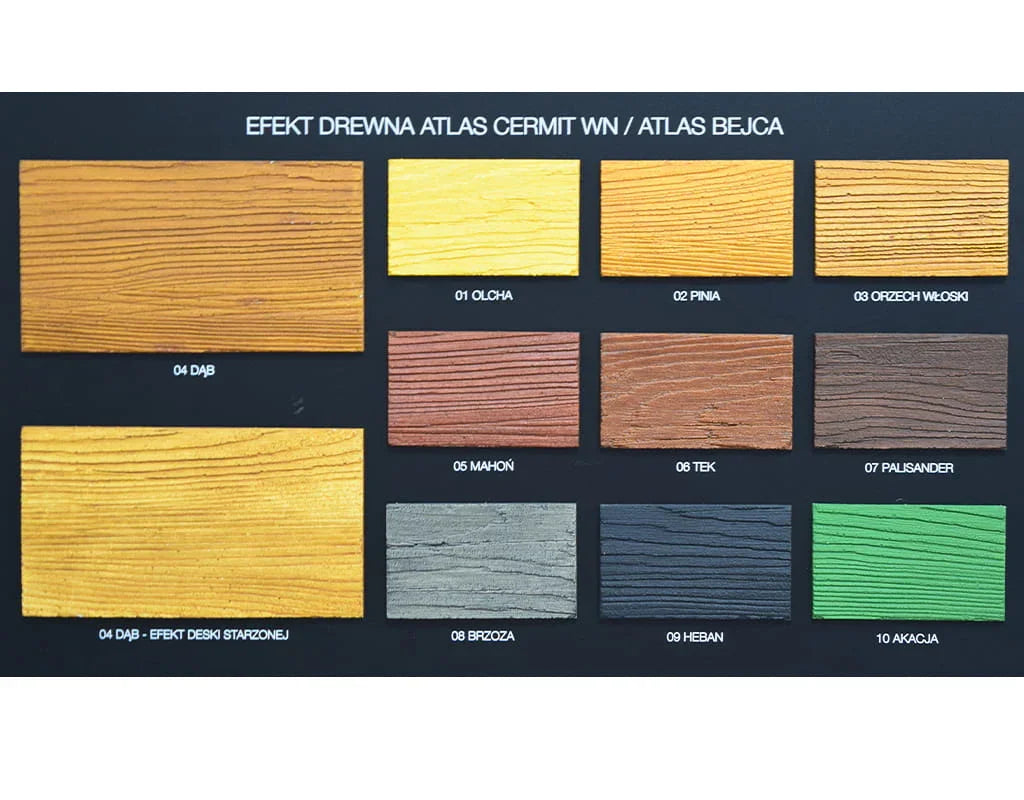
- Shade 06 in a range of ten: 01 alder, 02 pine, 03 walnut, 04 oak, 05 mahogany, 06 tekwood, 07 rosewood, 08 birch, 09 ebony, 10 acacia.
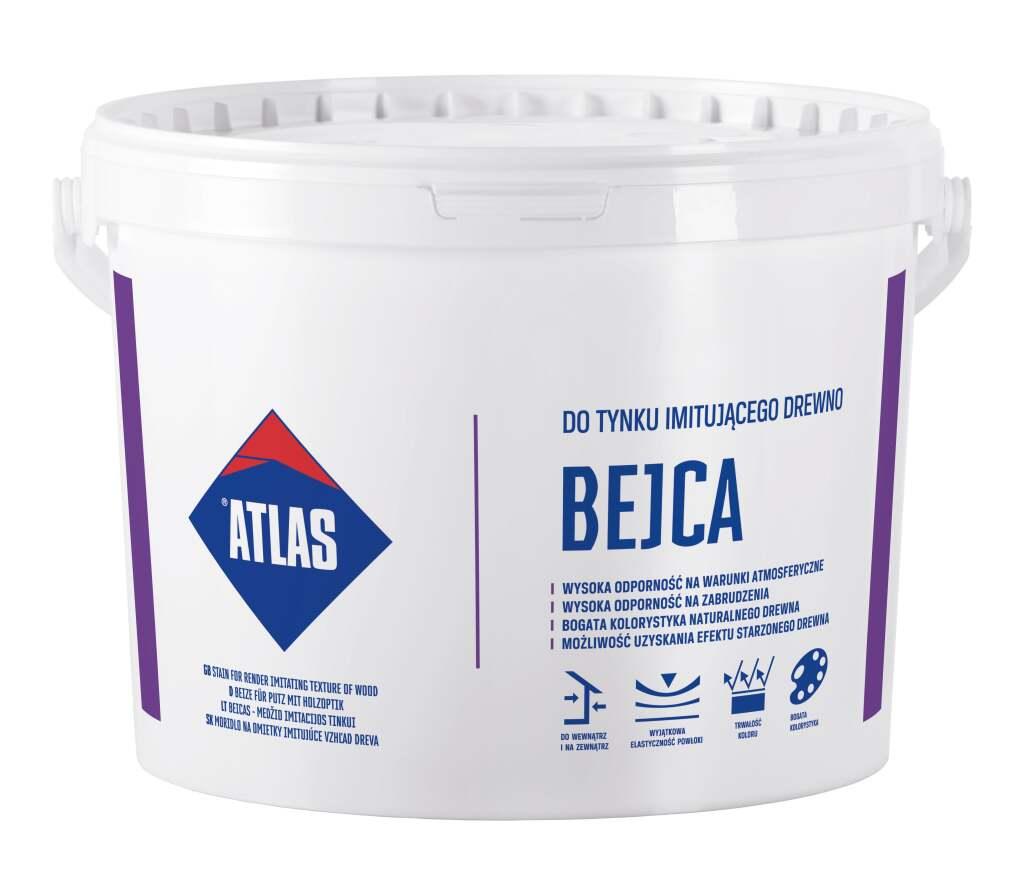
Atlas Bejca Teak comes in a 4-litre pack with a storage life of 12 months from the production date printed on it.
The Background Decides the Waiting, Not the Coating
Timing is settled by what lies underneath rather than by Atlas Bejca Teak itself, and it is worth settling before the scaffold goes up. Atlas sets a seasoning period for every permitted background, and the periods are not close to one another. They hold for setting at +20 °C and 50 % air humidity, so a cold damp fortnight does not count the same as a warm dry one.
| Background | Wait before the coating |
|---|---|
| Cermit WN decorative render | at least 3 days |
| New cement and cement–lime renders | at least 14 days, moisture 2 % |
| Concrete | at least 3 months, moisture under 2 % |
| Gypsum plasters and fillers | moisture under 2 % |
| Plasterboard and fibre-cement board | moisture under 2 %, fixed stably |
Whichever it is, the background is dry, sound and free of contamination before anything goes on it. Concrete is the one that catches people out: three months is a season, not a fortnight, and a facade planned around a shorter wait has to change either its programme or its background. Where the wall is older and has been painted or is simply dusty, the preparation stage belongs with an exterior render primer chosen for that background rather than for the coating over it.
Coverage, and How Many Packs a Wall Takes
Consumption is stated per litre rather than per pack: 4–5 m² from one litre at a single coat. The pack holds 4 litres, so 4 L × 4–5 m²/L gives 16–20 m² per coat. The Atlas data sheet adds that exact consumption is settled by a trial on the substrate to be painted.
- Divide the area by 16 m² per pack per coat — the tight end of the band — and round up.
- Multiply by the number of coats. A 40 m² elevation takes three packs for one coat.
- One or two layers are both permitted and no second coat is required, so the depth of the timber tone is the applicator's decision rather than a rule.
The trial panel earns its place twice over on a semi-transparent product. It settles consumption for the porosity of this render, and it settles the colour, because the cured shade of the Cermit WN underneath shows through Atlas Bejca Teak and contributes to what the eye finally reads.
Laying On Atlas Bejca Teak
Four things decide whether the wall looks like one wall.
- Substrate and air between +10 °C and +30 °C, air humidity under 80 %, and not on a strongly sunlit elevation.
- Stir Atlas Bejca Teak thoroughly with a slow-speed paint mixer, never thinned and never mixed with anything else.
- Brush, roller or sponge, along the pressed grain, in one even thin layer with every recess covered and nothing left bare.
- Coating of a single production date on a single surface, tools washed in clean water afterwards.
Bejca dries in roughly 30 minutes, widening to two hours with the weather, and early resistance to rain comes after some 24 hours; until then the face is kept clear of dust and rain. There is also a two-stage method for an aged timber look: Bejca is worked back with a sponge and left to dry fully, then a coat of transparent Bejca goes over it. The transparent grade is a separate product from the ten tinted shades, so both materials are planned before the first stage begins.
Where It Sits in the Method
The colour is the last of four steps, and the other three are on the same shelf.
- Cermit WN mineral render — laid some 4 mm thick at roughly 2.5–3.0 kg per square metre, in 25 kg bags. The grain is pressed into it 20 to 60 minutes after laying.
- Silicone wood stamp, 200 × 20 cm — forms the plank and the grain.
- Anti-adhesive agent for silicone moulds — the Cermit WN documentation requires the mould to be greased thoroughly before use.
- Our step-by-step guide to decorative effect renders runs the sequence end to end, and our guide to sealers for decorative renders covers the choice of shade.
Teak Against the Other Three Shades
Renders World keeps birch, teak, walnut and ebony of the ten. Since the shades differ in pigment alone — same binder, same consumption, same permitted backgrounds, same pack — the choice is a choice of colour and of nothing else, settled on the sample panel rather than on a specification sheet.
- 08 Birch — the palest, for a light timber tone over a darker base render.
- 06 Teak — this one, the warm mid tone, and the default board colour on a full elevation.
- 03 Walnut — a step darker, where contrast against pale render is the point.
- 09 Ebony — the darkest, and the one the dark-colour caution is aimed at.
Technical Data and the Limits
| Property | Value |
|---|---|
| Density | 1.02 kg/dm³ |
| Consumption | 4–5 m² per litre, one coat |
| Pack | 4 litre bucket |
| Application temperature | +10 °C to +30 °C |
| Air humidity during the work | under 80 % |
| Drying | 30 minutes to two hours |
| Early resistance to rain | after about 24 hours |
| Water absorption, 24 h | 200 g/m² or less, over Cermit WN |
| Relative diffusion resistance | 1.0 m or less |
| Scrub resistance | over 5000 strokes, PN-C/81913 |
| VOC content | under 129.9 g/l, category A/f/FW |
| VOC permitted | 130.0 g/l for that category |
| Storage life | 12 months from the production date on the pack |
| ATLAS ETICS kit | ITB-KOT-2020/1616, issue 3 |
| ATLAS ROKER kit | ITB-KOT-2021/1919, issue 2 |
| ATLAS ROKER EPS kit | ITB-KOT-2020/1188, issue 1 |
The coating is excluded on horizontal surfaces, on surfaces under permanent direct action of water and snow, and where damp rises by capillary action.
Questions Buyers Ask
- Can I put it on a wall that is not Cermit WN? Yes, within the list above, but the waiting time changes with the background — three days over Cermit WN, a fortnight over new cement render, three months over concrete.
- Is teak technically different from walnut, birch or ebony? No. The ten Atlas Bejca shades differ in pigment alone, so choosing among the shades Renders World stocks is a decision of tone.
- What keeps the colour from fading? Semi-transparent pigments Atlas selects for high UV resistance carry the colour, and an unopened pack keeps for 12 months from the production date printed on it.
- Does it suit an insulated wall? Atlas Bejca Teak is named as a component of the ETICS, ROKER and ROKER EPS kits, with the assessment numbers in the table above.
Technical Documentation
- ATLAS BEJCA karta techniczna, update date 2023-09-04 (PDF)
- ATLAS BEJCA Technical Data Sheet, English edition, update date 2023-04-05 (PDF)
Atlas Bejca Teak is the shade to pick when the brief wants an ordinary warm timber board rather than a statement. The rest of the method, and the birch, walnut and ebony shades beside it, sit together in our range of decorative effect renders.