
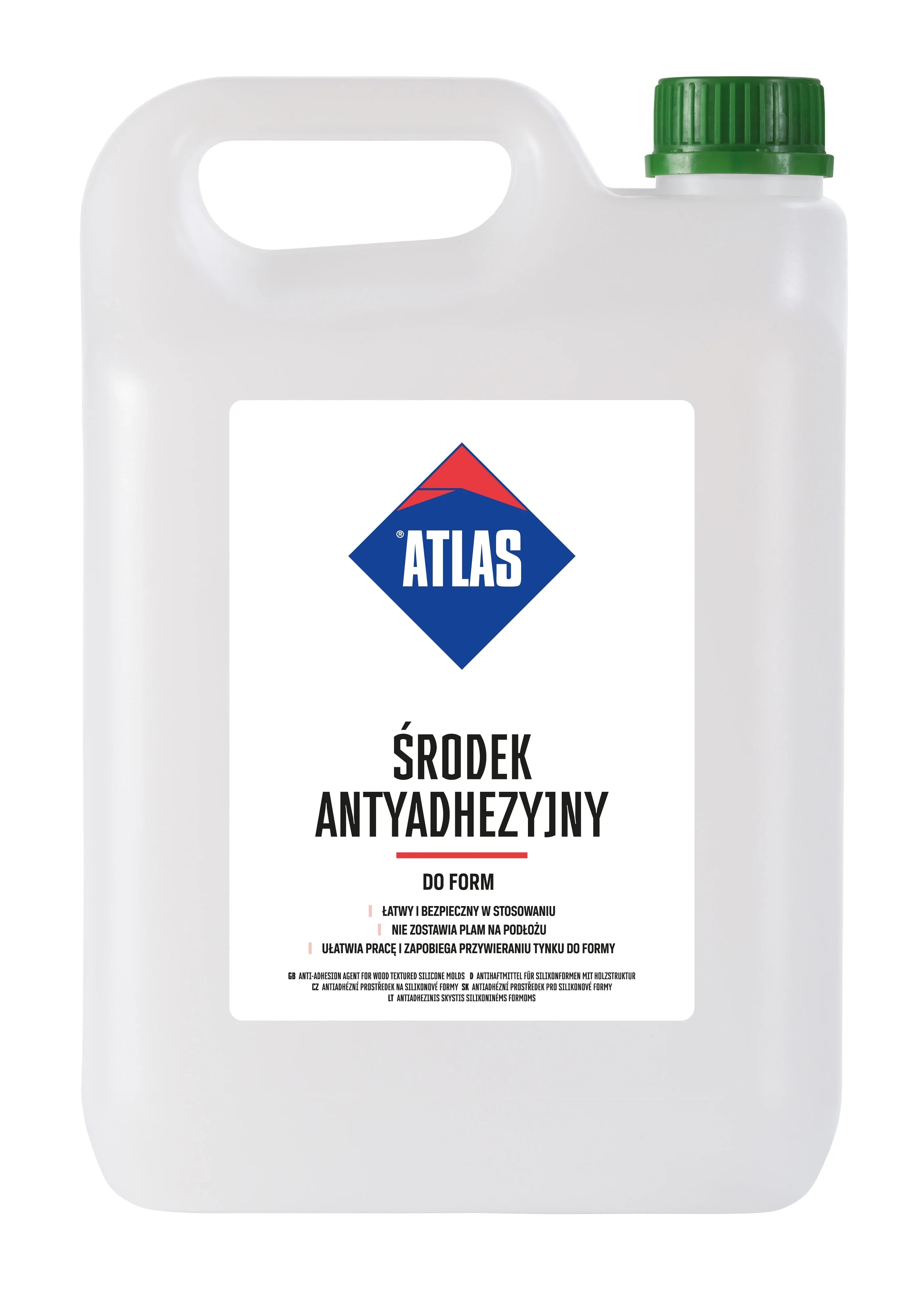

Description
Wood-effect render is made by pressing a mould into wet mineral render, and a mould release agent is what lets the mould come away again. Atlas anti-adhesive release agent 5L is the one named in the render's own method, and at Renders World it sits in the stencil and stamp render range beside the render and the moulds it serves.
Where a Mould Release Agent Sits in the Wood-Effect Sequence
The place of a mould release agent in this job is fixed by the render, not by preference. The ATLAS CERMIT WN technical card sets out the wood-texture method, and the release step is written into it.
- Lay the render about 4 mm thick where the texture will be pressed.
- Wait 20 to 60 minutes after laying, until the surface has stiffened enough to hold an impression.
- Grease the mould thoroughly before use with the Atlas anti-adhesive release agent — the card names it, so this is an instruction and not a suggestion.
- Colour comes later: after three days the surface may be covered with the ATLAS BEJCA tinted impregnant.
Two things follow for a UK job. A release agent is a consumable and not a tool, so it belongs on the order beside the render; and it works on the mould and never on the wall, which keeps it clear of the face that later takes colour.
Why This One and Not a General-Purpose Release Oil
- It leaves no stains on the substrate, which matters because the finish is decorative and is seen at close range.
- It does not degrade or deform the moulds, stated as a property of the release agent, so the pattern tool survives repeated cycles.
- Biodegradable and ready to use: a clear red liquid that must never be diluted or combined with other materials.
- Declared for silicone and polyurethane moulds, which covers pattern tooling that is not the Atlas silicone mould.
- Not classified as hazardous under regulation 1272/2008, with one precautionary statement on the safety data sheet: keep out of reach of children.
Technical Data, With the Two Scopes Kept Apart
The release agent's own figures are few; the ones that govern a working day belong to the render underneath. Both sets are below, each against the document it came from.
| Parameter | Figure | Applies to |
|---|---|---|
| Pack size | 5 l plastic container | The release agent |
| Appearance | clear red liquid | The release agent |
| Density | 0.91–0.92 g/cm³ | The release agent |
| Consumption | ~50 ml per greasing | The release agent |
| Working temperature | +5 °C to +30 °C | Substrate and ambient |
| Storage temperature | +5 °C to +30 °C | The release agent |
| Shelf life | 12 months from production | The release agent |
| Render layer | about 4 mm | ATLAS CERMIT WN |
| Imprinting window | 20–60 minutes after laying | ATLAS CERMIT WN |
| Render consumption | 2.5–3.0 kg/m² | ATLAS CERMIT WN |
The mould release agent is dosed per greasing and not per square metre, because the figure is an average for one full coating of a mould and is not tied to any mould size: a plank format will draw more than 50 ml and a hand stamp less. The render underneath is the opposite — it is ordered by area, and at the heavier rate 25 kg ÷ 3.0 kg/m² = about 8 m² from one bag of CERMIT WN.
How to Apply It: Dosage, Direction and Re-Coating
The method below is the manufacturer's. One detail in it decides whether the pattern releases cleanly, and it is the direction of the stroke: work along the mould.
- Do not dilute: this mould release agent arrives ready to use, and adding anything to it is expressly ruled out.
- Coat the patterned side: apply with a brush or a roller, working along the mould rather than across it, in as even a layer as you can manage.
- Use about 50 ml per greasing, the card's average for one full coating of a mould.
- Recoat on the card's cycle: after two impressions, brush the mould clear of render residue and apply a thin fresh layer.
- Follow the render card where the two differ: CERMIT WN asks for the mould to be greased thoroughly before use and carries no impression count, so on a decorative elevation coat before each press and treat the two-impression allowance as the minimum.
The full sequence from substrate to sealer is set out in the concrete effect render application guide, and mould and stencil selection is covered in the wood and brick stencil guide.
How Far One Container of Mould Release Agent Goes
Yield is counted in greasings, because a release agent has no idea how big your mould is: 5,000 ml ÷ 50 ml per greasing = about 100 greasings from one 5-litre container. Converting that to square metres needs the face area of the mould you are actually using — the Atlas silicone plank mould and the compact Fox hand mould answer that differently — so take your own mould's face area and divide it into the greasing count.
- On the release agent's own cycle, two impressions per coating, one container covers a long run of pressing.
- On the render card's stricter reading, one greasing per impression, the same container still outlasts most single elevations.
- Either way it is a standing consumable, which is why Renders World keeps this mould release agent on the shelf beside the render rather than ordering it per job.
Washing the Mould and Storing the Container
- Wash the mould after the session with water and added detergent. Incomplete washing can permanently deform the mould, which the card states plainly.
- Clear the recesses during the work with a brush, so each impression starts from a clean pattern.
- Store the container sealed in its original packaging, in a cool, dry, well-ventilated place between +5 °C and +30 °C. Kept that way the product holds for 12 months from the production date.
Specify It With the Rest of the Wood-Effect System
A mould release agent is one of four things a stamped facade needs, and it is the smallest of them by a distance. Renders World stocks all four together.
- The render and the mould come first in the sequence, and the pairing is set by the CERMIT WN method.
- Colour follows three days later with an ATLAS BEJCA tinted impregnant; the options are compared in the sealers for concrete effect renders guide.
- Substrate preparation may need a primer before any of it, from the exterior render primers range.
- A concrete look instead of timber uses no release agent at all; Atlas base coat paint is the route over the same family of renders.
FAQ: Yield, Compatibility, Recoating and Care
- Coatings per container · declared moulds and renders · recoating cycle · storage · handling.
How many mould coatings does a 5-litre container of mould release agent give?
About one hundred, from 5,000 ml at the stated average of 50 ml per greasing. That average is not tied to a mould size, so a 2-metre plank format will draw more than 50 ml and a hand-sized stamp less. Run your first container against a tally of presses and you will have a figure calibrated to your own tooling.
Which moulds and renders is this release agent declared for?
Silicone and polyurethane moulds, and mineral renders — the card gives the wood-texture technology using ATLAS CERMIT WN as its example application. It is also stated as compatible with ATLAS BEJCA, so the cured surface still takes the tinted impregnant. Other mould materials sit outside what the card covers, so ask the tooling supplier for their own recommendation.
Do I need to recoat the mould before every impression?
The agent's card permits two impressions per coating, then a brush-out of render residue and a thin fresh layer. The CERMIT WN card asks for the mould to be greased thoroughly before use and gives no impression count. The safer working rule is the render card's: coat before each press, and treat the two-impression allowance as the manufacturer's minimum rather than a target.
What handling precautions does Atlas state?
The release agent is not classified as hazardous under regulation 1272/2008, and the safety data sheet carries one precautionary statement: keep out of reach of children. Both documents are linked below.
Technical Documentation