
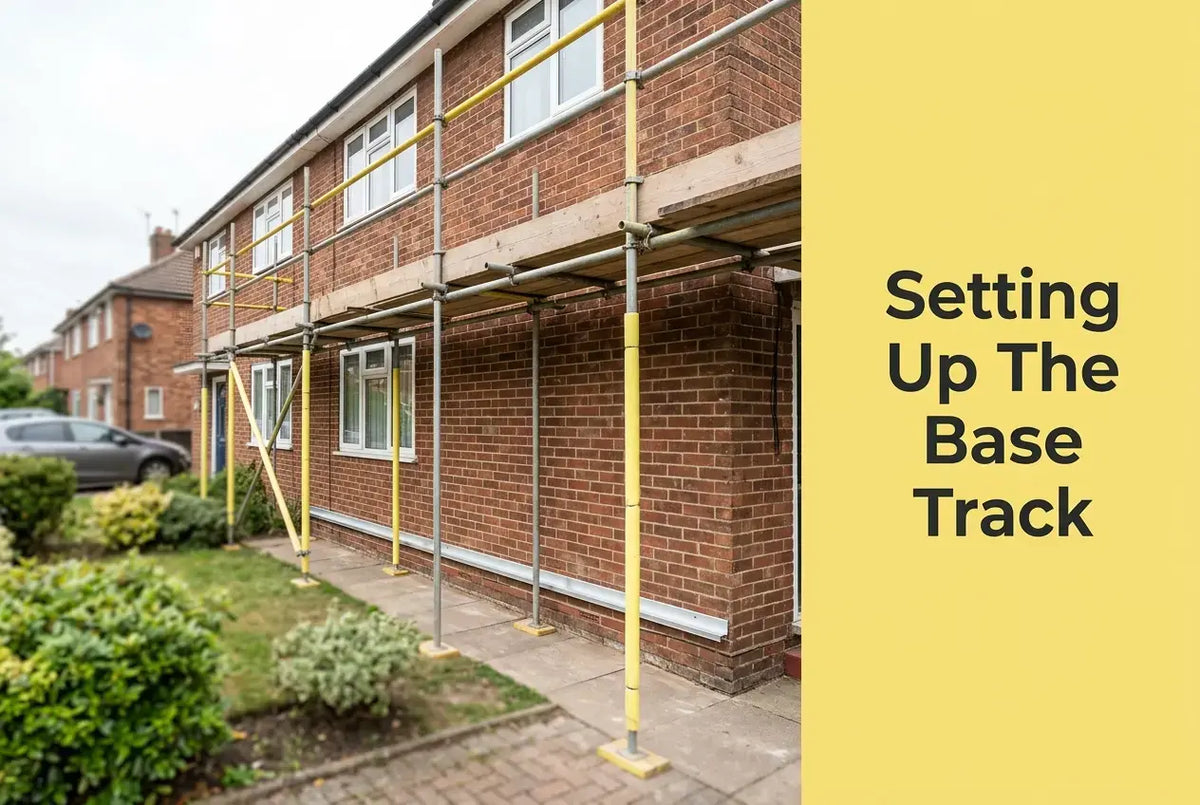
Day one of an external wall insulation programme delivers one thing: a levelled base line. Every board course, every mechanical fixing and every render stop above it inherits that geometry, which is why the starter profile is set out before a bag of adhesive is opened. Renders World holds the full width ladder on the insulation fixing accessories shelf, so the channel and the fasteners that follow it are settled on one order line.
What follows is the trade sequence for that first morning — survey, datum, dry run, fix — with the figures held to what a manufacturer sheet or a live listing actually carries. Where this day sits in the wider fortnight, the day-by-day EWI installation timeline owns the programme.
Why the Base Track Governs Every Course Above It
Setting up the base track on day one fixes the datum that every later course inherits, and the fasteners driven through the boards above it work to ETA-16/0509, which sets 30 mm anchorage into the structural substrate. That anchorage depth is measured from the face of the masonry, not from the face of the render, so the base line and the plug schedule are two halves of the same decision.
The track itself contributes geometry rather than performance. It holds the bottom edge of the first course to a single line, gives the basecoat and render a defined stop at the plinth, and keeps the finished facade square to the building rather than square to the ground. Everything measurable about the wall above — thickness, fixing length, render stop height — is referenced back to it.
- The datum is the cheapest accuracy on the job. Set once with a laser and projected to every elevation, it costs an hour; re-established elevation by elevation, it drifts.
- Channel width is a product designation, not a documented tolerance. The 103 mm profile is named for a 100 mm build-up by convention, and no sheet retrieved this session states a channel-to-board fit for any width in the range.
- The fixing schedule belongs to a table, not a rule of thumb. Plug length and count come from the manufacturer sheet, and the plug length calculation method works the substrate side through before the first board is bonded.
What to Confirm Before the First Length Goes Up
Ten minutes of checking at the scaffold base is what keeps the day moving, and four of the five items are settled at order rather than on site. Getting the survey pack right is a step worth taking properly, because each item resolved in advance is one that cannot stall the first fixing hole.
- The channel matched to the real board. Offer an off-cut into the profile with its adhesive bed allowed for and confirm it seats squarely rather than riding the lip. The EPS insulation boards range publishes the thickness ladder the base course is chosen from, and pairing both on one delivery keeps the two consistent.
- The width, priced. The 103 mm channel profile lists at £7.00 per 2.5 m length, the 83 mm channel profile at £7.70, and the 163 mm channel profile at £11.40, all August 2026, materials only.
- Gauge, where the drawing names one. The 163 mm profile at 1.0 mm gauge is the member that declares its metal and its section thickness on the label, at £14.90 per 2.5 m length, August 2026. Where a specification is silent on gauge, the standard 163 mm listing covers the same channel.
- Instruments and consumables staged before the lift. A rotary laser with a receiver, a long spirit level, a chalk line, a hammer drill, a fine-tooth metal-cutting blade and a flat file for deburring fresh cuts.
- The profile's own fixing instructions. Drill diameter, plug type and fixing centres for the track are the vendor's figures or the system designer's, and requesting them with the order keeps them off the critical path.
Weather is the fifth check and the one that reaches furthest. Mechanical fixing of the profile is workable in most UK conditions, but the adhesive-bonded first course that follows has its own temperature and cure limits per product, and the EWI weather window planning method sets those out product by product.
How to Set the Datum, Then Fix the Track
The base line runs horizontal, and it is established above the existing damp-proof course rather than parallel to the ground. Damp-proofing provision for walls in England is guided by Approved Document C, and the height that applies to a particular property is confirmed against the existing DPC and the assessor working on the job rather than carried from the last one.
- Survey the existing details first. Mark where the finished facade line will fall against sills, thresholds, soil pipes and meter boxes while the wall is still bare, so extensions and relocations are known before the track is fixed.
- Establish one datum and project it. Set the base line with a tripod-mounted rotary laser, take it to every elevation from that single reference rather than transferring by spirit level, and snap a chalk line so the height survives until boarding starts.
- Verify the chalked line by hand. Run the spirit level along the marked datum at several points per elevation and re-shoot the laser before fixing where the two disagree, so any deviation is caught while it is still a pencil mark.
- Dry-run the lengths before drilling. Laid end to end along the chalk line, the profiles show a fixing point landing on a movement joint or a service penetration in time to move it.
- Fix to the profile's own instructions. Confirm drill diameter, plug type and centres on the first length against the vendor's sheet or the system designer, then pack low spots in the substrate so the top edge returns to the datum before fixings are fully driven.
- Keep the run continuous at corners and leave the movement allowance those instructions call for, so the base reads as one line around the building and the drip detail stays unbroken.
Key Takeaway: The base track is a geometry component, and the figures that matter on day one split cleanly in two. The datum, the chalk line and the continuity at corners are yours to set; the drill diameter, the fixing centres and the DPC height are the vendor's, the system designer's and the assessor's. Set the first group carefully, request the second in writing with the order, and the elevation above the track runs off one reference.
What the Fastener Sheet Governs Above the Track
Once the first course is bonded off the shelf, the schedule is a published table. The LTX-10 data sheet gives the length as board thickness, plus adhesive and any old plaster, plus the anchorage depth — and it names EPS and XPS polystyrene as the materials it covers and no others.
| Plug length | New build, 10 mm adhesive allowed | Over 20 mm existing plaster |
|---|---|---|
| 90 mm | 50 mm board (30 mm in aerated concrete) | 30 mm board (10 mm) |
| 110 mm | 70 mm board (50 mm) | 50 mm board (30 mm) |
| 120 mm | 80 mm board (60 mm) | 60 mm board (40 mm) |
| 140 mm | 100 mm board (80 mm) | 80 mm board (60 mm) |
| 160 mm | 120 mm board (100 mm) | 100 mm board (80 mm) |
Anchorage is 30 mm on substrate categories A to D and 50 mm in autoclaved aerated concrete, with the drilled hole at 40 mm and 60 mm respectively. Two working details from the same sheet are worth carrying to site: holes in solid materials are cleared with four back-and-forth strokes of the drill at reduced speed, and holes in hollow brick or aerated block are drilled without impact, because breaking the inner walls of the block reduces pull-out resistance.
On count, the sheet recommends a minimum of six fasteners per m² in the field of a wall and eight per m² in the corner zone below 15 m, rising to eight and ten above that height, and states plainly that the recommendation does not replace the thermal insulation design. The top-to-bottom mesh embedding technique picks the elevation up once those fixings are driven.
Ordering the Base Line and Getting It to Site
Take-off is straightforward arithmetic against the 2.5 m module. A 24 m base line gives 24 ÷ 2.5 = 9.6, so ten lengths cover it, and at the 103 mm width that is 10 × £7.00 = £70.00 in profile, materials only, at August 2026 prices — labour, boards, adhesive and fixings all costed separately. Carrying one spare length is sensible where external corners are mitred.
Where the base track fits into the wider specification, the external wall insulation hub sets out how each collection owns a layer of the build-up, from starter profile through to finish coat. Renders World processes orders the same day where stock is available, with courier deliveries running next working day on the express option or two business days on economy, kerbside; pallets are shrink-wrapped but not weatherproof, so a scaffold-day delivery needs somewhere dry to land. Local deliveries over £300 run free within 15 miles of the Southampton headquarters.
Written by Mariusz Saja. Technically reviewed by Rafał Wyrzykowski. Last reviewed Aug 2026.
FAQ: Datum, Quantities and Substrate Limits
How many 2.5 m lengths does a perimeter need?
Divide the measured base line by 2.5 and round up, working elevation by elevation rather than as one perimeter figure, because the off-cuts fall differently on every wall. An 18 m run gives 18 ÷ 2.5 = 7.2, so eight lengths cover it, with a ninth worth carrying where corners are cut.
What height should the base line sit at?
Above the existing damp-proof course, confirmed on the property rather than taken as a standard figure. Approved Document C guides damp-proofing provision for walls in England, and the workable height on a given elevation also depends on ground level, existing render terminations and the depth of the new build-up. Setting it against the surveyed DPC is the reliable route.
What fixing centres and drill diameter does the track itself take?
No installation instruction for these profiles was retrieved this session, so the honest answer is that both come from the vendor's own sheet or the system designer for the substrate in question. Requesting them with the order settles it on the first length. The figures published above cover the plugs through the boards, which is a separate schedule with its own assessment behind it.
Can the same schedule be used with mineral wool slabs?
The channel seats any rigid slab that fits it, but the fastener table does not transfer. The LTX-10 sheet names EPS and XPS polystyrene only, so plug type, length and count for a stone wool build-up are specified by the system designer against that system's own assessment, and each slab's declared class comes from its own declaration of performance.
What separates the two 163 mm profiles?
The label. One names aluminium and a 1 mm gauge, the other names neither, and both declare the same 163 mm channel at 2.5 m. On price the difference is £14.90 against £11.40 per length at August 2026, and the declared despatch weights are 3 kg against 2 kg — fulfilment data rather than a section mass, so it indicates a heavier profile without quantifying its stiffness.