
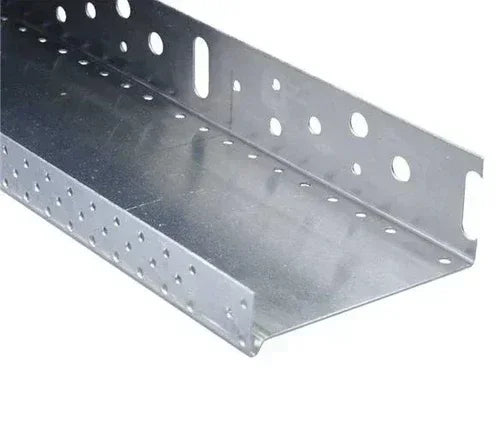
BASE TRACK 83mm 2.5m


Price:
Sale price£7.70

Shipping calculated at checkout

Stock:
In stock

Pickup available at Renders World Southampton

Usually ready in 2 hours

Description

Most UK domestic retrofit work specifies 80 mm graphite EPS as the main-wall insulation. Solid-wall Victorian and Edwardian terraces, 1930s semi-detached houses, post-war cavity homes adding over-cladding — three property archetypes, one board thickness, one base track. The 83 mm profile is the precision-formed aluminium starter that turns that specification into a clean, level, weather-protected first course across every elevation.

What the 83 mm Base Track Does in a UK EWI System

The 83 mm base track is the starter profile sized to anchor 80 mm insulation boards across the main wall on UK external wall insulation systems — a 2.5-metre aluminium length with 0.6 mm gauge, integral drip edge, perforated web, and clip-on mesh-carrier compatibility, fixed directly above the damp-proof course. It is the fourth profile in the insulation fixing accessories range and the track that appears on more UK retrofit programmes than any other width.

An 80 mm graphite EPS board with lambda 0.032 W/mK typically achieves a wall U-value of approximately 0.30–0.35 W/m²K on a standard single-leaf masonry substrate, subject to the existing wall construction and calculation method. That performance envelope places 80 mm at the sweet spot where solid-wall retrofits deliver a meaningful thermal improvement without forcing the deeper window-sill extensions and reveal treatments that thicker boards demand — and the 83 mm track is the foundation on which every course of those boards sits.

What Makes the 83 mm Base Track Worth Specifying

  • Matched to the Volume Specification of UK Domestic Retrofit: The 83 mm channel takes 80 mm boards with the 3 mm clearance needed for adhesive application — and 80 mm boards are the specification that comes up most often across solid-wall terraces, 1930s semi-detached houses, and cavity-wall properties adding over-cladding. This is the track for the most common retrofit job in the UK.
  • U-Value Target Within Practical Reach: Working with 80 mm graphite EPS boards at lambda 0.032 W/mK, the typical achievable U-value of 0.30–0.35 W/m²K (subject to calculation) lands on the threshold where most retrofit coordinators and energy assessors set the practical target — measurable thermal improvement without disproportionate detailing complexity.
  • Integral Drip Edge at the Wall Base: The formed lower lip projects clear of the wall face, shedding rainwater and ground-level splash-back away from the lowest course of insulation. On exposed elevations and ground-floor work near pavements, that geometry protects the most weather-loaded zone of the entire EWI assembly.
  • Perforated Web for Construction-Moisture Drying: Punched apertures along the horizontal shelf allow residual construction moisture and minor vapour drive to escape from behind the lowest board course rather than accumulating against the wall base — particularly relevant on retrofit work over older masonry that holds variable moisture content from decades of weather exposure.
  • Corrosion-Resistant Aluminium Across the Service Life: The natural aluminium oxide layer holds structural integrity through prolonged moisture contact and alkaline basecoat chemistry, matching the expected 25-30 year service life of the wider EWI system rather than degrading at the most exposed component.
  • Fast Site Handling at Terrace-Row Scale: At 0.6 mm gauge each 2.5 m length is light enough for single-person handling, cuts cleanly with tin snips, and fixes at 300 mm centres in minutes. On a terrace-row programme running ten or twenty houses, that handling efficiency compounds into measurable programme time saved.

Technical Specifications — 83 mm Base Track Data Highlights

Parameter Value
Profile Width 83 mm
Length 2,500 mm (2.5 m)
Material Aluminium alloy
Gauge (Thickness) 0.6 mm
Finish Natural aluminium (mill finish)
Drip Edge Yes — integral lower lip extending beyond wall face
Perforated Web Yes — punched apertures along horizontal shelf
Pre-installed Mesh No — clip-on mesh-carrier profile required
Recommended Fixing Centres 300 mm
Suitable Insulation Thickness 80 mm boards
External Corner Detail 45° mitre cut both sides
Recommended Expansion Gap 2–3 mm between adjacent lengths
Recommended Fixing 6 mm masonry bit · wall plug + screw
Typical U-Value With 80 mm EPS 0.30–0.35 W/m²K (subject to calculation)
Corrosion Resistance Inherent aluminium oxide layer

How the 83 mm Base Track Installs in a Render or EWI System

The 83 mm base track enters the EWI build-up as the first installed component on the elevation. The installer establishes the datum line around the full building perimeter — typically 150 mm above finished ground level and directly above the DPC — using a laser level transferred to each elevation and snapping a chalk line as a permanent reference. The track is pre-drilled at 300 mm centres with a 6 mm masonry bit and fixed through into the substrate with wall plugs and screws rated for the masonry type. A 2–3 mm expansion gap between adjacent lengths accommodates thermal movement, and external corners are mitre-cut at 45° to maintain continuous drip-edge geometry around the corner.

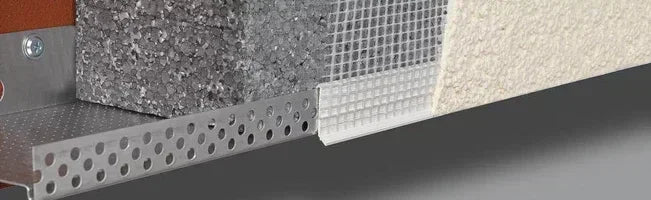
Once the full track run is verified level and secure, adhesive is applied to the rear face of each 80 mm insulation board and the board is seated firmly onto the horizontal shelf with the perforated web facing downward toward the substrate. The clip-on mesh-carrier profile then snaps onto the front lip to carry fibreglass mesh into the basecoat layer above. The step-by-step installation guide for insulation fixings covers each stage in detail, and the fixing pattern and spacing calculation guide sets out the layout method for the mechanical fixings driven through the main board courses above the track per ETAG 014 wind-load categories.

Installation Notes — Long-Run Datum Discipline, Solid-Wall Fixing Verification, Expansion-Gap Mapping

Long-run datum discipline matters more on the 83 mm profile than on any narrower track. The 80 mm boards it carries are the volume thickness on terrace-row work where a single project might run 60-80 metres of base-track across multiple houses, and cumulative datum error from a slightly off-level start compounds with each additional length. The reliable method is a single laser level set to the design datum, projected across every elevation, with the chalk line snapped from the laser reference rather than transferred between elevations by spirit level. A correction at one elevation does not propagate to the next.

Solid-wall fixing verification is the second discipline specific to this track. Solid Victorian and Edwardian brick walls — the primary substrate type for 80 mm retrofit insulation — vary considerably in mortar quality, brick density, and joint integrity across a single elevation. Standard nylon frame plugs at 300 mm centres handle most of the run, but on older lime-mortar work the certified pull-out per anchor can drop measurably at any given fixing point. A torque-resistance check on three test anchors at the start of each elevation confirms whether the substrate carries the design load or whether longer plugs with deeper embedment are needed — five minutes of verification that prevents a track sagging under board weight several days later.

Expansion-gap mapping closes the install. Mark the 2-3 mm gap positions on the chalk line before drilling any fixing holes — a gap landing directly over a fixing point weakens the anchorage at that hole and creates a moisture-trap where water sits rather than draining off the drip edge. The mapping exercise takes a minute per elevation and removes the avoidable rework of moving fixings later. At internal corners, butt one track length into the adjacent wall face and seal the junction with an EWI-system-compatible sealant bead at fix-up rather than at snagging.

What UK Installers Do Differently With the 83 mm Base Track

  • Keep it permanently on the van as the default stock: Across any domestic retrofit programme — single property or full terrace row — 80 mm EPS is the specification that comes up most often, and the 83 mm track is the foundation for every one of those jobs. Running a permanent twenty-length stock on the van eliminates the per-job ordering cycle for the most-used profile in the range.
  • Mark expansion gaps before any drilling starts: Mapping the 2-3 mm gap positions on the chalk line first, then drilling fixing holes around those positions, prevents the avoidable scenario of a gap landing over a fixing point. A few minutes of marking saves the rework of relocating a fixing later when board weight reveals the problem.
  • Run terrace rows in single-direction sequence: On a long terrace, fix the base track on every house from left to right (or right to left) consistently rather than starting each house independently. The single-direction approach keeps the datum laser set to one reference for the full programme and removes the chance of a half-millimetre drift between houses that becomes a visible step in the finished render line.
  • Verify three fixings per elevation with a torque check on lime-mortar substrates: Pre-1919 brick walls with lime mortar carry variable pull-out across a single elevation. Three test anchors per elevation at the start of the day — driven, then checked with a torque wrench or pull-tester — confirm whether the design fixing length holds or whether to step up to a longer plug for the rest of the run.
  • Handoff to mechanical fixings cleanly: The base track carries dead load and provides alignment, not the primary wind-load resistance on the boards. Brief the operator handling mechanical fixings on the boards above that the pattern starts where the track ends — the track and the mechanical fixings work as separate components of the same anchorage strategy, not as a continuous fixing line.

Is the 83 mm Base Track Right for Your Project?

  • Choose the 83 mm base track if you are anchoring 80 mm EPS or XPS boards on a domestic retrofit — solid-wall Victorian or Edwardian terrace, 1930s semi-detached house, or post-war cavity-wall property adding external over-cladding to reach a U-value target in the 0.30–0.35 W/m²K range, subject to calculation. The guide to solid-wall Victorian retrofit with EWI sets out the wider system context for these projects.
  • Stepping down to lighter facade insulation? The 53 mm base track at 2.5 m length matches 50 mm boards on budget-conscious retrofits, smaller commercial elevations, or phased programmes where 50 mm is the first stage of a future over-cladding build-up.
  • Stepping up to a tighter U-value target? The 93 mm base track at 2.5 m length takes 90 mm boards on solid-wall properties targeting U-values below 0.30 W/m²K where an additional 10 mm of insulation depth makes the calculation work.
  • Need 100 mm boards for tighter compliance targets? The 103 mm base track at 2.5 m length matches 100 mm boards on enhanced specifications approaching the threshold where Part L compliance considerations become a primary driver of the insulation choice.

FAQ — 83 mm Base Track Coverage, Retrofit Spec, Ordering

Why is 80 mm the most common domestic retrofit thickness?

An 80 mm graphite EPS board strikes a practical balance between thermal performance, installed cost, and the visual impact of the board thickness on the building facade. It delivers a meaningful U-value improvement on the majority of pre-1970 masonry walls without forcing the deeper window-sill extensions, reveal treatments, and roof-overhang adjustments that thicker boards demand. Many retrofit coordinators and energy assessors set 80 mm as the point where diminishing returns begin — each additional 10 mm adds cost and detailing complexity for a progressively smaller thermal gain on the calculated U-value.

How many 83 mm base track lengths are needed for a typical semi-detached house?

Measure the total linear run of the base line around all elevations being insulated, in metres, and divide by 2.5. A typical three-elevation semi-detached property with a combined base run of around 20 m requires eight 2.5 m lengths, plus one or two extra lengths to allow for mitre-cut waste at external corners and step changes in DPC height. Ordering one additional length as reserve is sensible — the time cost of a short-fall return trip exceeds the carrying cost of a spare length.

How does ordering change for a terrace-row programme?

On a terrace-row programme running multiple houses, the per-house calculation method still applies but the total quantity benefits from a single delivery rather than per-house top-ups. For a row of six mid-terrace houses at roughly 12 m of base line each (front and rear elevations, minimal gable run), the total requirement falls around 30 lengths. Adding three lengths as cutting and replacement reserve produces a sensible single-delivery quantity. The single delivery reduces site disturbance compared with sequential per-house orders.

Can the 83 mm track be mixed with wider profiles on the same project?

Yes — mixed-width track runs are standard practice on projects where insulation thickness varies across the building envelope. The 83 mm profile carries the main wall area, while wider tracks such as the 93 mm or 103 mm handle elevations or properties where a tighter U-value target is specified. Narrower tracks cover reveal and soffit detail work. All profiles share the same aluminium alloy, 0.6 mm gauge, and fixing method, so they install identically and align at the same datum height with no transition complication.

Is the 0.6 mm gauge strong enough for 80 mm boards on an exposed gable end?

The 0.6 mm gauge supports the dead-load weight of 80 mm EPS boards on domestic-scale elevations without issue. On highly exposed gable ends where sustained wind uplift is a concern, the insulation boards themselves are secured with mechanical fixings driven through the board face above the track line — the track provides alignment and base support, not the primary wind-load resistance. The board-level fixings handle the wind loading, calculated per ETAG 014 wind-load categories for the project site.

What is the function of the perforations along the track shelf?

The punched apertures along the horizontal web allow residual construction moisture and minor vapour drive to escape from behind the lowest board course rather than accumulating against the wall base. On retrofit work over older masonry that holds variable moisture content from decades of weather exposure, the ventilation pathway supports the long-term drying performance of the insulation assembly. The perforations should face downward toward the substrate when the track is fixed — orientation matters and is easy to invert by habit if shifting from a non-perforated narrower profile.

What fixing type works for different retrofit substrate conditions?

On standard clay brick or concrete block in sound condition, a nylon frame plug with a countersunk screw at 300 mm centres provides reliable anchorage. On lime-mortar Victorian or Edwardian brickwork with variable joint quality, use a longer plug with greater embedment depth and verify pull-out resistance on three test anchors per elevation before committing to the full run. On lightweight aggregate or aerated concrete block, rotation-only drilling preserves the substrate's internal structure and maintains the certified fixing performance.

You may also like

Recently viewed