
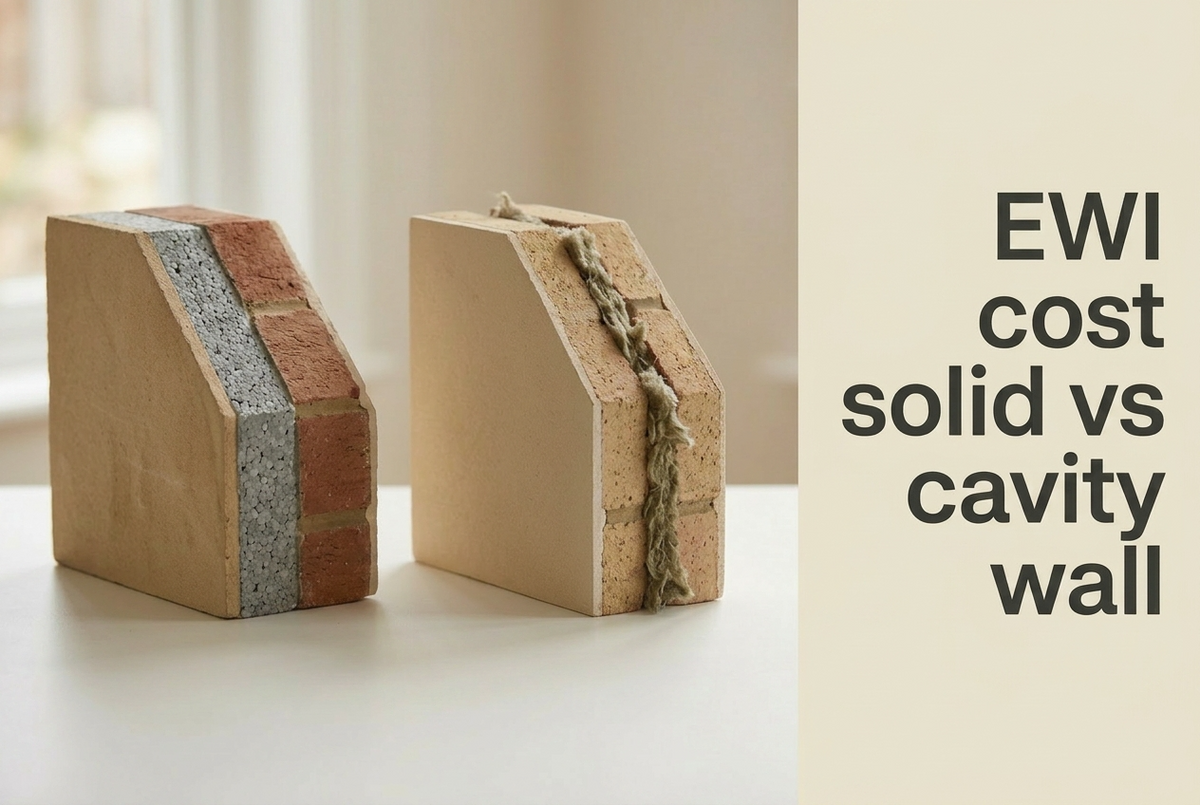
Solid-wall and cavity-wall properties pay very different rates for the same job. A pre-1919 solid-walled Victorian terrace typically lands at £110–£180/m² installed in 2026, while an equivalent post-1930s cavity-walled semi sits at £85–£130/m² — a £25–£50/m² gap driven entirely by substrate behaviour, not contractor margin. Renders World ships the full EWI systems range at fixed per-m² rates for both wall types, with the bundle composition adjusted to match the substrate rather than a one-size specification.
The gap matters because roughly one in five English homes is solid-walled and pre-1919, and the funded retrofit pipeline through PAS 2035 concentrates heavily on this stock. Anyone quoting, buying, or specifying EWI in 2026 needs to know which substrate they are pricing for before the first board is ordered. The companion guide to solid-wall Victorian retrofit covers the full installation sequence; this article isolates the cost question specifically, so the budget and tier decision can be made before site assessment.
Selection Criteria — Solid Wall vs Cavity Wall in 2026
The substrate decides almost every line in an EWI quote. A solid 215 mm brick wall built before 1919 carries roughly ten times the heat-loss rate of a modern cavity construction, demands a thicker insulation layer to reach the same U-value target, and behaves very differently when it comes to vapour movement. Cavity-walled properties from the 1930s onward already have a partial thermal break, so the EWI specification is leaner across every component — and the budget benefits accordingly.
Five criteria separate the two cost stacks in practice. Starting wall U-value sets the thickness target; substrate condition sets the prep cost; vapour permeability sets the material choice between graphite EPS and mineral wool; detailing complexity sets the labour multiplier; and grant eligibility sets the homeowner's actual contribution. Each criterion lands differently on the two wall types, and the verdict below shows by how much.
- Starting U-value: solid 215 mm brick at ~2.1 W/m²K versus uninsulated cavity at ~1.5 W/m²K. Solid walls need 120–160 mm of insulation to reach 0.28 W/m²K; cavities typically need 90–110 mm for the same target.
- Substrate condition: pre-1919 brickwork carries higher rates of spalling, soft mortar, salt contamination, and old paint coatings — all of which add prep time before adhesive can bond reliably.
- Vapour strategy: solid walls absorb moisture from wind-driven rain and rely on outward drying. This pushes mineral wool toward the default specification on most pre-1919 stock, while cavity walls run comfortably on graphite EPS.
- Detailing density: Victorian facades carry string courses, bay windows, recessed sashes, and ornate cornicing. Cavity-era housing carries flush windows, simple soffits, and standard reveal depths — far fewer detail interventions per square metre.
- Grant funding profile: solid-wall homes are the priority target for the Warm Homes Plan and remaining ECO4 routes, so the homeowner contribution on a £15,000 solid-wall job can be £0 in some cases, while cavity-wall retrofits more often run on self-funded budgets.
Why Solid Wall EWI Costs More — Five Substrate-Driven Cost Drivers
The £25–£50/m² gap between the two wall types is not arbitrary. Five concrete cost drivers compound across the project, each adding measurable pounds per square metre to the final invoice. Knowing where the money goes is what makes the difference between an informed buyer and one who simply accepts the headline figure on a quote.
Driver 1 — Thicker Boards for Same U-value Target
Achieving a wall U-value of approximately 0.28 W/m²K — the working target for current Part L compliance on a retrofit — needs 100 mm of graphite EPS on a cavity wall and 120–140 mm on a solid wall. Each 20 mm thickness step adds roughly £2–£3/m² to the board cost alone, and the longer mechanical fixings needed to anchor through the thicker board add another £0.50/m². The detailed maths sits in the U-value calculation guide, but the working figure for solid walls is consistently one thickness band above the cavity equivalent.
Driver 2 — Substrate Preparation on Pre-1919 Brickwork
Cavity-era brick from the 1930s onward typically arrives at site in sound, paint-free condition. Pre-1919 brickwork rarely does. Soft lime mortar, spalled face brick, old emulsion paint, salt deposits, and biological growth all need attention before adhesive can transfer load safely. Budget £3–£8/m² for prep on a typical Victorian elevation versus £0–£2/m² on a sound cavity wall — and add a contingency for repointing where the existing mortar fails its hand-test on assessment day.
Driver 3 — Vapour-Permeable Material Specification
Solid walls move moisture outward. Specifying an impermeable system traps that moisture inside the brickwork and accelerates decay, so the working default on pre-1919 stock is dual-density Rockwool mineral slab with a silicone-silicate render finish. The uplift over standard graphite EPS runs £4–£8/m² on the insulation line alone, with a further £1–£2/m² on the render. On cavity walls, vapour permeability matters less because the cavity itself acts as a moisture buffer, so graphite EPS at the lower price point remains the sensible default. The physics behind the choice is covered in the dew-point and condensation risk guide.
Driver 4 — Detailing Around Period Features
A typical Victorian terrace presents bay windows, recessed sashes, decorative string courses, ornate cornicing, and chimney stack junctions on a single elevation. Each detail intervention takes time: a bay window with corner beads, mesh reinforcement, and reveal returns can add 4–6 labour hours to the job. Cavity-era housing presents flush windows, simple soffits, and standard depth reveals — fewer interventions, lower labour multiplier. Budget £600–£1,200 of detailing labour on a Victorian semi versus £300–£600 on a cavity-walled equivalent of similar size.
Driver 5 — PAS 2035 Compliance Overhead on Funded Work
Any solid-wall retrofit delivered under the Warm Homes Plan, ECO4, or GBIS routes runs through the PAS 2035 framework, which mandates a Retrofit Coordinator from assessment through to post-completion monitoring. That role adds £400–£900 to the project cost in coordinator fees, moisture risk assessment, and SWIGA-recognised quality documentation. The cost is real but is almost always absorbed by the funding stream rather than passed to the homeowner — so on funded work it does not affect the customer-facing budget. On self-funded solid-wall jobs that still want SWIGA backing, the figure sits on the invoice in plain sight.
Comparison Table — Solid Wall vs Cavity Wall Materials Cost
Putting the drivers into a single view shows the gap component by component. The figures below assume a 100 m² wall area, mid-spec materials, and ex-VAT Renders World bundle pricing on a Standard tier.
| Cost Component | Cavity Wall (per m²) | Solid Wall (per m²) | Gap |
|---|---|---|---|
| Insulation board | £11–£14 (graphite EPS 100 mm) | £18–£24 (Rockwool 120–140 mm) | +£7–£10 |
| Adhesive + basecoat | £6–£9 (standard cement-based) | £8–£12 (fibre-enhanced for Rockwool) | +£2–£3 |
| Mechanical fixings | £1.50–£2.50 (8 per m², 110 mm plug) | £2.00–£3.50 (8 per m², 160 mm plug) | +£0.50–£1 |
| Reinforcement mesh | £1.20–£1.80 (standard 160 g/m²) | £1.50–£2.20 (heavier for impact zones) | +£0.30–£0.40 |
| Quartz primer | £1.50–£2.50 | £1.50–£2.50 | £0 |
| Render finish | £7–£11 (silicone thin-coat) | £9–£13 (silicate-silicone for breathability) | +£2 |
| Substrate prep | £0–£2 | £3–£8 | +£3–£6 |
| Detailing per opening | £150–£250 | £250–£400 | +£100–£150 per window |
| Materials total | £28–£42/m² | £43–£65/m² | +£15–£23/m² |
| Labour (UK average) | £45–£65/m² | £60–£90/m² | +£15–£25/m² |
| Installed total | £85–£130/m² | £110–£180/m² | +£25–£50/m² |
The materials line carries roughly half of the gap; labour carries the other half. Both lines move together because thicker boards, denser detailing, and breathability-driven material upgrades each add hours to the install as well as pounds to the materials list. The general EWI cost guide for 2026 covers the cavity-wall baseline in more depth; this article isolates the substrate-driven uplift specifically.
Cost Scenarios — Three Project Sizes by Wall Substrate
Translating per-m² figures into project totals exposes how the substrate gap compounds at scale. The three scenarios below assume competent UK installation, English Midlands labour rates as a baseline, mid-tier Renders World bundle specification, and exclude VAT.
Scenario A — Mid-terrace, 55 m² of external wall. On a cavity-walled mid-terrace (post-1930s build), materials at £35/m² × 55 m² = £1,925, labour at £50/m² adds £2,750, scaffolding £900, detailing £600. Total installed: approximately £6,175 ex VAT. On a solid-walled Victorian terrace at the same wall area, materials at £55/m² × 55 m² = £3,025, labour at £70/m² = £3,850, scaffolding £900, detailing £1,000. Total installed: approximately £8,775 ex VAT. The £2,600 gap on a 55 m² project is almost entirely substrate-driven.
Scenario B — Semi-detached, 100 m² of external wall. Cavity-walled 1950s semi: materials £35/m² × 100 m² = £3,500, labour £55/m² = £5,500, scaffolding £1,400, detailing £1,200. Total installed: approximately £11,600 ex VAT. Solid-walled Edwardian semi: materials £58/m² × 100 m² = £5,800, labour £75/m² = £7,500, scaffolding £1,400, detailing £2,200 (bay window, decorative reveals). Total installed: approximately £16,900 ex VAT. The £5,300 gap reflects both the thicker mineral-wool specification and the detailing-heavy facade typical of Edwardian housing.
Scenario C — Detached, 160 m² of external wall, Premium specification. Cavity-walled 1970s detached: materials £42/m² × 160 m² = £6,720, labour £65/m² = £10,400, scaffolding £2,400, detailing £2,000. Total installed: approximately £21,520 ex VAT. Solid-walled large Victorian detached: materials £65/m² × 160 m² = £10,400, labour £85/m² = £13,600, scaffolding £2,400, detailing £3,500 (multiple bays, chimneys, ornate features). Total installed: approximately £29,900 ex VAT. At this project size, the substrate gap reaches £8,000+ — most of which sits in detailing labour rather than in the material spec itself.
How to Reduce Cost on Either Substrate Without Cutting Quality
Three honest levers apply to both wall types, and one trap applies more sharply to solid-wall jobs than to cavity ones. Buying materials direct as a Renders World EWI system bundle removes contractor mark-up on the materials line — typically £400–£900 savings on a 100 m² project, with all five system components shipping in one matched delivery. The detailed breakdown of bundle versus component buying sits in the bundle-vs-component cost analysis.
Combining scaffolding with any other planned external work — roof, soffits, gutters, repointing, painting, solar — splits the £900–£3,500 scaffolding line across two trades. This lever is especially attractive on Victorian properties, where chimney repointing and roof attention often coincide with the EWI window anyway. Grant funding is the third lever: solid-wall homes are the priority target for the Warm Homes Plan and remaining ECO4 routes, so the funded share of a £16,000 solid-wall retrofit can substantially exceed the funded share of a £12,000 cavity-wall job. Cavity-walled properties also qualify for grants in many cases, but the targeted stream is narrower.
The trap to avoid on solid-wall jobs specifically is downgrading from mineral wool to graphite EPS purely to close the cost gap. Saving £4–£8/m² on the insulation line by switching material risks trapping moisture in a substrate that was originally designed to dry outward, and the long-term cost of remediation comfortably exceeds the short-term saving. On cavity walls the material switch is neutral and the saving is genuine. On solid walls, the specification must be matched to the substrate — and the Renders World bundle does this automatically when wall type is declared at order stage.
Grant Implications by Substrate Type
The grant landscape narrows the customer-facing gap between the two substrates considerably. Solid-wall homes — particularly those with low EPC ratings — sit at the top of the priority list for the Warm Homes Plan, ECO4, and the Warm Homes: Local Grant. For eligible households on qualifying benefits, the full installation cost can be funded, which means a £16,000 Victorian retrofit and a £12,000 cavity-wall retrofit both arrive at the homeowner as a £0 contribution.
Cavity-walled properties qualify for grant streams as well, but the funded share more often partial. ECO4 sunsets at the end of 2026 and the £15bn Warm Homes Plan extends grant routes from 2027 onward, with eligibility hinging on benefits status, EPC band (D–G typically qualifies), and postcode for the Local Grant route. None of these checks is one the homeowner needs to run alone — a TrustMark-registered installer runs the assessment as part of the survey at no upfront cost. The financial picture for self-funded buyers, who are typically cavity-wall owners targeting carbon reduction rather than benefit-driven funding, is best modelled through the EWI payback period calculator.
Key Takeaway: Solid-wall EWI in 2026 costs £25–£50/m² more installed than cavity-wall EWI — driven by thicker breathable insulation, Victorian substrate prep, period-feature detailing, and PAS 2035 compliance overhead. Grant funding largely closes the gap for eligible households, leaving cost-conscious cavity-wall owners and grant-funded solid-wall owners arriving at very similar customer-facing totals.
Verdict — Which Cost Route Wins for Which Wall Type
For cavity-walled homes built between 1930 and 2000, the Standard tier Renders World bundle with 100 mm graphite EPS, silicone thin-coat finish, and standard adhesive-and-mesh specification represents the cost-optimal route. Materials land at £35–£42/m², labour at £45–£65/m², and the total installed sits at the low end of the UK 2026 range. Self-funded buyers see acceptable payback periods of 18–28 years on a properly detailed installation, with the bulk of the value sitting in comfort and EPC uplift rather than in fuel saving alone.
For solid-walled pre-1919 properties, the Premium tier bundle with Rockwool 120 mm mineral slab, silicate-silicone render, and fibre-enhanced adhesive is the substrate-appropriate route. Materials land at £55–£68/m², labour at £70–£90/m², and the total runs higher — but the grant landscape closes the gap for eligible households, and the breathability specification protects the masonry for a 25-year-plus service interval. Specifying down to a cheaper EPS-on-Victorian build to close the headline cost is the one decision that consistently long-tails the lifetime cost on this stock. The full installation method for this scenario sits in the Victorian solid-wall retrofit guide.
Written by Mariusz Saja. Technically reviewed by Rafał Wyrzykowski. Last reviewed June 2026.
FAQ — Solid Wall vs Cavity Wall EWI Cost Questions
Why does solid-wall EWI cost more than cavity-wall EWI in 2026?
Five substrate-driven factors compound: thicker insulation to reach the same U-value target, substrate prep on pre-1919 brickwork, vapour-permeable material specification (typically mineral wool over graphite EPS), heavier detailing around Victorian period features, and PAS 2035 compliance overhead on funded projects. Together these add £25–£50/m² installed across a typical UK retrofit.
Can I use graphite EPS on a solid-walled Victorian house to save money?
Graphite EPS works on some solid-wall projects, particularly south-facing sheltered elevations with a documented vapour strategy and a ventilation plan that compensates for the lower permeability. On most pre-1919 stock the substrate-appropriate default is dual-density mineral wool, because solid brickwork relies on outward drying that an impermeable insulation layer interrupts. Saving £4–£8/m² on materials by specifying down risks trapping moisture in the masonry — a remediation cost that comfortably exceeds the original saving. A PAS 2035 Retrofit Coordinator's moisture risk assessment is the formal mechanism for confirming the right specification before installation.
Do grants cover the full cost of solid-wall EWI in 2026?
For eligible low-income households on qualifying benefits, ECO4 and the Warm Homes: Local Grant can fully fund solid-wall EWI installation through 2026, with the £15bn Warm Homes Plan extending grant routes from 2027. Solid-wall homes with low EPC ratings sit at the top of the priority list across these schemes. Eligibility depends on tenure, income, benefits status, EPC band, and postcode — a TrustMark-registered installer runs the assessment as part of the survey at no upfront cost.
How much more does a 100 m² Victorian semi cost than a 100 m² 1960s semi to insulate?
On a representative semi-detached at 100 m² of external wall, the cavity-walled 1960s example lands at approximately £11,600 installed ex VAT, while the solid-walled Edwardian example lands at approximately £16,900 — a gap of around £5,300. Roughly £2,300 of that gap sits in materials (thicker breathable insulation, fibre-enhanced adhesive, silicate-silicone render), with the balance in labour for substrate prep and period detailing. Grant funding typically closes most or all of the customer-facing gap for eligible households.
Is mineral wool always required on a solid wall?
Mineral wool is the working default for pre-1919 solid-walled properties because of its high vapour permeability (μ ≈ 1) and Euroclass A1 fire classification. Graphite EPS is sometimes specified on sheltered south-facing solid walls where a documented ventilation strategy compensates for the lower permeability, but the Retrofit Coordinator on a PAS 2035 project will normally specify mineral wool by default. On cavity walls the choice is neutral and graphite EPS is the cost-optimal pick. The full material comparison sits in the graphite EPS vs mineral wool guide.
How do I budget for a solid-wall retrofit before getting a quote?
Start with wall area measurement — external wall area for a typical UK semi is 90–110 m², not a guess. Multiply by £130–£150/m² as a working envelope for a solid-walled Edwardian or Victorian semi at Standard-to-Premium Renders World bundle specification, then add £1,400 for scaffolding and £200 per period detail (bay window, decorative reveal, chimney junction). The resulting figure brackets the realistic installed total within ±10% for most pre-1919 retrofits before grant funding. For cavity-walled equivalents, use £100–£115/m² as the working envelope instead.
Next Steps for Pricing Your Project
The fastest way to firm up the budget for either substrate is to measure wall area in square metres, declare wall type at order stage, and request the matching bundle tier. The Renders World full EWI system bundle returns an immediate materials price for cavity and solid-wall specifications, with the component mix adjusted automatically — graphite EPS for cavity, Rockwool for solid wall, with the relevant adhesive, mesh, primer, and render finish matched in. For households checking grant eligibility, the Warm Homes Plan overview covers the current schemes and routes through TrustMark-registered installers. Direct trade enquiries and bulk-order pricing route to the Renders World technical desk via the EWI systems hub.