
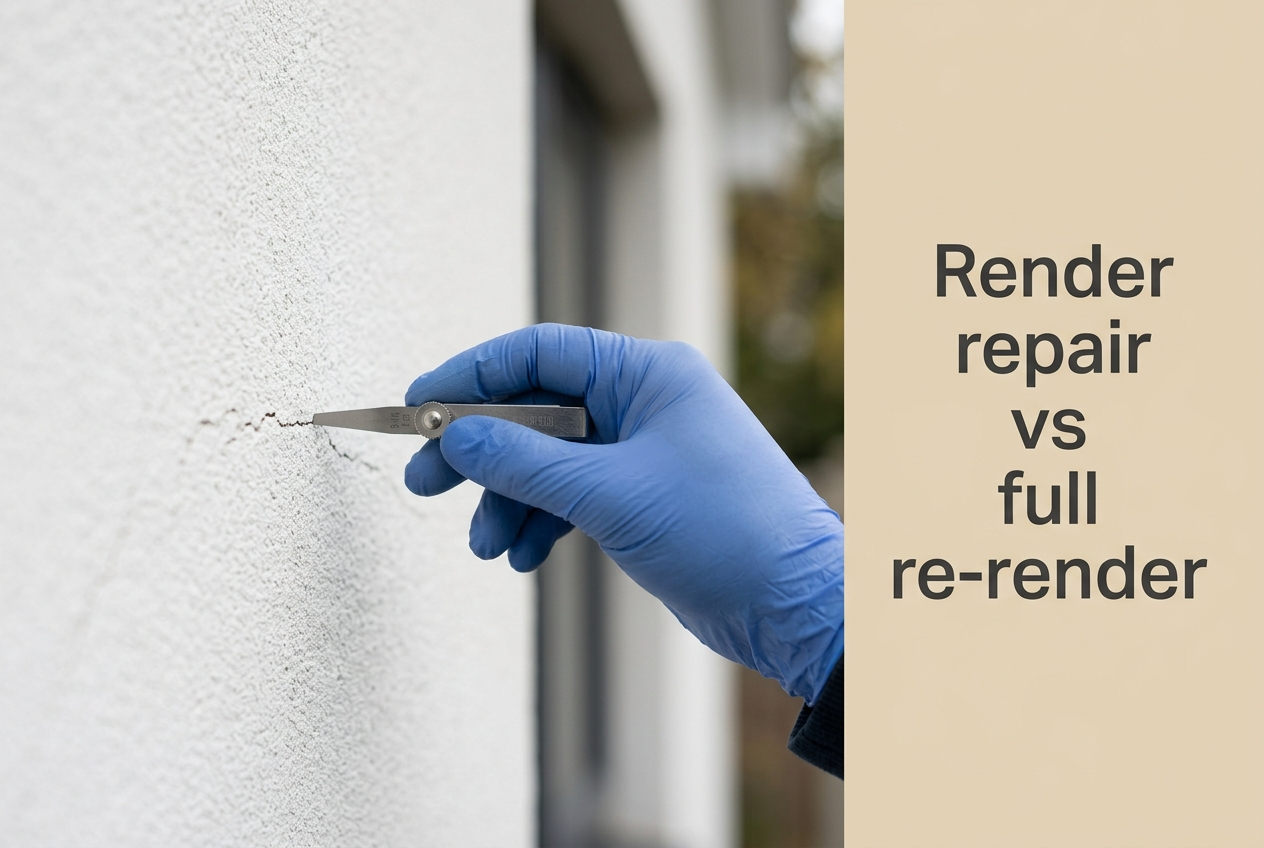
A cracked render facade puts every homeowner and specifier at the same fork: spend £400–£900 on a localised mesh-patch repair that lasts a decade, or £6,000–£15,000 stripping and re-rendering the whole elevation for a fresh 25-year service life. The right call depends on five concrete factors — crack pattern, substrate condition, system age, exposure, and how long you plan to own the property. This Renders World guide ranks every viable repair route against full re-rendering on cost per m², expected lifespan, and remaining service value, then names the specific silicone render system we recommend for each scenario.
The decision matters because most facade owners default to whichever option their first contractor suggests, and that bias runs both ways. A general builder typically over-recommends full re-render (more billable work); a maintenance contractor typically under-recommends it (faster turnaround). The honest answer sits in between and depends on diagnosis — which is why the companion render cracking causes and prevention guide is the right starting point for crack identification before pricing the fix.
The Problem — When Cracked Render Forces a Repair-or-Replace Decision
Render cracking sits in three populations on UK facades, and each one drives a different decision. Cosmetic hairlines under 0.2 mm in width are common across silicone systems and rarely require intervention beyond seasonal monitoring. Moderate cracks between 0.2 mm and 1.0 mm — typically appearing at window reveals, floor-slab lines, and corners where mesh detailing was inadequate — sit squarely in the repair-or-replace zone. Cracks above 1.0 mm, accompanied by hollow-sounding patches when tapped, signal a system-level failure that needs surveyor input before any cost decision lands.
The financial gap between repair and re-render is large enough that getting the decision right matters. A targeted mesh-patch repair on a single crack typically lands at £400–£900 including materials, scaffolding, and finish-matching. Full re-rendering of one elevation on a semi-detached house runs £2,500–£5,500. Re-rendering the entire facade of a three-bedroom semi sits at £8,000–£15,000. The cheapest credible repair costs roughly 5% of the most expensive replacement — so the diagnostic accuracy that separates the two routes is where genuine money is saved or wasted.
Two warning signs push the decision firmly toward replacement regardless of crack count. The first is widespread delamination — when more than 15% of the facade area sounds hollow under tap-testing, the bond between basecoat and substrate has failed in a way no patch can resolve. The second is an original system installed without primer or with mismatched components from different manufacturers; cracks on this kind of build-up tend to multiply faster than repairs can keep up, and stripping back to substrate is the only durable answer. The silicone render maintenance guide covers the inspection routine that catches both warning signs early.
Why Standard "Just Patch It" Advice Often Doesn't Work
Generic patch repair sounds like the obvious answer to a cracked facade, and on a sound system with a localised crack it is. The reason "just patch it" generates so many follow-up callbacks is that the advice gets applied to systems where the underlying problem is not localised — and a cosmetic patch over a systemic failure reopens within twelve to eighteen months in almost every case.
Three failure modes drive most repeat-callback patches. The first is patching over an unprimed substrate: if the original installer skipped the primer step, the basecoat bond is weak across the whole elevation, and reinforcing one stress zone simply shifts the next crack to the next-weakest point. The second is patching over mixed-manufacturer components: where the basecoat and finish coat came from different product families, elastic-modulus mismatch drives ongoing micro-cracking that no patch can outrun. The third is patching over a structural movement source — if the building itself is still settling, no surface intervention will hold.
The honest test is whether the surrounding render is sound. Tap-test a one-metre radius around every crack with a wooden handle. If the surrounding area rings solid, a mesh-patch repair using Atlas 150 g/m² alkali-resistant fibreglass mesh embedded with 150 mm overlap beyond the crack in every direction restores the affected zone for a decade or more. If more than two or three knock points within the radius sound hollow, the patch will fail and the budget needs redirecting to a wider intervention. The full embedding technique sits in the basecoat and mesh reinforcement guide.
The Right Approach — Five Repair Scenarios Ranked by Cost and Lifespan
Five distinct routes cover every realistic repair-or-replace decision a UK facade owner faces. Each one matches a specific failure pattern, and choosing the route that matches the diagnosis is what determines whether the money spent buys ten years of service or eighteen months.
Route 1 — Skim Coat Over Hairline Crazing
Applies when: hairline cracks below 0.2 mm in a random map pattern, surrounding render rings solid, no hollow zones. The fix is a thin re-coat of the same silicone render product family applied at full grain thickness over the affected zone, blending out to a natural break in the elevation. Materials: 1 tub of matched silicone render covers approximately 11 m². Cost: £150–£400 for materials and labour combined on a single elevation. Expected lifespan: 10–15 years before the next cosmetic refresh.
Route 2 — Localised Mesh-Patch Repair
Applies when: linear or diagonal cracks 0.2–1.0 mm at openings, junctions, or stress zones, surrounding render sound. The cracked basecoat and finish are cut back to substrate, fresh fibreglass mesh is embedded with 150 mm overlap beyond the visible crack, and the basecoat-primer-finish sequence is reapplied. Cost: £400–£900 per crack zone including small scaffold or tower. Expected lifespan: 10–15 years on the patched zone, matching the surrounding render's remaining life.
Route 3 — Movement Joint Retrofit
Applies when: cracks recur along the same line after previous patching, typically at floor-slab lines, building extensions, or material-change junctions. A proprietary render movement bead is set into the basecoat layer at the recurring crack line, accommodating ongoing differential movement without transferring stress into the render surface on either side. Cost: £600–£1,400 per movement joint installed. Expected lifespan: 15+ years on the joint itself; transforms a recurring callback into a permanent fix.
Route 4 — Single-Elevation Strip and Re-Render
Applies when: widespread cracking concentrated on one elevation (typically south or west on UK exposure), or where one elevation suffered storm damage. The full elevation is stripped to substrate, reassessed for soundness, and rebuilt with a fresh primer-basecoat-mesh-render sequence. Cost: £2,500–£5,500 per elevation including scaffolding and detailing. Expected lifespan: 25+ years on the renewed elevation; the remaining elevations continue on their original schedule until they reach end of service life.
Route 5 — Full Facade Re-Render
Applies when: cracks distributed across multiple elevations, system over 20 years old, mixed-manufacturer components in original build-up, or 15%+ of total facade area showing delamination. The entire facade is stripped to substrate and rebuilt with a single-system, manufacturer-matched build-up. Cost: £8,000–£15,000 for a typical three-bedroom semi (110–140 m² facade area). Expected lifespan: 25+ years on the complete new system; resets the entire facade clock and is the only route that resolves system-level original-installation failures.
Selection Criteria — What Decides Between Repair and Re-Render
Five criteria separate the two camps in practice. Working through them in order is the fastest way to land on the right route without waiting for a contractor's opinion to anchor the decision.
- Crack extent and pattern. Localised cracks at predictable stress zones with sound surrounding render point to repair routes 1–3. Distributed cracks across multiple elevations point to routes 4 or 5.
- Tap-test result. Solid tap response across the facade preserves the repair option. Hollow response on more than 15% of total area forces the replacement decision regardless of crack count.
- System age. Modern silicone systems below ten years old usually warrant repair — the underlying chemistry still has 15+ years of remaining service. Systems over twenty years old, particularly those installed before the widespread adoption of fibreglass mesh, more often justify replacement.
- Original installation quality. Documented manufacturer-matched build-up with primer, mesh, basecoat, and finish from one family supports the repair route. Unknown or mixed-manufacturer original installation usually fails the patch and pushes the budget toward replacement.
- Ownership horizon. Owners planning to sell within three years gain more from a credible repair that holds for the showing window. Owners staying 10+ years recover the replacement cost through reduced ongoing maintenance and higher facade value at eventual sale.
Comparison Table — Five Routes Compared on Cost, Lifespan, Disruption
Putting the five routes into a single view shows where each one wins and where it loses. The figures below assume Renders World materials at standard UK 2026 rates, mid-tier installer labour, and a typical three-bedroom semi as the reference project.
| Route | Cost Range | Lifespan | Best For | Avoid When |
|---|---|---|---|---|
| 1 — Skim Coat | £150–£400 | 10–15 yrs | Hairline crazing <0.2 mm, single elevation | Any hollow tap response |
| 2 — Mesh Patch | £400–£900 per zone | 10–15 yrs | Linear cracks at openings, sound surround | Mixed-manufacturer original system |
| 3 — Movement Joint | £600–£1,400 per joint | 15+ yrs | Recurring cracks at slab lines or junctions | Cracks not aligned to structural movement |
| 4 — Single-Elevation Strip | £2,500–£5,500 | 25+ yrs (on that elevation) | Storm damage or one-elevation failure | Distributed cracks across 3+ elevations |
| 5 — Full Re-Render | £8,000–£15,000 | 25+ yrs (whole facade) | 20+ yr old system, hollow >15%, mixed components | Sound system <10 yrs with localised cracks |
One observation from across UK facade projects: routes 1–3 work decisively well when diagnosis is accurate and the surrounding system is sound. Routes 4 and 5 work decisively well when the original build-up was compromised. The expensive mistake is using routes 1–3 on a system that needed route 4 or 5, because the patch fails and the eventual replacement still needs to happen — just with the patch cost added on top. The reverse mistake (jumping to route 5 when route 2 would have held) wastes capital but does not cause durability problems. When the diagnosis is uncertain, the bias toward the more thorough route is the cheaper bias over a ten-year horizon.
Ranked Profiles — The Products We Recommend for Each Scenario
Each route has a system specification that matches the working conditions of the repair. The recommendations below are the silicone render formulations Renders World stocks for these exact scenarios, and the choice between them is driven by colour matching, certification needs, and exposure rather than by price.
For Skim Coats and Mesh Patches — Atlas Silicone Render
Atlas Silicone Render is our default recommendation for routes 1 and 2 because it tints from the 480-shade SAH palette at the Renders World Southampton warehouse, so matching the existing facade colour is realistic on most repair jobs. Adhesion at 0.35 MPa is comfortably above the working threshold for a localised patch, and the 1.5 mm or 2.0 mm grain options cover the vast majority of UK residential silicone systems already on walls. Coverage runs at approximately 11.4 m² per 25 kg tub — one tub typically covers an entire single-crack mesh patch including blend-out, with the remainder reserved for any subsequent touch-up over the next twelve months.
For Single-Elevation Strip and Full Re-Render — Atlas Gemini RS
Atlas Gemini RS is the recommendation for routes 4 and 5 where you are committing to a fresh 25-year service life on the renewed area. Gemini RS carries BBA Agrément Certificate 13/5018 and a 140 J impact rating, which matters more on a full strip-and-replace than on a localised patch because the renewed elevation will weather another two decades of UK climate before any further intervention. The W2 V2 classification holds vapour permeability without compromising hydrophobicity, and the warranty backing the certificate provides the third-party assurance Building Control and homebuyer surveyors expect on substantial facade work.
For Heritage or Conservation-Area Re-Render — Silicone-Silicate Hybrid
For pre-1919 brickwork, lime-bedded masonry, or projects in conservation areas, the silicone-silicate hybrid in the Renders World range achieves V1 vapour permeability (Sd below 0.14 m), which typically satisfies the breathability expectations referenced in BS 7913 and Historic England guidance subject to individual conservation-officer assessment. The silicate component forms a chemical bond with mineral substrates rather than sitting as a polymer film on top, integrating with the existing wall fabric. The dedicated heritage and conservation render guide covers the specification pathway for listed buildings and conservation projects.
Key Takeaway: Repair beats re-render on sound silicone systems under ten years old with localised cracks — typical cost £400–£900 versus £8,000–£15,000. Re-render beats repair on 20-year-old systems, mixed-manufacturer build-ups, or any facade where more than 15% of area sounds hollow under tap-testing. The expensive mistake is patching a system that needed replacement; the diagnostic walk catches this before the budget is committed.
Verdict — Which Route for Which Facade
For sound silicone systems under ten years old showing localised cracking at predictable stress zones, route 2 (mesh patch with Atlas Silicone Render and Atlas 150 g/m² fibreglass mesh) is the cost-optimal choice. Total spend lands at £400–£900 per crack zone and the patched area matches the surrounding render's remaining service life. This is the right answer for the majority of UK homeowners asking the repair-vs-replace question for the first time.
For systems showing distributed cracking across multiple elevations, mixed-manufacturer original components, or any facade above twenty years of age, route 5 (full re-render with Atlas Gemini RS) is the route that resets the clock honestly. The £8,000–£15,000 investment buys 25+ years of fresh service life on a BBA-certified system, removes the recurring callback pattern that dogs aged facades, and stabilises the property's facade value through the next ownership cycle. The companion silicone render cost per m² guide breaks down the full re-render budget by elevation area for projects at this scale.
Where the diagnosis is genuinely uncertain — cracks present but tap-test results mixed, system age unknown, original installer no longer contactable — a paid facade survey by an independent renderer or surveyor costs £200–£400 and consistently resolves the route question before any work commits. For projects with the budget and time to specify a complete renewed system from the ground up, the silicone render buying guide ranks the seven Renders World formulations by exposure and project type.
Written by Mariusz Saja. Technically reviewed by Rafał Wyrzykowski. Last reviewed June 2026.
FAQ — Repair vs Re-Render Decision Questions
How do I tell whether my render needs repair or full replacement?
Three field tests sort the question. Measure crack width with a gauge or ruler — cracks under 0.2 mm are usually cosmetic, 0.2–1.0 mm sit in the repair zone, above 1.0 mm need surveyor input. Tap-test the surrounding area with a wooden handle — solid response across the facade supports repair, hollow response on more than 15% of area forces replacement. Estimate system age — modern silicone systems under ten years old usually warrant repair routes 1–3, while systems over twenty years old often justify full re-render. When two of these three tests point to replacement, the route 5 budget is the realistic answer.
How much does a localised render crack repair cost in 2026?
A single mesh-patch repair on a sound facade typically lands at £400–£900 including materials, basecoat, fibreglass mesh, finish coat, and a small scaffold or access tower. The figure varies with crack length, access difficulty, and how closely the existing facade colour can be matched from the standard 1,000-shade palette. For multiple crack zones on the same elevation handled in one site visit, the per-crack cost drops considerably because the scaffold and travel cost amortise across all repairs. Skim-coat refresh over hairline crazing — without any mesh patching — runs cheaper still at £150–£400 per elevation.
Will a patched repair look obvious against the existing render?
On modern silicone systems where the original colour reference is documented, a competent repair blends into the surrounding render within one full weather cycle as the patched zone develops the same hydrophobic surface and minor weathering as the rest of the facade. The blend is most successful when the same product family is used (Atlas patching Atlas, Ceresit patching Ceresit) and when the grain size matches the original. Through-coloured silicone holds its tone for decades, so a 5-year-old facade and a fresh patch will be visually identical after the first dozen rain cycles. Mid-elevation patches blend more readily than patches at corners or edges, where the eye registers any colour drift more sharply.
Can I re-render only the worst elevation and leave the others?
Single-elevation strip-and-re-render (route 4) is a credible option when one elevation has failed substantially worse than the others — typically a south or west face with higher solar and wind-driven rain exposure, or storm damage concentrated on one side of the building. The £2,500–£5,500 cost per elevation resets that face to a fresh 25-year service life while the other elevations continue on their original schedule. The risk to manage is colour matching: a brand-new south elevation can sit slightly brighter than the weathered remaining facade until both equalise over the first weathering cycle. Specifying a slightly muted shade on the renewed elevation, or accepting a deliberate elevation-level colour reset, both resolve this cleanly.
When does re-rendering pay for itself versus repeated patching?
The pay-back maths favours full re-rendering when more than three separate patch repairs would otherwise be needed across the next decade. At an average £600 per patch, four repairs total £2,400 — and if the underlying system is compromised, the patches won't hold for ten years anyway. Re-rendering at £8,000–£15,000 buys 25+ years of fresh service and removes the recurring callback pattern entirely. For owners planning to stay in the property 10+ years, route 5 typically beats serial patching on lifetime cost. For owners planning to sell within three years, the credible repair route holds the showing window and lets the next owner make the longer-term call.
Does insurance ever cover render repair or replacement?
Buildings insurance typically covers render damage from sudden, identifiable events — storm damage, vehicle impact, vandalism, escape of water from a burst pipe behind the wall. Insurance rarely covers gradual deterioration, original installation defects, or routine wear, which is the category most repair-or-replace decisions actually sit in. Where storm damage is the suspected cause, photograph the damage immediately, contact the insurer within the policy's notification window, and obtain a contractor's assessment that explicitly identifies the storm as the cause. The contractor's report determines whether the route 4 or route 5 cost falls on the insurer or the owner.
What is the best render product for repair work in 2026?
For sound silicone systems needing localised repair, Atlas Silicone Render is our top recommendation because the 480-shade Atlas palette tinted at Southampton gives realistic colour matching on most UK residential facades. Adhesion at 0.35 MPa, V2 vapour permeability, and the 1.5/2.0 mm grain options cover the working range for routes 1 and 2. For full re-render projects targeting BBA certification and a 140 J impact rating across a fresh 25-year service life, Atlas Gemini RS is the system specification — the certificate documentation typically satisfies Building Control and homebuyer-survey requirements without the additional inspection costs an unverified system can attract.
Next Steps for Your Repair-or-Replace Decision
The fastest way to land on the right route is the diagnostic walk: crack-width gauge for measurement, wooden handle for tap-testing, and an honest estimate of system age. With those three data points the route choice usually resolves in under fifteen minutes. For repair-route projects, the Renders World premium silicone render range and the matched fibreglass mesh collection ship together for next-day UK delivery on standard repair quantities. For full re-render projects, the complete silicone render range covers every system from Atlas pure silicone through Gemini RS certification to the silicate-silicone hybrid for heritage substrates — direct trade enquiries and full-facade quote support route through the Renders World technical desk via the silicone render collection page.