


Description
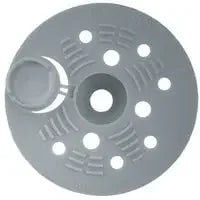
The TD-60 discs are insulation washers 60mm in size, made by Klimas Wkręt-met for fixing EPS polystyrene and mineral wool to timber, OSB, plywood, fibre-cement board and thin steel sheet. A separate steel screw goes through the collar into the wall behind, and the 64 mm collar presses the insulation in place. It comes as a bag of 100 discs, alongside the other EWI fixings at Renders World.
Insulation Washers 60mm for Timber and Steel: What the TD-60 Is For
A hammer-in plug needs brick, block or concrete to grip. A timber frame, an OSB sheathing board or a profiled steel wall has nothing for a plug to expand into, so the insulation is screwed on instead — and a screw head on its own would pull straight through soft insulation. The TD-60 is the wide plastic collar that gives the screw something to press on.
Klimas names four substrates for it:
- structural timber of strength class C22;
- OSB board and plywood;
- fibre-cement board;
- thin profiled steel sheet.
It holds two kinds of insulation: EPS polystyrene boards and mineral wool slabs. On a brick, block or concrete wall, use a hammer-in plug such as the LTX 70 mm insulation fixing plug instead.
Why Installers Choose the TD-60 on Timber and Steel
- A cap built into the collar. The plug that closes the screw hole is part of the collar. Klimas makes it to cut thermal bridging at the fixing and to seal the connection, so there is no separate cap to buy and press in.
- One washer for many build-ups. The same TD-60 is used from 30 mm to 190 mm of insulation. Only the screw changes with the thickness and the substrate.
- Made for timber and steel build-ups. Klimas shaped the 64 mm pressing collar for the insulation commonly fixed to timber or steel sheet, and it takes a wide range of screws.
- Surface fixing. The collar sits on the face of the insulation, not in a recess.
- Nationally assessed. The fastener is covered by Polish National Technical Assessment ITB-KOT-2019/0913.
- Timber screws on the same shelf. Renders World stocks the Klimas KDH timber screw for every timber size in the selection table.
TD-60 Specification
| Property | Value |
|---|---|
| Maker | Klimas Wkręt-met (KLIMAS Sp. z o.o., Poland) |
| Product | Screwed-in fastener collar |
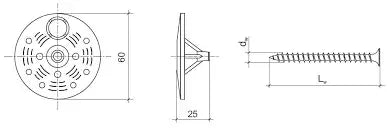
| Size | 60 (TD060 / TDP060) |
| Collar diameter | 64 mm |
| Collar material | Polyamide (TD-060) or polypropylene (TDP-060) |
| Screw material | Galvanised steel |
| Insulation | EPS polystyrene, mineral wool |
| Substrates | Timber C22, OSB and plywood, fibre-cement board, steel sheet |
| Fixing type | Screwed in, surface mounted |
| Screws used with it | WDB-T, WSR-T or KDH |
| Assessment | ITB-KOT-2019/0913 |
| Pack | 100 discs |
The 60 in the name is the size; the collar itself measures 64 mm across. Klimas makes the washer in two versions, TD-060 in polyamide and TDP-060 in polypropylene — both take the same screws and fit the same build-ups.
Choosing the Screw for Each Insulation Thickness
Pick the screw from two things: how thick the insulation is, and what is behind it. Klimas uses three screws with this collar:
- WDB-T — for steel sheet 0.5 to 0.75 mm thick, 4.8 mm diameter;
- WSR-T — for steel sheet 0.5 to 1.25 mm thick, 4.8 mm diameter;
- KDH — for timber, OSB and fibre-cement board, with a PZ drive, 5.0 or 6.0 mm diameter.
The maker's selection table, row by row. Every row uses the same TD-60 washer:
| Insulation | Steel sheet (WDB-T / WSR-T) | Timber C22 (KDH) | OSB, fibre-cement board (KDH) |
|---|---|---|---|
| 30 mm | 48050 | 05060 | 05060 |
| 40 mm | 48060 | 05070 | 05070 |
| 50 mm | 48070 | 05080 | 05080 |
| 60 mm | 48080 | 05090 | 05090 |
| 70 mm | 48090 | 05100 | 05100 |
| 80 mm | 48100 | 06120 | 06120 |
| 90 mm | 48120 | 06120 | 06120 |
| 100 mm | 48120 | 06140 | 06140 |
| 110 mm | 48140 | 06160 | 06140 |
| 120 mm | 48140 | 06160 | 06160 |
| 130 mm | 48160 | 06180 | 06160 |
| 140 mm | 48160 | 06180 | 06180 |
| 150 mm | 48180 | 06200 | 06180 |
| 160 mm | 48180 | 06200 | 06200 |
| 170 mm | 48180 | — | 06200 |
| 180 mm | 48200 | — | — |
| 190 mm | 48200 | — | — |
Timber and OSB part ways at 110 mm, 130 mm and 150 mm, where timber takes the next screw up, and the timber column stops at 160 mm — so use the column for the board that is actually behind the insulation. For timber and OSB, Renders World stocks the KDH screw for every row in 5 kg boxes: KDH 5.0 × 60, 70, 80, 90 and 100 mm, and KDH 6.0 × 120, 140, 160, 180 and 200 mm.
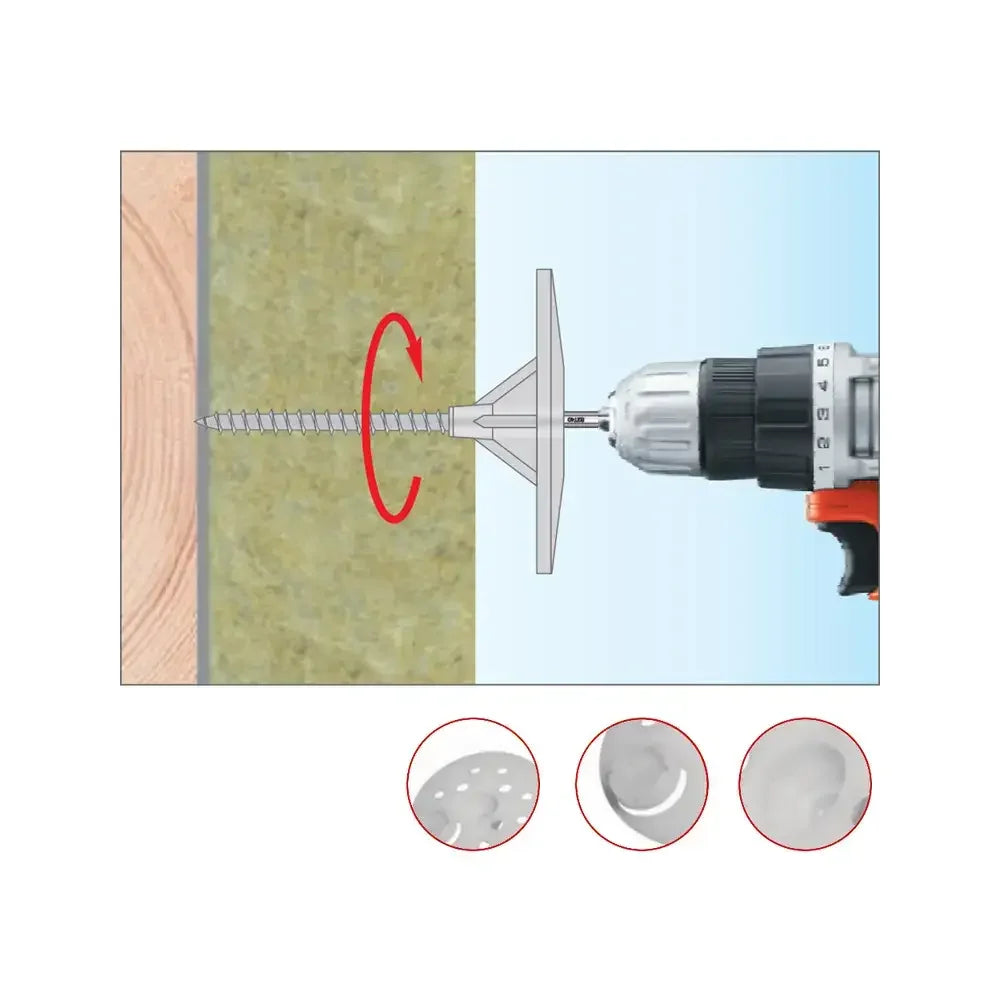
How to Fit TD-60 Washers
- Pick the screw for the insulation thickness and the substrate from the table above.
- Push the screw through the TD-60 washer and set the washer on the face of the board.
- Drive the screw with a drill-driver until the collar sits flush on the face of the insulation.
How many fixings go into each board, and where, depends on the wall and its height. The fixing pattern and spacing guide sets out the layout, and the EWI fixings installation guide covers the rest of the mechanical fixing work.
Pull-Out Resistance for the Fixing Design
Klimas publishes characteristic pull-out resistance from the substrate for both versions. These figures are for the fixing design.
| Substrate | Screw | TD-060 (kN) | TDP-060 (kN) |
|---|---|---|---|
| Steel sheet 0.50 mm | WDB-T / WSR-T | 0.40 / 0.34 | 0.40 / 0.34 |
| Steel sheet 0.75 mm | WDB-T / WSR-T | 0.66 / 0.92 | 0.66 / 0.92 |
| Steel sheet 0.88 mm | WDB-T / WSR-T | 1.11 / 1.11 | 1.13 / 1.44 |
| Steel sheet 1.00 and 1.25 mm | WSR-T | 1.11 | 1.84 |
| Timber C22, 25 mm | KDH 5.0 | 1.19 | 2.08 |
| Timber C22, 30 mm | KDH 6.0 | 2.08 | 2.47 |
| OSB 12.5 mm | KDH 5.0 / KDH 6.0 | 0.84 / 0.95 | 0.84 / 0.95 |
| OSB 18 mm | KDH 5.0 / KDH 6.0 | 1.19 / 1.38 | 1.26 / 1.38 |
| Fibre-cement board 12.5 mm | KDH 5.0 / KDH 6.0 | 0.86 / 0.86 | 0.86 / 0.86 |
Ordering, Delivery and Collection
- Dispatch: orders go out the same day when the washers are in stock.
- Delivery: after the order, the team contacts you with the most cost-effective way to send it; small parcels up to 25 kg can go next day. Every delivery is kerbside.
- Collection: pick them up from the counter at Unit 9A, Central Trading Estate, Southampton SO14 5JP.
Order one screw for each washer, sized from the table above. Changed your mind? Washers bought from Renders World can come back in their original condition within 14 days — the details are on the cancellations and returns page.
Is the TD-60 Right for Your Wall?
- Yes — for EPS boards, such as the graphite EPS range, on a timber frame, OSB, plywood, fibre-cement board or steel sheet.
- Yes — for a mineral wool slab on the same substrates.
- No — for brick, block or concrete. Those walls take a hammer-in plug; see the EWI plugs range.
FAQ — TD-60 Insulation Washers
What is in the bag?
100 TD-60 washers. The screws are chosen separately, by insulation thickness and substrate, from the selection table.
Can I use them on brick or block?
No. Klimas lists timber, OSB and plywood, fibre-cement board and steel sheet. On masonry, use a hammer-in plug such as the LTX.
Do I need caps for the screw holes?
No. The cap is built into the collar and closes the hole as the screw goes home.
Which screw for 100 mm EPS on OSB?
The KDH 06140 — a 6.0 × 140 mm KDH timber screw, which Renders World stocks in 5 kg boxes.
Does it work with mineral wool?
Yes. Klimas makes the TD-60 for both EPS polystyrene and mineral wool.
Is the washer recessed into the board?
No. It is a surface fixing: drive the screw until the collar sits flush on the face of the insulation.
Technical Documentation for the TD-60
- Klimas TD-060 / TDP-060 product page and product data sheet (2024) — substrates, fitting, technical parameters, screw selection table and pull-out resistance.