
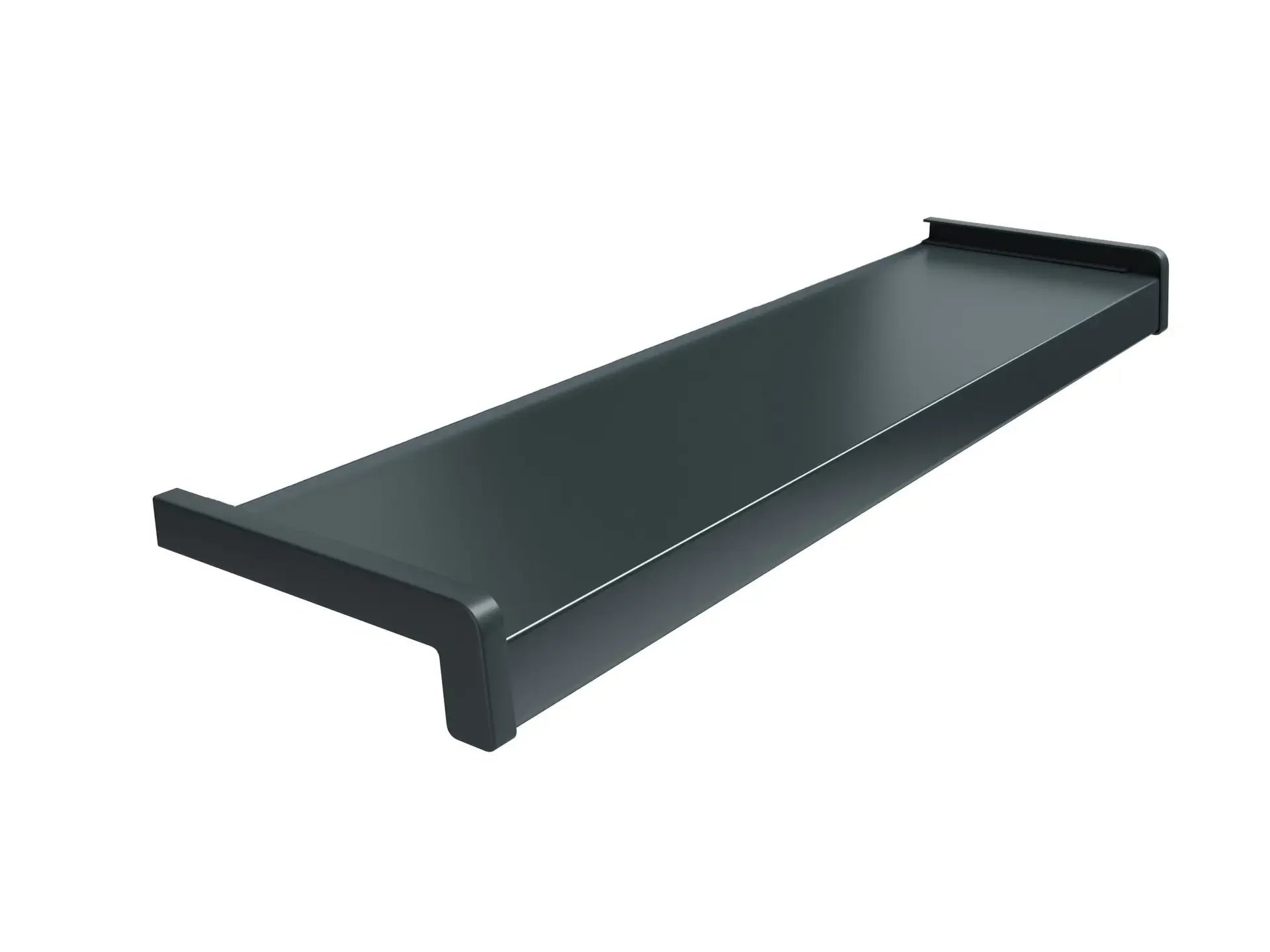
Description
Sized for the 90–120 mm insulation build that defines most modern UK EWI specifications, the Anthracite Oversill 2.5 m × 170 mm is the workhorse projection in the anthracite oversill family — deep enough to clear graphite EPS and standard mineral wool builds with the 30–40 mm drip margin proper detailing demands, without the visual mass of the deepest 220 mm profile. Supplied through our window sill extensions and oversills collection, the profile is finished with industrial-grade powder coating and arrives wrapped in factory-applied PVC protective film. Stocked for trade self-collection from our Southampton counter.
What the 170 mm Anthracite Oversill Does in a UK Render or EWI System
The 170 mm Anthracite Oversill is a 2.5-metre powder-coated aluminium profile that carries the original window sill outward across the new EWI build of 90–120 mm insulation plus basecoat and topcoat, restoring the rainwater shedding that the original sill — sized for an uninsulated wall — can no longer deliver. The 170 mm projection is the most-specified depth in the anthracite range across UK EWI work because it corresponds to the insulation band that defines current Part L-driven specification: 90 mm graphite EPS, 100 mm standard EPS, or 100–120 mm mineral wool. The anthracite finish aligns with the RAL 7016 family that defines current UK contemporary specification on residential and commercial facades alike.
The profile carries a factory-applied PVC protective film across the visible face, retained through the rendering stage and peeled away after surrounding work has cured to taping-clean. At 2.5 metres per unit the profile cuts efficiently to suit windows from narrow utility openings up to full picture-window widths, with a single length typically serving 1.8–2.2 m openings once end-cap clearances are deducted.
Why Trade Specifiers Choose the 170 mm Anthracite Oversill
- Workhorse depth for standard EWI: the 170 mm projection fits the 90–120 mm insulation thicknesses that cover the majority of UK Part L-driven EWI specifications — graphite EPS, standard EPS and standard mineral wool builds.
- Industrial powder-coat finish: the factory-applied coating delivers consistent colour density and bonded surface protection across a service life that matches the typical 25–30 year EWI design horizon.
- Factory-applied PVC film: safeguards the visible face through transport and on-site handling, eliminating the additional cleaning step that exposed dark surfaces would otherwise require after render work.
- 2.5 m unit length: a single profile covers most UK domestic window widths in one piece, removing the visible joint line that two-piece installations introduce on a dark trim where any joint reads more visibly.
- Anthracite contemporary specification: aligned with the dark-trim aesthetic that has dominated UK new-build and EWI refurbishment over recent years, matching anthracite window frames and rainwater goods on a continuous facade line.
- Self-collection logistics: packed for damage-free transit from our Southampton warehouse, avoiding the courier-handling marks that visible facade products absorb on long transit.
Technical Specifications — 170 mm Anthracite Oversill Data Sheet
| Property | Value |
|---|---|
| Profile type | Window oversill extension for render and EWI systems |
| Material | Powder-coated aluminium extrusion, exterior grade |
| Colour | Anthracite (RAL 7016 family) |
| Length | 2.5 m |
| Projection (depth) | 170 mm |
| Insulation build accommodated | 90–120 mm standard EWI; up to 130 mm on sheltered elevations |
| Finish | Industrial-grade powder coating |
| Surface protection | Factory-applied PVC film, removed post-install |
| Compatible end caps | Anthracite end-cap pair (sold separately) |
| Delivery | Self-collection from Southampton — courier transit excluded |
| Storage | Flat, dry, protective film retained until install |
How to Fit the 170 mm Anthracite Oversill — Build-Up Match, Fall, Sealing
To confirm the 170 mm depth is right for your project, add the insulation thickness to the basecoat and topcoat allowance (typically 10–15 mm combined) and then add a 30–40 mm minimum drip projection beyond the finished render face. A 100 mm standard EPS build with 12 mm of basecoat and topcoat totals 112 mm — the 170 mm oversill leaves about 58 mm of projection, a comfortable drip clearance for exposed and weather-facing walls. For shallower 70–90 mm insulation builds, step down to the 140 mm anthracite oversill; for deep-retrofit and Passivhaus-adjacent builds running 140 mm insulation or more, step up to the 220 mm anthracite oversill.
Fit the oversill after the basecoat and reinforcing mesh have cured but before the decorative finish coat is applied. Set the profile with a slight outward fall — typically 5–10 degrees — so rainwater drains clear of the wall rather than tracking back toward the substrate. Bed the back upstand into a continuous neutral-cure silicone seal against the original masonry sill, fix mechanically at 300 mm centres along the back upstand, and pair with the matching anthracite end-cap pair at each reveal to close the watertight termination. For the full installation sequence — measurement, cutting, sealant routing and basecoat integration — the window sill extensions installation guide for UK projects walks through the trade method with worked examples.
Installation Notes — Fall Angle, Film Protection, Dark-Finish Discipline
Retain the protective PVC film on the visible face throughout render application and surrounding finishing work. Anthracite shows render splatter and basecoat marks far more visibly than white profiles, and the film prevents the additional cleaning step that exposed dark surfaces would otherwise require. Peel only after all render work around the window has cured to taping-clean and any final tidy-up is complete; early peeling at basecoat stage is the most common cause of remedial cleaning on dark trim at handover, and the cleanup is harder than the prevention.
Dark powder-coated surfaces reveal incorrect fall angles visually within a few weeks of service — rainwater that tracks back rather than drains forward leaves a faint mineral residue on anthracite that telegraphs the geometry error long after the install is complete. The 5–10 degree outward fall is therefore worth verifying before the mechanical fixings drive home, not after. Oversill detailing sits within the broader window reveal treatment that also includes stop beads at jambs and corner beads at external arris points; the render detailing around windows and doors pillar guide covers the full junction-by-junction coordination of profiles around openings.
Pro Tips From UK Installers Using the 170 mm Anthracite Oversill
The 170 mm depth is the volume specification in the anthracite range, and the discipline that separates a clean install from a marginal one sits in handling the dark finish well and getting the fall geometry right first time.
- Coordinate the RAL family at order stage: anthracite window frames vary across the RAL 7016 family; confirm the frame supplier's exact RAL with the project before ordering oversills so the facade line reads as one continuous anthracite tone.
- Edge-seal the cut ends immediately: a bare aluminium cut edge on anthracite reads as a bright silver line under raking light; tool a thin bead of anthracite silicone or matching touch-up along the cut edge before the end cap goes on.
- Verify fall on the wet bed, not after fixing: a long spirit level held at the front edge before the back upstand mechanical fixings drive home is the only reliable check; corrections after fixing distort the powder-coat surface.
- Carry anthracite-coloured silicone, not clear: clear sealant cures pale against anthracite and reads as a visible joint line; a colour-matched neutral-cure silicone disappears at the back upstand.
- Plan around prevailing weather face: on exposed weather-facing elevations the 170 mm gives a comfortable 50–60 mm projection past the finished render face — the safer margin compared to specifying 140 mm "to save material" on a wall that takes driving rain.
Is the 170 mm Anthracite Oversill Right for Your Project?
- Standard EWI builds (90–120 mm insulation): the workhorse projection depth for the most common UK EWI specifications including graphite EPS at 90 mm, standard EPS at 100 mm, and mineral wool at 100–120 mm.
- Lighter retrofit (70–90 mm insulation): the 140 mm anthracite oversill is the correct match — the 170 mm would project further past the finished render face than the build requires.
- Deep retrofit and Passivhaus-adjacent (140 mm+ insulation): step up to the 220 mm anthracite oversill for high-performance specifications running deeper insulation builds.
- White facade schemes: the 170 mm white oversill is the matched specification for traditional and conservation-zone work where existing fascia, rainwater goods and trim follow a white colour line.
FAQ — 170 mm Anthracite Oversill Coverage, Compatibility, Ordering
How do I confirm the 170 mm depth is right for my project?
Measure the total finished build from the original masonry face outward — insulation thickness plus adhesive layer plus basecoat plus decorative finish. The oversill projection should exceed that measurement by 30–40 mm to deliver proper drip clearance past the finished render face. For 90–120 mm insulation builds with standard 10–15 mm render thickness, the 170 mm depth gives the right overhang on exposed and weather-facing walls.
How does the 170 mm compare to the 140 mm and 220 mm anthracite oversills?
All three share the same 2.5 m length, powder-coated aluminium construction and anthracite finish. The 140 mm covers shallow builds (70–90 mm insulation) typical of partial-fill retrofits and conservation work; the 170 mm covers standard EWI (90–120 mm insulation, the Part L volume band); and the 220 mm is reserved for deep-retrofit and Passivhaus-adjacent specifications running 140–170 mm insulation. Selecting the depth that matches the actual build avoids both inadequate drip clearance and the visible step that overspecified profiles create.
Are end caps included with the oversill?
No — end caps are sold separately as a matched anthracite pair. Order the anthracite end-cap pair alongside the oversill so both arrive ready for the install sequence in one self-collection visit. One pair closes both ends of one oversill run.
Why is delivery limited to self-collection?
Powder-coated extrusions of this length and finish sustain corner damage during courier transit at a rate that makes shipping uneconomic for a visible facade product, and anthracite shows transit marks more readily than white. Self-collection from our Southampton counter ensures the profile arrives with the powder-coat edge intact and ready for install. Trade buyers collecting larger orders regularly can arrange scheduled pickup in advance to suit project schedules.
Should the protective PVC film come off before installation?
Keep the film in place throughout install and surrounding render work. Peel only after the render system around the window has fully cured and any surface cleaning is complete — the film exists specifically to protect the dark powder-coated face from render splatter and tooling marks during the build sequence, and dark finishes show splatter marks far more readily than white.
How does the anthracite finish age on south-facing and weather-facing elevations?
Industrial powder coating delivers stable colour retention through prolonged UV exposure subject to manufacturer guidance, with anthracite tones holding their depth across typical UK exposure cycles. Performance is best maintained when the protective film is removed only after install and the surface is kept clean of cementitious residue from the surrounding render work; routine facade washing supports long-term appearance across all elevation orientations.

