
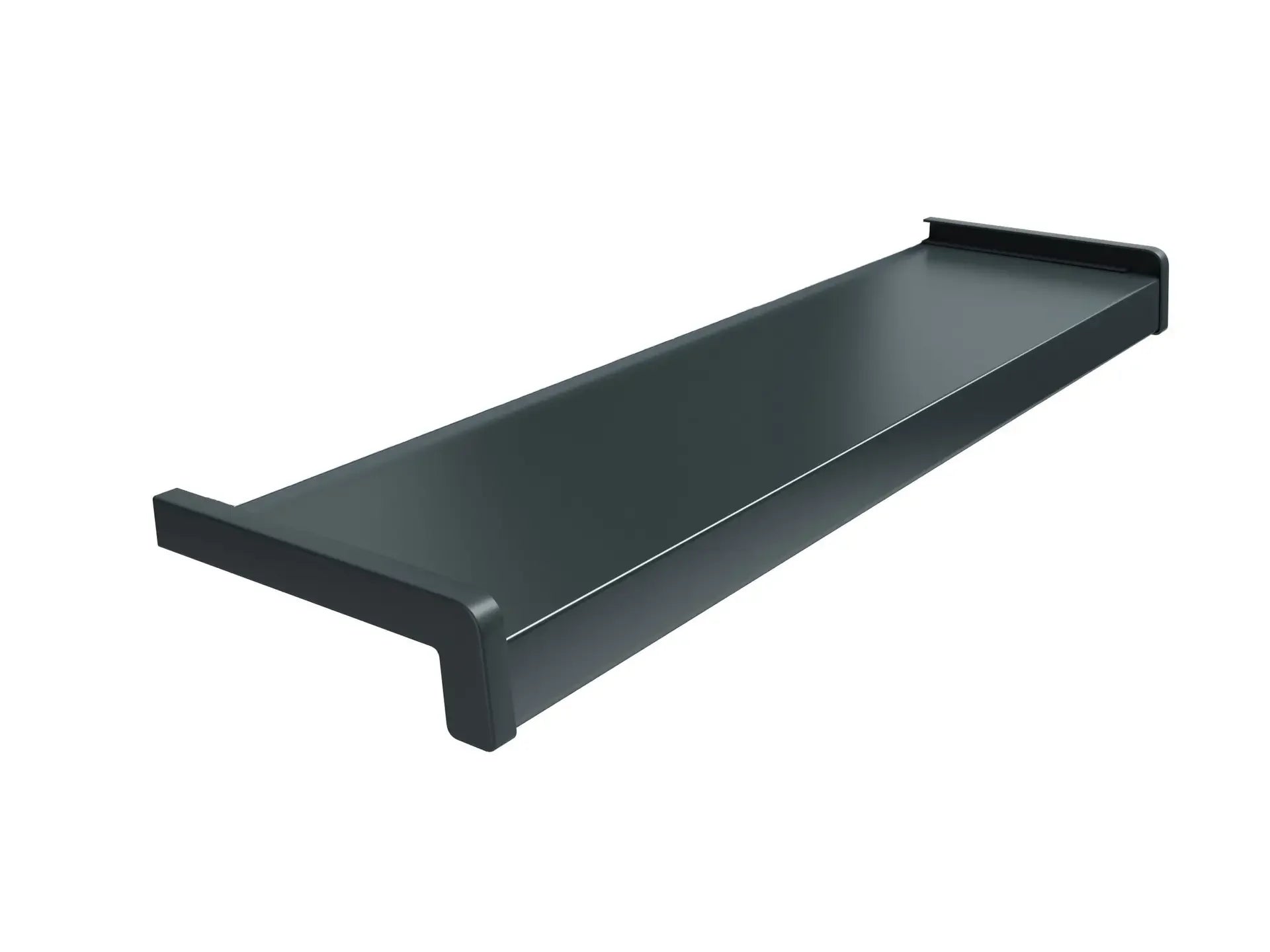

Description
Renders World stocks this profile as the shallowest of four anthracite over sill depths, and the page below carries only what could be read live this session. The profile sits in the window sill extensions and over sills range with the matching verge trims and end caps.
Where the 110 mm Anthracite Over Sill Works on a Rendered Wall
The over sill anthracite 2.5m 110mm depth profile carries a window's drip edge out past a newly rendered wall face, and it lists at £20.90 per 2.5 m length as at August 2026. Once insulation and render are added to an elevation, the original masonry sill no longer projects beyond the finished face, and an over sill restores that shed line across the opening.
This is the shallowest of the four anthracite depths Renders World publishes, which makes it the profile for the lightest external build-ups on a dark trim line — and the one to check most carefully against your own measurements, since the margin between the finished render face and the front of the profile is smallest here.
- Certain from the range itself: four anthracite depths at 110 mm, 140 mm, 170 mm and 220 mm, each on a 2.5 m length.
- Confirmed live this session: the price above, and stock showing as available at the time of the fetch.
- Confirmed on ordering: profile geometry, material and fixing guidance, checked against current stock by the technical desk.
Why Installers Specify a Matched Anthracite Over Sill
The reasons for choosing a matched profile over a generic one are practical rather than technical, and they hold on any depth in the range.
- One length per opening: a 2.5 m profile covers most domestic window widths in a single piece, which keeps the visible trim face unbroken across the head of the reveal.
- Colour continuity on dark schemes: anthracite trim reads as one line only where sills, verge trims and end caps come from the same colour family, so specifying them together is the straightforward route.
- Matched end caps available: the anthracite cap pair closes the cut ends of an anthracite run, and caps are colour-specific — a white cap on a dark run shows at the most visible point of the detail.
- Shallowest option in the family: where the external build is genuinely light, the 110 mm profile is the correct answer rather than a compromise, and stepping up unnecessarily adds projection the wall does not need.
- Sold as a single trade line: profiles, trims and caps come from one counter, so a single order closes every opening on the elevation.
Reading the 110 mm Depth Against Your Build-Up Before Ordering
Depth is chosen against the finished wall, not against the insulation alone. Measure the total added build outward from the original masonry face — board thickness, adhesive, the reinforced basecoat and the decorative finish — then choose a profile that projects past that finished face rather than stopping level with it. That method is sound and needs no document.
What the over sill anthracite 2.5m 110mm depth page will not do is convert that method into a depth-per-thickness chart. No manufacturer document for these profiles was retrievable this session by pointer, page or search, and a minimum drip projection is a manufacturer figure rather than something derivable on site. The full over sills and verge trims range takes the same position, which is why the two pages now agree.
- Send the build-up to the desk: board type, thickness and the render system going over it are enough for the desk to confirm the depth against current profile geometry.
- Measure the cured basecoat, not the drawing: the finished face is what the drip edge has to clear, and on light builds the difference matters proportionally more.
- Measure every opening separately: reveal depths on older housing vary along the same elevation, so one template carried across a wall fits poorly somewhere.
- Where the call is borderline, the step to the next depth is £3.00 at this end of the range, which makes the deeper profile an easy decision once the desk has confirmed the geometry.
How to Fit an Anthracite Over Sill Into the Render Build-Up
Sequence is what makes these profiles read as one clean line, and it sits inside the render programme rather than before or after it. Fixing centres, fall angle and the sealant specification all belong to a manufacturer document this session could not obtain, so they are confirmed on ordering rather than stated here.
- Fit after the boards, before the reinforced layer: the profile goes on once insulation is bonded and fixed, so the basecoat and mesh return up to its edge and lock it into the system.
- Set an outward fall: the profile drains forward, clear of the wall, rather than allowing water to track back toward the substrate.
- Bed the rear upstand in one continuous run of sealant rather than intermittent dabs — an uninterrupted line is what keeps driven rain out at the frame junction.
- Cut with a fine-toothed blade and deburr so an end cap seats without being forced onto a rough edge.
- Leave any protective film in place through basecoat and topcoat, peeling it once the render has cured, which keeps cementitious splash off the visible face.
The sill extension fitting guide works through measuring and cutting in order, and the reveal and opening detailing guide places this profile alongside the beads at the same openings — render stop beads at jamb terminations and render corner beads at external angles. The finish going over the whole detail comes from the thin-coat silicone render range.
The Four Anthracite Depths Side by Side
All four anthracite profiles share the 2.5 m length and differ on projection, so depth and price are the honest comparison. Prices below were read from the product pages in August 2026 and are material cost only.
| Profile | Price, August 2026 | Position in the range |
|---|---|---|
| 110 mm depth, this profile | £20.90 | Shallowest of the four |
| 140 mm anthracite over sill | £23.90 | One step deeper |
| 170 mm anthracite over sill | £27.90 | Two steps deeper |
| 220 mm anthracite over sill | Quote on the product page | Deepest of the four |
What the 110 mm Profile Costs and How It Reaches Site
At £20.90 for the 2.5 m length in August 2026, the over sill anthracite 2.5m 110mm depth is the lowest-priced profile in the anthracite range, and no VAT treatment was displayed alongside the figure. The price covers the profile alone: end caps are ordered separately, one pair per continuous run, in the matching anthracite.
Renders World processes orders the same day where stock is available, and delivery is arranged after the order rather than costed automatically, because profile lengths and pallet weights vary too widely for a checkout calculation. Small parcels up to 25 kg and pallets up to 1200 kg both move on a next-day courier service, with an economy option at two business days, and all deliveries are curbside. Free local delivery in the company van runs to 15 miles of the Southampton base above the order value set out in the shipping policy, with a per-mile charge beyond that to a limit of 60 miles.
Is the Shallowest Anthracite Depth the Right Call Here?
Four points settle it, and the last one is the quickest route to certainty.
- Light external build, dark trim line: where the added build-up is genuinely thin and the scheme calls for anthracite, this is the profile sized for it.
- Deeper or exposed builds: step to the 140 mm anthracite over sill or the 170 mm anthracite over sill where the finished face sits further out.
- White trim schemes: the same four depths run in white, and the matching profile is listed in the over sills and verge trims collection.
- Not certain yet: send the build-up to the technical desk and order the confirmed depth with its matching cap pair in one go.
FAQ — Depth, End Caps, Quantities and Care
How many profiles and end caps does one opening need?
One 2.5 m length covers most domestic openings in a single piece, and one end cap pair closes that run at both ends. Count caps by runs rather than by windows: a bay made from three separate sections takes three pairs, while one wide opening formed from a single profile takes one.
Do the anthracite end caps suit this depth?
Caps are supplied colour-matched and pair to their own trim, so an anthracite run takes anthracite caps. Cap-to-depth fit is confirmed by the desk when the order is placed, since no manufacturer compatibility document for these profiles was available this session.
Why is there no insulation thickness stated for this depth?
A depth-to-build mapping depends on a manufacturer's stated minimum drip projection, and no document carrying that figure could be retrieved. The earlier bands published here and on the sibling depths disagreed with each other, so the method and a desk confirmation replace them — a firmer answer than a figure with nothing behind it.
How is the profile looked after once the render is finished?
Periodic rinsing with clean water to clear airborne deposits is the whole of it, avoiding solvents and abrasive pads. Keeping cementitious runoff off the face during the build pays off most, since marking on a trim face usually comes from render residue rather than from the finish itself.