
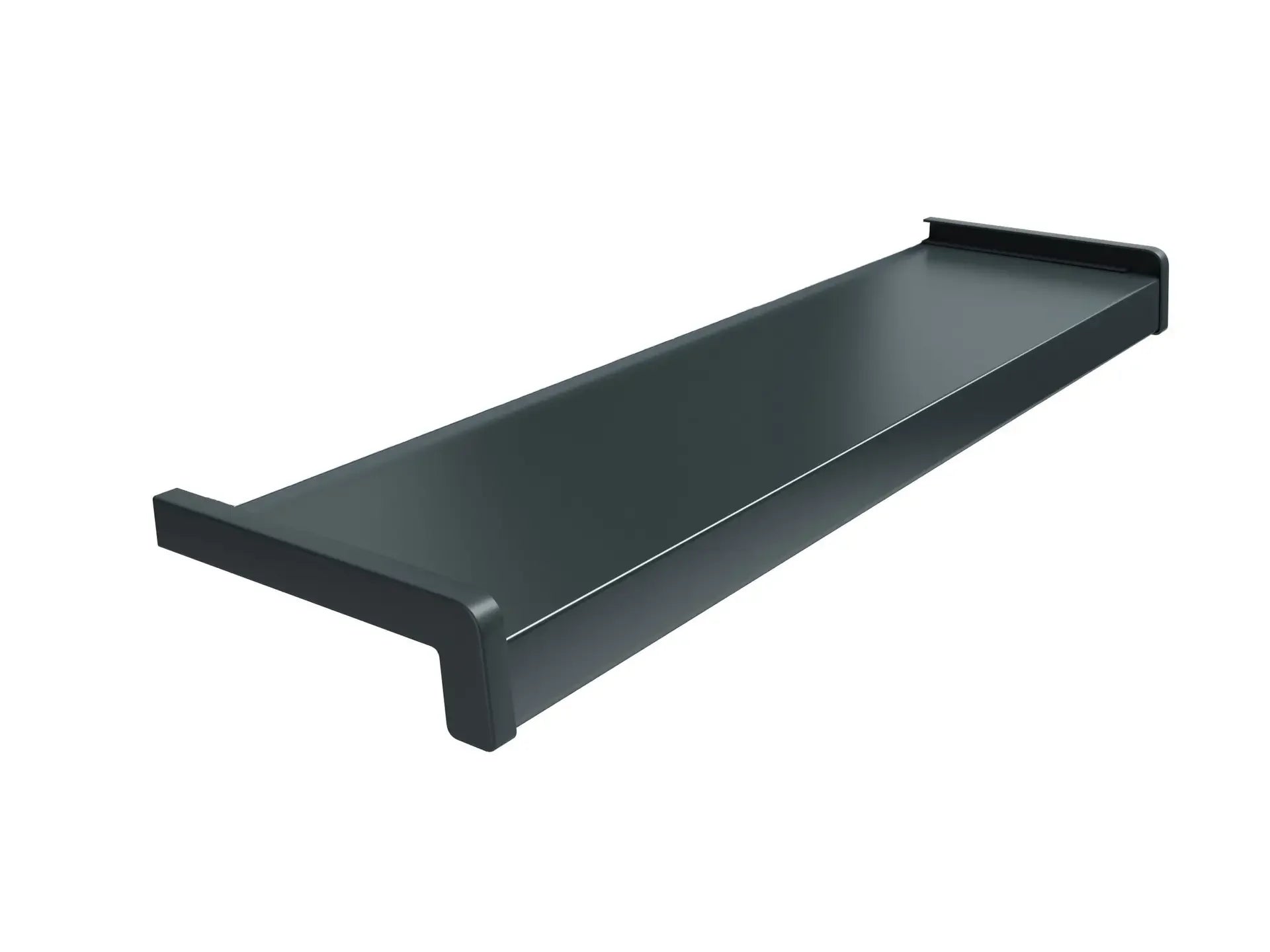
OVER SILL ANTHRACITE 2.5m 220mm DEPTH


Price:
Sale price£30.40

Shipping calculated at checkout

Stock:
In stock

Pickup available at Renders World Southampton

Usually ready in 2 hours

Description

For PAS 2035 deep-retrofit work, EnerPHit refurbishment, and forward-specified new-build EWI anticipating Future Homes Standard performance, the Over Sill Anthracite 2.5 m × 220 mm is the deepest projection in our anthracite oversill family — sized to carry the original window sill outward over EWI insulation builds in the 150–170 mm band, where standard 170 mm profiles run short of the finished render face. Powder-coated aluminium extrusion in RAL 7016 anthracite, supplied with factory-applied PVC protective film and stocked in our window sill extensions and oversills range for trade self-collection from Southampton.

What the 220 mm Anthracite Oversill Does in a UK EWI System

The 220 mm Anthracite Oversill carries the original window sill outward over insulation builds of 150–170 mm, providing the drip overhang that protects the rendered reveal below from rainwater tracking back against the substrate. At 2.5 m length and 220 mm projection in RAL 7016 anthracite powder coat, the profile addresses the deepest end of current UK EWI specification — typically PAS 2035 Whole-House refurbishment and EnerPHit-certified projects where fabric calculations drive insulation into the upper depth band.

An oversill at this projection is the structural transition between the masonry sill that remains in place and the finished render face that now sits 170–190 mm proud of the original wall plane. The visible architectural mass is meaningful at this depth: a 220 mm trim becomes part of the facade composition, not an unobtrusive detail, so anthracite is the dominant colour choice because the dark trim reads more sympathetically than white against the visual weight of a deep window reveal.

Why Specifiers Choose the 220 mm Anthracite Oversill for Deep Builds

  • Sized for 150–170 mm insulation builds: the projection delivers the 30–40 mm drip overhang past finished render needed on deep-retrofit and EnerPHit specifications, where shallower oversills would sit flush with or behind the render face.
  • RAL 7016 industrial powder coat: factory-applied coating gives consistent colour density across the trim, holding the contemporary aesthetic that aligns with the deep-retrofit project character on which this depth is most often specified.
  • PVC protective film through extended programmes: deep-retrofit work brings multiple trades through the window detail across weeks, and the factory film keeps the dark powder coat clear of render splatter and tooling marks until taping-clean handover.
  • Single 2.5 m profile per opening: covers domestic window widths in one length, avoiding the intermediate joint that would otherwise read as a visible architectural line on a 220 mm depth.
  • Forward-compatible with Future Homes Standard: the projection accommodates insulation depths anticipated as UK regulatory thresholds tighten, allowing forward-specified new-build work to lock detailing decisions without revisiting trim selection later.
  • Matched anthracite end caps available: closes both ends of the run in the same RAL 7016 finish — the anthracite end-cap pair is ordered alongside for a coordinated install.

Technical Specifications — 220 mm Anthracite Oversill Data

Property Value
Profile type Window oversill extension — deep projection
Material Powder-coated aluminium extrusion, exterior grade
Colour Anthracite, RAL 7016 family
Length 2.5 m (single unit)
Projection (depth) 220 mm
Insulation build accommodated 150–170 mm typical
Finish Industrial-grade powder coating, both faces
Surface protection Factory-applied PVC film, removed post-install
Recommended outward fall 5–10° for rainwater shedding
Compatible end caps Anthracite end-cap pair (sold separately)
Delivery route Self-collection only — Southampton counter
Storage Flat, dry, protective film retained until install

Courier transit is excluded for this product because powder-coated deep-projection profiles damage too frequently in transit to remain economic on visible trim.

How the 220 mm Anthracite Oversill Installs Over EWI

Fit the oversill after the basecoat and reinforcing mesh have cured but before the decorative finish coat goes on, so the trim is bedded into a stable substrate while the render face can be worked tight against the profile edge afterwards. Set the trim with a 5–10 degree outward fall so rainwater drains clear of the wall rather than tracking back behind the upstand toward the substrate. Bed the back upstand into a continuous neutral-cure silicone seal against the original masonry sill, then fix mechanically at recommended centres along the upstand.

At 220 mm projection the trim is structurally working harder than shallower profiles, so verify wind-uplift fixing capacity against the project's exposure category — particularly on south-westerly elevations facing prevailing UK weather. Retain the PVC protective film until all surrounding render and finishing work has cured to taping-clean, peeling it off only at handover. For the full installation sequence covering oversills, verge trims and end caps as a system, our window sill extensions installation guide walks through the order of work and detailing logic that applies across the whole trim family.

Installation Notes — Conditions, Sequencing, Film Removal

For the best result, plan the oversill fit between basecoat cure and decorative finish application so the render face can be worked cleanly against the trim edge. Confirm the back upstand sits flush against the original masonry sill before sealing, since gaps behind the upstand are difficult to remediate once the silicone bead cures and the surrounding render is applied.

The 220 mm projection means the visible face sits substantially proud of the wall plane, so on high-exposure facades supplementary mechanical fixings along the upstand may be advisable beyond standard centres. Keep the protective film intact through every adjacent trade interface — window installers, EWI applicators, and finishing teams will all pass over the trim across the install programme, and the powder coat is most reliably protected by leaving the film in place until the very end of the build sequence.

How the 220 mm Depth Compares to Shallower Anthracite Oversills

The anthracite oversill family runs across four projections, each matched to a different EWI insulation depth band. Choosing the right depth is a measurement decision: total finished build from the original masonry face outward should sit 30–40 mm short of the oversill projection to deliver proper drip clearance past the finished render face.

Anthracite Oversill Insulation Band Typical Project Type
140 mm depth 60–90 mm Mid-range refurbishment EWI
170 mm depth 90–120 mm Workhorse standard EWI builds
220 mm depth (this product) 150–170 mm PAS 2035 deep-retrofit, EnerPHit, forward-spec new build

If your insulation build falls outside the 150–170 mm band, the 170 mm or 140 mm anthracite oversill is the correct route — over-specification at 220 mm creates a visible architectural step at the window detail that is rarely intentional. Where the project specifies white trim rather than anthracite, the matched 220 mm white oversill covers the same insulation band in RAL 9010 powder coat.

Pro Tips From UK Installers Fitting Deep-Projection Oversills

  • Order the end caps with the oversill, not after: the matched anthracite pair has a lead time of its own, and arriving on site without caps leaves a deep trim run looking unfinished through inspection visits.
  • Mark the fall before bedding: a pencil line on the masonry sill showing the 5–10 degree outward angle keeps the trim consistent across multiple openings on the same elevation — small variations are visible at 220 mm projection where they would not be at 110 mm.
  • Validate the projection on elevational drawings first: 220 mm is a facade element, not a trim, so the architectural impact should be reviewed before the depth is committed — particularly on heritage-adjacent or sensitively-sited buildings.
  • Leave the PVC film on until handover: deep-retrofit programmes routinely run multiple weeks of post-render trade work around the window detail, and the powder coat survives those weeks reliably only with the factory film intact.
  • Check wind-uplift on exposed elevations: on south-westerly and coastal sites, the deeper projection benefits from supplementary mechanical fixings along the upstand beyond the standard centres specified for shallower trims.

Is the 220 mm Anthracite Oversill Right for Your Project?

  • Deep-retrofit and PAS 2035 Whole-House work: the correct projection for fabric specifications targeting U-values around 0.15 W/m²K on solid-wall properties, where insulation depth lands in the 150–170 mm range.
  • EnerPHit certified refurbishment: sized for the insulation depths typical of Passivhaus-standard refurbishment work, subject to project-specific building physics calculation.
  • Forward-specified new-build EWI: a sound choice where the project anticipates regulatory tightening over its programme and the team wants to lock the trim depth on a future-proofed basis.
  • Standard EWI at 90–120 mm insulation: the 170 mm anthracite oversill is the workhorse depth — the 220 mm projection would project past the render face and create a visible architectural step.
  • Mid-range builds at 60–90 mm insulation: the shallower 140 mm anthracite oversill matches the build depth without over-specification.

FAQ — 220 mm Anthracite Oversill Specification, Ordering, Fitting

How many oversills do I need for a typical window opening?

One 2.5 m oversill covers most domestic window widths in a single length, which matters at 220 mm projection because any intermediate joint becomes architecturally visible on a deep trim. Measure the opening width and add 30–50 mm overhang each side past the reveal. For wider openings exceeding 2.5 m clear, two profiles are joined with a manufacturer-approved jointing strip — plan the joint position to fall away from the visual centre of the opening.

How do I confirm 220 mm is the right depth for my project?

Measure the total finished build from the original masonry face outward — insulation thickness plus adhesive layer plus basecoat plus decorative finish — and compare against the projection. The oversill should exceed total build thickness by 30–40 mm to deliver proper drip clearance past the finished render face. Total builds in the 170–190 mm range are the right match for 220 mm depth; builds shallower than around 160 mm should typically run on the 170 mm oversill instead.

Are end caps included with the oversill?

End caps are sold separately as a matched pair. Order the anthracite end-cap pair alongside the oversill so both arrive together — one pair closes both ends of a single oversill run, and a coordinated delivery keeps the install sequence on programme.

Are there fixing implications at this projection depth?

At 220 mm projection the trim is structurally working harder than shallower alternatives, and wind-uplift loading on south-westerly elevations facing prevailing UK weather should be verified against the project's exposure category. Supplementary mechanical fixings along the upstand may be advisable on high-exposure facades — confirm against the project specification and any system-supplier guidance covering the EWI build-up in use.

How is the powder-coated finish maintained over the building's life?

The RAL 7016 powder coat is designed for long-term exterior durability and typically needs only periodic rinsing with clean water to remove airborne deposits. Avoid solvent cleaners or abrasive pads, which can dull the coating sheen over time. Any localised damage from impact during the building's life can be touched in with a matched RAL 7016 exterior-grade paint.

Will the deep projection cause issues with heritage planning consent?

On listed buildings or properties in conservation areas, a 220 mm projection is often a planning consideration regardless of trim colour, because the visible architectural mass changes the window detail proportion in ways that may not be acceptable to local planning authorities. Validate the projection through elevational drawings at the planning application stage and consult the local planning authority where heritage sensitivity applies, rather than committing to the depth in advance.

Why is this product self-collection only?

Powder-coated deep-projection profiles damage too frequently in courier transit to remain economic — the visible face is dark and any handling marks or coating chips show clearly against the RAL 7016 finish. Self-collection from our Southampton counter keeps the trim in good condition through to install, which is the outcome that matters most on visible facade detailing.

You may also like

Recently viewed