


Description
At 180 mm or 200 mm of insulation, no shorter plug in the LTX-10 series can do the job. The board depth alone consumes the entire reach of every other variant before the masonry is even touched. The LTX 220 mm exists for exactly this problem — the longest hammer-driven anchor in the range, supplied in 100-piece boxes rather than the 200-piece format used across the rest of the series, and built for Passive House and near-zero energy specifications where insulation depth is the headline of the build.
What the LTX 220 mm Plug Does in a UK EWI System
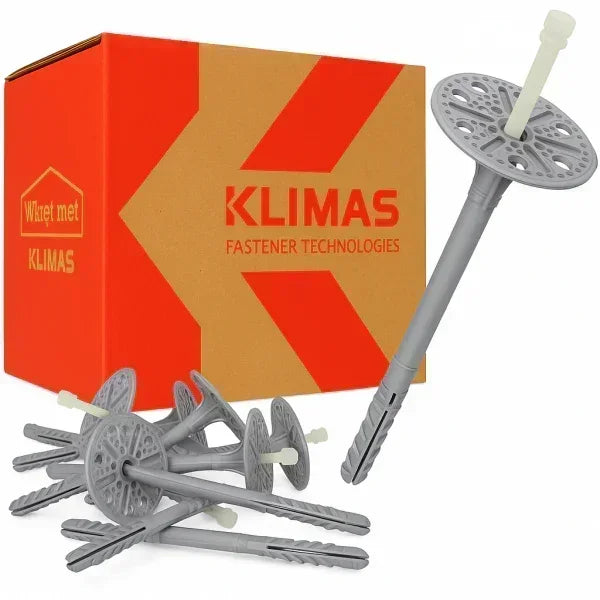
The Klimas LTX 220 mm polystyrene fixing plug is the maximum-length hammer-in mechanical anchor in the LTX-10 series — 10 mm sleeve, 60 mm flange, 30 mm anchorage into masonry, certified under ETA-16/0509 (ETAG 014) for fixing 180–200 mm insulation boards on new-build walls in UK external wall insulation systems. Supplied in 100-piece boxes from the insulation fixing accessories range, it is the only LTX variant that reaches the board thicknesses specified on certified Passive House projects and near-zero energy new-builds.
The 100-piece pack format is the defining commercial fact of this SKU. The increased sleeve length per unit means each plug occupies more material and box volume than shorter variants, so packaging dimensions stay manageable on site at half the standard pack count. Coverage per box falls to 12–17 m² at 6–8 fixings per square metre — half the area a 200-piece box of shorter plugs covers.
Like every other LTX-10 variant, the body is polyethylene and the expansion pin is glass-fibre-reinforced polyamide. No metal pathway runs from substrate to render, delivering 0.001 W/K at surface mount and a true 0.000 W/K when recessed. At 200 mm insulation thickness, that thermal discipline is what allows a Passive House U-value calculation to survive contact with the construction site.
What Makes the LTX 220 mm Plug Worth Specifying
- The Only LTX Variant That Reaches 180–200 mm Boards: The 220 mm length pairs with 180–200 mm graphite EPS boards on new-build masonry — the maximum insulation thicknesses in the Renders World range, associated with Passive House certification and certified near-zero energy performance. No shorter LTX plug provides adequate anchorage at these board depths.
- Engineered for the Highest-Stakes Thermal Builds: At 200 mm insulation, the U-value performance per square metre represents the largest thermal investment in the domestic specification range. All-plastic construction at 0.000 W/K immersed protects every fraction of that calculated performance — on Passive House projects, fractions of a watt determine certification outcomes.
- Retrofit Coverage to 180 mm Over Existing Plaster: On retrofit walls carrying 20 mm of existing plaster beneath the adhesive, the 220 mm plug accommodates 160 mm boards at surface mount and 180 mm boards when immersed — reaching the absolute maximum thicknesses specified under EnerPHit retrofit standards and PAS 2035 whole-house upgrades.
- Glass-Fibre Pin Tested at Range-Maximum Length: At 220 mm, pin rigidity is no longer a margin — it is the determining factor of consistent installation. Glass-fibre reinforcement in the polyamide pin maintains the stiffness needed to drive cleanly through the longest hammer path in the range without shaft flex.
- Manageable 100-Pcs Pack Format on Site: Half the pack count of shorter LTX variants keeps each box at sensible weight and dimensions for site handling. The smaller batch also matches the lower per-project volume of Passive House work — boxes turn over without long shelf storage.
- ETA-16/0509 Across Every Substrate Including AAC 2 and AAC 7: European Technical Assessment under ETAG 014 covers concrete from C12/15, solid clay and calcium silicate brick, perforated brick including Porotherm 25, lightweight aggregate block, and both autoclaved aerated concrete density grades — full coverage of UK low-density masonry substrates.
Technical Specifications — LTX 220 mm Data Sheet Highlights
| Parameter | Value |
|---|---|
| Product Code | LTX-10220 |
| Plug Diameter (dk) | 10 mm |
| Overall Length (Lk) | 220 mm |
| Flange Diameter (Dk) | 60 mm |
| Anchorage Depth (heff) | 30 mm · 50 mm for aerated concrete |
| Drill Hole Depth (h0) | 40 mm · 60 mm for aerated concrete |
| Body Material | Polyethylene (PE) |
| Pin Material | Polyamide reinforced with glass fibre (PA + GF) |
| Washer Stiffness | 0.50 kN/mm |
| Thermal Transmittance (χ) — surface mount | 0.001 W/K |
| Thermal Transmittance (χ) — immersed mount | 0.000 W/K |
| Characteristic Pull-Out — Concrete C20/25 | 0.75 kN |
| Characteristic Pull-Out — Solid Brick | 0.75 kN |
| Characteristic Pull-Out — Perforated Brick | 0.60 kN |
| Characteristic Pull-Out — Porotherm 25 | 0.60 kN |
| Characteristic Pull-Out — Lightweight Aggregate Block | 0.40 kN |
| Characteristic Pull-Out — AAC 2 (lower density) | 0.50 kN |
| Characteristic Pull-Out — AAC 7 (higher density) | 0.60 kN |
| Certification | ETA-16/0509 (ETAG 014) |
| Pack Quantity | 100 pcs |
How the LTX 220 mm Plug Installs in a Render or EWI System
The LTX 220 mm enters the ETICS build-up after the adhesive bonding the insulation board to the substrate has fully cured — typically 24 hours on EPS at +20 °C. A 10 mm hole is drilled through the full board thickness and 40 mm into the masonry (60 mm into aerated concrete), the plug body is inserted until the flange sits flush against the board face, and the glass-fibre-reinforced pin is driven home with steady hammer rhythm until the head seals against the sleeve collar. Basecoat with embedded fibreglass mesh then covers the flange, preparing the surface for the high-specification render finish typical of Passive House and near-zero energy facades.
Fixing density follows the project wind-load calculation, typically 6 plugs per square metre in central zones, rising to 8 at corners and edges and 10 on exposed elevations above 15 metres. The fixing pattern and spacing calculation guide sets out the layout method aligned with ETAG 014 wind-load categories, and the step-by-step installation guide for insulation fixings details every stage from substrate assessment through drill-mode selection to final inspection.
Installation Notes — 100-Pcs Pack Planning, Bit Reach, Hole-by-Hole Discipline
Pack planning is the first install consideration that distinguishes the 220 mm plug from every shorter LTX variant. A standard semi-detached or detached Passive House new-build at 180–200 mm insulation typically requires 500–800 fixings across all elevations, which translates to five to eight 100-piece boxes — roughly double the box count of a 200-piece pack format for the same fixing total. Stage delivery and on-site storage accordingly, and brief site supervisors that mid-project reorder lead time at this specification level can affect the programme more significantly than on standard builds.
Drill bit reach is non-negotiable at this length. A standard 210 mm SDS masonry bit cannot reach the substrate through 180–200 mm of insulation plus 40 mm of anchorage depth. A 300 mm bit is the absolute minimum, and a 350 mm bit gives the operator clearance margin that produces consistent hole geometry across an elevation. Bit wear is the fastest of any plug in the range — budget for one replacement bit per 300–350 holes to hold hole diameter within the certified tolerance.
Hole-by-hole discipline closes the install. Every hole at this depth needs depth verification with a calibrated stop, dust clearance via mechanical passes plus a compressed-air burst, and a perpendicularity check before plug insertion. Over-drilling by 10 mm at this length creates a void behind the expansion zone that prevents the expansion wings from bearing against solid masonry — and unlike at shorter plug lengths, the void is impossible to detect visually after the plug is seated. Immersed mounting with an EPS countersinking cutter and grey EPS finishing caps achieves 0.000 W/K per fixing and is the standard method on Passive House work, not an upgrade option.
What UK Installers Do Differently With the LTX 220 mm Plug
- Build quality verification into the programme as a fixed line item: At Passive House investment levels, hole-by-hole quality checks are scheduled work, not optional discipline. Three fixings per elevation should be verified for depth, dust clearance, perpendicularity, and pin seating before basecoat application — make it a documented step, not an end-of-day visual scan.
- Recalculate box counts on the 100-pcs format: Estimators familiar with the 200-piece LTX range can default to halving the box count from habit; the 220 mm pack is already half. For 600 fixings, the answer is six boxes, not three. Set the order spreadsheet to flag the 220 mm SKU separately.
- Carry a 350 mm bit, not just 300 mm: The extra 50 mm of bit length translates to noticeably faster drilling rhythm because the operator does not need to apply forward pressure to extract the bit from a tight hole. On a 700-fixing project, that rhythm difference shortens drilling by half a day.
- Replace bits at 300 holes on AAC and LAC substrates: The certified pull-out values on lightweight aggregate and lower-density AAC blocks are sensitive to hole diameter creep from worn bits. Tighter bit-replacement intervals on these substrates protect the design pull-out figure.
- Use immersed mounting on every elevation without exception: Passive House U-value calculations assume the thermal envelope performs as drawn. Surface-mounted fixings at 0.001 W/K per plug, repeated 600–700 times across a building, introduce a measurable performance gap. The countersinking step is the cheapest way to close it.
Is the LTX 220 mm Plug Right for Your Project?
- Choose the LTX 220 mm if you are fixing 180–200 mm EPS or XPS boards on new-build masonry, or 160–180 mm boards on retrofit walls with up to 20 mm of existing plaster — the certified Passive House and near-zero energy thickness band.
- Stepping down to deep-renovation thicknesses? The LTX 200 mm plug at 200 pcs per box is the precise length for 160 mm boards on deep retrofit and near-Passive House builds, with the larger box format that suits higher-volume projects.
- Stepping down to Part L compliance thicknesses? The LTX 180 mm plug at 200 pcs per box matches 140–150 mm boards on standard Part L specifications and is the most common length on current new-build EPS work.
- Specifying mineral wool for fire-rated or high-rise façades? Higher-density mineral wool and fire-strategy requirements typically call for metal-pin fixings with greater pull-out capacity; the broader mechanical fixings range includes heavy-duty variants for those specifications.
FAQ — LTX 220 mm Coverage, Pack Format, Ordering
Why is the 220 mm plug sold in 100-piece boxes when every other LTX variant comes in 200?
The 220 mm is the longest plug in the LTX-10 range, and the increased sleeve length per unit means each plug occupies more material volume and packaging space than shorter variants. A 100-piece box keeps overall pack dimensions and weight at the level that suits single-person site handling — a 200-piece box of 220 mm plugs would be impractical to lift and stack on a working scaffold. When estimating quantities, allow that each box covers 12–17 m² of wall area at 6–8 fixings per square metre, roughly half the coverage of a 200-piece box of shorter plugs.
What is the maximum insulation thickness this plug can secure?
On new-build substrates with a 10 mm adhesive layer, the 220 mm plug accommodates boards up to 180 mm thick with surface mounting and up to 200 mm with immersed mounting using an EPS hole cutter. On retrofit substrates carrying 20 mm of existing plaster, the working range is 160 mm at surface mount and 180 mm when immersed. These are the absolute maximum insulation thicknesses in the LTX system — beyond 200 mm, the standard ETICS mechanical fixing approach is replaced by alternative anchorage strategies designed for ultra-thick builds.
How many boxes are needed for a Passive House detached property?
A typical detached Passive House new-build presents 80–120 m² of external wall area for insulation, depending on storey height and gable configuration. At 6 fixings per square metre in central zones and 8 per square metre at corners and edges, total requirement falls between 500 and 800 fixings. Five to eight 100-piece boxes cover that range. Ordering one additional box as reserve is sensible at this specification level — misdrilled holes are more likely at 220 mm depth than at shorter plug lengths, and the lead time to source a replacement box mid-programme can affect the certification inspection schedule.
How does the 220 mm plug perform on autoclaved aerated concrete blocks?
Characteristic pull-out on AAC blocks varies by density grade: 0.50 kN on AAC 2 (lower density) and 0.60 kN on AAC 7 (higher density). Both values meet the design requirements for standard domestic EPS insulation under typical UK wind-load conditions, but the difference between grades matters on exposed elevations where the wind-load calculation runs closer to the design margin. The 50 mm anchorage depth specified for aerated concrete (60 mm drill hole) is essential — driving to standard 40 mm anchorage compromises the certified performance on these substrates. Rotation-only drilling mode is non-negotiable to preserve the block's cellular structure.
Can I install the 220 mm plug with a standard 210 mm SDS masonry bit?
No — at 220 mm plug length with 180–200 mm board thickness plus 40 mm anchorage, the required total drilling depth exceeds the reach of a 210 mm bit once chuck depth and operator clearance are subtracted. A 300 mm bit is the practical minimum and a 350 mm bit is the preferred choice for consistent drilling rhythm across an elevation. Bit wear is the fastest of any plug in the range at this depth, so factor one replacement per 300–350 holes into the project material list.
Does the all-plastic construction support Passive House certification environmental criteria?
The polyethylene body and polyamide pin are recyclable thermoplastics, and the cardboard outer packaging enters standard paper and card recycling streams. The all-plastic construction carries lower embodied carbon per fixing than steel-pin alternatives, which contributes positively to the whole-life carbon assessment and embodied-energy calculations integral to Passive House and EnerPHit certification frameworks. On a building with 600–800 fixings, the cumulative embodied-carbon difference between all-plastic and steel-pin systems is a measurable line in the certification dossier.
What ambient conditions does the plug install in?
The polyamide pin retains its drive characteristics across UK site temperatures, from cool winter mornings down to around +5 °C through to summer heat above 25 °C. As with all ETICS fixings, the underlying adhesive must have reached the manufacturer-specified cure time before mechanical fixing begins — typically 24 hours on EPS at +20 °C, extended in colder conditions. Avoid driving plugs into substrates that are visibly frosted or saturated.
Technical Documentation — LTX-10 TDS and Anchorage Reference
- Klimas LTX-10 Product Data Sheet (PDF) — covers all LTX-10 length variants including the 220 mm anchor.


