
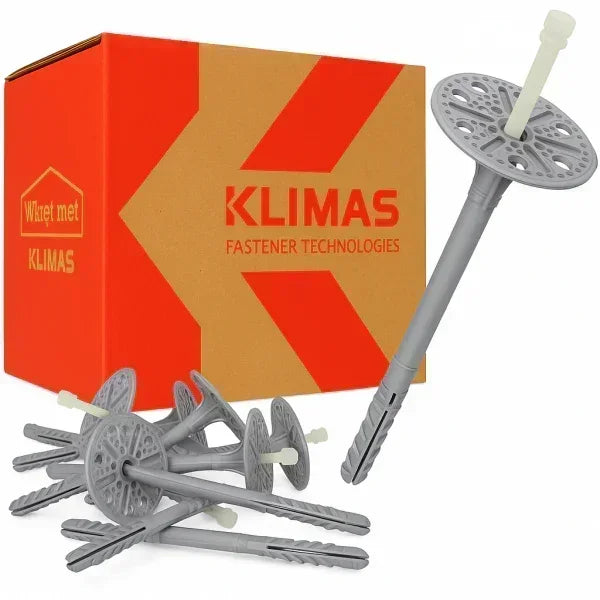

Description
The LTX 200mm polystyrene fixing plug 200pcs box is the Klimas LTX-10 length for a 160 mm insulation board on new or stripped brick, block or concrete. Over about 20 mm of old plaster it holds a 140 mm board. Each plug is a plastic sleeve and pin, hammered in, with a 60 mm plate on the board face.
It is also the longest LTX length that comes 200 to a box; the next one up, 220 mm, is packed in hundreds. The full set of lengths is in the insulation fixing accessories range.
Boards the 200 mm Plug Fixes
Board thicknesses for the 200 mm plug on brick, block and concrete, from the Klimas selection table:
| Wall | Plate on the board face | Plate recessed |
|---|---|---|
| New or stripped wall, 10 mm adhesive bed | up to 160 mm | up to 180 mm |
| Old plaster of 20 mm plus the adhesive bed | up to 140 mm | up to 160 mm |
The 2026 assessment's formula lands on the same numbers: 200 − 10 − 30 = 160 mm on a new wall, 200 − 30 − 30 = 140 mm with old plaster behind the adhesive.
Aerated concrete asks for 50 mm in the block, so the plug gives 20 mm less board: 140 mm on the surface or 160 mm recessed on a new wall, and 120 mm or 140 mm over old plaster.
What the 200 mm Length Does Well
- 160 mm boards on bare masonry, plate on the surface — this length's own row.
- Up to 180 mm recessed on a new wall, once the plate is sunk into the board.
- 140 mm boards over old plaster without stripping the wall first.
- Still 200 per box. The pack only drops to 100 at 220 mm, so price per plug stays easy to compare with the shorter lengths.
- No metal through deep insulation. 0.001 W/K per plug on the surface and 0.000 W/K recessed, from a polyethylene sleeve and a glass-fibre reinforced polyamide pin.
LTX-10200 Specification
| Parameter | Value |
|---|---|
| Product code | LTX-10200 |
| Sleeve diameter × length | 10 × 200 mm |
| Plate diameter | 60 mm |
| Drill bit | 10 mm (cutting diameter up to 10.45 mm) |
| Anchorage depth in the wall | at least 30 mm; 50 mm in aerated concrete |
| Drilled hole depth | at least 40 mm; 60 mm in aerated concrete |
| Sleeve material | Polyethylene |
| Pin material | Polyamide, glass-fibre reinforced |
| Point thermal transmittance | 0.001 W/K on the surface · 0.000 W/K recessed |
| Plate stiffness | 0.50 kN/mm |
| Minimum spacing, edge distance and wall thickness | 100 mm each |
| European Technical Assessment | ETA-16/0509 of 30 March 2026 |
| Box | 200 plugs |
Pull-Out in Each Wall Type
| Wall | Drilling | Characteristic pull-out |
|---|---|---|
| Concrete C12/15 | hammer | 0.50 kN |
| Concrete C20/25 to C50/60 | hammer | 0.75 kN |
| Solid clay brick | hammer | 0.75 kN |
| Calcium silicate solid brick | hammer | 0.60 kN |
| Calcium silicate hollow block | hammer | 0.60 kN |
| Vertically perforated clay brick | rotary only | 0.60 kN |
| Porotherm 25 perforated block | rotary only | 0.40 kN |
| Lightweight concrete block | rotary only | 0.60 kN |
| Aerated concrete, density from 0.35 kg/dm³ | rotary only | 0.50 kN |
| Aerated concrete, density from 0.65 kg/dm³ | rotary only | 0.60 kN |
Concrete: the Klimas sheet gives 0.75 kN from C20/25, the 2026 assessment from C16/20 — for concrete whose grade is not known, count on 0.50 kN. All values are characteristic; the fixing design applies safety factors and sets how many plugs go into each square metre.
Fitting the 200 mm Plug
- Bond the boards with adhesive before any plug goes in; plugs work against wind suction only.
- Drill a 10 mm hole where adhesive is behind the board. On a 160 mm board the hole runs through board and adhesive and then at least 40 mm into the wall — 60 mm into aerated concrete — so the bit must be long enough for the full depth.
- Drill without hammer into perforated brick, hollow block and aerated concrete.
- Take the dust out with four slow in-and-out strokes.
- Plate flush, then the pin, driven in one go. Do not hit a set pin again.
Plugs need 100 mm between them and from the wall edge, fixing between 0 °C and +40 °C, and mesh and base coat over the plates within six weeks. Whole-wall sequence: the guide to installing insulation fixings.
Recessing the 200 mm Plug
The WK-FT cutter from Klimas sinks the plate into the board, the pin is driven and a polystyrene disc closes the recess. With this length that allows 180 mm of board on a new wall and 160 mm over old plaster, at 0.000 W/K per plug.
Selection Table for All LTX Lengths
Every length Renders World stocks, on brick, block or concrete. "New wall" counts a 10 mm adhesive bed; "old plaster" counts that bed plus 20 mm of plaster.
| Plug | New wall, surface | New wall, recessed | Old plaster, surface | Old plaster, recessed |
|---|---|---|---|---|
| 70 mm | 30 mm | 50 mm | 10 mm | 30 mm |
| 90 mm | 50 mm | 70 mm | 30 mm | 50 mm |
| 110 mm | 70 mm | 90 mm | 50 mm | 70 mm |
| 120 mm | 80 mm | 100 mm | 60 mm | 80 mm |
| 140 mm | 100 mm | 120 mm | 80 mm | 100 mm |
| 160 mm | 120 mm | 140 mm | 100 mm | 120 mm |
| 180 mm | 140 mm | 160 mm | 120 mm | 140 mm |
| 200 mm (this box) | 160 mm | 180 mm | 140 mm | 160 mm |
| 220 mm (100 per box) | 180 mm | 200 mm | 160 mm | 180 mm |
Add any plaster beyond 20 mm to the board thickness before reading the table, or run the build-up through the plug length calculator.
Picking Between 180, 200 and 220 mm
- 200 mm for 160 mm EPS insulation boards on a new or stripped wall, or 140 mm boards over about 20 mm of old plaster.
- 220 mm for 180 mm boards on a new wall, or 160 mm over old plaster, plate on the surface.
- 180 mm for 140 mm boards on a new wall.
LTX 200 mm Plug — Questions Before Ordering
Which plug for a 170 mm board?
There is no 170 mm row. On a new wall the 200 mm plug reaches 160 mm on the surface or 180 mm recessed; the 220 mm plug reaches 180 mm on the surface. So: 220 mm with the plate on the surface, or 200 mm recessed.
How many boxes for a 100 m² wall?
At the Klimas minimum of 6 plugs per m² in the field and 8 per m² at corners (walls up to 15 m), 100 m² needs 600 to 800 plugs — three to four boxes of 200.
On walls above 15 m the minimum becomes 8 per m² in the field and 10 per m² at corners. The insulation design for the building fixes the number.
What does old plaster change?
About 20 mm of plaster plus the adhesive bed takes 30 mm of the plug before it reaches the wall, so the surface-fixed board drops to 140 mm. Recessed, it is back to 160 mm.
Which walls need rotary drilling?
Perforated clay brick, Porotherm 25, hollow blocks, lightweight concrete block and aerated concrete. Hammer drilling is used in concrete and solid brick.
Is it suitable for stone wool?
Klimas recommends the LTX-10 for EPS and XPS polystyrene boards. Stone wool slabs are fixed with the plug the wool system names.
How do I close a recessed fixing?
Klimas's method is the WK-FT cutter to make the recess and a polystyrene disc pressed in over the plate before base coat.