


Description
The Atlas decorative render sample book puts concrete, wood, metal and brick finishes side by side on fold-out panels, so a facade look can be chosen from the finish itself rather than from a screen. It sits among the render colour samples at Renders World, and it is printed in Polish.
What the Atlas Decorative Render Sample Book Is
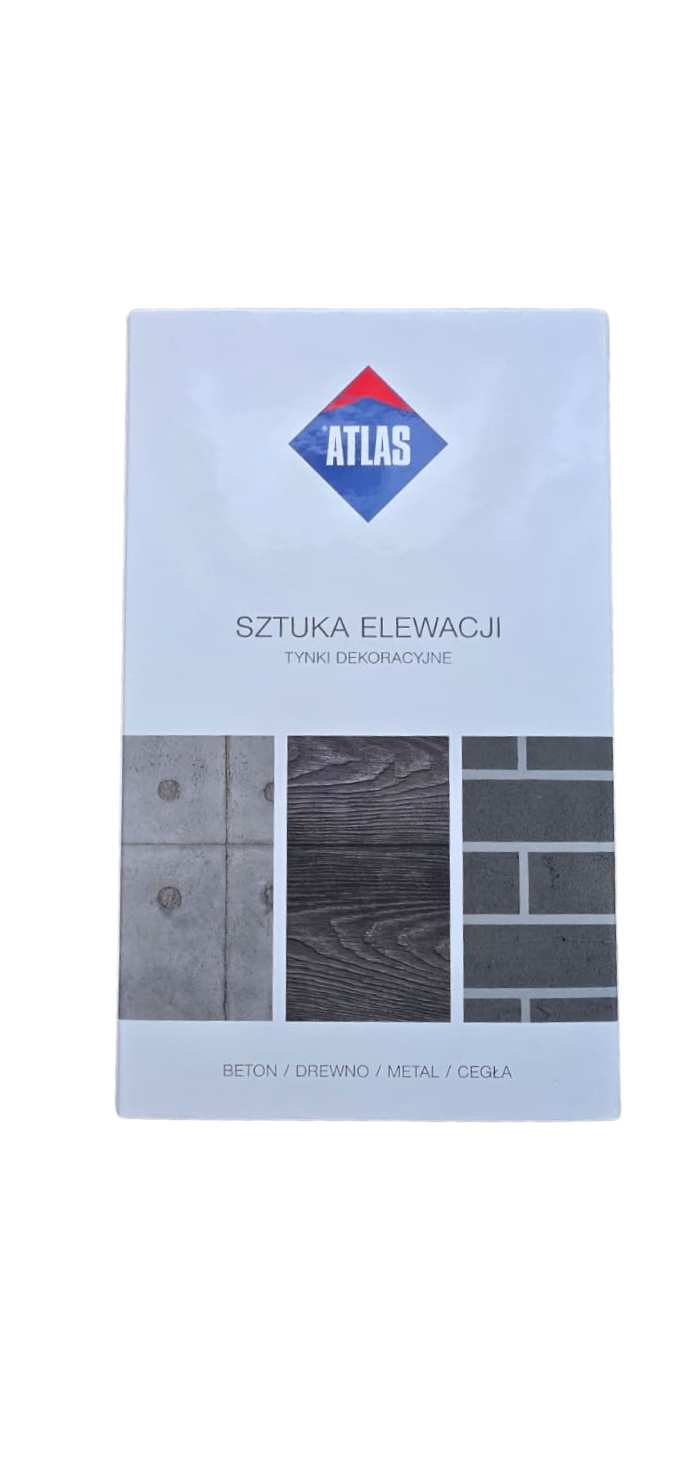
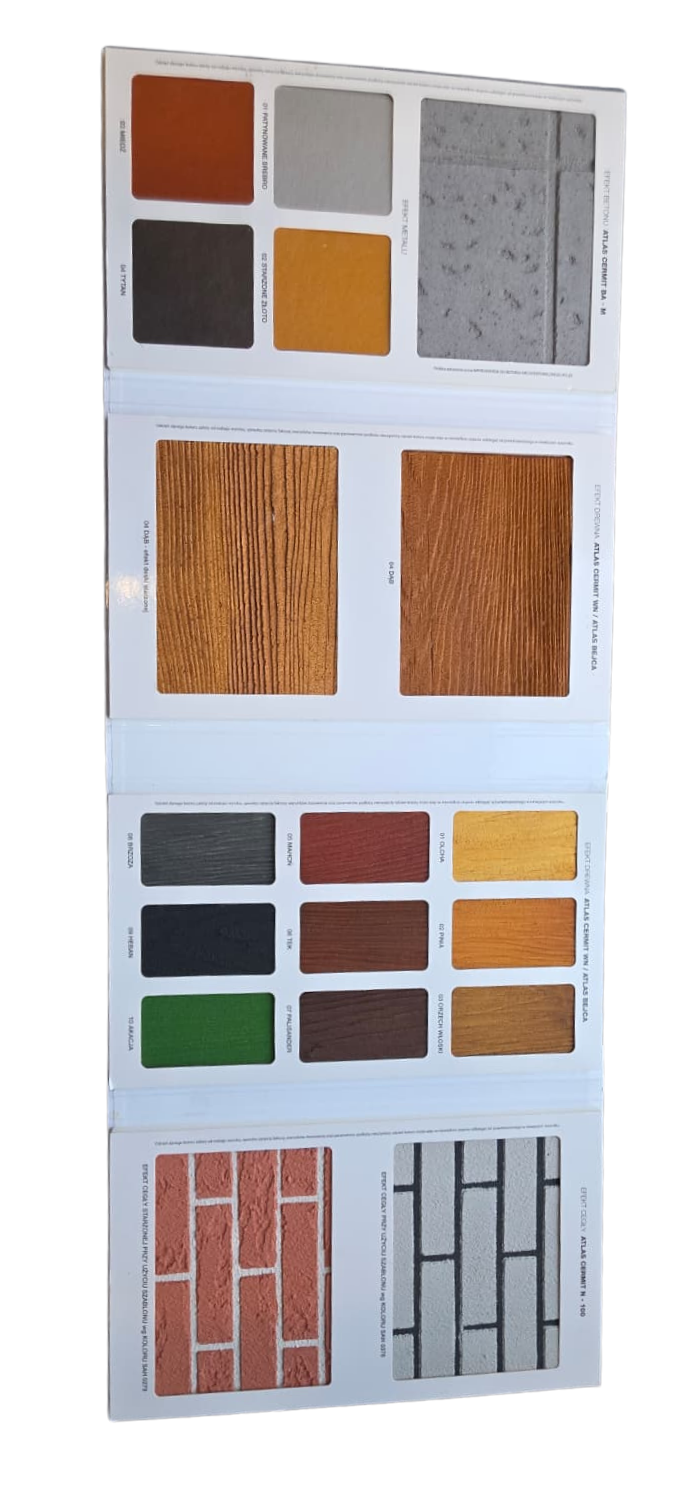
This is Atlas's printed swatch book for its decorative renders. The cover reads SZTUKA ELEWACJI, TYNKI DEKORACYJNE — the Polish title of Atlas's decorative render series — and names four effects: beton, drewno, metal and cegła, which are concrete, wood, metal and brick. Inside, the book opens into fold-out panels, one group of swatches per effect, most of them headed with the Atlas product that makes the finish.
The four effects in the book are not all sold here in the form Atlas makes them, and that is the most useful thing to know before ordering. The table sets out what each panel shows and what Renders World sells for that look: the wood panels match the shelf, the concrete and brick panels carry Atlas renders that are not stocked, and the metal panel has no counterpart here.
| Effect | What the panel shows | Sold here for that look |
|---|---|---|
| Wood | Oak fresh and aged, nine more stains | ATLAS CERMIT WN, BEJCA in four colours |
| Concrete | An Atlas mineral concrete render | ATLAS SILKON BA instead |
| Brick | Light and aged red stencilled brick | Ceresit CT 60 Visage instead |
| Metal | Silver, gold, copper, titanium | Nothing — not sold here |
The Ten Wood Stain Colours, and the Four on the Shelf
The wood panels are the part of the Atlas decorative render sample book that maps straight onto this shop's shelf. Atlas's wood effect is a system — the mineral CERMIT WN render pressed with a silicone form imitating timber, a release agent for the form, and BEJCA stain over the top — and the stain comes in ten colours. The book labels them in Polish, and the English names below are the ones on Atlas's own English BEJCA card.
| Label in the book | Colour | At Renders World |
|---|---|---|
| 01 OLCHA | Alder | Not stocked |
| 02 PINIA | Pine | Not stocked |
| 03 ORZECH WŁOSKI | Walnut | ATLAS BEJCA 03 Walnut |
| 04 DĄB | Oak | Not stocked |
| 05 MAHOŃ | Mahogany | Not stocked |
| 06 TEK | Teak | ATLAS BEJCA 06 Teak |
| 07 PALISANDER | Rosewood | Not stocked |
| 08 BRZOZA | Birch | ATLAS BEJCA 08 Birch |
| 09 HEBAN | Ebony | ATLAS BEJCA 09 Ebony |
| 10 AKACJA | Acacia (a green) | Not stocked |
The aged-plank finish in the book is shown on oak only. Atlas's publication for this series shows every colour both ways, fresh and aged, because the stain gives either look depending on how it is applied. The stamp and the release agent sit in the timber effect render range with the render and the stains, which is where the method is bought as a set.
Reading a Swatch Before You Order
Atlas states that the colours it prints are illustrative and may differ slightly from the real shade, so the Atlas decorative render sample book narrows a choice rather than fixing a batch. Two habits make it work on site.
- Order by the number, not the name. The number printed under each wood swatch is the number in the stain's own name on the shelf, so 06 TEK in the book is BEJCA 06 Teak in the basket; the Polish word is not needed.
- Judge it where the finish will go. Atlas's own colour guidance asks for the surface structure and size, the light intensity and the substrate to be taken into account before a shade is chosen, and a panel held against the real elevation shows all of them.
Concrete and Brick: What the Shelf Holds Instead
The concrete panel shows an Atlas mineral render that this shop does not sell. The concrete look sold here is ATLAS SILKON BA, a silicone-based render with a smooth texture imitating architectural concrete, in nine recommended colours with any other shade made to order. Its own sheet names four effects it can give:
- architectural concrete with many pits
- monolithic concrete
- grooved slabs
- smooth slabs
The Atlas colour fan also sold here prints nine concrete strips labelled SILKON BA, which makes it the better reference when the concrete finish is the one being chosen.
The brick panels in the Atlas decorative render sample book come from an Atlas stencil render that is not stocked either. Brick is made here with a different maker's system: Ceresit CT 60 Visage plaster pressed through a Visage London brick stencil or a Visage Boston brick stencil. The book's brick panels show what a stencilled brick facade can look like, but they are not swatches of that system, so a brick colour is matched by eye rather than by code. The guide to wood and brick stencils walks through how both methods form their pattern, and the plaster and both stencils sit together in the brick stencil for render range.
The metal effect has no counterpart on this shelf, so its four swatches are a reference for a decorative finish that is not sold here.
Ordering, Delivery and Returns
The Atlas decorative render sample book is a single printed item, so it travels as a small parcel and is covered by the shop's ordinary terms.
- Dispatch: orders are processed the same day when the book is in stock.
- Delivery: not calculated at checkout — after the order, the customer service team contacts you with the most cost-effective option; small parcels up to 25 kg go next day, and every delivery is kerbside.
- Collection: from the counter at Unit 9A, Central Trading Estate, Southampton SO14 5JP, Monday to Friday 7am to 5pm and Saturday 7am to 12pm, telephone 023 8200 2442.
A change-of-mind return runs to 14 days, with the book in its original condition and bought directly from Renders World or its online store.
FAQ
Is the Atlas decorative render sample book in English?
No. The cover, the panel headings and the swatch labels are in Polish. Each wood colour has an English name as well — 06 TEK is teak, 09 HEBAN is ebony — and its number matches the stain on the shelf.
Does the shop sell every finish in the book?
Not in the form Atlas makes them. Wood is sold as Atlas's own method, with four of the ten stain colours. Concrete is sold as ATLAS SILKON BA, brick as Ceresit CT 60 Visage with stencils, and metal is not sold.
Can I order alder, pine, oak, mahogany, rosewood or acacia?
Those six colours appear in the book but are not on the shelf. The stocked colours are 03 walnut, 06 teak, 08 birch and 09 ebony.
Is the swatch the exact colour of the finished wall?
Atlas describes its printed colours as illustrative and says they can differ slightly from the real shade. The wall's own light, the texture of the finish and the way a stain is worked all move the result.
Which reference helps with a concrete finish?
For the concrete look sold here, the Atlas colour fan, which prints nine concrete strips labelled SILKON BA. This book's concrete panel belongs to a render the shop does not carry.
Technical Documentation
- Atlas — Sztuka elewacji, Vademecum Systemów Ociepleń part 1, edition 5 (PDF, Polish) — Atlas's own publication of the decorative render series the book belongs to.