

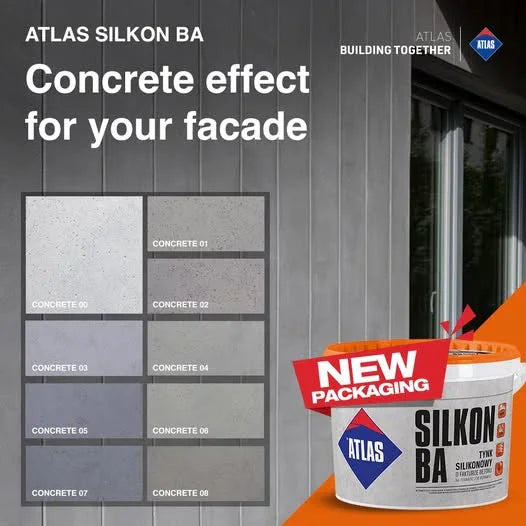


Description
A fair-faced concrete look on a rendered wall is made by hand, one coat laid over the next, by the person holding the float. Atlas Silkon BA concrete effect silicone render 20kg is made for that job, and the result depends on a wall prepared the way Atlas describes and on weather that gives the second coat its time.
Atlas Silkon BA Concrete Effect Silicone Render 20kg: What It Is and Where It Goes
It is a ready-to-use thin-coat render on a blend of silicone and acrylic resins, with surface hydrophobisers and fibre reinforcement, and an aggregate of up to 1.2 mm. Atlas declares it to EN 15824 and makes it to imitate architectural concrete, on a whole facade, in bossage or on sections of it.
- Insulated walls: the finishing coat of external wall insulation on EPS boards.
- Mineral walls: even, prepared concrete and traditional cement or cement-lime renders.
- Old tiles and showers: over existing ceramic tiles once they are primed and their bond has been checked, and as an interior render, including under the shower.
Atlas rules it out on horizontal surfaces under lasting water and snow, and on walls wetted by rising damp. Those details need a different product; the vertical wall above them is where this render belongs. At Renders World it sits in the wider concrete and timber effect range.
Finish, Colour and Weather Performance
- Four concrete looks from one bucket: heavily pitted architectural concrete, monolithic concrete, grooved slabs and smooth slabs, all made with the float, roller or brush during application.
- Dark colours with a limit: the Flex Tech resin blend allows dark facade shades with a light reflectance value (HBW) above 15%.
- Water Protect, a high share of hydrophobisers, keeps absorbency very low and lets the surface dry quickly once rain stops.
- Clean Technology: silicone resins, siloxanes, biocides and a tight surface let rain rinse off dust and dirt, and Atlas states long-lasting resistance to mould, algae and lichen.
Atlas recommends nine shades and makes any other shade to order, so the colour is settled with the order rather than on the wall.
Atlas Silkon BA Technical Data
| Property | Value |
|---|---|
| Pack | 20 kg bucket |
| Aggregate | up to 1.2 mm |
| Average consumption | 2.5 kg/m² |
| Standard | EN 15824:2017, DoP 272/CPR |
| Water vapour permeability | class V2 |
| Diffusion resistance | 0.14 m < Sd < 1.4 m |
| Water absorption | class W2 |
| Adhesion | 0.35 MPa |
| Air and substrate | +5 °C to +30 °C |
| Relative humidity | below 80% |
| Second coat | after about 2 hours* |
| Drying | about 24 hours |
| Shelf life | 12 months from production |
* At +20 °C and 50% relative humidity. The 2.5 kg/m² figure is an average; Atlas asks for a trial on the actual wall to fix the exact consumption, because a deeply pitted finish and a smooth slab do not use the same amount. As a component, it sits in Atlas insulation systems assessed in Poland — ATLAS ETICS (ITB-KOT-2020/1616, edition 3), ATLAS ROKER (ITB-KOT-2021/1919, edition 2) and ATLAS ROKER G (ITB-KOT-2018/0583, edition 2) — and those assessments belong to the systems, not to the bucket.
Preparing and Priming the Wall
The wall has to be stable, even, clean, dry and primed. Hollows are filled first with Atlas ZW 330 or Atlas plastering mortar over a wall primed with Uni-Grunt, Uni-Grunt Ultra or Grunt NKP, and any mould or algae comes off with Atlas Mykos Plus.
| Substrate | Before rendering | Priming on the Atlas sheet |
|---|---|---|
| New cement or cement-lime render | 7 days per 1 cm, moisture 4% | Cerplast |
| Concrete | 28 days, moisture below 4% | Cerplast |
| Reinforced layer of an ETICS | at least 1 day | Cerplast |
| Ceramic tiles | bond checked | Ultragrunt |
Indoors, plasterboard and fibre-cement boards take the render once they are fixed firmly and their moisture is below 2%, and a sound interior paint coat with good adhesion needs no seasoning time first.
On new render, concrete and the reinforced layer of an insulation system, the priming coat is Atlas Cerplast, sold at Renders World as Cerplast Quartz Top Coat Primer in the render base coat range; old ceramic tiles take Atlas Ultragrunt instead. Atlas Base Coat Paint does a different job: it is an interior undercoat for acrylic or latex paint, not a primer for this render.
Applying the Render by Hand
- Stir, and add nothing. The render is ready to use; it is never diluted, thickened or combined with other materials.
- First coat: lay it at aggregate thickness with a smooth stainless steel float or a Venetian float.
- Second coat: once the first has set, after about two hours, apply the second, scrape off the excess and pre-smooth towards the texture you want.
- Texture: for a stronger effect, work it straight away with a coarse-cell sponge roller or a brush float; smooth it with a Venetian float during initial setting, which is also how the burnt look is made.
- To divide the wall into panels, scratch lines gently with a flat screwdriver against a spirit level, or tape the first coat and pull the tape as soon as the second is on.
On a cold, damp day the render can take the Atlas setting accelerator Eskimo, which Atlas dedicates to Silkon BA; it is dosed by weight of render. The concrete effect application guide walks through the method on site.
Site Rules That Decide the Result
- Size the work by trial: the sheet asks for the largest area per laying-and-texturing cycle to be found by trial for that wall and that day's weather.
- Wet-on-wet only: a section that dries before the next is laid leaves a visible joint, so breaks are planned at corners, bends, under downpipes and at colour boundaries.
- One production date per surface: this is how the maker avoids shade differences, so buy each surface from one date.
- Protect the wall from direct sun, wind and rain while you work and while it dries; setting takes longer in high humidity and at around +5 °C.
- Tools go into clean water straight after use, and set residue comes off with Atlas Szop 2000.
Ordering and Collection
- Dispatch: Renders World processes orders the same day when the stock is there.
- Delivery: quoted by the team after the order is placed; every delivery is kerbside.
- Collection: Unit 9A, Central Trading Estate, Southampton SO14 5JP, Monday to Friday 7am to 5pm and Saturday 7am to 12pm.
A render tinted for your order is mixed for it and sits outside the 14-day change-of-mind return described in cancellations and returns.
FAQ — Atlas Silkon BA
How much render should I order?
Start from what the manufacturer gives, then test:
- average consumption 2.5 kg/m²;
- a 20 kg bucket;
- a trial area on the real wall to fix the exact rate.
A heavily pitted texture carries more material than a smooth slab, and each surface should come from one production date.
Can it go over tiles in a shower?
Yes. Atlas lists interior use, including under the shower, and application over old ceramic tiles once they are primed with Atlas Ultragrunt and their bond to the wall has been checked.
Can I choose a dark colour?
Dark facade shades are allowed where the light reflectance value (HBW) is above 15%. Check the HBW of a made-to-order shade before it is mixed; the guide to dark render colours and solar heat explains why the limit exists.
What weather does it need?
Air and wall between +5 °C and +30 °C and humidity below 80% while it goes on and sets, with the wall sheltered from sun, wind and rain until it dries, which takes about 24 hours.
Can it be used on a sill or a plinth?
Not on horizontal surfaces that stay under water or snow, and not where rising damp wets the wall. Those details need another product.
Technical Documentation