


Description
Atlas ties its darkest facade shades to a light reflectance figure, not to a colour name: HBW above 15% over a HOTER U2 reinforced layer, above 6% over STOPTER K-100. A physical colour reference is where that decision gets made, outdoors, against the brick it has to live beside.
Where the Atlas 480 Colour Catalogue Earns Its Place on a UK Specification
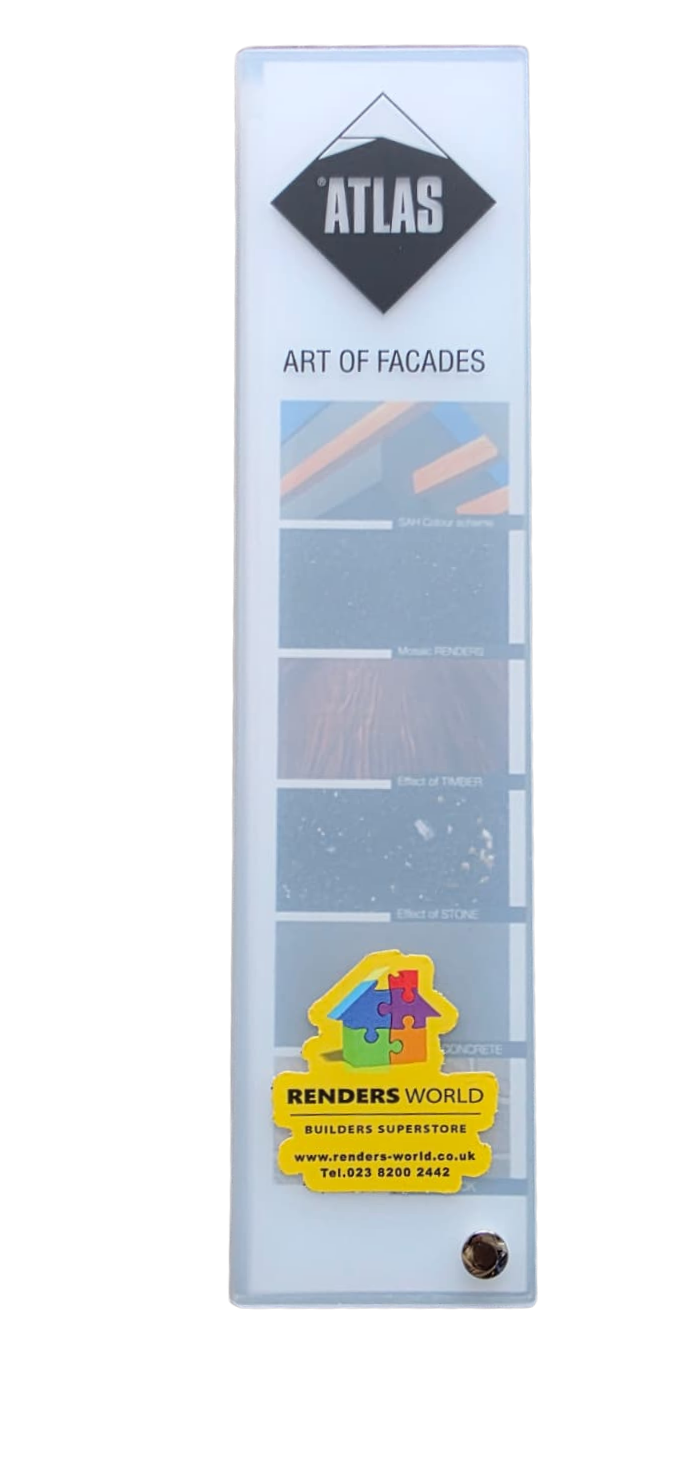
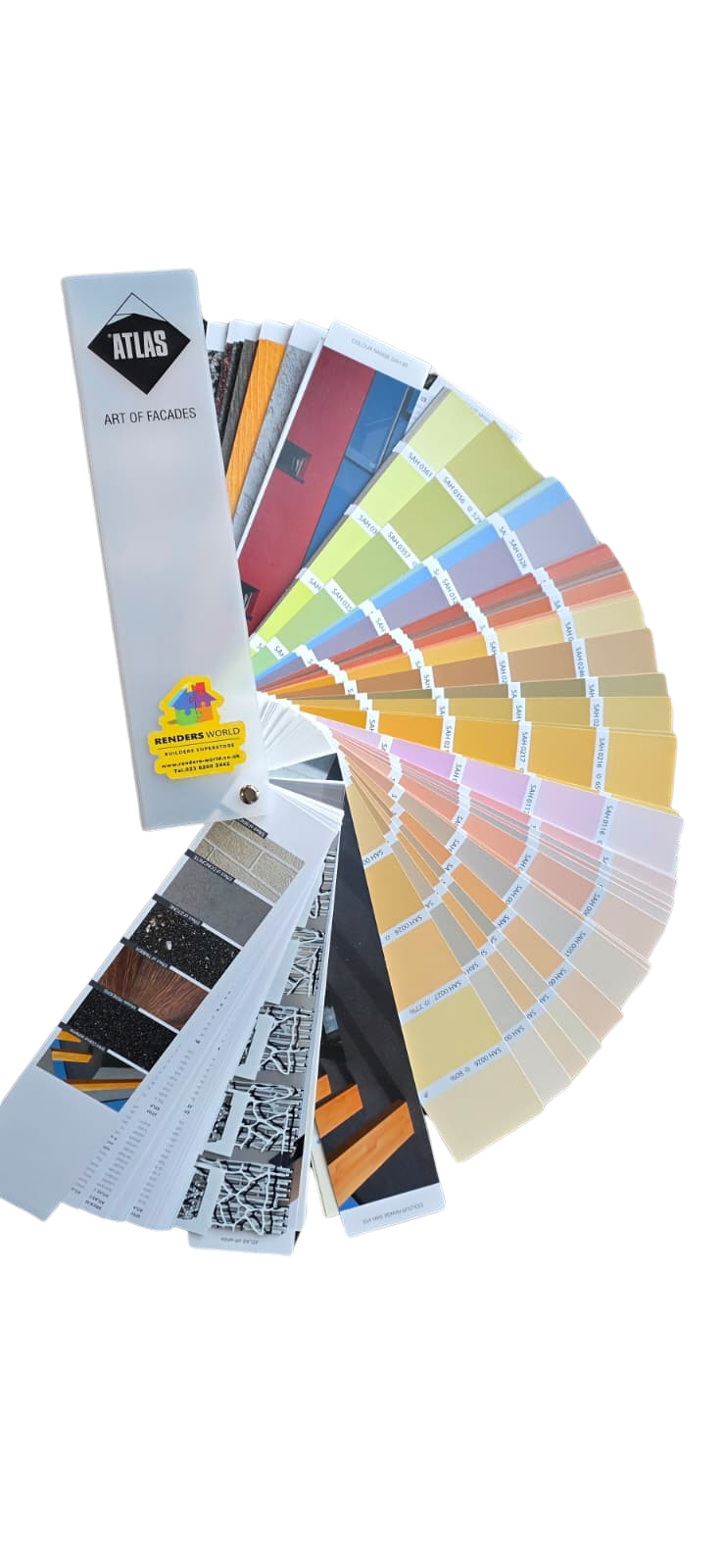
The Atlas Catalogue 480 Colours Sample settles a facade shade outdoors rather than on a screen, and Atlas Silicone Render carries its deepest shades only above a light reflectance of HBW 6%, in a STOPTER K-100 reinforced layer. Held in the render colour charts and catalogues range at Renders World, it is the reference a specifier reaches for once a client wants a shade outside the popular sets.
Its value shows at the point the colour meets a build-up. Atlas sets two reflectance conditions for its silicone render — HBW above 15% over a HOTER U2 or HOTER U2-B reinforced layer, and HBW above 6% over STOPTER K-100 — so the shade and the adhesive beneath it are a single decision, taken at the same table.
- The palette held against the wall: a page can sit beside brick, roof tile and frame under one sky, which is the comparison that actually settles a shade.
- Reflectance read before the code is fixed: checking the figure at quotation stage means the reinforced layer can be specified around the colour rather than after it.
- One colour system across renders and paints: Atlas publishes SAH as a colour range for its plasters and paints, so an approved code follows the job from the main elevation onto the facade paint.
- Colour fastness with testing behind it: the render sheet attributes its fastness to hybrid inorganic and organic pigments confirmed by Xenotests, which is a firmer answer than "UV stable" when a client asks how the shade ages.
What the Atlas SAH Palette Contains, and the Count Worth Checking
Two Atlas sources describe the SAH range and they do not agree on its size. The ATLAS SILICONE RENDER data sheet states 480 colours in the SAH Paints and Plasters colour range, while the Atlas SAH colour-chart application describes 200 pastel toned-down colours and 200 intensive shades, a total of 400.
That gap is a purchasing instruction rather than a problem. Confirm the count for the edition on the shelf and for the product the code is ordered against before a code reaches a tender document, and Renders World will check the current copy against your specification.
| Property | What the Atlas sources state |
|---|---|
| Colour system | SAH Paints and Plasters colour range |
| Count, render data sheet | 480 colours |
| Structure, Atlas colour-chart application | 200 pastel/toned-down + 200 intensive |
| General dark-colour guidance | Avoid below HBW 20%; keep under 1/10 of elevation area |
| Deep shades in system | HBW >15% over HOTER U2 or U2-B; HBW >6% over STOPTER K-100 |
| Pigments | Hybrid inorganic and organic; fastness confirmed by Xenotests |
| Standard governing the render | EN 15824:2017 |
The stricter of the two dark-colour statements is the general one: Atlas advises avoiding shades below HBW 20% on insulated buildings and holding them under a tenth of the elevation area, while the product sheet permits lower figures inside named systems. Lead with the general limit and treat the system figures as the exception you specify for — how deep shades behave on sun-exposed elevations works through the thresholds each manufacturer ties to its own build-up.
Using the Catalogue Outdoors, from First Shortlist to Approved Code
A swatch page is small and an elevation is not, so the comparison needs staging. Run it in a fixed order and the result still stands months later, when the render is finally mixed.
- Open the Atlas Catalogue 480 Colours Sample at the property in daylight, hold the page flat against the wall at chest height, then step back two to three metres — street-level distance.
- Look twice in one day, because an east wall in the morning and a west return under low sun give one code two characters.
- Set the final two candidates against the materials that stay: brick, roof tiles, window frames.
- Check the reflectance figure for any deep shade against the reinforced layer proposed beneath it.
- Photograph the approved page with its code visible, and write that code on the order.
Two guides carry the method further: narrowing a facade colour down covers light direction and adjacent materials, while staging a colour chart across a live project sets out the sequence specifiers use on multi-plot work.
How It Compares With the Other Colour References in the Range
Four references sit in this collection and each answers a different question, so a minute spent choosing saves a week waiting on the wrong one. The table separates them by what the swatch physically shows.
| Reference | What it shows | When to choose it |
|---|---|---|
| Atlas Catalogue 480 Colours Sample | The Atlas SAH range at full breadth | A named SAH code, or an unusual shade |
| Atlas Render Sample 24 Colours | A curated set of Atlas shades | Fast domestic shortlist |
| Ceresit colour sample books | The Ceresit facade palette | A project built on Ceresit renders |
| Ceresit mosaic sample | Aggregate mosaic arrangements | Plinths and feature detailing |
- Shortlisting a domestic job: the 24-colour Atlas set closes most first conversations quickly, and both references sit in the same collection page.
- Matching an existing facade or a named code: the full catalogue is the volume that carries it through to sign-off.
- Detailing the base of the wall: plinths take an aggregate finish instead, chosen from the mosaic renders for plinths and their own swatches.
- Texture belongs in the colour decision: how grain size changes the way a shade reads explains why one code looks different at two textures.
Ordering the Catalogue and the Render the Code Points At
The Atlas Catalogue 480 Colours Sample is £10.00 and showing as available, checked August 2026; the figure on the page as you read it is the current one. The 24-colour Atlas set returns the same £10.00 at the same check, so the choice between them is scope, not budget.
Once a code is approved the route to material is short, and Renders World supplies both ends of it.
- Order the finish: the code is mixed into Atlas silicone render, which consumes from 2.2 kg/m² applied by hand at up to 1.5 mm grain — so 100 m² × 2.2 kg/m² = 220 kg, and 220 kg ÷ 25 kg per bucket = 8.8, meaning nine buckets before waste and openings.
- Refreshing rather than re-rendering: the Atlas sheet names ATLAS SALTA N as the renovation route for an existing render, which is where silicone masonry paints answer a sound wall that has simply weathered.
- Keeping one elevation even: Atlas instructs that a single surface is rendered with material of the same manufacturing date, so order the elevation in one go.
- Where UK palettes are heading: earth-tone facade schemes for 2026 shows which tonal families are being specified now.
FAQ — Ordering the Catalogue and Reading Its Shades
What does the full catalogue give that the 24-colour set does not?
Breadth, and the ability to answer a code chosen by someone else. The curated set covers frequently specified tones for a quick decision; the catalogue is what a project needs when an architect has already named a SAH code or an existing rendered wall has to be matched.
Does one SAH code work across Atlas renders and paints?
Atlas publishes SAH as a colour range for its plasters and paints together, so a code approved for the render has a counterpart on the paint side. Confirm availability against the specific product before ordering, since each sheet states its own colour conditions.
Can a dark shade from the catalogue go across a whole elevation?
Atlas guidance on insulated buildings is to avoid shades below HBW 20% and to keep them within a tenth of the elevation area, which makes deep colours ideal for plinths, reveals and feature panels. Above that reflectance, or inside the named STOPTER K-100 and HOTER U2 systems, a broader use is specified properly.
What can this reference support in an environmental specification?
The render sheet records that production is covered by a type III Environmental Statement and that the material is water-dilutable under EN 15824:2017. Choosing higher-reflectance tones from the pastel half also aligns with the same reflectance guidance that governs the dark end.
How should the catalogue be stored between projects?
Flat, dry and out of prolonged direct sunlight, filed with a note of previously approved codes. Kept that way the swatches stay representative, and matching a later phase or an extension becomes a five-minute job rather than a fresh selection exercise.
Technical Documentation Behind the Figures on This Page
- ATLAS Silicone Render technical data sheet — SAH colour range, reflectance conditions for dark shades by reinforced layer, pigment and Xenotest statement, consumption and renovation route; sheet update date 29 March 2022.
- ATLAS SAH colour range, manufacturer colour-chart application — palette structure and the general dark-colour guidance on insulated buildings, fetched August 2026.