
Description
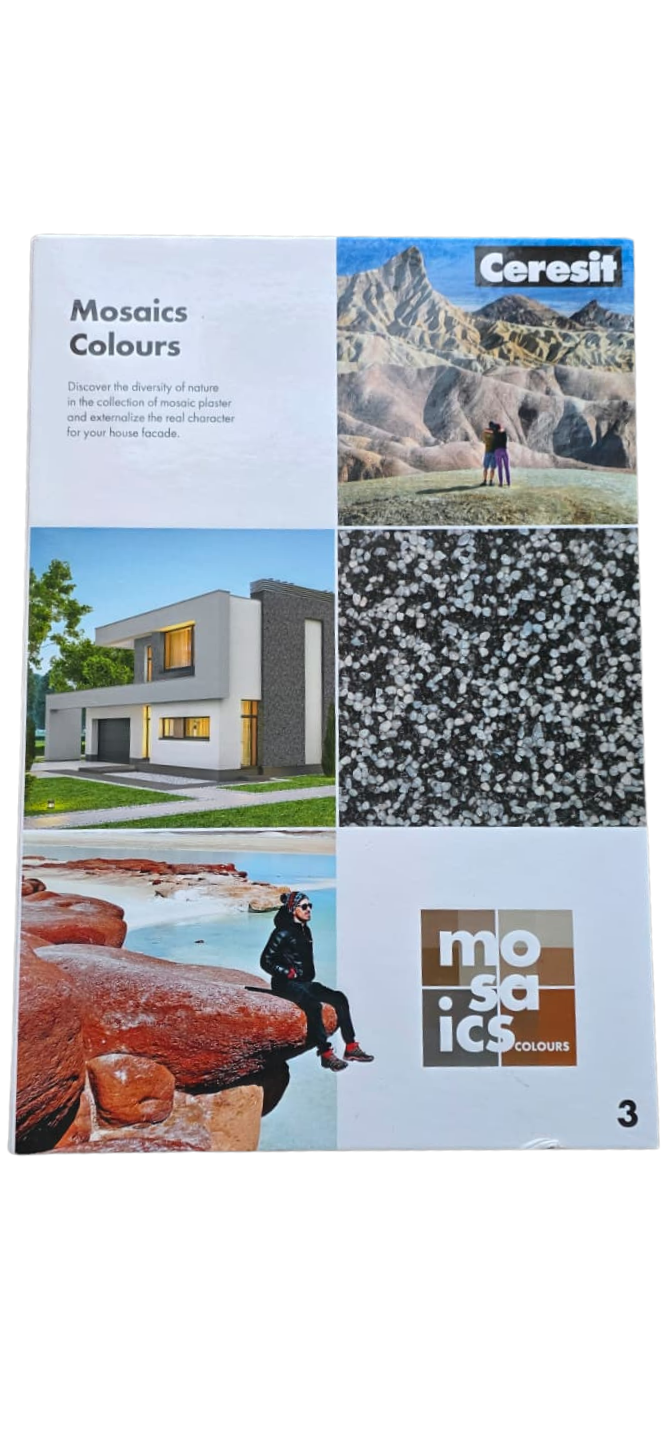
The render colour charts and catalogues collection at Renders World includes the Ceresit Mosaic Sample Book as the dedicated physical reference for the Ceresit CT177 mosaic render range. Every swatch is produced with the real aggregate-blended finish — coloured quartz grits set in transparent resin at 1.0–1.6 mm grain — giving architects, contractors, and homeowners a tactile reference for a material whose appearance depends on aggregate pattern and surface sparkle as much as on pigment.
When the Ceresit Mosaic Sample Book Saves Time on UK Projects
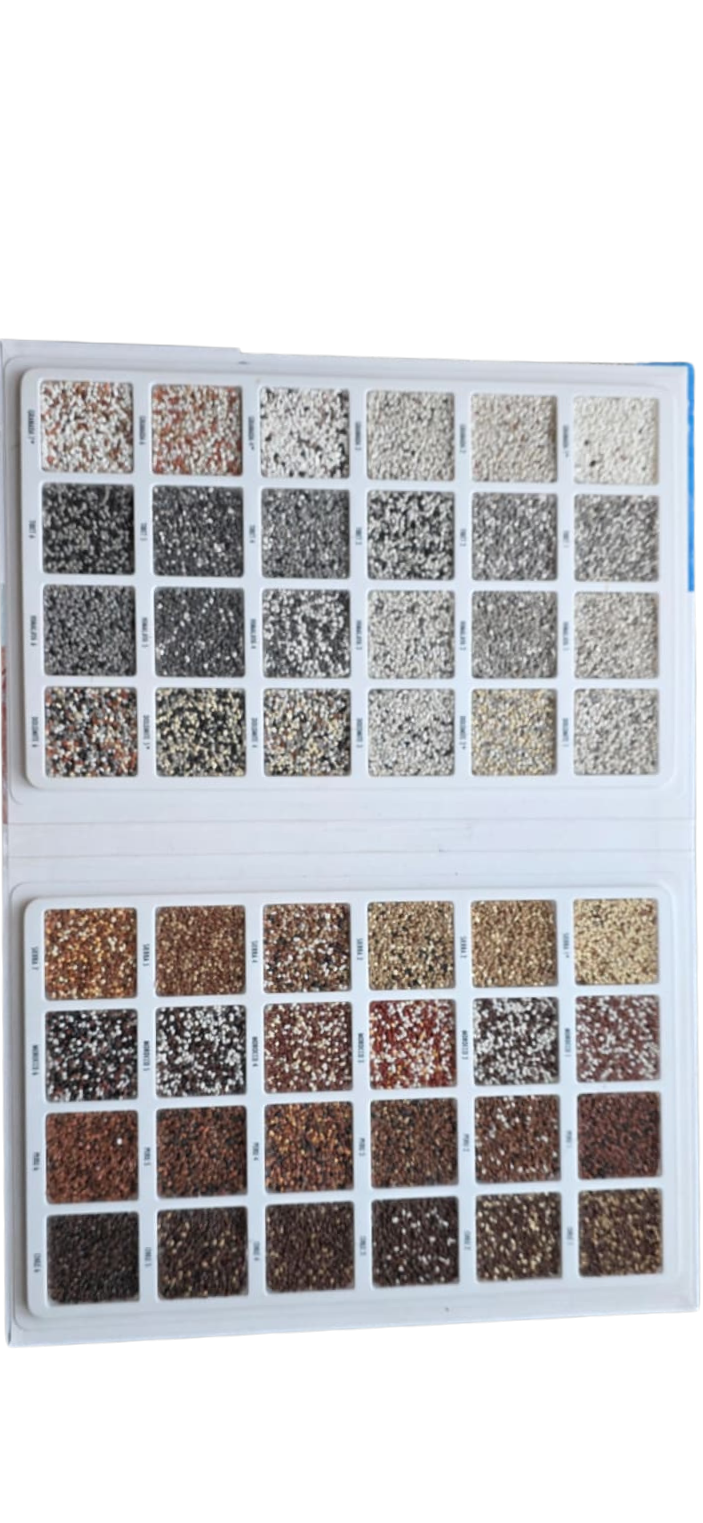
The Ceresit Mosaic Sample Book is a bound physical guide containing 48 colour arrangements from the Ceresit CT177 mosaic palette, organised into named lines including Dolomite, Himalaya, Granada, and Sierra. Each swatch presents the actual quartz-grit aggregate, transparent resin binder, and multi-tonal depth that define the finished plinth or feature wall — accuracy that screens and printed brochures cannot deliver for a material where texture and colour are inseparable.
This is the right reference whenever a project specifies CT177 from the mosaic render range for building plinths, entrance surrounds, column bases, staircase walls, or other high-traffic surfaces. For flat-colour selection on the main facade above the plinth, the Ceresit Colour Sample Book 1 is the matching reference from the same manufacturer system, and many specifiers carry both books to the same client meeting so plinth and facade colours are finalised in one session.
Why Specifiers Order the Ceresit Mosaic Sample Book Up Front
- Authentic aggregate-blended swatches: Every sample is produced with real CT177 — coloured quartz grits in transparent resin — so the multi-tonal depth and surface sparkle in the book are exactly what appears on the finished plinth.
- 48 colours and named lines in one volume: The complete Ceresit mosaic palette — Dolomite, Himalaya, Granada, Sierra, and additional lines — sits in a single book, eliminating the multi-sample-request loops that typically delay decorative plinth specifications.
- Texture as well as colour: Mosaic render derives its character from visible aggregate, and the swatches capture that three-dimensional quality — essential for a material that flat colour references cannot represent.
- Plinth and splash-zone focus: The book targets the surfaces where mosaic render genuinely excels — plinths, entrance areas, columns, and stair walls facing splashing, abrasion, and dirt — rather than treating mosaic as a generic facade option.
- HBW guidance for sun-exposed elevations: Light-reflection notation in the Ceresit mosaic system identifies which blends are suitable for south-facing plinths and which are better reserved for sheltered orientations.
- Coordinates with the wider Ceresit palette: The mosaic colour lines are designed to pair with the Ceresit Colours of Nature system used for silicone, silicate-silicone, and acrylic facade renders, so plinth and facade decisions stay within one manufacturer family.
Selection Guide — Find Your Mosaic or Decorative Reference
| Your Project Direction | Right Reference | Why |
|---|---|---|
| CT177 mosaic plinth, entrance, or feature panel | Ceresit Mosaic Sample Book (this product) | 48 aggregate-blended swatches · Dolomite · Himalaya · Granada · Sierra · 1.0–1.6 mm grain |
| Main facade flat colour to coordinate with the mosaic plinth | Ceresit Colour Sample Book 1 | Colours of Nature palette · Water · Sand · Earth · Forest families |
| Concrete or brick decorative effect instead of mosaic | Atlas Concrete and Brick Sample Book | Concrete textures · brick effects · Cermit BA-M / N-100 / Silkon BA |
| Ready to order the mosaic render itself | Ceresit CT177 mosaic plaster | 25 kg trade buckets · 6 m² coverage · matches the swatch codes exactly |
Technical Specifications — Ceresit Mosaic Sample Book Data
| Property | Detail |
|---|---|
| Sample type | Bound physical book with mosaic render aggregate swatches |
| Colour system | Ceresit Mosaic palette (CT177 / CT77 range) |
| Total colours | 48 arrangements across named colour lines |
| Colour lines | Dolomite, Himalaya, Granada, Sierra, and additional named ranges |
| Aggregate type | Coloured quartz grits in transparent resin binder |
| Grain size represented | 1.0–1.6 mm |
| Product represented | Ceresit CT177 mosaic plaster (25 kg and 10 kg packs) |
| Typical applications | Plinths, entrance areas, staircase walls, columns, balustrades, window and door jambs |
| Application context | Exterior plinths and high-traffic interior surfaces |
| Format | Professionally bound sample book |
| Intended users | Architects, specifiers, contractors, homeowners |
How to Use the Ceresit Mosaic Sample Book Effectively
The book delivers most value when the swatches are assessed in the position the finished mosaic will occupy. For plinth selection, open the book outdoors at the project site and hold the chosen page at plinth height — approximately 300–600 mm above ground level — rather than at chest height. The viewing angle and proximity to paving, gravel, or planting beds shifts how the aggregate reads in context, and chest-height assessment routinely produces a different decision from plinth-level assessment of the same swatch.
Check the swatch at an oblique angle as well as face-on, because individual quartz grits catch and reflect light differently depending on viewing direction — creating subtly different colour impressions from each angle. This effect is what gives mosaic render its visual depth and is the single biggest reason photographs of mosaic finishes fail to convey the real material.
For plinths on south-facing elevations, confirm that the chosen swatch has an HBW (light-reflection factor) of 20 or above before specifying. Darker mosaic blends absorb more solar energy and can generate thermal stress in sun-exposed positions, although plinths shaded by the building above are typically tolerant of lower HBW values. For interior applications under artificial lighting, view the swatch under the same lamp colour temperature planned for the space so the aggregate tones read as intended once installed.
Once the swatch is approved, the colour code transfers directly to the product order — the CT177 25 kg trade pack for full plinths and the CT177 10 kg project pack for smaller feature areas both carry the same colour-code matching as the swatches. For the full application sequence — substrate preparation, priming with CT16 quartz primer, application technique, and weather protection during curing — the mosaic render for plinths guide covers the layered specification step by step, and the decorative facades with mosaic render guide shows how the named colour lines are being applied on current UK projects.
Practical Tips From UK Renderers on Mosaic Selection
- Bring the mosaic book to the same meeting as the facade colour reference. The plinth decision follows naturally once the main facade tone is committed, and showing both swatches together closes both choices in one consultation.
- Let clients hold the swatch in their hand at plinth height. The multi-tonal aggregate depth is impossible to convey on a screen, and clients who arrived expecting a plain grey often end up choosing a richer blend they would never have considered from a digital image.
- On developer projects, photograph mosaic and facade swatches together by plot number. The two-swatch record per plot prevents mix-ups when ordering materials for twenty or thirty units simultaneously, particularly when different plot types use different colour combinations.
- Check the HBW value before promising any deep blend on a south plinth. The Ceresit guidance of HBW ≥ 20 for sun-exposed surfaces is well-established, and flagging a deeper blend at quotation stage protects the programme.
- Pair the Dolomite or Sierra neutrals with cool grey facades. Warm sandy mosaic tones at plinth level ground a cool grey elevation visually, while matching neutrals create a seamless single-material reading — both are stronger than a stark plinth-facade contrast on most UK domestic buildings.
Is the Ceresit Mosaic Sample Book Right for Your Project?
- Ideal for your project if you are specifying CT177 mosaic render for plinths, entrance surrounds, staircase walls, or feature panels and want to see and feel the actual aggregate-blended finish before committing to a colour.
- Need flat colour reference for the main facade? The Ceresit Colour Sample Book 1 covers the Colours of Nature palette for silicone, silicate-silicone, and acrylic renders — the correct companion for selecting the facade tone above the plinth.
- Considering a concrete or brick effect instead of mosaic? The Atlas Concrete and Brick Sample Book shows texture and colour options for concrete and brick effect renders — the right starting point when the design intent is architectural surface imitation rather than aggregate-blended mosaic.
- Want broader colour-selection context? The silicone render colour selection guide covers how light, orientation, and surface texture shape the final appearance — useful when coordinating mosaic plinth tones with the facade above.
FAQ — Ceresit Mosaic Sample Book Ordering, Use, and Practical Notes
How much does the Ceresit Mosaic Sample Book cost compared to ordering the render itself?
The book is a low-cost design tool that represents a fraction of the price of a single 25 kg bucket of CT177 mosaic render. Confirming the colour from a physical swatch before ordering prevents the significantly greater expense of applying a plinth finish that does not complement the main facade — a mistake that typically requires a full strip-back and re-render of the plinth area. On any project where the plinth sits at eye level from the street, the book is the most cost-effective step in the entire specification process.
Are the mosaic render colours in this book suitable for environmentally considered projects?
Ceresit CT177 mosaic render achieves a W3 water-permeability classification (≤ 0.1 kg/m²·h⁰·⁵) and V2 vapour permeability, meaning the plinth surface repels driven rain and splashing while allowing the masonry behind to breathe — reducing the risk of trapped moisture and the remediation work it would require. The natural quartz-grit aggregate is a mineral filler with no synthetic colour additives in the grits themselves, and the improved CT77 formulation offers enhanced UV resistance that extends the period between maintenance cycles. Choosing a lighter-toned blend from the Dolomite or Himalaya lines also reflects more solar radiation at plinth level, contributing to a cooler microclimate around the building base.
What does the HBW rating mean for mosaic render colours, and does it affect my choice?
HBW is the relative luminance factor — a measure of how much light the surface reflects. Ceresit recommends mosaic colours with an HBW of 20 or above for large sun-exposed facade areas, because darker aggregate blends absorb more solar energy and can generate thermal stress in the render system beneath. For plinths shaded by the building above and receiving less direct solar exposure, deeper mosaic tones with a lower HBW are generally viable. The sample book allows you to check the colour line and blend against this guidance before specifying, and the mosaic render plinth guide explains how to match aggregate colour to elevation orientation and exposure conditions.
Can I use this sample book to coordinate the plinth finish with a different-brand facade render?
The Ceresit mosaic palette is designed to complement the Ceresit Colours of Nature system, but it coordinates effectively with any facade render range — including Atlas silicone renders — provided the colour comparison is made physically at the project site under natural daylight. Placing the mosaic swatch from this book alongside the chosen facade swatch from the relevant colour chart confirms whether the two finishes pair well before any material is ordered. The neutral stone, grey, and sandy tones in the Dolomite and Sierra lines are particularly versatile and complement a wide range of main facade colours across manufacturers.
What is the difference between the Mosaic Sample Book and the standard Ceresit Colour Sample Books?
The standard Ceresit Colour Sample Books show the flat-colour palette for Ceresit silicone, silicate-silicone, acrylic, and silicate renders and paints — products applied as the main facade finish. The Mosaic Sample Book shows the 48 aggregate-blended colours specific to CT177 mosaic render — a specialist product where visible quartz grits create a multi-tonal, textured surface that behaves very differently from a flat-colour render. The two types of book serve different product decisions and are typically used together when a project includes both a main facade render and a mosaic plinth or feature finish.
How should I store the book between projects?
Storing the book flat in its original binding and away from prolonged direct sunlight keeps the aggregate swatches representative for repeated use across multiple specifications. The applied-mosaic finish on the swatches resists UV fade more effectively than printed colour charts, but sustained exposure will gradually shift pigments on any reference material. Keeping the book in a project folder alongside notes on previously specified blends makes it straightforward to return to an approved plinth colour for follow-on phases, matched extensions, or maintenance work years later.


