
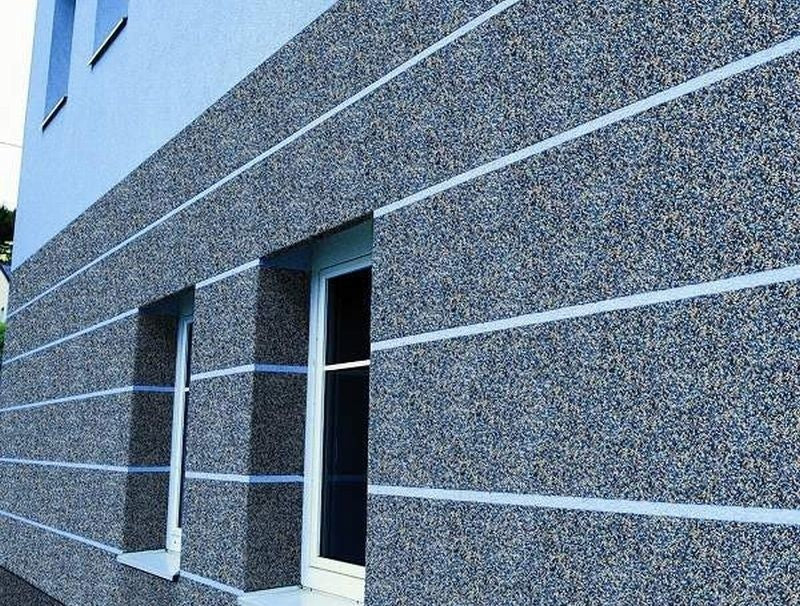


Description
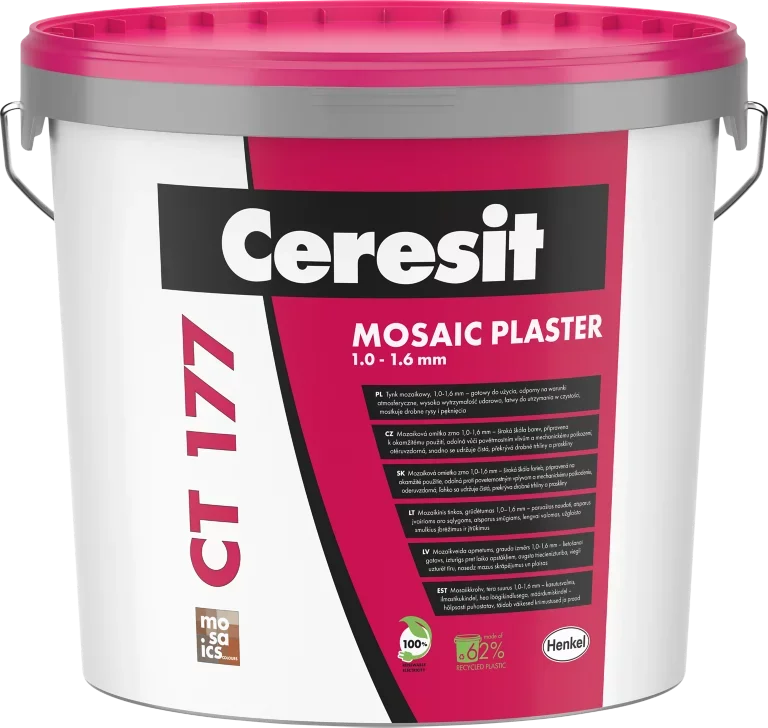
The 25 kg Ceresit CT 177 mosaic render is the trade-volume bucket within our mosaic renders collection — one pack delivers approximately 6 m² of resin-bound coloured-quartz plinth finish at a confirmed yield of 4.0 kg/m², giving a single-batch run across a full semi-detached plinth without seam matching between buckets.
Where Ceresit CT 177 Mosaic Render Performs Best — UK Plinth Applications
Ceresit CT 177 is a 1.0–1.6 mm acrylic mosaic plaster that achieves Category I impact resistance under ETAG 004 with W3 water absorption and V2 vapour permeability under EN 15824:2017, certified for plinth zones, reveals, and entrance surrounds on UK external wall insulation systems. In plain terms: the product shrugs off knocks, repels driven rain, and lets the wall breathe — exactly the trio of demands the ground-level zone of a facade has to meet. The formulation locks coloured quartz aggregate inside a transparent acrylic-resin matrix rather than relying on a surface paint film that can chalk or peel, which is why CT 177 holds up where conventional thin-coat renders and masonry paints struggle hardest. For specifiers, the 25 kg pack is the right call when batch continuity across a full elevation matters more than the smaller-project flexibility of the 10 kg CT 177 mosaic bucket.
Typical UK use sits in three places: the 300–600 mm plinth band of EWI build-ups on XPS or high-density EPS, full-perimeter plinths on traditional solid-wall properties below the DPC line, and architectural reveals or entrance returns where impact protection is non-negotiable. Specify it where the wall meets the world.
Why Trade Specifiers Choose Ceresit CT 177
- Impact-proof plinth protection: Category I impact resistance under ETAG 004 — the highest decorative thin-layer classification — absorbs lawnmower strikes, wheelie-bin knocks, and foot traffic without cracking or chipping the surface.
- Rain runs off, walls keep breathing: W3 water absorption (w ≤ 0.1 kg/m²·h⁰·⁵) repels driven rain and splashback, while V2 vapour permeability (Sd 0.14–1.4 m) lets trapped wall moisture migrate outward — essential on solid-wall properties without a cavity.
- Colour locked inside each grain: Pigment is bound within the quartz aggregate rather than applied as a paint film, so there is no coating to peel, chalk, or fade under UV — the plinth holds its appearance through full 25-year facade cycles.
- Flexes through UK freeze–thaw: The acrylic-resin binder accommodates seasonal substrate movement, so the surface stays seamless where a rigid cement plinth coating develops hairline cracks across winter cycles.
- Garden-hose maintenance: The dense, low-porosity quartz surface releases road spray, splashback, and air-pollution residue under a soft rinse — reducing long-term upkeep to a seasonal wash rather than a recoat.
- Certified EWI compatibility: CT 177 holds European Technical Assessments across the Ceresit Ceretherm Popular, Classic, Premium, Visage, and Wool Classic systems, giving Building Control a clear compliance pathway for the plinth zone of insulated facades.
- Matched plinth detail in UK retrofit specifications: On Ceretherm Premium build-ups over high-density EPS, CT 177 is the specified plinth finish above an XPS perimeter band — the combination Renders World stocks as a standard pairing for UK semi-detached retrofits where ground-zone impact protection drives the specification.
Technical Specifications — Ceresit CT 177 Data Sheet Highlights
| Property | Value |
|---|---|
| Pack size | 25 kg bucket |
| Approximate coverage | ~6 m² per bucket |
| Yield | ~4.0 kg/m² |
| Grain size | 1.0–1.6 mm |
| Density | ~1.75 kg/dm³ |
| Base | Aqueous synthetic resin dispersion with coloured mineral fillers |
| Adhesion (EN 15824:2017) | 0.6 MPa |
| Water absorption (EN 15824:2017) | W3 · w ≤ 0.1 kg/m²·h⁰·⁵ |
| Vapour permeability (EN 15824:2017) | V2 · Sd 0.14–1.4 m |
| Impact resistance (ETAG 004) | Category I |
| Thermal conductivity (EN 15824:2017) | λ = 0.61 W/(m·K) |
| Application temperature | +10 °C to +25 °C |
| Preliminary drying time | ~30 min |
| Rain resistance | ~3 days |
| Fire reaction (EN 13501-1) | B-s1,d0 / B-s2,d0 (system-dependent) |
| Declaration of Performance | No. 00469 (EN 15824:2017) |
How to Apply Ceresit CT 177 — Mixing, Coverage, and Pot Life
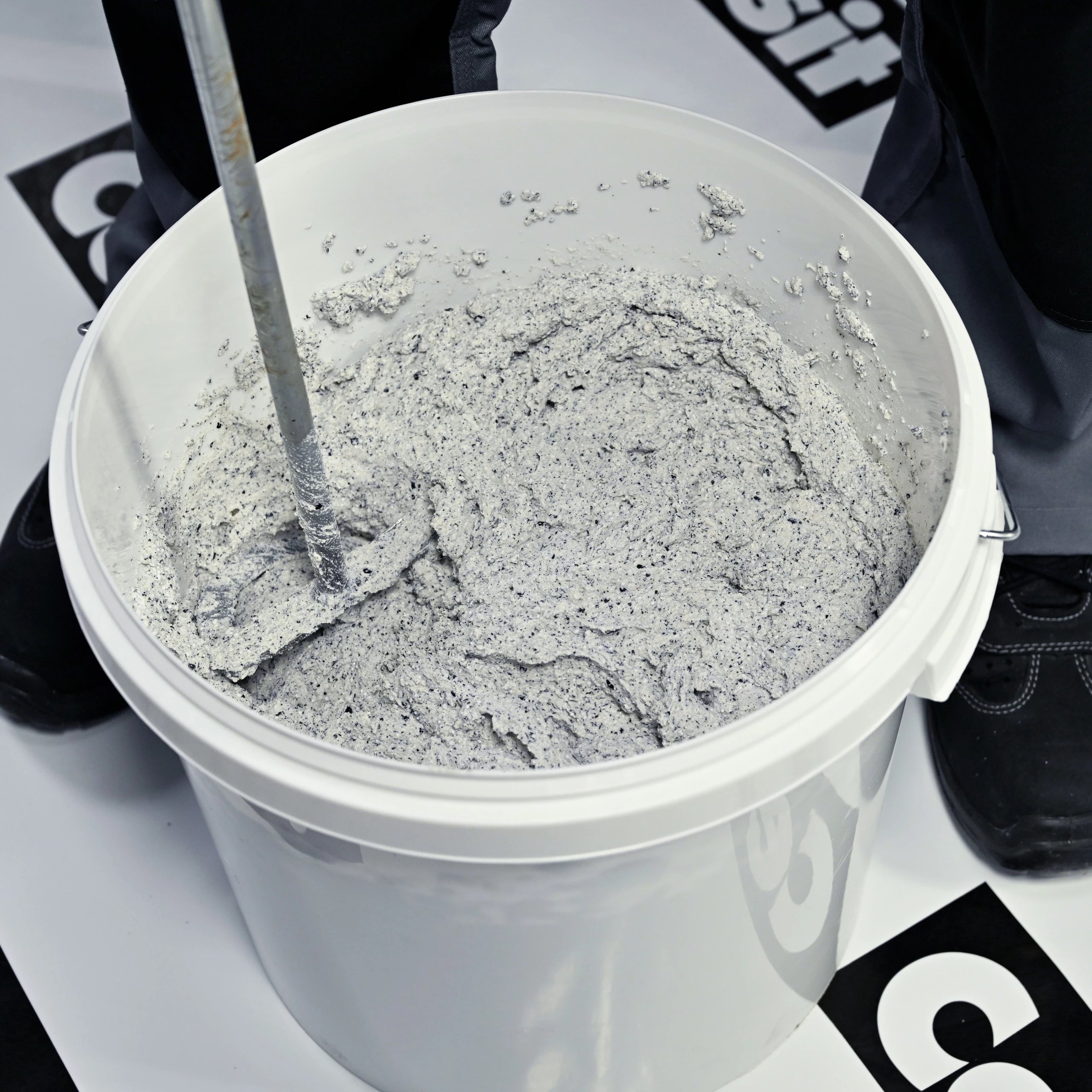
The 25 kg bucket arrives ready-tinted and ready to use — stir each pack on a slow-speed drill fitted with a basket mixer until the resin and aggregate reach a homogeneous consistency. A maximum of 250 ml of clean water per 25 kg may be added if consistency adjustment is needed — staying at or under that cap preserves the certified 0.6 MPa bond strength and keeps the resin matrix delivering its full Category I impact performance.
Coverage planning is straightforward at the confirmed 4.0 kg/m² yield: one 25 kg bucket finishes approximately 6 m² of plinth. For a standard semi-detached plinth of 15–18 m², three to four buckets from the same production batch deliver consistent aggregate colour and binder viscosity from one corner to the other.
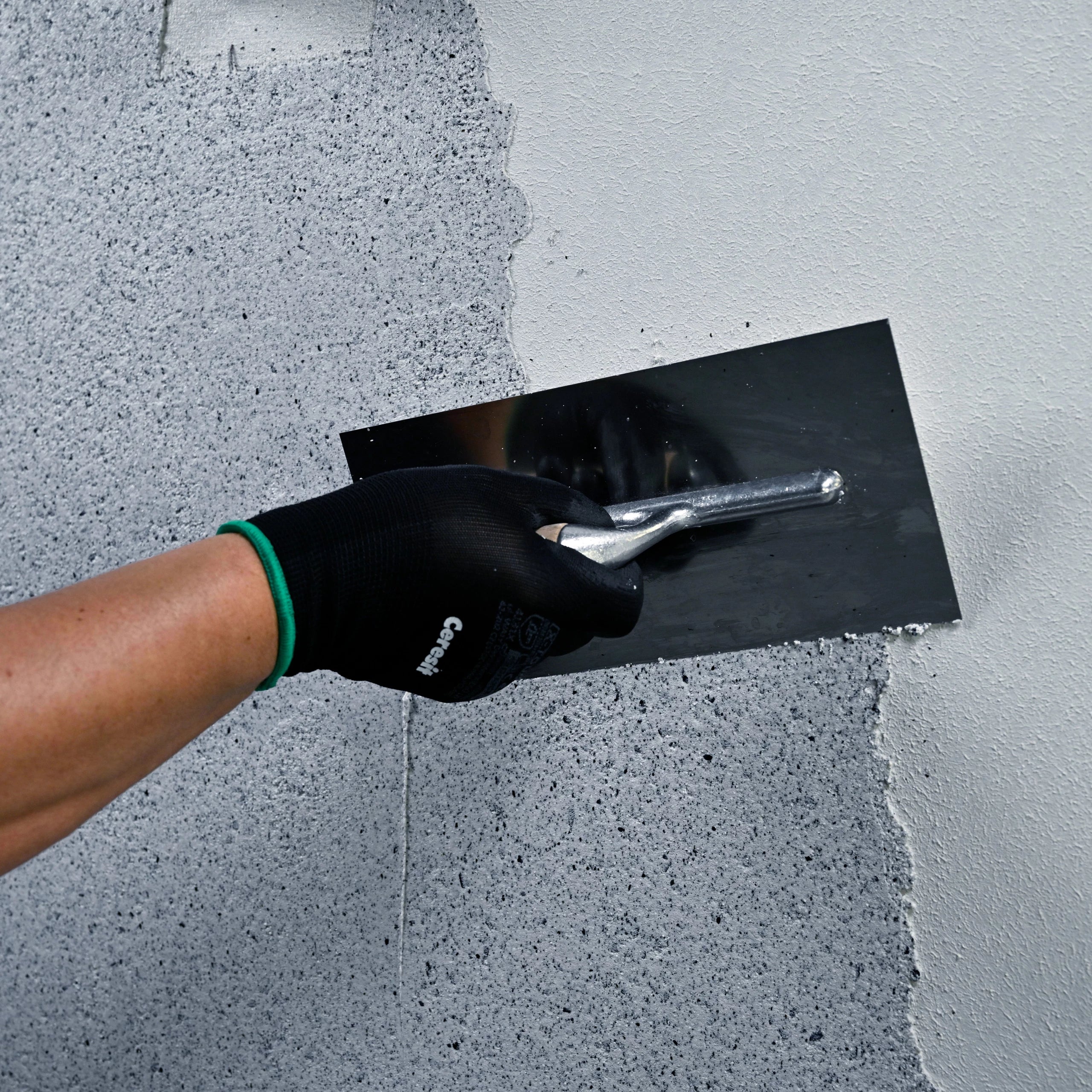
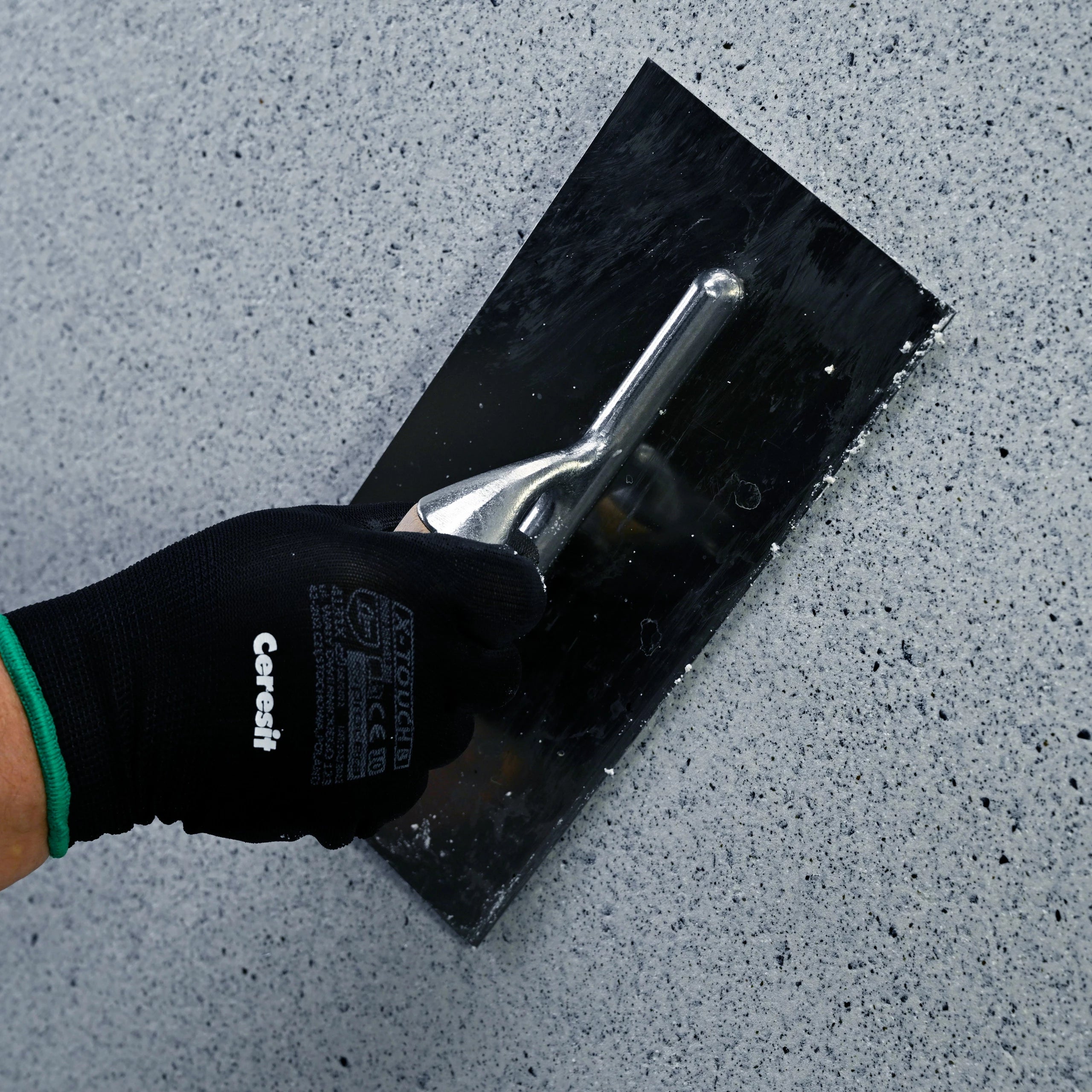
Apply with a stainless-steel float in a single direction at roughly 1.5× grain thickness (about 2.0–2.5 mm wet), working wet-on-wet across the full elevation to eliminate visible lap joints. The resin begins curing within approximately 30 minutes, so plan each wall as one uninterrupted session — full step-by-step mosaic plinth application method covers cutting-in around angles, taped break lines for unavoidable mid-wall stops, and substrate-priming sequence.
Installation Notes — Conditions, Drying Times, and Finishing
Both air and substrate temperature should sit between +10 °C and +25 °C throughout application and for approximately three days afterwards while the acrylic resin cures — this range delivers the full cross-linking that produces the hard, weather-resistant, colour-stable surface. Relative humidity below 80 % during the cure window keeps surface condensation from interfering with film formation, so fully sheeting the scaffold extends the workable season into spring and autumn.
For best results on the substrate side, prime mineral surfaces with a quartz primer from the render primers range — Ceresit CT 16 is the matched primer for CT 177 and should be tinted close to the chosen aggregate colour, so the grey basecoat never telegraphs through the transparent resin binder. Mature cement or cement-lime plasters (28+ days old), concrete (3+ months old, moisture ≤ 4 %), and reinforced basecoat layers using Ceresit ZU, CT 85, CT 190, or CT 100 mortar (3+ days old) all bond securely once primed.
Protect the finished surface from rainfall for at least three days using scaffold netting or tarpaulins — early rain contact during the cure can leave a temporary milky haze on the resin film that takes longer to clear than the standard cure window allows.
Pro Tips From UK Installers Using Ceresit CT 177
- Order the full plinth in one batch: Buying three to four 25 kg buckets from the same production batch gives the corner-to-corner colour continuity that low-angle sunlight reveals — splitting an order across batches risks a visible aggregate-tone shift mid-elevation.
- Tint the CT 16 primer to match: Pulling the quartz primer close to the mosaic aggregate shade eliminates the grey shadow behind the transparent binder, so the finish reads true to the colour sample from the first coat rather than developing depth only after the second.
- Float in one direction, never circular: A consistent linear pass lets the 1.0–1.6 mm aggregate settle into its natural random pattern; circular trowelling produces the swirl marks that clients notice in raking morning or evening light.
- Use masking tape for clean break lines: When a mid-wall stop is unavoidable, run adhesive tape across a vertical mortar joint or detail line, finish up to it, and lift the tape while the material is still fresh — this beats blending into a partially cured edge every time.
- Store buckets between +5 and +25 °C: Keeping unopened packs above freezing and resealing opened buckets overnight preserves resin workability across multi-day projects, so the last bucket trowels as smoothly as the first.
Is Ceresit CT 177 25 kg Right for Your Project?
- Yes — for full-house plinths and trade jobs: The 25 kg bucket is the right specification when you need approximately 6 m² of impact-resistant, colour-permanent mosaic finish per pack — ideal for complete house plinths, multi-elevation entrance surrounds, and any project where batch consistency across larger areas determines the visual result.
- Smaller pack for repairs or feature panels: The Ceresit CT 177 in a 10 kg bucket covers approximately 2.5 m² using the identical formulation at the same 4.0 kg/m² yield — the practical choice for snagging work, single reveals, and decorative accent panels where a 25 kg pack would leave surplus material.
- Pairing mosaic below DPC with a silicone topcoat above: On main wall elevations above plinth height, a silicone or silicone-silicate topcoat offers higher self-cleaning performance and lower Sd vapour resistance across broad areas — our decorative-facade design guidance covers dual-finish specification for projects combining mosaic plinth and silicone main facade.
- Tinted primer matched at point of order: Browse the quartz primers range to specify CT 16 in the closest shade to your chosen aggregate — ordering primer and mosaic together avoids the most common cause of patchy coverage on the first pass.
FAQ — Ceresit CT 177 25 kg Coverage, Compatibility, and Ordering
How many 25 kg buckets cover a typical house plinth?
Three to four 25 kg buckets cover a standard semi-detached plinth of roughly 15–18 m² at the confirmed yield of approximately 4.0 kg/m², where one bucket finishes around 6 m². Measure the full perimeter, multiply by your plinth height (typically 300–600 mm above ground level), and add 5–10 % for corners, reveals, and normal site wastage. Order all buckets in one batch for uniform aggregate colour from end to end.
Which primer is the correct preparation under CT 177?
Ceresit CT 16 quartz primer is the matched primer — it creates a keyed surface that gives the mosaic resin reliable grip and evens out substrate suction so the finished colour reads true. Tint the CT 16 close to the chosen aggregate shade so the grey basecoat stays invisible behind the transparent binder. On gypsum substrates (interior applications only), apply Ceresit CT 17 deep-penetration primer first, then CT 16 over the top, for the adhesion and suction control the resin needs.
Can CT 177 be applied below +10 °C in winter?
Both air and substrate temperature should remain between +10 °C and +25 °C throughout application and for roughly three days afterwards while the acrylic resin cures — this range delivers the full cross-linking that produces the hard, colour-stable surface. The UK's April-to-October window typically gives six to seven months of reliable conditions; fully sheeting the scaffold and maintaining relative humidity below 80 % extends that into the shoulder months.
Is CT 177 breathable enough for solid-wall properties without a cavity?
CT 177 holds a V2 vapour-permeability rating (Sd 0.14–1.4 m under EN 15824:2017), so moisture trapped in a solid masonry wall migrates outward through the render rather than accumulating behind it — the performance solid-wall properties need at the plinth zone. Where maximum breathability across main elevations is the priority, a silicone or silicone-silicate topcoat offers a lower Sd value across broad areas; at the plinth specifically, CT 177's superior impact resistance and rainwater repellency outweigh that marginal difference.
How is a mosaic-rendered plinth maintained over the long term?
A seasonal garden-hose rinse keeps most plinths fresh — the dense, low-porosity quartz surface resists dirt adhesion and biological colonisation more effectively than open-textured finishes. North-facing sections shaded by vegetation may develop algae over several years; a professional biocidal wash every two to three years stops spores establishing before they become visible, and visible growth lifts cleanly with a specialist algae remover and a soft brush — rather than high-pressure jetting, which can degrade the resin binder over time.
What's the shelf life and storage requirement once opened?
Unopened buckets stored between +5 °C and +25 °C remain workable to the printed shelf life on the lid (typically 12 months from production). An opened bucket resealed tightly the same evening can be reused on the following morning's session with a brief re-stir — leaving the bucket open overnight allows the resin surface to skin, which then needs removing before the rest of the material is used.
Technical Documentation — Ceresit CT 177 TDS, DoP, and Certifications
- Ceresit CT 177 Technical Data Sheet (Henkel global English edition, PDF)
- Declaration of Performance No. 00469 — EN 15824:2017 (W3 · V2 · 0.6 MPa adhesion · B-s1,d0 fire reaction system-dependent)
- European Technical Assessment coverage — Ceresit Ceretherm Popular, Classic, Premium, Visage, and Wool Classic EWI systems
Product information last reviewed by the Renders World technical team, May 2026, against the current Henkel TDS edition.