
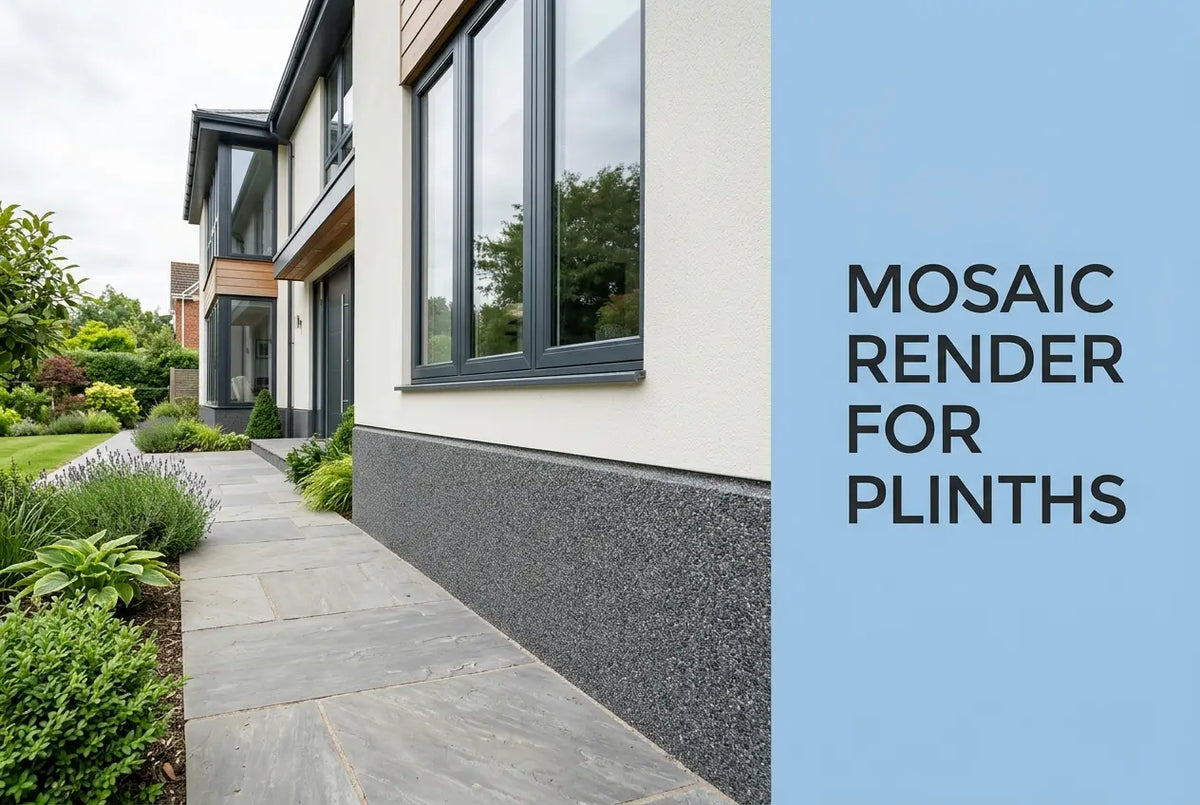
The plinth is the strip of wall that takes rain rebound off hard landscaping, mower and boot knocks, and road salt, all at once. Ceresit CT 177 is built for exactly that band, and its data sheet names plinths, balustrades and window and door jambs as its outdoor uses. This guide follows the order a renderer works in — substrate, primer, single wet-on-wet pass, protection — using figures read from the CT 177 and CT 16 sheets fetched for this revision. The material itself sits in the Renders World mosaic render range.
Why a Plinth Needs Mosaic Render Rather Than a Wall Finish
A mosaic render for plinths UK guide has to start with the sheet rather than the sales pitch: CT 177 declares Category I resistance to impact under ETAG 004 and 0.6 MPa adhesion under EN 15824, which is why it is specified on the one band of wall that gets hit. Its binder is a transparent resin holding coloured quartz grits of 1.0–1.6 mm, so the colour lives inside the aggregate rather than in a surface film.
Three declared properties explain the specification, and each has a practical consequence at ground level.
- Water absorption class W3, w ≤ 0.1 kg/m²h0,5 under EN 15824, with absorption after 24 hours below 0.5 kg/m² under ETAG 004 — driven rain and splashback sit on the surface rather than soaking in.
- Category I impact under ETAG 004, plus the sheet's own note that the material bridges hair-like cracks already present in the substrate.
- Resistance to scrubbing, which the sheet pairs with its recommendation for surfaces that get dirty quickly — a plinth can be washed rather than repainted.
One scope point matters before anyone reaches for a dark shade. The sheet recommends CT 177 at a light reflection coefficient of HBW ≥ 20, and advises consulting Ceresit's technical department where the chosen colour falls below that, so the right thermal insulation system can be selected. It goes further on intense dark colours: used as the facade layer of a Ceretherm insulation system, they should be limited to small areas — plinths and architectural details being the examples given. The plinth is the small area, which is precisely why deep mosaic shades belong there and not across an elevation.
How to Prepare and Prime a Plinth for Mosaic Render
Most plinth defects are decided before the mosaic is opened. The CT 177 sheet lists the substrates it accepts and the age each must reach, and every one of them is primed with the same product.
Substrate Ages the Sheet Requires
- Cement and cement-lime plasters: over 28 days old, primed with CT 16 quartz primer.
- Concrete: over three months old with moisture content ≤ 4%, primed with CT 16.
- Mesh-reinforced layers made of Ceresit ZU, CT 85, CT 190 or CT 100 mortar: over three days old, primed with CT 16.
- CT 87 mortar: over two days old, primed with CT 16.
Across all four the substrate must be even, load-bearing, colour-uniform, dry and free of grease, bitumen and dust, with hollows filled — the sheet names CT 29 putty for that. It also flags moisture pressure from behind: where a wall is exposed to permanent damp, sealing layers have to be right first, because the render can be damaged from the substrate side. That is the honest reason a plinth build-up is worth slowing down for.
Priming with CT 16, Tinted to the Aggregate
Use a quartz primer from the Renders World exterior render primers range: Ceresit CT 16 quartz primer is the product both sheets name for this job. Its own sheet gives a drying time of approximately 3 hours, consumption of 0.2 to 0.35 l/m² or 0.3 to 0.5 kg/m² depending on how smooth and absorbent the substrate is, and an application window of +5 °C to +25 °C below 80% humidity. It must not be diluted — the fine aggregate in it is what makes the primed surface rough and scratch-resistant, and that roughness is the key the mosaic grips.
Both sheets agree on the colour point, and it is the tip that saves a repaint: CT 16 should be used in a colour similar to the mosaic plaster, because the CT 177 binder is transparent and a grey bed reads through it. Where the substrate is absorbent, prime first with Ceresit CT 17 and leave it a minimum of two hours before the CT 16 goes on. Apply CT 177 only once the quartz primer has completely dried.
How to Apply Mosaic Render: Stirring, Trowel Thickness and Timing
CT 177 arrives ready to use. The sequence below is the sheet's own, in order, and the timing figure is the one that governs how the wall is planned.
- Stir slowly. Use a slow-speed drill with a basket mixer until the consistency is homogeneous. Over-long or intensive stirring can discolour the aggregate and aerate the mass, so stop at homogeneous rather than mixing on principle.
- Adjust only if you must. A small amount of clean water may be added, not exceeding 250 ml per 25 kg. Too much makes the material unusable — there is no recovery from an over-watered tub.
- Apply at 1.5 times the grain. Spread evenly with a stainless steel trowel in a layer at minimum 1.5 times the grain thickness, applying successive layers wet-on-wet and smoothing out. Do not sprinkle the render with water.
- Work one level without breaks. Keep the consistency the same and finish the level in one session. Preliminary drying time is approximately 30 minutes, which is the whole reason a plinth run is planned before the first lid comes off.
- Tape a planned stop. Where work must be interrupted, run self-adhesive tape along a defined line, apply and smooth up to it, then tear the tape away with the fresh material still on it and restart from that edge.
Conditions are tighter than for a silicone finish. Work dry, with air and substrate between +10 °C and +25 °C and relative humidity under 80%, and protect the finished render with nets or tarpaulins until it has completely hardened. The sheet gives resistance to rain after approximately three days and warns against applying to walls in strong sunlight, since drying too fast is its own defect. Fresh CT 177 looks milky and clears as it dries; with prolonged water contact, such as heavy rain, the milkiness can return until the surface dries again. Use material from the same production batch number on a single plane, and avoid the product altogether in areas exposed to long-lasting moisture.
Key Takeaway: Four habits carry a mosaic plinth — prime with CT 16 tinted close to the aggregate, stir slowly enough not to aerate or discolour, finish each level in one wet-on-wet pass inside the roughly 30-minute preliminary drying time, and net the scaffold until the render has hardened, with rain resistance reached after about three days.
Declared Performance of CT 177 and the Scope of Each Figure
Every value below is from the CT 177 sheet, with the standard it was declared against, because two of them mean different things depending on which document is quoted.
| Property | Declared value | Scope |
|---|---|---|
| Base | Aqueous synthetic resin dispersion, coloured mineral fillers | Product |
| Grain | Quartz grits 1.0–1.6 mm | Product |
| Density | Approx. 1.75 kg/dm³ | Product |
| Adhesion | 0.6 MPa | EN 15824 |
| Interlayer adhesion after ageing | ≥ 0.08 MPa | ETAG 004 |
| Water absorption | Category W3, w ≤ 0.1 kg/m²h0,5 | EN 15824 |
| Water absorption, 24 h | < 0.5 kg/m² | ETAG 004 |
| Vapour permeability | Category V2, 0.14 ≤ Sd < 1.4 m | EN 15824, product |
| Impact resistance | Category I | ETAG 004 |
| Thermal conductivity | λ = 0.61 W/(m·K) | EN 15824 |
| Reaction to fire | B-s1, d0 | System: Ceresit Ceretherm Visage |
| Reaction to fire | B-s2, d0 | Systems: Ceretherm Popular, Classic, Premium |
| Standard | EN 15824, DoP No. 00469 | External renders on organic binders |
Read the fire rows carefully: those classes belong to named Ceretherm systems under EN 13501-1, not to the bucket, and a plinth finished on a different build-up does not inherit them. The permeability line has the same double scope — the sheet states Sd ≤ 1.0 m under ETAG 004 for the system alongside the V2 category under EN 15824 for the product, and it is the EN 15824 line that describes what you are buying. EN 15824 itself is published in the UK through BSI.
Choosing the Shade and Pack Size for a Plinth Order
Two packs carry the same formulation, and the choice is scale against waste. Prices are as displayed in August 2026 without a VAT label on the product page, so confirm the VAT basis before quoting a client.
| Pack | Price, Aug 2026 | Stock, Aug 2026 | Where it fits |
|---|---|---|---|
| Ceresit CT 177, 25 kg bucket | £75.00 | Out of stock | Full plinth runs on one batch number |
| Ceresit CT 177, 10 kg bucket | £37.50 | In stock | Reveals, jambs, returns, patch repairs |
This page publishes no coverage figure and no bucket count, and that is deliberate rather than an omission. A standing instruction on the record forbids a coverage claim for CT 177, on the reasoning that yield on a mosaic depends on grain and substrate, and that instruction holds until an operator lifts it — even though the sheet was successfully retrieved for this revision and does carry an approximate yield. Until then, order by measuring the plinth run and its height, then confirming the quantity with the Renders World technical desk against the shade you have chosen. Buy the whole plinth on one batch number while you are at it, since the sheet asks for a single batch on any one plane and low sunlight finds the seam where two batches meet.
Ordering a Complete Plinth Build-Up
Three confirmations turn this into a clean order. Check the substrate has reached the age the sheet requires; specify CT 16 tinted close to your aggregate shade, with CT 17 first if the substrate is absorbent; and check the shade against the HBW ≥ 20 recommendation before committing, since that is the figure that sends a dark choice back to Ceresit's technical department. Renders World stocks the mosaic, the quartz primer and the reinforcing components against one trade order, so a plinth build-up arrives as a set — start from the plinth mosaic range for the finish itself, or from the full render build-up where the primer and basecoat are needed on the same delivery.
Written by Mariusz Saja. Technically reviewed by Rafał Wyrzykowski. Last reviewed Aug 2026.
FAQ — Applying Mosaic Render on a UK Plinth
How much mosaic render will a plinth take?
No coverage figure is published here, because a standing instruction on this page's record forbids a yield claim for CT 177 until an operator removes it. Measure the plinth perimeter and its height for the area, then confirm quantity with the trade desk against your shade and substrate. Order the full run on one batch number, as the sheet asks for a single production batch on any one plane.
What temperature can mosaic render be applied at?
Air and substrate should both sit between +10 °C and +25 °C, in dry conditions with relative humidity below 80%, and the render needs protecting with nets or tarpaulins until fully hardened. That +10 °C floor is five degrees above the CT 16 primer's own +5 °C minimum, so on a cool day the primer can go on before the mosaic can. Rain resistance arrives after approximately three days.
Which primer and basecoat go under CT 177?
CT 16 quartz primer, in a colour close to the mosaic, over any of the substrates the sheet names: cement or cement-lime plaster over 28 days, concrete over three months at ≤ 4% moisture, CT 87 mortar over two days, or a mesh-reinforced layer of Ceresit ZU, CT 85, CT 190 or CT 100 over three days. Absorbent substrates take CT 17 first, with at least two hours before priming. Apply the mosaic only once the primer is completely dry.
Can a dark mosaic shade be used on a plinth?
The sheet recommends CT 177 at HBW ≥ 20 and asks that colours below that be discussed with Ceresit's technical department so the right insulation system is chosen. For intense dark colours used as the facade layer of a Ceretherm system, it limits use to small areas and names plinths and architectural details as those areas — so a deep shade is more defensible on a plinth than across an elevation.
Why does fresh mosaic render look milky?
Because the dispersion is milky when wet and clears as it dries, which the sheet states plainly. With prolonged water contact, heavy rain during the cure being the usual cause, the milkiness can return until the surface dries again. Netting or sheeting the plinth until the render has hardened keeps the handover on schedule, and the effect is cosmetic rather than a fault in the material.