
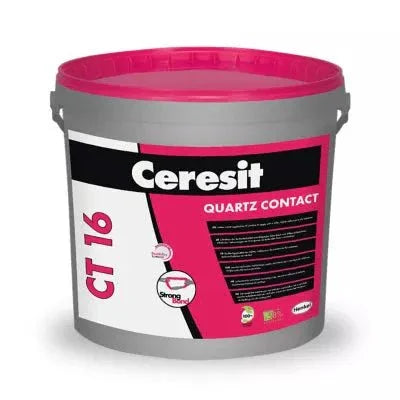
Ceresit CT16 Quartz Top Coat Primer 10L - 15kg


Price:
Sale price£36.30

Shipping calculated at checkout

Stock:
In stock

Pickup available at Renders World Southampton

Usually ready in 2 hours

Description

Thin-coat silicone, acrylic, or mineral renders at 1.0–2.0 mm cannot generate enough mechanical grip on a smooth cured EWI basecoat to hold permanently — and that is the gap Ceresit CT16 fills within the Atlas and Ceresit primer range. A 10 l container of this ready-to-use quartz-filled bonding primer covers ~30 m² at 0.3 l/m², leaves a scratch-proof textured key in roughly 3 hours, and is the specified intermediate layer within six Ceresit Ceretherm systems and across the Atlas premium silicone render range.

Where Ceresit CT16 Performs Best in UK Render Systems

Ceresit CT16 is the textured bonding coat that sits between a consolidation primer (or cured EWI basecoat) and the finish render — a synthetic resin dispersion loaded with quartz mineral fillers and white pigment that deposits a sandpaper-grade surface for the render to physically grip into. The water absorption coefficient stays at w < 0.5 kg/m²√h while vapour diffusion resistance sits around μ 120, which keeps the bonding film tight against driving rain without choking moisture migration out of the wall.

The product earns its place on three project types: full ETICS external wall insulation builds where CT16 is specified as the mandatory bonding layer within Ceresit Ceretherm systems (Popular, Aquastatic, Self Clean, Solar Protect, Impactum, Visage) over a cured reinforcement basecoat before silicone, silicate-silicone, acrylic, mineral, or elastomeric topcoat renders go on; render renovation jobs over high-suction masonry after a consolidation primer such as Uni-Grunt has equalised absorbency in the substrate; and interior decorative-plaster preparation on gypsum plaster, gypsum board, chipboard, and cured concrete where the textured key supports interior finishing coats with the same mechanical principle as exterior work.

Why Trade Specifiers Choose Ceresit CT16

  • Permanent mechanical render bond: Quartz aggregate embedded in the dried film creates a tactile rough surface that the thin-coat render keys into mechanically — the bond mechanism that holds a 1.5 mm render layer in place across the 25-year service life of a properly specified facade system.
  • White opacity for accurate render colour: High-pigment formulation masks the grey cementitious basecoat completely, so the specified render colour reads true on the finished wall rather than being dulled by grey bleed-through — particularly important for light shades and colours with a low Heat Brightness Value.
  • Uniform drying under the render coat: The quartz film seals porosity variation in the basecoat, so the render above loses moisture at the same rate across every square metre — no patchy drying, no visible colour banding, no premature surface cracking.
  • Ready to use, no on-site mixing: Stir-and-apply formulation eliminates the dilution errors that compromise quartz density and produce inconsistent mechanical grip when primers are over-diluted on site. The bond strength specified is the bond strength delivered.
  • Six Ceretherm systems compatibility: Specified as the bonding coat within Popular, Aquastatic, Self Clean, Solar Protect, Impactum, and Visage Ceresit systems — one primer covers every topcoat formulation in the Ceresit range without product substitution.
  • Low 16 g/l VOC against 40 g/l EU limit: Supports BREEAM and low-emission building specifications without the fumes or odour of higher-VOC bonding agents — practical for both exterior facades and interior decorative-plaster preparation.

Ceresit CT16 — Data Sheet Highlights

Parameter Value
Pack size 10 l plastic bucket
Coverage range 20–50 m² per 10 l (substrate-dependent)
Typical coverage ~30 m² per 10 l at 0.3 l/m²
Consumption rate 0.2–0.5 l/m²
Density ~1.5 kg/l
Base Synthetic resin dispersion + quartz mineral fillers + pigments
Colour White (tintable to render shade)
Appearance after drying Scratch-proof, textured quartz key
VOC content Max 16 g/l (EU limit 40 g/l)
Application temperature +5 °C to +25 °C (substrate and ambient)
Relative humidity Below 80%
Drying time ~3 hours standard; up to 6 hours in cool/humid conditions
Water absorption (w) < 0.5 kg/m²√h
Vapour diffusion resistance (μ) ~120
Dilution Do not dilute
Application method Roller or brush
Shelf life 12 months (frost-free storage)
System compatibility Ceresit Ceretherm Popular · Aquastatic · Self Clean · Solar Protect · Impactum · Visage

How to Apply Ceresit CT16 — Stirring, Coverage Control, Sequence

Application starts with thorough stirring of the container — quartz aggregate settles toward the bottom during storage, and an unstirred container delivers resin-heavy product first and quartz-heavy product later, producing visibly different grip levels across the same elevation. Stir before opening, stir again periodically during application, and check substrate temperature is between +5 °C and +25 °C with relative humidity below 80% before starting.

  • On cured EWI basecoat (standard application): Apply one even coat with a medium-pile roller or brush directly to the cured, dry reinforcement layer at ~0.3 l/m². Surface ready for render topcoat after approximately 3 hours under standard conditions.
  • On high-suction masonry (sequence with consolidation primer): Apply a deep-penetrating primer such as Atlas Uni-Grunt first to regulate substrate suction, allow to dry, then apply CT16 as the second priming stage. Applying CT16 directly to unconsolidated high-suction masonry wastes material because the substrate absorbs the resin before the quartz film forms.
  • Tinting for colour-critical projects: CT16 can be factory-tinted or site-tinted to the final render shade. For dark colours with a Heat Brightness Value below 25, colour-matching the quartz primer is a functional requirement that prevents grey basecoat show-through under raking light.
  • Single continuous wall-section pass: Complete each wall section in one pass rather than stopping mid-elevation — the primer forms a surface film within minutes, and overlapping a partially dried edge creates a visible ridge that telegraphs through the finished render.

The full quartz primer application method for professional EWI work — including substrate verification, coverage control, and sequence handover to the render trade — is covered in the quartz primer application UK professional 2026 guide. For the broader cleaning, repair, and consolidation sequence before CT16, see the substrate preparation before rendering process.

Installation Notes — Coverage Control, Drying Window, Tool Maintenance

Coverage control matters as much as substrate preparation. Aim for an even film that just conceals the grey basecoat without building up to runs — excessive thickness restricts vapour flow through the system and creates a resin-rich layer that the render slides on rather than keys into. On a 100 m² facade, three 10 l containers at 0.3 l/m² covers the job with around 10% contingency for window detailing and overlap, which avoids interrupting the render day for a top-up delivery.

Drying window extends in UK ambient — standard 3 hours at +20 °C / 50% RH can stretch to 6 hours on north-facing elevations or in autumn and spring damp. Professional best practice is to prime in the afternoon and render the following morning, allowing a full overnight cure that guarantees film formation even if site temperatures drop below +10 °C after application. Rinse rollers and brushes with water immediately after the session, before the resin and quartz cure onto fibres.

Pro Tips From UK Installers Using Ceresit CT16

  • Stir before, stir during: Quartz settles fast. A 30-second power-drill stir before opening and a 10-second restir every 15 minutes of application keeps quartz density consistent across the bucket and across the wall.
  • Tint to render shade on light colours: White-on-grey basecoat is the standard sequence, but tinting CT16 toward the render colour on light shades and HBV-below-25 dark shades eliminates colour-shift risk under raking light. A 30-minute job at the supplier, not a site task.
  • Coverage target is 0.3 l/m², not maximum thickness: Build-up creates runs and a resin-rich slip layer. Aim for the just-conceals-the-grey threshold and stop there.
  • Prime afternoon, render morning: Overnight cure guarantees film formation even when ambient drops post-application. The next-day handover to the render trade also removes the partial-cure risk that comes from rushing on the same day.
  • Don't substitute CT16 for a consolidation primer: CT16 sits on the substrate as a film; it does not penetrate to consolidate. On raw masonry, Uni-Grunt or equivalent goes first to prepare the wall; CT16 goes next to provide the render key. Skipping the consolidation stage on high-suction substrates wastes CT16 material as the substrate drinks it before the quartz film can form.

Is Ceresit CT16 Right for Your Project?

  • Right for cured EWI basecoat under thin-coat render: The specified intermediate quartz primer for all Ceresit Ceretherm systems and any thin-coat silicone, silicate-silicone, acrylic, mineral, or elastomeric render system that requires a textured mechanical key over a cured cementitious basecoat.
  • Tintable trade-pack alternative: Cerplast Quartz Primer White 25 kg covers approximately 75 m² and is specifically formulated for tinting to match Atlas silicone render shades — the more economical pack for full-property facades where colour-matching the primer is part of the specification.
  • Not yet primed substrate: If the substrate is raw masonry (brick, block, aerated concrete) that has not been primed yet, start with a deep-penetrating consolidation primer such as Atlas Uni-Grunt 10 kg first to regulate suction, then follow with CT16 to create the textured key. The two products perform different functions and are not interchangeable.
  • Concrete, tile, or OSB substrate: For sealed or non-porous substrates that resist consolidation primers, Atlas Ultragrunt provides the heavy-duty bonding bridge that should sit beneath CT16 in the priming stack.

FAQ — Ceresit CT16 Coverage, Dilution, Compatibility

How much wall area does the 10 l container of CT16 actually cover?

On a standard cured EWI basecoat with regulated absorbency, the 10 l container covers approximately 30 m² at a midpoint consumption rate of around 0.33 l/m². On more porous substrates or direct-to-masonry applications over a consolidation primer, consumption rises to ~0.5 l/m² and coverage drops to roughly 20 m². On very smooth, low-porosity surfaces, consumption falls to 0.2 l/m² and coverage stretches to 50 m². Calculating wall area and adding 10% for waste and window detailing ensures the elevation completes without a mid-job interruption.

Can CT16 be diluted with water to stretch coverage?

CT16 must not be diluted. The quartz aggregate is suspended at a precise concentration that creates the correct surface texture and grip strength — dilution reduces quartz density in the dried film, weakening the mechanical key and potentially dropping adhesion below the threshold the system certification relies on. The product is formulated ready to use: stir, apply one even coat, allow 3 hours to dry.

How long should I wait between CT16 and the render topcoat?

CT16 dries to a scratch-proof, textured finish in approximately 3 hours under standard conditions (+20 °C, 50% RH). In cooler or more humid conditions — particularly north-facing elevations or UK autumn and spring — drying extends to approximately 6 hours. The surface is ready when it feels uniformly dry and lightly abrasive across the full primed area. Professional best practice: prime in the afternoon, render the following morning, allowing a full overnight cure.

What is the difference between CT16 and a deep-penetrating primer like Uni-Grunt?

The two products perform completely different functions and are not interchangeable. Atlas Uni-Grunt is a penetrating consolidation primer that soaks into the substrate to equalise absorbency and strengthen the surface layer — it prepares the wall. Ceresit CT16 sits on top of the prepared surface and deposits a textured quartz film that the render mechanically grips onto — it creates the bond. On most professional rendering projects, Uni-Grunt goes first to regulate the substrate, then CT16 creates the mechanical key, then the finish render goes on.

Is CT16 suitable for dark-coloured render on south-facing walls?

CT16 is the correct quartz primer for dark-coloured facades, and tinting it to match the render shade is a functional specification step (not a cosmetic upgrade) that ensures the grey basecoat does not dull the finished colour under raking light or become visible through minor surface scratches. For colours with a Heat Brightness Value below 25 on south- or west-facing elevations, the render itself should be a solar-protect formulation such as Ceresit CT76 that manages thermal stress on the insulated facade — CT16 provides the bonding key, the render provides the heat management, each addressing a different aspect of system performance.

Is CT16 suitable for interior decorative-plaster preparation?

CT16 is suitable for interior walls and ceilings — on gypsum plaster, gypsum board, chipboard, and cured concrete — providing the same textured bonding key for interior decorative plasters and finishing coats. The low-VOC formulation (max 16 g/l) produces minimal fumes during application, and the white opacity improves coverage efficiency of the finish coat above. Standard room ventilation during the 3-hour drying window is sufficient.

You may also like

Recently viewed