

Description
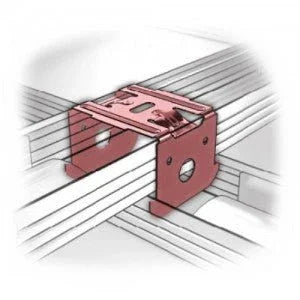
The CD60 cross connector holds two layers of CD60 ceiling profiles together where they cross at right angles. It is the piece that makes a two-level grid: the upper profiles run one way, the lower profiles run the other, and at every crossing a cross connector locks the two together. It is made of galvanised steel and sold in the Renders World drylining range, for suspended plasterboard ceilings and attic construction.
What the CD60 Cross Connector Does
- It joins two levels. The connector sits on the profile of the upper layer and is pressed firmly between the walls of the profile in the lower layer.
- At right angles. It connects CD60 profiles perpendicular to each other, in suspended ceilings with a two-level cross grid.
- A saddle with two legs. The shop drawing shows it over the upper profile, one leg down each side, each leg with a hole, and the lower profile crossing beneath.
- Galvanised steel. Hidden above the plasterboard once the ceiling is finished.
Cross Connector at a Glance
| Detail | CD60 cross connector |
|---|---|
| Joins | Two CD60 profiles crossing at right angles |
| Grid | Two levels: upper and lower layer of profiles |
| Fitting | On the upper profile, pressed into the lower one |
| Material | Galvanised steel |
| Used for | Suspended plasterboard ceilings and attic construction |
Which CD60 Connector Goes Where
| Connector | Where it goes | What it joins |
|---|---|---|
| A100 longitudinal connector | Along a run of profile | Two CD60 lengths end to end, in one line |
| CD60 cross connector | Two-level grid | An upper and a lower CD60 crossing at right angles |
| CD60 one side connector | Single-level grid | The end of one CD60 to the side of another, in a T |
| CD60 double side connector | Single-level grid | Two CD60 profiles crossing each other at the same level |
Building a Two-Level Grid
In this kind of ceiling the upper layer of profiles hangs from the structure and the lower layer, fixed across it, takes the plasterboard. The CD60 cross connector is what ties one layer to the other.
- Fix the UD27 wall channel round the room where the ceiling will sit.
- Hang the upper layer of CD60 profiles: ES60 hangers under a slab or flat ceiling, the WKK 200 mm hanger in attics and roof structures.
- Lay the lower layer across the upper one at right angles, using the 3 m or 4 m CD60 profile.
- At each crossing, place a CD60 cross connector on the upper profile and press it firmly between the walls of the lower profile.
- Screw the plasterboard to the lower layer with drywall screws.
When both layers of profile have to sit at the same level, the joint is a one side or double side connector instead (see the table above).
Ordering, Delivery and Collection
- Dispatch — orders leave the same day when the stock is there; ordering the connectors with the profiles and hangers keeps the frame in one delivery.
- Delivery — quoted by the team once the order is in; every delivery is kerbside.
- Collection — from the counter at Unit 9A, Central Trading Estate, Southampton SO14 5JP, Monday to Friday 7am to 5pm and Saturday 7am to 12pm.
- Returns — 14 days in original condition for goods bought directly from Renders World or its online store; special orders and promotion purchases stay outside this.
FAQ
What is a CD60 cross connector used for?
It connects CD60 profiles at right angles in a suspended ceiling with a two-level cross grid, holding the upper layer to the lower one at every crossing.
How is it fitted?
It is placed on the profile in the upper layer and inserted by pressing it firmly between the profile walls in the lower layer.
Does it work when both profiles are at the same level?
No. For a single-level grid take the CD60 double side connector where profiles cross, or the one side connector where one profile ends against another.
What is it made of?
Galvanised steel.
Can it be used in an attic?
Yes. Renders World sells it for attic construction as well as for suspended ceilings under a slab, with the WKK hanger carrying the profiles in roof spaces.