

Description
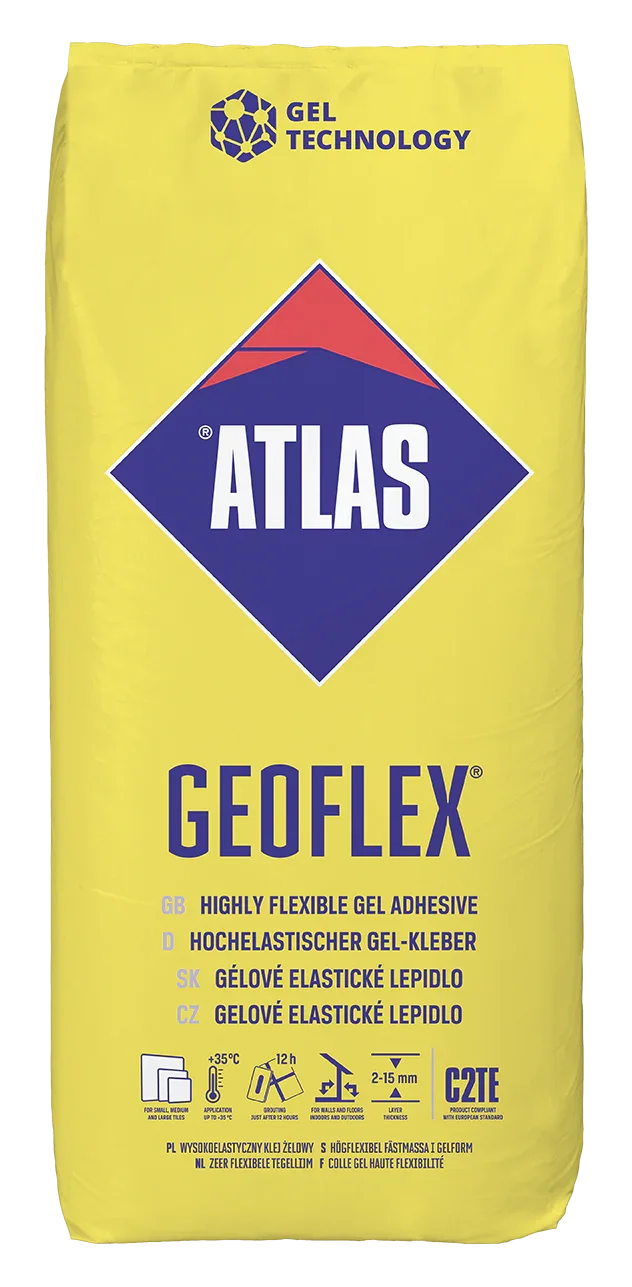
Atlas Geoflex is a gel adhesive for ceramic and stone tiles, declared C2TE to EN 12004, that works at any bed depth from 2 to 15 mm on walls and floors, inside and out. A silicate gel in the mix holds back part of the mixing water so the cement cures fully under porous and dense tiles alike. One 25 kg bag of Atlas Geoflex can be mixed stiff for walls, where nothing may slip, or loose enough to flow out under a floor. It sits in the Renders World range of tile adhesives.
Atlas Geoflex at a Glance
Six reasons to choose Geoflex:
- Thin bed or thick bed from one bag. Atlas Geoflex covers 2 to 15 mm: an even substrate, an uneven one skimmed first, or an uneven one tiled straight over without levelling.
- Zero slip on walls. With water at the low end of the mixing range, about 0.26 l per kg, tiles can be set from the top of the wall down with no support.
- Full flow on floors. With water at the high end, about 0.33 l per kg, Atlas Geoflex spreads out underneath for the full contact floors and outside work need.
- Absorbent and dense tiles alike. The gel keeps water for the cement, so glazed wall tiles and porcelain both bond.
- Sun-exposed surfaces. Atlas Geoflex is made for bonding safely on balconies and terraces in direct sun, while tiling and while it sets.
- Back in use quickly. Walk on it and grout after 12 hours; full foot traffic after 3 days.
| Property | Atlas Geoflex |
|---|---|
| Class (EN 12004+A1) | C2TE: improved, extended open time, reduced slip |
| Declaration of Performance | 282/CPR, all tile fixing inside and outside |
| Tensile adhesion | ≥ 1.0 N/mm² in all four tests, freeze-thaw included |
| Reaction to fire | A1 and A1fl |
| Bed depth | 2 to 15 mm; at least 4 mm after pressing |
| Water per 25 kg | 6.38 to 8.12 l |
| Working temperature | +5 °C to +35 °C |
| Pot life / open time | about 4 hours / at least 30 minutes |
| Grout and walk on | after 12 hours |
| Full load | foot traffic 3 days, wheeled traffic 14 days |
| Pack | 25 kg foil sack, 12 months from production |
The times are for about 23 °C and 55 % humidity; in other conditions they change.
Which Tiles and Which Rooms
Atlas Geoflex is listed for:
- Tiles: glazed wall tiles, terracotta, porcelain stoneware, clinker, stoneware, ceramic mosaic, and concrete or cement-mortar tiles.
- Sizes: up to 0.50 m² per tile, with the longer side up to 100 cm.
- Places: kitchens, bathrooms, laundries and garages in houses; showers and rooms washed down with plenty of water; terraces, balconies, loggias, slab stairs outside, walkways and plinths; low and medium foot traffic in homes, offices, schools and shops.
Natural stone, glass mosaic and glass, coloured or printed tiles need an application test first, set out below, and for glass and printed tiles the tile maker's advice as well.
Choose another adhesive for tiles over 0.50 m², slim panels, laminated porcelain, composite boards and insulating panels; for facades, pools, saunas, cantilever stairs and high-traffic or industrial floors; for timber board floors, metal and plastic; and for drinking-water tanks. Each of those jobs calls for a different product.
Substrates and How to Prepare Them
Atlas Geoflex goes onto cement and anhydrite screeds, cement, lime and gypsum plaster, block walls, concrete, terrazzo, waterproofing coats, plasterboard, fibre-cement boards, heated screeds, bonded paint, OSB and, indoors only, old tiles. The substrate has to be stable, clean and even. Hollows deeper than a 15 mm bed takes up are filled first, for example with ZW 330 levelling mortar, ready to tile about 5 hours after a 5 mm layer. Mould and algae are treated with Atlas Mykos Plus.
- Too absorbent or patchy: prime with Atlas Grunt NKP undiluted or Uni-Grunt Ultra.
- Dense, glossy or painted: a bonding coat of Atlas Ultragrunt, the bonding primer for concrete, terrazzo, oil paint, OSB and tile on tile.
- Wet areas: waterproof first. Tiles can go on Woder E liquid membrane after 2 hours as damp-proofing or 4 hours as full waterproofing, and on two-component Woder Duo after 12 hours; tapes and corners are in the tanking and waterproofing range.
Screeds must be dry: Atlas cement screeds at 4.0 % CM, Atlas anhydrite screeds at 1.0 % CM, other cement screeds at least 12 MPa, 28 days old and below 4 % moisture; new concrete needs 3 months. Gypsum skim coats come off first. OSB floors need boards of at least 25 mm (22 mm on the Atlas M-System) and walls at least 18 mm, with no movement under load, sanded with 40 to 60 grit and primed. For tile on tile, tap-test the old tiling, remove loose tiles, degrease and dull the glaze with a diamond disc.
Mixing: Zero Slip or Full Flow
Pour the bag into measured clean water, mix with a slow drill and paddle until even, leave 5 minutes and mix again. Use Atlas Geoflex within about 4 hours.
| Mix | Water per kg | Water per 25 kg bag |
|---|---|---|
| Zero slip, walls | about 0.26 l | about 6.5 l |
| Mixing range | 0.255 to 0.325 l | 6.38 to 8.12 l |
| Full flow, floors | about 0.33 l | about 8.25 l |
The flowing floor mix takes 8.25 l per bag, used with a 12 mm half-round notch trowel: just above the 8.12 l at the top of the mixing table. Measure the water every time: the same bag of Atlas Geoflex behaves as two different adhesives at the two ends of the range.
Fixing the Tiles
- Spread: rub a thin coat into the substrate, then add a thicker coat and comb it straight away with a notched trowel such as the 8 × 8 mm steel trowel, in one direction, vertically on walls; on large tiles run the ribs parallel to the short side.
- Contact: press each tile in within about 30 minutes, with at least two thirds of its back covered; floors and outside work need full contact, with adhesive on the tile back as well where needed.
- Open time check: touch the combed adhesive. If it sticks to your fingers, tiles can still go on; if not, scrape it off and spread fresh.
Each piece can be slid into line for about 20 minutes after pressing, and nothing is soaked before fixing. Before fixing natural stone or glass, bond one test tile with 60 % of its back in contact and look at it after 2 to 3 days; if no shade difference shows, go ahead. Clean tools with water straight after use; set adhesive comes off with Atlas Cement Away (Szop).
How Many Bags to Order
Geoflex consumption on an even substrate rises with the tile and the trowel; uneven substrates and adhesive on the tile back use more.
| Tile size (cm) | Wall: notch / kg per m² | Floor: notch / kg per m² |
|---|---|---|
| 2 × 2 mosaic | 4 mm / 1.4 | 4 mm / 1.4 |
| 10 × 10 | 4 mm / 1.4 | 6 mm / 2.2 |
| 15 × 60, 20 × 25, 25 × 40, 30 × 30 | 6 mm / 2.2 | 8 mm / 2.8 |
| 30 × 60, 40 × 40, 50 × 50 | 8 mm / 2.8 | 10 mm / 3.4 |
| 60 × 60, 70 × 70 | 10 mm / 3.4 | 12 mm / 4.3 |
| Plank tiles, e.g. 20 × 90 | 8 mm / 2.8 | 10 mm / 3.4 |
One 25 kg bag covers about 18 m² at 1.4 kg/m², 11 m² at 2.2, 9 m² at 2.8, 7 m² at 3.4 and 6 m² at 4.3; the flowing floor mix uses 6.7 kg/m², so a bag covers under 4 m². A 6 m² bathroom floor in 60 × 60 porcelain at 4.3 kg/m² needs about 26 kg — two bags. Plank tiles go on with adhesive on both the floor and the tile back.
Grouting, Joints and Underfloor Heating
- Grout: after about 12 hours, with an Atlas grout such as its ceramic grout.
- Movement joints: internal corners and gaps around sanitary fittings take Atlas sanitary silicone, Silton S or the elastic version, not grout. Both are in the grouts and sanitary silicones range.
- Balconies and terraces: screed fields of at most 3 × 3 m, or up to 25 m² when the tiling itself is jointed into at least four panels of up to 9 m²; every screed joint carried through the tiling.
On a heated screed that has been fully heated up first, Geoflex can go on with the heating off, restarting it after at least 14 days. With the heating on, the screed stays stable at no more than +35 °C for the 14 days after tiling. Heating mats bedded in the adhesive are tiled with the heating off.
Ordering, Delivery and Returns
Renders World processes orders the same day when the stock is there. Add the primer, the membrane and the grout to the same basket so the whole floor or wall arrives together.
- Delivery: quoted by the team after the order; parcels up to 25 kg go next day and pallets next day or in two business days on the economy option, always kerbside.
- Collection: from the counter at Unit 9A, Central Trading Estate, Southampton SO14 5JP, Monday to Friday 7am to 5pm and Saturday 7am to 12pm.
- Returns: goods bought directly from Renders World can go back within 14 days in their original condition; goods in paper bags, tinted products, special orders and promotion purchases are excluded.
Technical Documentation
FAQ
Is Atlas Geoflex an S1 adhesive?
Its declared class is C2TE: an improved cementitious adhesive with extended open time and reduced slip. A specification that asks for S1 or S2 needs that letter in the adhesive's class code; the code of Atlas Geoflex is C2TE.
Is it the same as Geoflex White or Geoflex Express?
No. Geoflex White and Geoflex Express are separate products with their own data sheets. The figures here belong to Atlas Geoflex alone.
How much water goes into one bag?
6.38 to 8.12 litres per 25 kg. Use about 6.5 litres for a stiff wall mix that does not slip and about 8.25 litres for a flowing floor mix.
How many square metres does a 25 kg bag cover?
About 11 m² with a 6 mm notch on wall tiles, about 9 m² with 8 mm, about 7 m² with 10 mm and about 6 m² with a 12 mm notch on large floor tiles.
Can I tile over old tiles?
Indoors, yes — tile on tile is listed for inside only. Tap-test the old tiling, take off loose tiles, degrease, dull the glaze and prime with Atlas Ultragrunt first.
Can it go on a floor with underfloor heating?
Yes, on water-heated screeds that have been heated up first. With the heating off, restart it after at least 14 days; with it on, keep the screed at no more than +35 °C for 14 days after tiling.