

Description
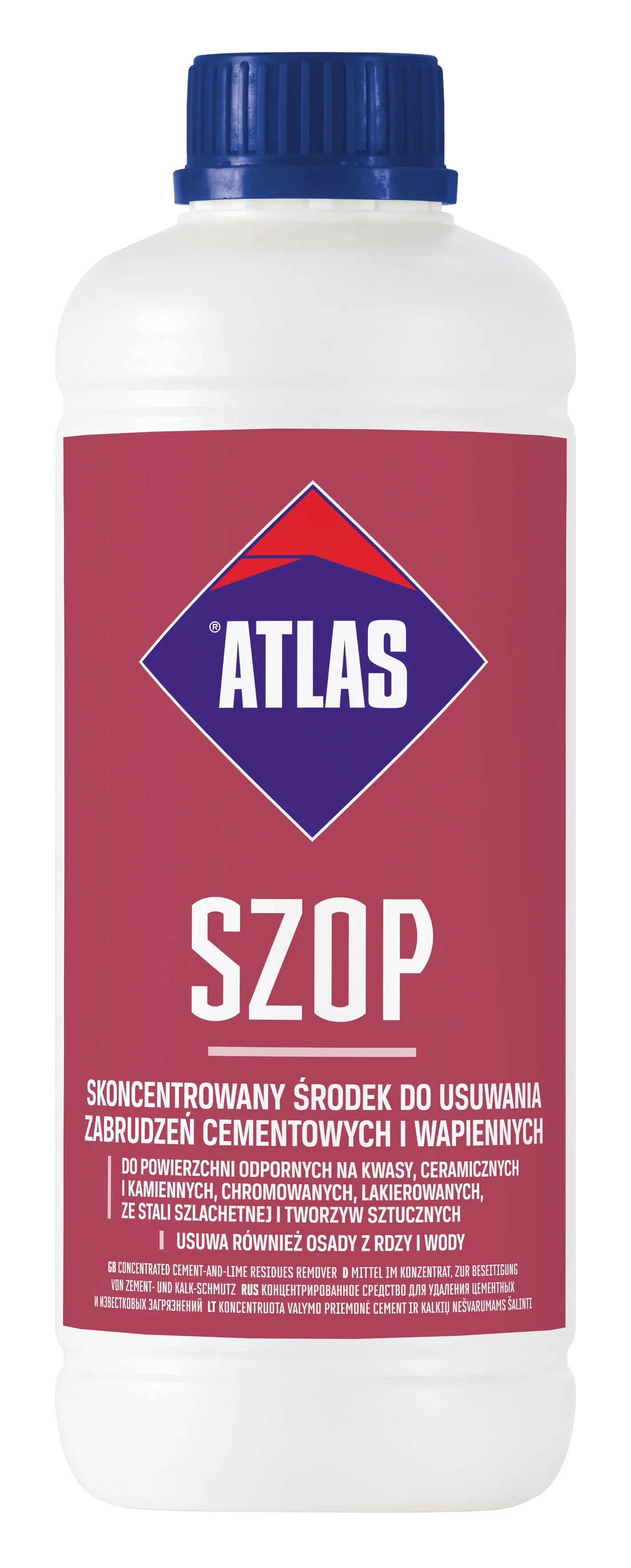
Atlas Cement Away, sold for years under the name ATLAS SZOP, is a concentrated cement remover in a 1 kg bottle. It takes cement, lime and gypsum residue off tiles, stone, sanitaryware, chrome, stainless steel and plastic once the rendering, tiling or plastering is done, and it sits in the Renders World cleaning products range.
What the Cement Remover Takes Off
The data sheet describes a cement and lime residue remover that contains inorganic acid, recommended for cleaning surfaces after building work where mineral mortars were used. The phosphoric acid in it is what dissolves the mineral residue, which is why the remover is meant for surfaces that stand up to acid.
- Construction residue: cement, lime and gypsum left by adhesives, grouts and plastering mortars.
- Everyday deposits: dirt, sediment and marks left by minerals in water, and rust stains.
- Surfaces named on the sheet: ceramic tiles (glazed, terracotta, porcelain stoneware, clinker), stone, sanitary facilities, and chrome-plated, lacquered, stainless steel and plastic surfaces.
The maker changed the name from SZOP to Cement Away and states that nothing else changed apart from the name and the label, so a data sheet headed ATLAS SZOP describes this bottle. The name Cement Away is also used by another manufacturer for a different cleaner, so quote SZOP or the Atlas name when you order.
Technical Data
| Property | Value |
|---|---|
| Product type | Concentrated cement and lime residue remover |
| Active ingredient | Phosphoric acid, 15–20 % by weight |
| Form and colour | Liquid, yellow to straw |
| pH, undiluted | 2 |
| Density | 1.1 g/cm³ |
| Viscosity | 80 cP |
| Dilution | Undiluted, or 1:3 to 1:15 with water |
| Consumption | Depends on the degree and nature of soiling |
| Packaging | Plastic bottle, 1 kg |
| Shelf life | 36 months from the production date |
| Storage temperature | +5 °C to +30 °C |
| Hazard class | Skin Corr. 1, H314 (signal word Danger) |
| Transport | UN 1805, class 8, packing group III |
Dilution by Type of Residue
The sheet treats dilution as a choice made against the residue in front of you rather than one fixed mix, so the same bottle of cement remover covers four kinds of job.
| Residue | Concentrate to water |
|---|---|
| Coarse, old adhesive, grout and plaster residue | Undiluted |
| Deposits from adhesives, grouts and plaster | 1:3 to 1:5 |
| Dirt and lime | 1:5 to 1:10 |
| Rust and tap-water stains | 1:10 to 1:15 |
On tiled work the table matters more than it looks. The sheet warns that on cladding whose joints are filled with cement grout, using the remover without proper dilution can wash the grout out or discolour it, so the joint sets the limit as much as the residue does.
How to Use It
- Wet the area first. Surfaces soiled with cement- or lime-based products are lightly soaked with water before the remover goes on.
- Apply with a brush or sponge, undiluted or at the dilution from the table.
- Give heavy deposits time. Soak particularly heavy soiling with the undiluted remover and leave it for several minutes to start working, then remove the residue.
- Rinse thoroughly with clean water or a slightly alkaline water solution, in every case.
- Clean tools with clean water straight after use.
A trial application on a less exposed part of the surface comes first, to see how that surface reacts. On absorbent, porous surfaces where the dirt has soaked into the material, removal can be difficult.
Safety, Storage and Transport
This is a corrosive remover that causes severe skin burns and eye damage; gloves, eye protection and ventilation are what keep it safe to use.
- Protection: gloves resistant to the product, protective workwear, and goggles or a face shield according to the work.
- Ventilation: do not breathe the vapour or spray; in a poorly ventilated space, a half mask with a filter for organic vapours.
- On skin or in eyes: rinse with running water for 10 to 30 minutes and call a doctor.
Keep the bottle tightly closed in a cool, dry, ventilated place between +5 °C and +30 °C, protected against frost and overheating and out of reach of children. It has a child-resistant closure and a tactile warning. Unused remover and dirty containers never go into drains or household waste; they go to an authorised waste company. For carriage the remover is dangerous goods, UN 1805, class 8.
Cement Away or SZOP 2000?
The maker renamed both of its end-of-job cleaners at the same time, and they work on opposite sides of the pH scale.
| Cleaner | Chemistry | Residue it removes |
|---|---|---|
| Cement Away (SZOP) | Acid, pH 2 | Cement, lime, gypsum, rust |
| Resin Away (SZOP 2000) | Alkaline, pH 10–11 | Primers, emulsion paints, dispersion renders |
A cured splash of cement-based adhesive on a tile calls for this bottle; a splash of primer or ready-mixed dispersion render calls for the other. The third product in the range is Atlas Mykos Plus, and green or red growth on a wall is identified with the guide to red and green algae on render. For white marks on the rendered face itself, start with the guide to efflorescence and white stains: the rendered face is not among the surfaces listed for this remover, and the guide to cleaning silicone render covers the wall.
Ordering, Delivery and Returns
- Dispatch: Renders World processes orders the same day when the stock is there.
- Delivery: the cost is not calculated at checkout; after the order, the customer service team contacts you with the most cost-effective delivery method. All deliveries are kerbside.
- Collection: from the Southampton counter, Unit 9A, Central Trading Estate, SO14 5JP, Monday to Friday 7am to 5pm and Saturday 7am to 12pm.
Change-of-mind returns run to 14 days, in original condition, for goods bought directly from Renders World or its online store.
FAQ
How far does a 1 kg bottle go?
No coverage figure is published for this cement remover: consumption depends on the degree and nature of the soiling. Because most jobs use it diluted, from 1:3 up to 1:15, the residue you are removing decides how far the bottle goes.
Is it safe next to cement grout?
Only when it is diluted properly. On tiles grouted with a cement-based grout, the remover used without proper dilution may wash the grout out or discolour it, so dilute it for the residue, try a less visible area first and rinse thoroughly afterwards.
Is Cement Away the same as ATLAS SZOP?
Yes. The maker renamed SZOP to Cement Away and states that only the name and the label changed. Resin Away is the new name of a different Atlas product, the alkaline cleaner for dispersion residue.
How should it be stored?
Tightly closed, in a cool, dry and ventilated place between +5 °C and +30 °C, protected against frost. The shelf life is 36 months from the production date on the packaging.
Technical Documentation