
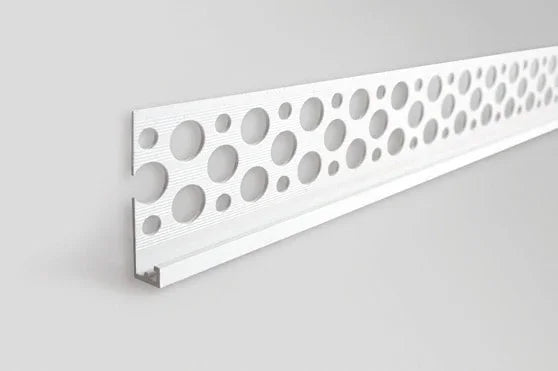

Description
The 6 mm PVC render stop bead without mesh is the no-wing version of the standard 6 mm termination profile, designed for situations where there is no fresh wet basecoat behind the bead for a mesh wing to embed into. It sits alongside its mesh-backed counterpart in the render stop beads range, and the choice between the two is driven entirely by what sits behind the bead — not the render finish in front of it. On retrofit terminations, partial-elevation works, and junctions against existing finishes, the no-mesh profile is technically the correct detail.
What the 6 mm No-Mesh Stop Bead Does at Dry-Junction Terminations
The 6 mm PVC render stop bead without mesh is a 2.5 m white rigid PVC profile that creates a flush 6 mm termination edge wherever a thin-coat render coat meets an existing finish, a dry substrate, or a prior installation that lacks the continuous wet basecoat needed to embed a mesh wing. The nose dimension is identical to the mesh-backed sibling — what differs is the fixing logic, with a perforated flange mechanically anchored to the substrate rather than chemically bonded through embedded mesh.
Specify this profile on retrofit work where opening up the wall for a mesh wing is impractical, on partial-elevation jobs that terminate against painted or pre-rendered surfaces, and at boundaries between new render and existing trim, cladding, or composite panels. The 6 mm depth keeps the bead flush with a standard reinforced basecoat plus 1.5–2 mm topcoat build-up, so terminations alternating between mesh and no-mesh beads stay visually consistent across the elevation.
Why Trade Specifiers Choose the No-Mesh Stop Bead for Retrofit Work
- Correct detail at dry-junction terminations: The absence of a mesh wing makes this the technically right profile against existing finishes, where embedding wet mesh into a dry surface would leave the wing as a brittle frill behind the topcoat.
- Standard 6 mm flush depth: Matches a 3–5 mm reinforced basecoat plus 1.5–2 mm topcoat build-up, holding the nose level with the finished surface so transitions to mesh-backed beads elsewhere on the elevation remain seamless.
- Leaner profile for long retrofit runs: Without the integrated mesh wing, the bead carries less material per metre — useful on extensive partial-elevation terminations where every linear metre adds up.
- Non-corrosive PVC body: No rust telegraphing through light silicone or acrylic topcoats in damp UK exposure or coastal microclimates, and no oxide staining at the nose line.
- Clean masking edge: The rigid nose holds tape true for sharp colour or finish transitions, useful where retrofit work meets an existing facade colour that must be cut in precisely.
- Cuts cleanly on site: Tin snips give square butt cuts and a fine-tooth hacksaw produces accurate 45° mitres at corner junctions — no abrasive disc dust on occupied refurbishment sites.
- Compatible with major UK render systems: Works with Atlas, Ceresit, and Roker basecoats and with every silicone, acrylic, and silicate-silicone topcoat stocked at Renders World.
Technical Specifications — 6 mm No-Mesh Stop Bead Data Sheet
| Property | Value |
|---|---|
| Profile type | Render stop bead, no mesh wing |
| Body material | Rigid PVC, white, UV-stabilised |
| Render depth (nose) | 6 mm |
| Length | 2.5 m per piece |
| Fixing method | Mechanical — adhesive dabs, render staples, or substrate-appropriate fasteners |
| Recommended fixing centres | 200–250 mm along perforated flange |
| Target render build-up | 3–5 mm basecoat + 1.5–2 mm topcoat |
| Frame gap (sealant joint) | 2–3 mm |
| System mesh lap onto flange | 100 mm minimum where continuous reinforcement is maintained |
| Application temperature | +5 °C to +25 °C (governed by render system or fixing adhesive) |
| On-site cutting | Tin snips or fine-tooth hacksaw |
| Compliance reference | Typically meets BS EN 13658-2 design principles for plastering accessories — confirm with project documentation |
How to Install the 6 mm No-Mesh Stop Bead — Mechanical Fixing, Alignment, Over-Rendering
Dry-fit the bead first against the termination line and check the nose for line and level with a long straight edge before committing to fixings. Mark fixing points along the perforated flange at approximately 200–250 mm centres, then anchor with render staples into masonry, screws into timber or board substrates, or intermittent adhesive dabs on suitable surfaces. On adhesive fixing, keep dabs intermittent rather than running a continuous bead — a continuous adhesive line tends to squeeze out behind the nose during pressing and disturbs the alignment.
Over-render the perforated flange with basecoat so the flange is fully concealed within the wider basecoat field. For the complete step-by-step process — dry-fitting tolerances, fixing-centre spacing on different substrates, mitre cuts at reveal corners, and sealant sequencing at frames — the full stop bead installation guide for UK projects sets out each stage in order. For coordinating the no-mesh bead with corner beads, bellcasts, and oversills around openings, the render detailing guide for windows and doors covers the full profile sequencing process.
Installation Notes — Conditions, Sealant Joints, Junctions with Mesh-Backed Beads
Where the bead terminates against a window or door frame, leave a 2–3 mm gap between the nose and the frame face. After the render has fully cured, this gap takes a low-modulus UV-stable sealant that forms the primary waterproof joint and accommodates differential thermal movement between the render system and the frame material. Closing the gap with render rather than sealant is the most common cause of edge cracking at frames, and it appears just as often on no-mesh retrofit work as on full-elevation installations.
Where this profile meets an adjacent run of mesh-backed bead — typically where a partial retrofit transitions into a full-elevation EWI area — butt the noses tightly end to end and lap the system reinforcement mesh from the wider facade onto the perforated flange of this profile by a minimum of 100 mm. That overlap preserves continuous crack control across the transition between fixing methods. Mitre joints belong at internal and external corners only — straight-run mitres introduce a visible kink, regardless of whether the bead is mesh-backed or no-mesh.
Pro Tips From UK Installers Using the No-Mesh Stop Bead
For best result, treat the mesh-versus-no-mesh decision as a question about what sits behind the bead, not what sits in front of it. Defaulting to mesh-backed beads for every job is a common reflex because they appear to reinforce the termination more thoroughly — but a mesh wing pressed against an existing dry painted finish has nothing to bond into, and the wing then sits as an unreinforced frill behind the topcoat where it adds bulk without strength. On retrofit and partial-elevation works the no-mesh profile is technically the better detail, fixed mechanically, with continuity of reinforcement maintained by lapping system mesh onto the flange from the wet side instead.
Pre-mark fixing centres on the flange before the bead leaves the workbench. Marking the 200–250 mm fixing points on the ground takes seconds and saves the rework of stapling into the wrong substrate position once the bead is held up against an awkward sill underside or soffit line. On masonry substrates with unpredictable hardness — typical of older retrofit projects — test-fix one staple before committing the full run; a softer brick may need a longer staple or a switch to screw fixing through the perforations to hold the line.
Is the 6 mm No-Mesh Stop Bead Right for Your Project?
- Best fit: terminations against existing finishes, retrofit and partial-elevation work, or any junction without a continuous wet basecoat behind the bead.
- Switch to mesh-backed at the same depth: for new full-elevation EWI or render with continuous wet basecoat, the 6 mm PVC stop bead with mesh is the correct selection because the mesh wing reinforces the termination chemically.
- Step down for decorative thin-coats: for single-coat refurbishment renders around 2–3 mm finish thickness, the 3 mm PVC stop bead with mesh proportions the nose to the thinner finish.
- Step up for deeper systems: for monocouche or thicker EWI build-ups, the 10 mm no-mesh stop bead matches the heavier render depth, with the 15 mm option in the wider render stop beads range covering traditional sand-cement coats.
- Need quantity advice? Retrofit terminations are often longer than openings suggest because elevations stop at material changes rather than fitted joinery; our technical desk can confirm exact lengths against site drawings on request.
FAQ — No-Mesh Stop Bead Fixing, Compatibility, Ordering
When should I choose the no-mesh version over the mesh-backed bead?
Choose no-mesh whenever the bead lands against a dry condition — existing finish, prior render, painted substrate, or any junction with no fresh wet basecoat to embed a mesh wing into. Choose mesh-backed when the bead sits within a continuous wet basecoat application, which is the standard scenario on new-build EWI and full-elevation render work. The depth of the bead (6 mm here) is matched to the render finish; the mesh-versus-no-mesh selection is matched to the substrate condition behind it.
How is the no-mesh bead fixed in place?
Mechanically — typically with adhesive dabs along the perforated flange, render staples into masonry or insulation, or appropriate fasteners into timber or board substrates. Spacing of approximately 200–250 mm holds the profile securely on most facades. The bead is then over-rendered so the flange is fully concealed within the basecoat, leaving only the 6 mm nose visible at the finished surface.
Will the white nose or flange show through coloured silicone topcoats?
The 6 mm nose itself is the same depth as the mesh-backed sibling and is fully masked by a correctly applied 1.5–2 mm topcoat at the manufacturer's coverage rate. The visibility risk on no-mesh installations is slightly different — the perforated flange behind the nose must be fully concealed by the basecoat. Where the basecoat is feathered too thin over the flange, the perforation pattern can read faintly through a translucent topcoat. Re-coating the flange zone before topcoat, or sealing with a matching silicone masonry paint after cure, resolves this cleanly.
Can I still maintain continuous mesh reinforcement at this termination?
Yes. Lap the system reinforcement mesh from the wider facade onto the perforated flange of the bead by a minimum of 100 mm. The flange perforations key the lapped mesh into the basecoat above, and the result is a continuous reinforced field across the termination line — the same crack-control performance as a mesh-backed bead, achieved by overlapping the system mesh instead of relying on a factory-bonded wing.
Is there a temperature limit for installation?
The PVC profile itself is unaffected by cold weather, but the fixing adhesive or basecoat is. Install only when the chosen render or adhesive is within its application window — typically +5 °C and rising, with no rain forecast within 24 hours of fixing. Mechanical fixings such as staples and screws are not temperature-limited, so on cold days the bead can be dry-fixed first and over-rendered once conditions allow.
How many no-mesh stop beads does a typical retrofit elevation need?
Retrofit lengths vary more than new-build because terminations follow material boundaries rather than fitted openings. Measure every edge where the new render terminates against an existing surface — including stops at cladding boundaries, between rendered and painted zones, and at horizontal datum changes — and divide by 2.5 m, rounding up with a 10–15% waste allowance. A partial-elevation retrofit typically uses 15–25 linear metres of no-mesh stop bead, with the exact figure driven by how the works are scoped.