
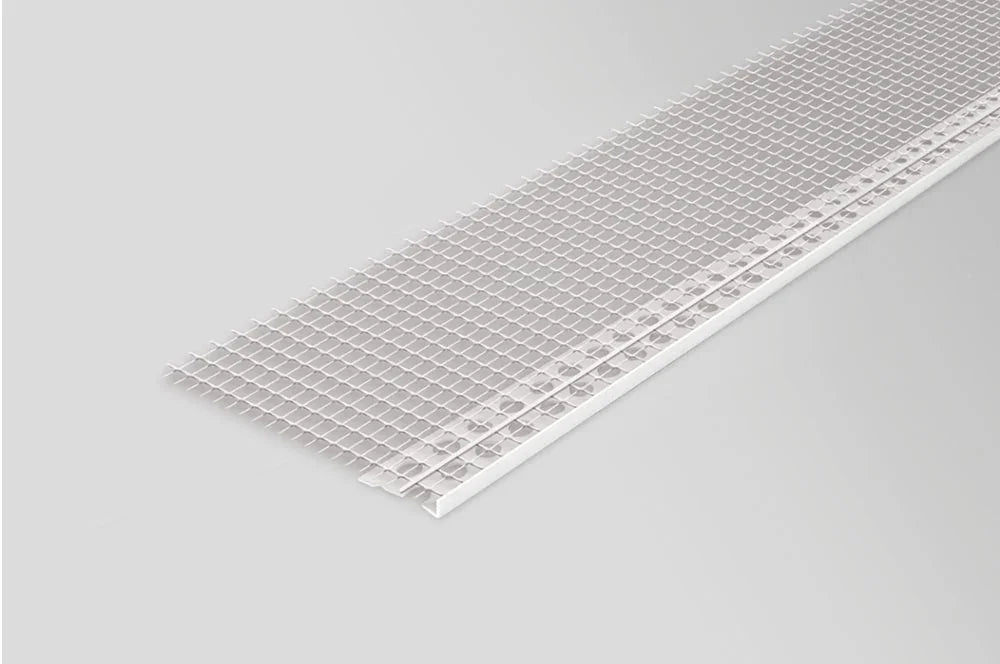
Description
The 6 mm PVC render stop bead with mesh is the single most-specified termination profile across UK thin-coat render and external wall insulation systems — sized to match the standard EWI build-up of a 3–5 mm reinforced basecoat plus a 1.5–2 mm topcoat. This 2.5 m profile sits at the centre of the wider render stop beads range and pairs a rigid PVC nose with an integrated alkali-resistant fibreglass mesh wing that embeds straight into wet basecoat, locking the termination edge into the reinforcement layer in a single fixing pass.
What the 6 mm PVC Stop Bead with Mesh Does in a Standard EWI System
The 6 mm PVC render stop bead with mesh is a 2.5 m white rigid PVC profile that creates a flush 6 mm termination edge at sill lines, expansion joints, plinth bands, and material change-overs on thin-coat silicone, silicate, and acrylic systems built over a reinforced basecoat. At 6 mm depth it accommodates the combined thickness of basecoat, embedded mesh, and topcoat without burying the bead or leaving it proud — which is why most thin-coat manufacturer guidelines are dimensioned around this exact profile.
Specify the 6 mm mesh-wing variant when the system is "standard" thin-coat over EPS, graphite EPS, or mineral wool insulation, or for direct-to-substrate renovation work that retains a continuous reinforcement layer. For very thin single-coat decorative renders at 2–3 mm total thickness, the 3 mm profile is the proportionate selection; for heavier EWI build-ups with deeper basecoat passes, the 10 mm and 15 mm variants step the termination up in proportion.
Why Trade Specifiers Choose the 6 mm Mesh-Wing Profile for UK EWI
- Dimensional default for standard EWI: The 6 mm nose suits a 3–5 mm reinforced basecoat plus 1.5–2 mm topcoat without protruding or being buried — the build-up most manufacturer guidelines specify by default.
- Integrated alkali-resistant mesh wing: The factory-bonded fibreglass wing keys into wet basecoat and overlaps continuously with the system reinforcement mesh, removing the need for a separate edge strip.
- Crack control at the highest-movement line: Mesh embedment distributes shrinkage and thermal stress across the bond zone, holding the termination against the hairline cracking that typically initiates where rigid profiles meet flexing render.
- Non-corrosive PVC body: Unlike galvanised steel, the PVC profile produces no rust staining beneath light silicone or acrylic topcoats in damp UK exposure and coastal microclimates.
- Rigid nose for masking discipline: The straight edge holds masking tape true during topcoat application, producing sharp transitions between colours, finishes, or render-to-cladding boundaries.
- Cuts cleanly on site: Tin snips give square butt-joint cuts and a fine-tooth hacksaw produces accurate 45° mitres at window reveal corners, with no abrasive disc dust on occupied refurbishment sites.
- Specified across major UK render systems: Compatible with Atlas, Ceresit, and Roker EWI basecoats and with every silicone, acrylic, and silicate-silicone topcoat stocked at Renders World.
Technical Specifications — 6 mm Stop Bead Data Sheet
| Property | Value |
|---|---|
| Profile type | Render stop bead with integrated mesh wing |
| Body material | Rigid PVC, white, UV-stabilised |
| Render depth (nose) | 6 mm |
| Length | 2.5 m per piece |
| Mesh | Alkali-resistant fibreglass, factory-bonded wing |
| Target render build-up | 3–5 mm reinforced basecoat + 1.5–2 mm topcoat |
| Mesh overlap with main reinforcement | 100 mm minimum |
| Frame gap (sealant joint) | 2–3 mm |
| Application temperature | +5 °C to +25 °C (governed by render system, not bead) |
| On-site cutting | Tin snips or fine-tooth hacksaw |
| Compliance reference | Typically meets BS EN 13658-2 design principles for plastering accessories — confirm with project documentation |
How to Install the 6 mm Stop Bead — Bedding, Embedment, Curing
Apply a continuous bed of basecoat or EWI adhesive along the termination line, press the bead firmly so the mesh wing embeds fully into the wet material, and check the nose for line and level with a long straight edge before the bedding sets. The mesh should disappear into the basecoat — if it remains visibly white on the surface, more material is needed under the wing. Allow the bedding layer to cure before applying the wider basecoat field, or set the bead first and feather the field basecoat over the wing in the same pass for a monolithic reinforced layer.
For the complete step-by-step process — adhesive bed preparation, jointing on longer runs, mitre cuts at reveal corners, and sealant sequencing at frames — the full stop bead installation guide for UK projects sets out each stage in order. For coordinating the 6 mm stop bead with corner beads, bellcasts, and oversills around window and door openings, the render detailing guide for windows and doors covers the full profile sequencing process.
Installation Notes — Conditions, Sealant Joints, Junctions
Where the bead terminates against a window or door frame, leave a 2–3 mm gap between the nose and the frame face. After the render has fully cured, this gap takes a low-modulus UV-stable sealant that forms the primary waterproof joint and accommodates differential thermal movement between the render system and the frame material. Closing the gap with render rather than sealant is the most common cause of edge cracking at frames on EWI work and the most reliable indicator of a profile fitted in too much haste.
Lap the system reinforcement mesh a minimum of 100 mm onto the bead's mesh wing to maintain continuous crack control across the detail. At window reveal corners, mitre the mesh wings at 45° rather than overlapping them — stacked mesh layers create a visible bulge that telegraphs through thin-coat finishes once the topcoat dries. On long horizontal runs at soffit lines, butt the noses tightly end to end and overlap successive mesh wings by the same 100 mm, keeping the tensile network continuous along the full termination.
Pro Tips From UK Installers Using the 6 mm Stop Bead
For best result, set the bead before the basecoat goes on the wider wall, not afterwards. Treating the stop bead as a finishing step — applied once the field is already coated — denies the mesh wing the fresh basecoat it needs to embed into properly. Set first, allow the bedding pull to grab, then continue the basecoat across the wall and feather over the wing in the same pass. The result is a single monolithic reinforced layer with no cold joint at the most movement-prone line on the elevation.
Order beads in whole multiples of typical opening perimeters. A 1.2 m × 1.2 m window needs 3.6 m of stop bead (two jambs plus head), and a 2.5 m profile gives one full piece plus a 1.1 m offcut that suits the next short return. Mixing in fresh full lengths with retained offcuts from previous openings produces near-zero waste across a multi-opening elevation. For projects mixing 6 mm with thinner or deeper variants, keep cut-off boxes separated by profile depth — the 3 mm, 6 mm, and 10 mm noses look similar at a glance and a mis-pick costs more in lost time than the bead itself.
Is the 6 mm PVC Stop Bead with Mesh Right for Your Project?
- Best fit: standard thin-coat render systems with a 3–5 mm reinforced basecoat plus 1.5–2 mm topcoat — the most common UK EWI configuration over EPS, graphite EPS, or mineral wool insulation.
- Step down to 3 mm with mesh: for single-coat decorative renders around 2–3 mm finish thickness, the 3 mm PVC stop bead with mesh is the proportionate selection.
- No-mesh alternative at the same depth: where the bead lands against an existing finish with no continuous fresh basecoat behind it, the 6 mm PVC stop bead without mesh handles the boundary cleanly.
- Step up for heavier systems: for monocouche, traditional sand-cement, or thicker basecoat applications, the deeper 10 mm and 15 mm options in the render stop beads range provide the proportioned nose those finishes need.
- Need quantity advice? A typical three-bedroom property with four to six openings requires 25–40 linear metres of 6 mm stop bead; our technical desk can confirm exact lengths against elevation drawings on request.
FAQ — 6 mm Stop Bead Coverage, Compatibility, Ordering
Why is the 6 mm depth the default specification for UK EWI?
Most UK external wall insulation systems are designed around a reinforced basecoat of 3–5 mm with a 1.5–2 mm thin-coat topcoat. The combined thickness sits naturally within a 6 mm nose, leaving the bead flush with the finished surface — neither buried by excess material nor proud of the topcoat. That dimensional fit is why the 6 mm profile carries the highest order volume in the stop bead range and why most manufacturer details are drawn around it.
Does the integrated mesh replace the system reinforcement layer?
No. The wing reinforces the bond at the termination only. The wider facade still requires a continuous reinforcement mesh embedded in the basecoat — lap the system mesh at least 100 mm onto the bead's wing to maintain a continuous reinforced field across the bond zone.
How many 6 mm stop beads does an average opening need?
A 1.2 m × 1.2 m window requires stop bead along both vertical jambs and the head, totalling approximately 3.6 linear metres — that is two 2.5 m lengths per opening with a 1.4 m offcut to use elsewhere. A larger 1.5 m × 1.5 m opening needs 4.5 linear metres. For a full elevation with six openings, allow 14–16 lengths plus 10–15% for cuts and waste.
Can the 6 mm bead be installed in cold weather?
The PVC profile itself is unaffected by low temperatures, but the bedding adhesive or basecoat is. Install only when the chosen render or adhesive is within its application window — typically +5 °C and rising, with no rain forecast within 24 hours of fixing. The bead will sit happily on site until conditions improve.
Will the white nose show through coloured silicone topcoats?
With a correctly applied 1.5–2 mm thin-coat topcoat at the manufacturer's specified coverage rate, the white nose is fully masked by the through-coloured finish. Under-applied topcoats — usually the result of stretching material across a larger elevation than the coverage allowed — can leave the nose faintly visible. Where this occurs, masking the exposed edge and over-painting with a matching silicone masonry paint restores a uniform appearance.
How is the 6 mm bead jointed on long runs?
Butt the noses tightly end to end and overlap the mesh wings by approximately 100 mm to maintain continuous tensile strength across the joint. Avoid mitre joints in straight runs — they introduce a visible kink in the finished line. Use mitres only at internal and external corners, cut at 45° with a fine-tooth hacksaw rather than snips so the wing edge stays clean and the doubled mesh sits flat in the basecoat.

