
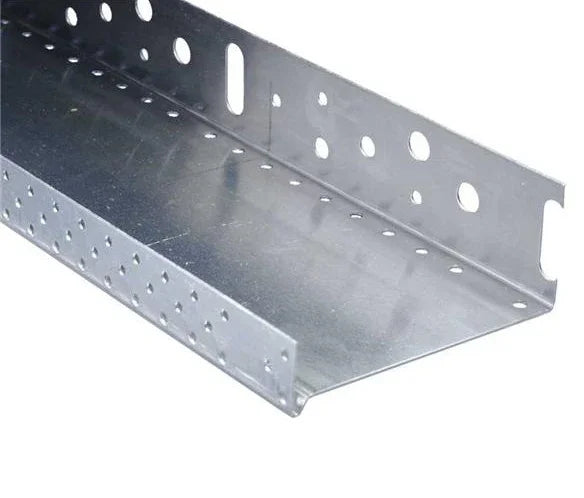
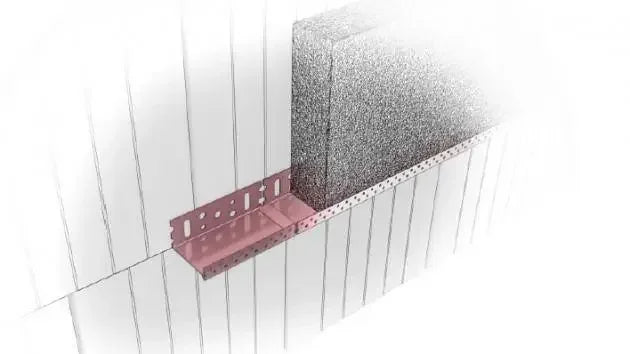
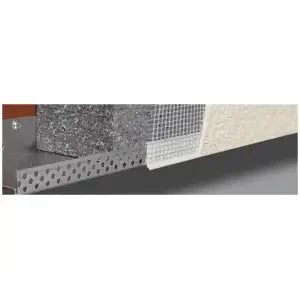


Description
Two profiles share the 93 mm channel on this shelf, and only one of them names its gauge. That is the difference a buyer can verify today: the name on this length declares a 1 mm gauge, the price is live, and the supplier's own instructions are worth requesting with the order.
Where the Gauge-Named 93 mm Starter Profile Belongs
The 1mm base track 93mm 2.5m is the gauge-named starter profile in the 93 mm range, priced at £8.40 per 2.5 m length in August 2026, and it sets the perimeter datum every board course above it follows. It belongs with the starter rails, plugs and discs on the insulation fixing accessories shelf, where Renders World lists it beside the profile that names no gauge at all.
The datum is the one line the whole facade inherits, so a starter profile earns its place by how true that line stays while boards, mesh and render land on it.
- The specification names a gauge — where a designer calls out a starter-rail thickness, this is the member of the 93 mm pair whose name declares one, so the order line matches the drawing without a substitution note.
- The base course is already at 93 mm — channel width and the 2.5 m module are identical across the pair, so the choice changes one line on the order and nothing about the setting out.
- The project files component data — request the profile's own instructions with the order, because the table below shows which figures the name carries and which only that document settles.
Why Trade Buyers Order the Named-Gauge Member at This Width
Renders World stocks the 93 mm width twice, and the reasons buyers reach for the named-gauge member are commercial and documentary rather than a performance claim.
- A gauge inside the name — the section thickness sits in the product name, which is what a specification calling out a starter rail needs to see; the other 93 mm profile names none.
- £8.40 per 2.5 m length — 40p above the £8.00 standard profile at the same width in August 2026, so matching a named gauge costs pennies on a run.
- One channel, one module — 93 mm and 2.5 m on both members, so a base line costed on one is costed on the other and the perimeter stays continuous.
- Stocked as a pair, not a substitution — both profiles are held at this width, so a drawing naming a gauge is answered from stock.
- Declared despatch weight is 2 kg on both — that is packaging data rather than a section mass, so a stiffness comparison comes from the supplier's instructions, not from a listing.
What the Name Declares, and What Needs the Supplier's Sheet
Everything below is read from the product name, read live from the product record, or marked not published, and the third column says which. No document for this profile was retrieved in this session, so nothing is filled in from a comparable product.
| Property | Value | What it rests on |
|---|---|---|
| Channel width | 93 mm | Product name |
| Length per piece | 2.5 m | Product name |
| Section gauge | 1 mm | Product name |
| Price per length | £8.40, August 2026 | Live product record |
| Metal and finish | Not published | No profile document retrieved |
| Board thickness the channel takes | Not published | Needs a manufacturer channel table |
| Fixing centres and drill diameter | Not published | Profile instructions or system designer |
| Perforation, drip edge, mesh detail | Not published | No profile document retrieved |
| Reaction to fire | Not published | A class belongs to a tested product or assembly, never to a profile name |
Two consequences follow, and both are practical. Treat the width in the name as a designation and confirm the fit with an off-cut of the intended board plus its adhesive bed before the first course is bonded.
Where a project needs the gauge, the metal and the fixing schedule in writing, ask for the profile's instructions on the order rather than taking a figure from any listing.
Fitting the Profile When No Manufacturer Table Is on File
Method carries this section, because the figures that would normally set it belong to the profile's instructions and to the wind-load assessment for the site. The sequence works with whatever those documents turn out to say.
- Set one datum and project it. Establish the base line above the DPC with a laser, carry it to every elevation from that single reference, and snap a chalk line so the height survives until boarding starts.
- Confirm the channel against the real board. Offer up an off-cut with its adhesive bed allowed for and check it seats squarely on the shelf rather than riding on the lip.
- Dry-run the lengths before drilling. Mark fixing positions through along the chalk line, which catches a fixing landing on a movement joint or a service while it is still a pencil mark.
- Take the fixing schedule from the documents that own it. Drill diameter, plug type and centres come from the profile instructions or the system designer, confirmed on the first length rather than carried from the last job.
- Confirm the metal before choosing a cutting tool. The name declares a gauge and not a material, and cutting, deburring and corrosion class all follow the metal, so ask which it is at the order.
The base track datum and levelling method covers the first day on site, the insulation fixings installation sequence picks the wall up from the first bonded course, and the fixing pattern and spacing method owns the per-square-metre calculation.
Choosing Between the Two 93 mm Profiles
Both members take the same channel and the same module, so the comparison runs on what each name declares and what each costs.
| Profile | What the name declares | Price per 2.5 m length |
|---|---|---|
| 1 mm gauge 93 mm profile (this product) | 93 mm channel, 2.5 m, 1 mm gauge | £8.40, August 2026 |
| 93 mm profile that names no gauge | 93 mm channel, 2.5 m; no gauge named | £8.00, August 2026 |
The honest reading is that one member names a gauge and the other does not, so a specification calling out a starter-rail thickness is answered by the named one. On price, £8.40 − £8.00 = £0.40 a length, about 5% at this width. Renders World lists the pair side by side, which makes this a choice rather than a substitution.
Ordering the Profile and Costing the Base Line
Measure the base line, divide by the 2.5 m module and round up. A 12 m perimeter gives 12 ÷ 2.5 = 4.8, so five lengths cover it, and 5 × £8.40 = £42.00 in profile, materials only, at the August 2026 price. Per linear metre, £8.40 ÷ 2.5 m = £3.36.
Carry a spare length where external corners have to be cut, and keep labour outside that figure — material and installed cost are never one number.
- Order this member where a gauge is specified — the order line reads 1mm base track 93mm 2.5m, one length per 2.5 m of base line plus a corner allowance.
- Order the other member where the drawing is silent — the 93 mm profile without a named gauge takes the same channel at £8.00 a length.
- Put the boards on the same delivery — the graphite EPS insulation boards ladder publishes the thickness range the base course is chosen from, with fit confirmed by off-cut.
- Where slabs are specified instead — the mineral wool insulation range covers the same base zone, and the slab documents carry its declared properties.
Questions Trade Buyers Ask Before Ordering the 1 mm Profile
How many lengths does a run need, and what does the profile cost?
Divide the measured base line by the 2.5 m module, round up, then add a length for corner cuts. At £8.40 a length in August 2026, a 12 m perimeter comes to five lengths and £42.00 in profile, materials only, with boards, adhesive and labour costed separately.
What separates this from the other 93 mm profile?
The name. One member declares a 1 mm gauge and the other declares none, while both share the 93 mm channel and the 2.5 m length. Where a specification calls out a starter-rail thickness, the named member answers it directly.
Which board thickness does the 93 mm channel take?
No manufacturer channel table for this profile was retrieved, so the answer is a method rather than a number. The channel is sized over the board it is matched to in this range's naming convention, and the fit is confirmed with an off-cut and its adhesive bed before the first course is bonded.
What should be confirmed before cutting and fixing?
Three things settle on the first length: the metal, because tooling and corrosion class follow it; the drill diameter and plug type for the substrate; and the fixing centres from the profile instructions or the system designer. Plug length above the track is a manufacturer table too, and the plug length calculation method sets out how it is derived.