CLEANING PRODUCTS
3 products
Showing 1 - 3 of 3 products
Three consumables cover the contamination Renders World sees on UK rendered facades, and each is a different chemistry with its own scope, as the manufacturer sheets set it out rather than the pack. Within the render systems range they are ordered against a diagnosis, not kept as a general-purpose wash.
How to Match a Render Cleaner to the Contamination
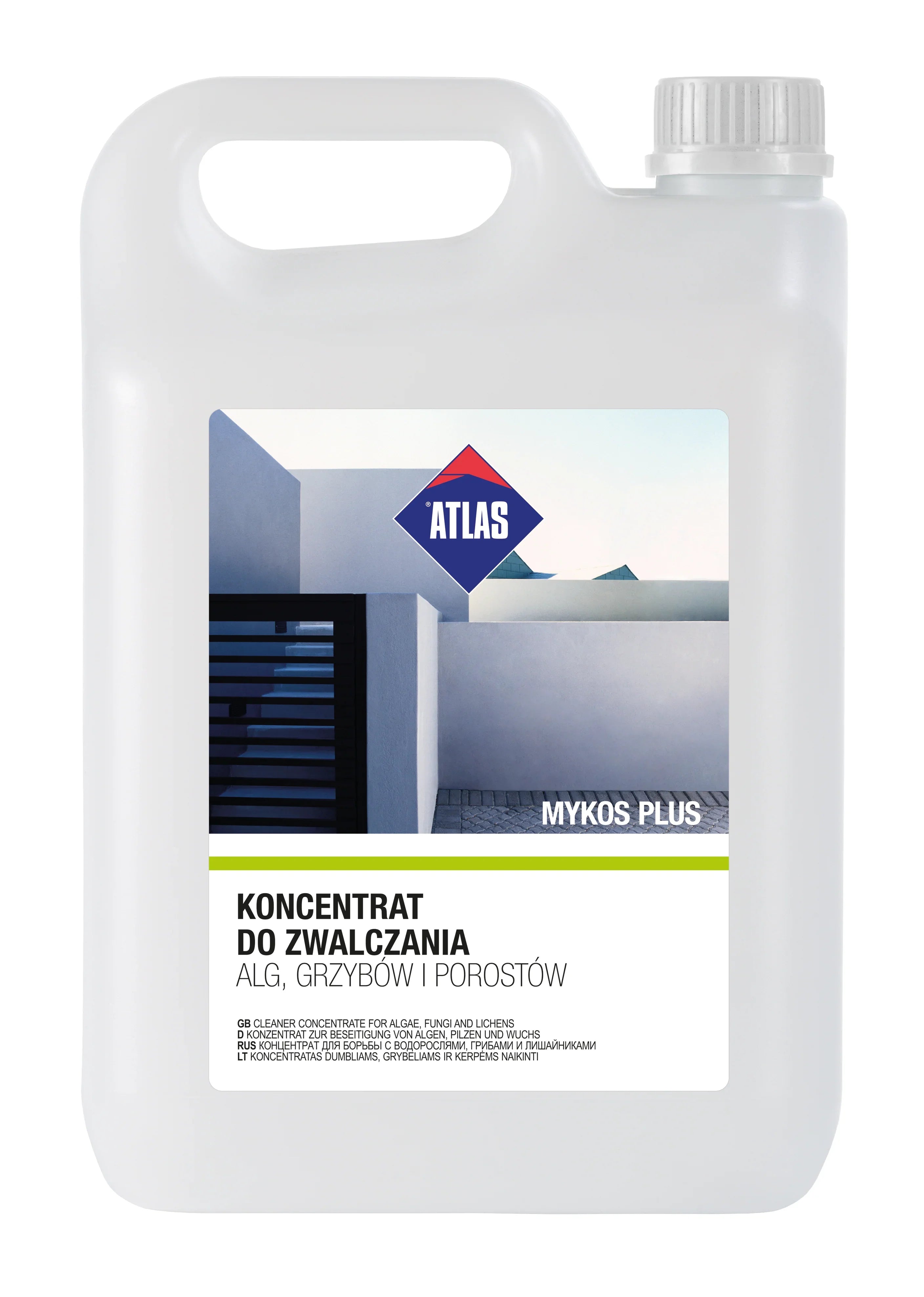
Cleaning products for renders divide by chemistry rather than by surface, and the Atlas Mykos Plus sheet declares a biocidal effect against algae and mould at a minimum of 150 g/m², which is what makes dosing rather than scrubbing the decisive step.
That figure needs reading alongside the consumption line, because the two sit in different scopes and a buyer who reads only one will under-dose. Consumption is given as 0.02 litres of concentrate per m² per single application, and dilution is permitted at most 1:5 with water — so one pass at maximum dilution delivers roughly 0.12 litres of solution per m², below the 150 g/m² at which biocidal effect is declared. Take the stricter figure: dilute less generously, or commit to the repeat passes the sheet sets out.
- Biological growth — algae, fungi, lichen and mould: the biocidal concentrate, whose marketing authorisation is No 7371/18, with actives alkyl (C12-16)-dimethylbenzylamine at 2.40 g/100 g and 2-octyl-2H-isothiazol-3-one at 0.24 g/100 g.
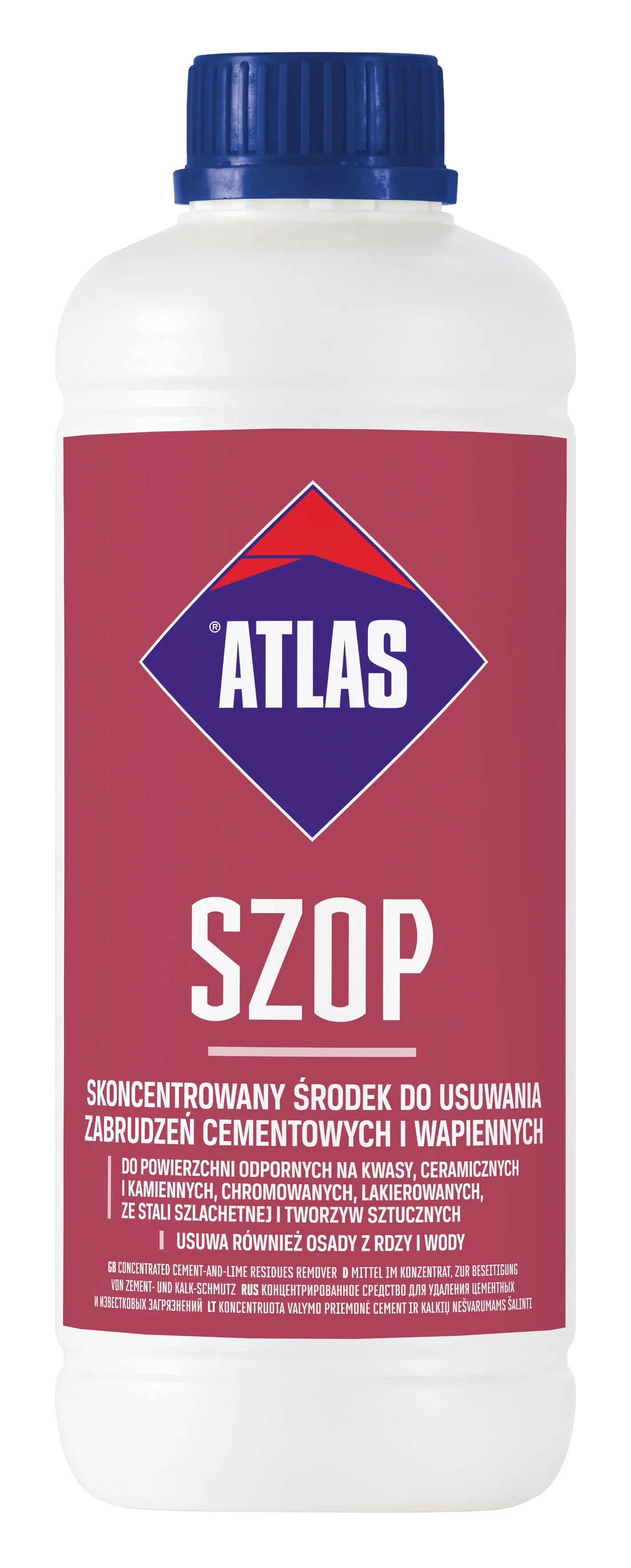
- Cement, lime and gypsum residue: the inorganic acid concentrate, scoped by its sheet to acid-resistant surfaces.
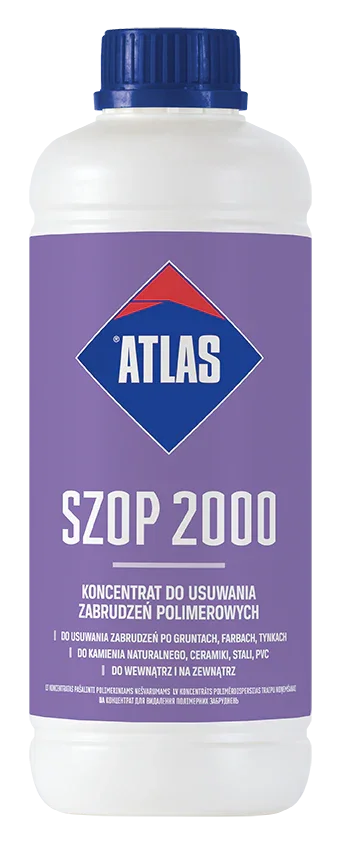
- Resin and binder residue: sold as a resin remover; no data sheet for it could be retrieved this session, so its chemistry and dilution are confirmed on ordering rather than stated here.
One naming point saves a wasted search. Atlas renamed both SZOP products, so Resin Away is ATLAS SZOP 2000 and Cement Away is ATLAS SZOP — the same goods under two labels, which is why the cement product's own sheet is headed SZOP and carries no mention of the newer name.
Choose the Right Consumable for the Stain You Have
| Your Project | Best System | Standout Spec |
|---|---|---|
| Algae, mould or lichen on a rendered or insulated facade | Atlas Mykos Plus 5 L | min 150 g/m² |
| Cement, lime or gypsum residue on tiles, sills and fixtures | Atlas Cement Away SZOP 1 kg | dilutes 1:3 to 1:15 |
| Resin and binder residue clean-up during finishing | Resin Away SZOP 2000 1 kg | 1 kg pack |
On the biocide the useful arithmetic is per pass: 5 l ÷ 0.02 l/m² = 250 m² for one application, and across the three passes the sheet recommends, 250 ÷ 3 ≈ 83 m² treated to the full protocol.
How to Use the Biocidal Concentrate on a Facade
The sheet's sequence is what earns the residual protection, and it is longer than most single-visit cleaning assumes. Following it through is the difference between a facade that stays clear and one that greens again next winter.
- Deal with the damp first: the sheet opens on inspecting the substrate and removing sources of moisture — damp proofing, roof flashing, ventilation — before any product is applied.
- Pre-clean, then apply generously: brush or vacuum off limited growth, remove tough infection mechanically, then apply uniformly and profusely until the surface is completely moist, by brush, roller or sponge.
- Leave at least 6 to 12 hours before removing stains mechanically.
- Apply three times with a 12 to 24 hour break between applications, because fungi are present at different growth stages and spore forms such as conidia resist a single pass.
- Wait 48 hours before finishing: painting and other finishing work start no earlier than 48 hours after application.
It penetrates a few millimetres into absorbable mineral substrates and is declared for building facades including thermal insulation systems, renders, concrete, limestone and stone — so silicone render over EPS or mineral wool sits inside its scope. Indoor wet rooms are routed to Atlas Mykos No. 1 instead. The sheet then recommends finishing with a silicone or silicate paint, naming ATLAS SALTA N, which makes the silicone masonry paints range the documented follow-on; confirm the variant, since the bucket stocked here is ATLAS SALTA. Diagnosis before any of this belongs to the red and green algae identification guide, and the safe render cleaning method covers technique.
Where the Acid Cleaner Applies, and Where It Does Not
The cement remover for renders is scoped more narrowly than its shelf position suggests, and reading that scope correctly protects both the wall and the warranty. Its sheet lists acid-resistant surfaces — ceramic tiles, stone, chromed, lacquered, stainless steel and plastic — and notes that absorbent porous surfaces, into which soiling has penetrated, are difficult to clean.
- Dilute to the residue: undiluted for thick old adhesive, grout and plaster mortar residue; 1:3 to 1:5 for haze from the same; 1:5 to 1:10 for dirt and lime; 1:10 to 1:15 for rust and tap-water staining.
- Pre-wet the area lightly with water, apply with a brush or sponge, and leave heavy soiling undiluted for a few minutes before working it.
- Mind cement grout: used without proper dilution on tiling, it can wash out or discolour a cementitious joint — dilution is the safeguard.
- Rinse thoroughly afterwards with clean water or a slightly alkaline solution.
- Regulatory status: not classified as a construction product; it holds a PZH Hygienic Assessment.
Because the sheet names no render among its target surfaces, this page routes efflorescence on a rendered wall to diagnosis rather than to a bucket: the efflorescence and white stains guide covers the salt-migration path, and the moisture route is what settles it lastingly. For staining on the render itself, the render maintenance schedule sets out the intervals.
FAQ — Quantities, Compatibility, Storage and Environment
How much biocide does one elevation need?
Work from 0.02 l/m² per application. A 60 m² gable needs 60 × 0.02 = 1.2 litres per pass and 3.6 litres across three passes, so a single 5-litre pack covers it with margin; the concentrate is also packaged in 1 litre for smaller work. Heavy growth calls for less dilution, so allow headroom on badly weathered walls.
Can the acid cleaner go straight onto render?
Its sheet scopes it to acid-resistant surfaces and does not list render, so treat it as the product for tiles, sills and fixtures adjacent to the wall rather than for the render face. Where mineral staining sits on the render itself, confirm the substrate and the deposit before choosing a chemistry — the diagnostic guides above are the right starting point.
What separates the three products in practice?
Chemistry and scope. The biocide treats living growth on mineral and rendered substrates with a residual preventive effect; the mould remover role is its own. The acid concentrate dissolves mineral deposits on acid-resistant surfaces. The resin remover addresses binder residue, though no sheet for it was retrievable this session, so its dilution comes from the label.
How long do these keep, and how should they be stored?
The biocide holds 24 months from manufacture, stored between +10 °C and +30 °C, out of direct sunlight and protected from freezing. The acid concentrate holds 36 months, kept below 30 °C and above freezing — below 0 °C it freezes and loses its working properties irreversibly, so a heated store through winter keeps stock usable.
What environmental precautions apply?
The biocide is very toxic to aquatic life with long-lasting effects, so releasing it to the environment is avoided, spillage is collected, and containers go to authorised disposal. Gloves, eye and face protection and protective clothing are specified for both concentrates, and confining application to the target area keeps runoff controlled. Follow the label and safety data sheet in full.