
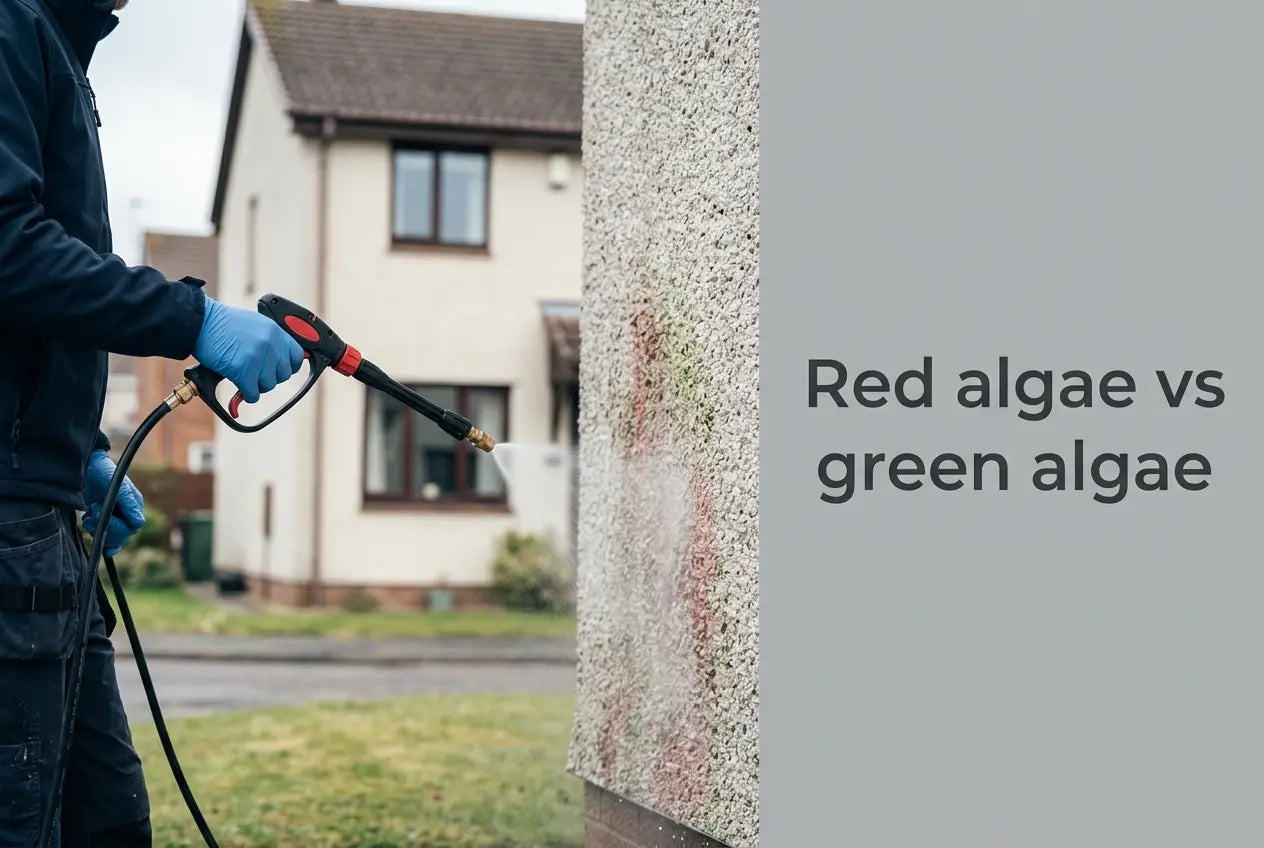
Red streaks and green patches on a rendered wall are two different organisms, and the useful news is that one authorised product treats both — the difference is in the dwell and the number of passes, not the bucket. Everything procedural below comes from the ATLAS MYKOS PLUS technical data sheet, updated 5 March 2018 and fetched this session, stocked through the Renders World render cleaning products range. Where the sheet is silent — and on the biology it is entirely silent — this guide says so rather than filling the gap.
What Red Algae and Green Algae Look Like on a UK Render Wall
Red algae and green algae on render are both organic growth, which matters commercially because the Atlas Mykos Plus sheet declares one authorised treatment covering algae, moulds, lichens and basidiomycete fungi under biocide marketing authorisation No 7371/18. Identification therefore decides your dwell time and pass count rather than which product you order.
The visual split is the part any owner can do from the ground, and it is worth doing before anyone quotes. Green growth reads as diffuse soft patches, typically on shaded elevations, low on the wall and near planting or splashback. Reddish or rust-coloured growth reads as streaking that follows the run-off path, often from a roof junction or a defective detail downwards. The sheet itself does not distinguish the two organisms or name any species, so the identification below is trade observation, and the treatment consequences that follow it are the sheet's.
One deposit gets misread as algae every season. White, crystalline, gritty material that rubs off as powder is not growth at all but migrating mineral salts, and it needs a different diagnosis entirely — the efflorescence and white staining guide covers that path. A quick test settles it: growth feels soft or slimy when wet, salt feels dry and powdery.
| What you can check | Reddish streaking | Green patching |
|---|---|---|
| Pattern on the wall | Follows the run-off path, often vertical from a junction | Diffuse patches, frequently low on the wall |
| Where it usually starts | Below a roof detail, flashing or overflow | Shaded elevations, behind planting, at splashback height |
| Feel when wet | Soft growth, colour stays after rinsing | Soft, slightly slimy biofilm |
| Moisture source to look for | Defective flashing or rainwater goods | Ground splashback, blocked gutter, vegetation contact |
| Treatment product | Atlas Mykos Plus, authorisation No 7371/18 | Atlas Mykos Plus, authorisation No 7371/18 |
| Where the sheet varies the method | Dilute at less than 1:5 and repeat passes | Standard protocol, three passes on established growth |
Why the Moisture Source Comes Before the Cleaner
The Atlas Mykos Plus sheet does not open on dilution. It opens on the substrate, instructing the user to inspect it, find and remove any possible sources of damp, and it names three: reconstruction of horizontal or vertical damp proofing, repairs of roof flashing, and installation of proper ventilation. That ordering is the sheet's own, and it explains most repeat callouts — a wall cleaned while still being wetted is a wall that will be cleaned again.
On a rendered facade the practical checks that follow from those three are straightforward and cost nothing: rainwater goods clear and discharging away from the wall, flashings and abutments sound, vegetation not touching the finish, and ground levels not bridging the damp-proof course. Resolve what you find, then treat. Where the render itself is cracked or a detail has failed, that is a repair question rather than a cleaning one, and the render cracking causes and prevention guide owns it.
Key Takeaway: Identify the growth from the ground, remove the damp source the sheet asks you to find, then run the full protocol — apply until the surface is completely moist, leave at least 6 to 12 hours, and repeat three times with 12 to 24 hours between passes. The repeat passes are what deal with resistant spore forms, so they are the step worth protecting in a programme.
How to Treat Algae on Render — the Documented Protocol
The sheet's sequence is longer than a single-visit clean assumes, and following it through is what earns the residual preventive effect. Note before you start that the sheet permits mechanical pre-cleaning by pressure washer where the situation warrants it, and mechanical stain removal after dwell — so the blanket advice to keep a pressure washer away from render is not what this document says. Judge it against the render's condition and age.
- Inspect and dry the substrate. Find and remove damp sources first, per the three routes the sheet names.
- Pre-clean the infected surface. Brush off and vacuum limited growth; remove very tough infection mechanically. The sheet allows manual or mechanical cleaning, chosen to suit the surface location and degree of contamination.
- Dilute at a maximum of 1:5 with water. For strongly developed organic growth, dilute at a smaller ratio — a stronger mix — or re-apply once earlier layers have dried completely.
- Apply uniformly and profusely until the surface is completely moist, by brush, painting roller or sponge, and leave for at least 6 to 12 hours.
- Remove stains mechanically after dwell, for example with water under pressure.
- Apply three times in total, keeping a 12 to 24 hour break between applications, because fungi are present at different growth stages and resistant spore forms such as conidia survive a single pass.
- Wait a minimum of 48 hours after application before painting or any other finishing work.
Trial first on any wall you have not treated before: the sheet recommends a sample application on a less exposed part of the surface to establish how the product behaves there, and separately notes that intensive biological staining can be removed from mineral, ceramic and other substrates after sample application. On scope, the sheet covers building facades with or without thermal insulation, renders, concrete, cement and cement-lime plasters, brick and block walls, limestone, stone, floors, screeds and painted coatings — so silicone render over EPS or mineral wool sits inside it. Timber is outside it, and indoor wet rooms route to Atlas Mykos No. 1 instead.
How Much Product an Elevation Needs, and What a Treated Wall Costs
Consumption is declared as 0.02 litres of concentrate per m² for a single application. That figure is per pass, which is where quoting goes wrong — the three-pass protocol triples it. Atlas Mykos Plus 5 L reads £37.50 at the Renders World product endpoint in August 2026, with no VAT figure displayed, and the concentrate is also packed in 1 litre.
- A 60 m² gable, full protocol: 60 m² × 0.02 l = 1.2 l per pass; 1.2 × 3 = 3.6 litres, so one 5 l pack covers it with margin.
- A 5 l pack across three passes: 5 l ÷ 0.02 l/m² = 250 m² for one pass; 250 ÷ 3 = 83 m² treated to the full protocol.
- Material cost per m² treated: £37.50 ÷ 83 m² = £0.45/m², material only, before access, labour or protection.
- Heavy growth costs more, not less: the sheet calls for a smaller dilution ratio on strongly developed growth, so a badly weathered wall consumes above the 0.02 l/m² baseline and wants headroom in the order.
One divergence inside the sheet is worth carrying into the order, because it is a purchasing instruction rather than a curiosity. The document declares a biocidal effect against algae and mould at a minimum of 150 g/m² of prepared solution, while also giving consumption as 0.02 l/m² of concentrate at a maximum 1:5 dilution — which yields roughly 0.12 litres of solution per m², short of that 150 g/m². Take the stricter reading: dilute less generously than the maximum, or commit to the full three passes rather than stopping at one.
Keeping a Treated Facade Clear
The sheet gives two documented routes to keeping the wall clear after treatment, and both are worth building into the quote rather than leaving to chance. The first is inherent: the product penetrates a few millimetres into absorbable mineral substrates and has a preventive effect, protecting the surface against the development of biological corrosion. The second is a finish. The sheet recommends silicone or silicate paints, naming ATLAS SALTA N, because they reduce substrate absorptivity and limit the risk of further contamination.
Note the variant. The bucket stocked in the Renders World silicone masonry paints range is ATLAS SALTA rather than SALTA N, so confirm which product suits before planning a treat-then-repaint sequence. And observe the 48-hour minimum between treatment and any finishing work in either direction. For intervals and the wider inspection routine, the silicone render maintenance schedule sets those out, and the safe render cleaning method covers technique on a sound finish.
Handling is not optional on this chemistry. The actives are alkyl (C12-16)-dimethylbenzylamine at 2.40 g/100 g and 2-octyl-2H-isothiazol-3-one at 0.24 g/100 g; the product is very toxic to aquatic life with long-lasting effects, causes skin and serious eye irritation and may cause an allergic skin reaction. Protective gloves, clothing, eye and face protection are specified, release to the environment is avoided, spillage is collected, and containers go to authorised disposal. Stored between +10 °C and +30 °C, protected from freezing and direct sunlight, shelf life is 24 months from the manufacturing date on the pack, and the product is stirred thoroughly before use. Follow the label and safety data sheet in full.
Worth knowing on the regulatory side: authorisation No 7371/18 is the manufacturer's own marketing authorisation as printed on the sheet, not a Great Britain authorisation number. Under the HSE guidance on biocidal product authorisation, a biocidal product must be authorised to be made available on the Great Britain market, so treat the GB status of any imported biocide as a question for your supplier rather than something a Polish data sheet answers.
Ordering the Right Cleaner for the Growth You Have
Both colours of growth take the same authorised biocide, so the order is simple once the diagnosis is done: establish that the staining is organic rather than mineral, deal with the damp source, then order enough concentrate for three passes over the affected area. Renders World holds the 5 litre pack alongside the acid and resin removers for the residues that are not growth at all, and the whole facade cleaning range is ordered against a diagnosis rather than kept as a general-purpose wash.
Written by Mariusz Saja. Technically reviewed by Renders World Team. Last reviewed Aug 2026.
Algae on Render — Your Questions Answered
How much biocide does one elevation need?
Work at 0.02 litres of concentrate per m² per pass, then multiply by the passes. A 40 m² elevation needs 40 × 0.02 = 0.8 litres per pass and 2.4 litres over three passes; a 100 m² elevation needs 2 litres per pass and 6 litres in total, so more than one 5 litre pack. Strongly developed growth calls for a smaller dilution ratio, which raises consumption above the baseline.
Do red and green growth need different products?
No. The sheet's authorised scope covers algae, moulds, lichens and basidiomycete fungi in one product, so both are treated with Atlas Mykos Plus. What varies is the dilution and the number of passes: heavier, more established growth is treated at a smaller dilution ratio or with repeat applications once earlier layers have dried.
Can a pressure washer be used on rendered walls?
The sheet permits mechanical cleaning including a pressure washer for the pre-clean, and mechanical stain removal with water under pressure after the dwell period, with the technique chosen to suit the surface location and degree of contamination. That is a judgement about the specific render's age and condition rather than a blanket permission, so on a thin-coat finish keep pressure low and test an inconspicuous area first.
Is it safe on render over external wall insulation?
The sheet's stated scope includes building facades with or without thermal insulation systems, along with renders, concrete, cement and cement-lime plasters, brick, block and stone. A trial application on a less exposed part of the surface is recommended before treating a full elevation, which is the sensible step on any finish you have not treated before.
How long before the wall can be painted or re-rendered?
A minimum of 48 hours after application before painting or other finishing work. The sheet then recommends a silicone or silicate paint, naming ATLAS SALTA N, to reduce substrate absorptivity and limit the risk of further contamination. Confirm the variant with us, since the paint stocked here is ATLAS SALTA.
Is household bleach a substitute?
Nothing in the fetched documentation supports a comparison with household products, so this guide makes none. What is documented is that Atlas Mykos Plus holds a biocide marketing authorisation, declares its two active substances and concentrations, penetrates a few millimetres into absorbable mineral substrates and carries a preventive effect — none of which a general household cleaner declares.
What environmental precautions apply at the wall base?
The product is very toxic to aquatic life with long-lasting effects, so release to the environment is avoided, spillage is collected and containers are disposed of through authorised companies. Confining application to the target area, protecting planting and controlling runoff are the practical measures; the safety data sheet carries the full handling protocol and takes precedence over any summary.