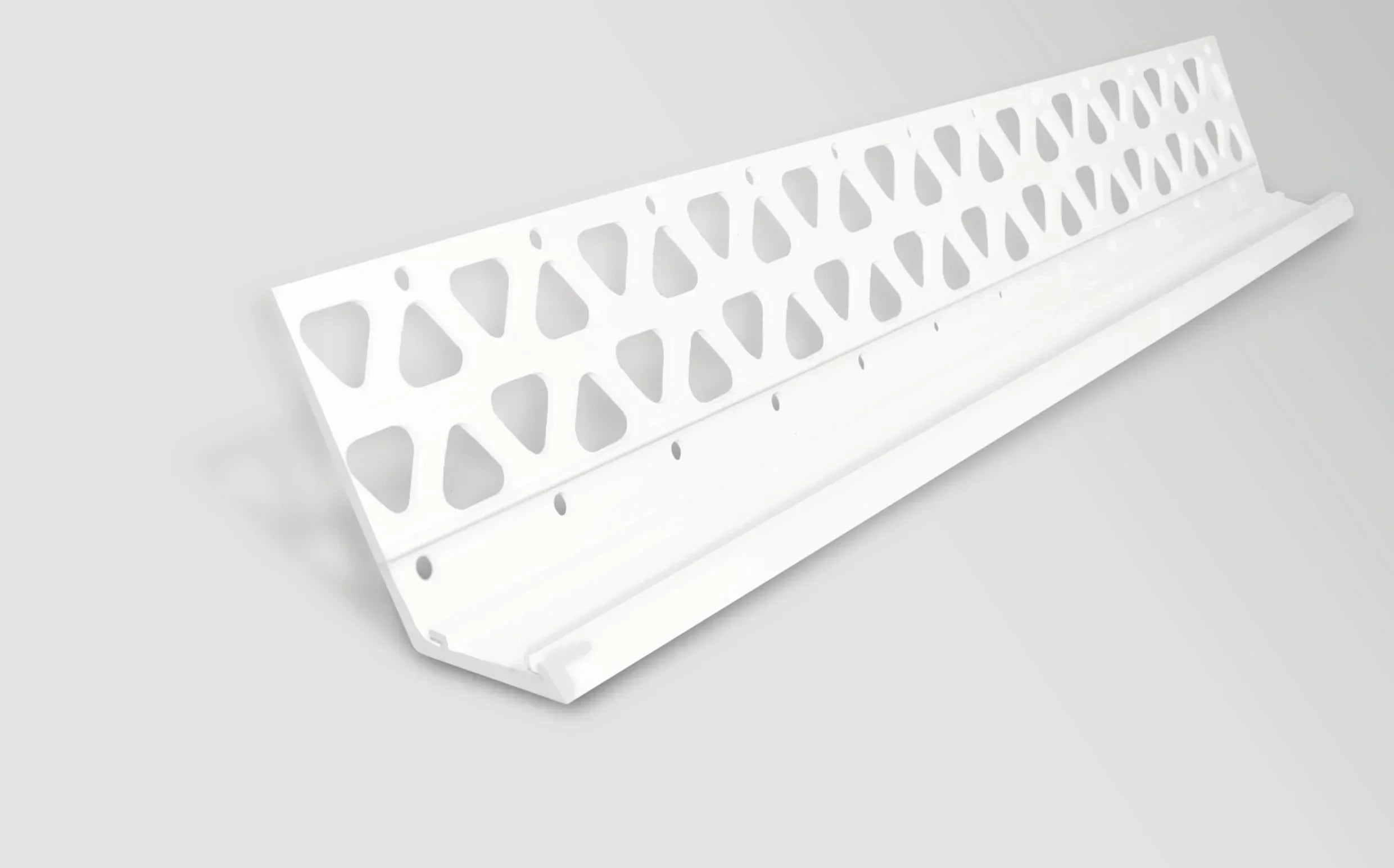
BELLCAST BEADS
2 products
Showing 1 - 2 of 2 products
Bellcast Beads UK — PVC Drip Profiles for Render
Part of the render beads and mesh range at Renders World, bellcast beads are the horizontal drip profiles that protect rendered facades at their most moisture-vulnerable points. Installed at DPC level, above window heads, and at any horizontal termination where rainwater must be deflected away from the substrate, a bellcast bead's curved lip throws water clear of the wall surface — preventing the damp patches, staining, and biological growth that the UK climate reliably produces on unprotected lower elevations. This focused collection offers two PVC render bellcast bead profiles in 10 mm and 15 mm depths, covering every common thin-coat, EWI, monocouche, and traditional sand-cement render build-up.
Product Overview — What This Category Covers
A bellcast bead is a rigid PVC profile with a bell-shaped drip nose that angles outward at approximately 115 degrees, creating a capillary break at horizontal render terminations. When rainwater reaches the drip lip, it falls vertically away from the wall rather than tracking back along the underside of the render edge — the single detail that separates a weatherproof base from one prone to recurring damp. This collection provides two profiles: a 10 mm bead in a 3.0 m length for thin-coat silicone and EWI systems, and a 15 mm bead in a 2.5 m length for heavier monocouche and traditional renders.
Key Benefits & Technical Advantages
- Active Rainwater Deflection: The curved drip lip directs water vertically away from the substrate, protecting plinths and lower masonry from splash-back, damp, and algae growth in the wet UK climate.
- Corrosion-Free PVC Construction: Lead-free, UV-stabilised PVC will never produce the oxide staining that galvanised steel alternatives can bleed through light-coloured render finishes over time.
- Integrated Depth Gauge: The upper wing sets the render thickness at the base of the wall, ensuring the coat finishes flush with the drip nose for a clean horizontal line.
- Mechanical Edge Protection: The rigid profile absorbs ground-level impacts from foot traffic, garden equipment, and hard landscaping — the zone where rendered walls take the most physical punishment.
- Full System Compatibility: Tested and approved for use with Atlas, Ceresit, and all premium silicone, acrylic, and monocouche render systems stocked at Renders World.
Technical Specifications & Selection Guide
| Profile | Depth | Length | Material | Recommended Render System |
|---|---|---|---|---|
| Bellcast Bead White 10 mm | 10 mm | 3.0 m | High-impact PVC (UV-stable) | Thin-coat silicone, silicate-silicone, EWI basecoat + topcoat |
| Bellcast Bead White 15 mm | 15 mm | 2.5 m | High-impact PVC (UV-stable) | Monocouche, traditional sand-cement two-coat, heavy mineral finishes |
Choose the 10 mm profile when the render build-up at the termination edge is between 4 mm and 10 mm — the range covered by most modern thin-coat silicone and EWI topcoat systems. Choose the 15 mm profile when the build-up reaches 12–18 mm, typical of machine-applied monocouche and traditional two-coat sand-cement renders. If the bead depth is shallower than the render, the drip nose will be buried and the capillary break is lost; if it is too deep, the nose stands proud and attracts mechanical damage at ground level.
Application & System Compatibility
Bellcast beads are positioned at a minimum of 150 mm above finished ground level (or at DPC level, whichever is higher) and above window and door heads on exposed elevations. The upper wing is embedded into a continuous bed of basecoat adhesive, with mesh wings overlapping the main fibreglass reinforcement layer by at least 100 mm. On EWI systems, bellcast beads form the moisture break between the rendered facade zone and the below-DPC plinth zone, which is the area most exposed to ground-contact moisture and splash-back. For the full profile sequencing around openings — including coordination with stop beads and corner beads — the render detailing guide for windows and doors covers the correct installation order and junction details.
Trade Insight: Pro Application Notes
The most common bellcast failure on UK sites is not a product defect — it is render overshooting the drip lip. When even 2–3 mm of render coat creeps past the bell-shaped edge, water follows that bridge back to the substrate, and the entire drip detail becomes non-functional. The single most impactful quality-control step is to run a sharp blade along the underside of the drip lip after the final coat has firmed but before it fully cures — a 30-second task per linear metre that protects years of facade performance. For the complete installation method including adhesive bed preparation, mechanical fixing guidance, jointing, and movement-joint detailing, the bellcast beads installation and water protection guide provides the full trade process with worked site examples.
Bellcast beads must always be the first profile fixed on any elevation. They establish the lower datum from which stop beads and corner beads are sequenced upward. Installing a bellcast after adjacent profiles have already set creates a cold joint at the horizontal-vertical junction — a joint that reliably cracks within the first winter thermal cycle. Planning the bellcast-first sequence before scaffolding goes up prevents costly rework on multi-storey facades.
Is This Right for Your Project?
- DPC-level drip protection on rendered facades: Both the 10 mm and 15 mm bellcast beads deliver active rainwater deflection at the base of the wall, preventing damp, staining, and biological growth on the plinth zone below.
- Drip detail above window and door heads: On exposed elevations and west-facing facades, a bellcast bead above each opening prevents water from running down the glass and into frame seals.
- Clean vertical or soffit terminations without a drip feature: Where the render needs to end in a flat, straight edge rather than a drip lip — at window jambs, soffits, and material transitions — a render stop bead provides the correct flat-nosed profile.
- Impact-resistant external wall corners: Where a vertical arris needs reinforcing against mechanical damage, a render corner bead provides the 90-degree impact protection that horizontal bellcast profiles are not designed to deliver.
Browse both bellcast profiles above to match the correct depth to your render build-up. At approximately £3.10–£3.50 per length, the full bellcast specification for a typical house represents one of the lowest-cost components in the render system — yet it prevents some of the most persistent moisture problems UK facades encounter. For project-matched quantities or specification advice, contact our technical team.
Frequently Asked Questions
Where should bellcast beads be installed on a rendered wall?
Bellcast beads are installed at every horizontal point where the render coat terminates and rainwater must be actively deflected. The primary position is at DPC level — a minimum of 150 mm above finished ground level — where the rendered facade meets the plinth zone. They are also specified above window heads and door frames on exposed elevations to prevent water from running into frame seals, and at horizontal transitions between rendered surfaces and adjacent cladding materials.
Which depth do I need — 10 mm or 15 mm?
Match the bead depth to the render build-up thickness at the termination edge. The 10 mm profile suits thin-coat silicone, silicate-silicone, and standard EWI topcoat systems where the render element is 4–10 mm thick. The 15 mm profile is designed for heavier systems — machine-applied monocouche at 12–15 mm and traditional sand-cement two-coat renders at 14–18 mm. Using the correct depth ensures the drip nose sits flush with the finished surface for a clean capillary break.
How many bellcast beads does a typical house need?
Measure the total horizontal run at DPC level plus any window and door heads requiring a drip detail, divide by the bead length (3.0 m for 10 mm or 2.5 m for 15 mm), round up, and add 10 % for cuts and waste. A typical three-bedroom semi-detached property usually requires 15–20 linear metres across all elevations. At trade pricing of approximately £3.10–£3.50 per length, total material cost for the full bellcast specification typically sits between £20 and £35.
Can bellcast beads be painted to match a coloured render?
The high-impact PVC readily accepts exterior silicone masonry paint. Clean the surface thoroughly and apply a suitable plastic primer before painting to ensure long-term adhesion. On most projects, the bellcast nose is concealed beneath the topcoat during normal application, so a separate painting step is only necessary where a deliberately exposed drip edge forms part of the architectural detail.