
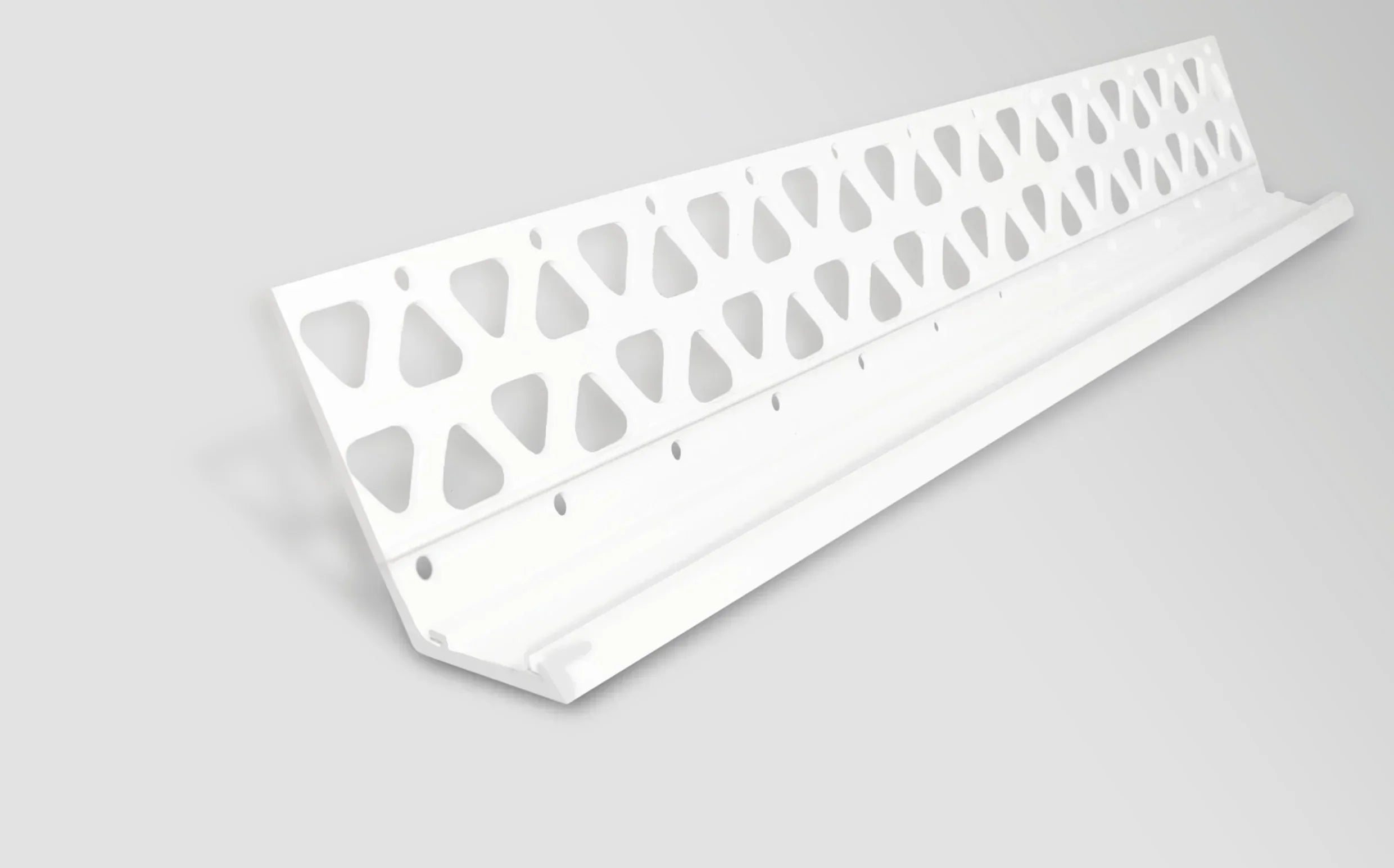
RENDER BELLCAST BEAD WHITE 10mm - 3m


Price:
Sale price£3.50

Shipping calculated at checkout

Stock:
In stock

Pickup available at Renders World Southampton

Usually ready in 2 hours

Description

The 10 mm white PVC render bellcast bead is the most widely specified drip profile across UK thin-coat silicone, silicate-silicone, and EWI systems — supplied here in a 3.0 m length that reduces vertical jointing on long plinth runs and continuous terminations. It sits in the bellcast beads range alongside the heavier 15 mm variant, and the 10 mm depth is matched to render build-ups between 4 and 10 mm where the formed drip nose finishes flush with the topcoat and throws rainwater clear of the substrate below.

What the 10 mm Bellcast Bead Does on Thin-Coat and EWI Plinth Terminations

The 10 mm bellcast bead is a 3.0 m rigid uPVC drip-edge profile that creates a controlled horizontal termination at DPC level on rendered plinths, beneath window cills lacking an integral drip, at the underside of canopies and overhangs, and at any horizontal point where the render coat must stop and rainwater must fall clear of the wall surface. The bell-shaped nose breaks surface tension at the edge, so water falls vertically rather than tracking back along the underside of the render — the single detail that keeps a plinth zone dry through wet UK winters.

The 10 mm arris depth is the working default for thin-coat systems where the combined basecoat plus decorative finish sits between 6 and 10 mm — covering silicone, silicate-silicone, mineral, and acrylic topcoats over standard EWI basecoat thicknesses. For heavier monocouche and traditional sand-cement renders at 12–18 mm finish thickness, the 15 mm variant proportions the nose to the deeper build-up.

Why Trade Specifiers Choose the 10 mm 3 m Bellcast for Long Plinth Runs

  • 3 m length reduces vertical joints on continuous runs: Longer than the typical 2.5 m alternative, a single 3 m bead spans a wider semi-detached plinth section with one fewer butt joint per elevation — useful where water-shedding continuity matters more than offcut economy.
  • 10 mm depth matches standard thin-coat build-up: The arris finishes flush with the topcoat on 6–10 mm finish systems — the dominant UK EWI configuration — so the drip nose stays proud of the wall plane and active.
  • Perforated mesh-ready wing: The wing locks into the basecoat and accepts fibreglass reinforcement mesh wrap, giving a continuous reinforced edge that resists the cracking common at unsupported termination lines.
  • Capillary break holding for decades: The bell-shaped nose interrupts the surface-tension pathway that allows water to track back beneath an unprotected render edge, closing the primary route for moisture to reach DPC or insulation behind.
  • Non-corrosive rigid uPVC body: Exterior-grade UV-stable PVC retains shape and colour through standard UK exposure with no rust telegraphing through light topcoats — a real benefit at base-of-wall where splash-back is constant.
  • White finish blends with most pale render colours: Reads cleanly under off-white, cream, light grey, and pale stone schemes; over-paintable with silicone masonry paint for darker facades where the visible nose would otherwise contrast.
  • Compatible across major UK render systems: Works with Atlas, Ceresit, and Roker basecoats and with every silicone, acrylic, silicate-silicone, and mineral topcoat stocked at Renders World.

Technical Specifications — 10 mm Bellcast Bead Data Sheet

Property Value
Profile type Bellcast / drip bead
Body material Rigid unplasticised PVC (uPVC), exterior grade, UV-stabilised
Colour White
Length 3.0 m per profile
Arris (nose) depth 10 mm
Wing type Perforated, mesh-compatible
Target render build-up 4–10 mm thin-coat / EWI topcoat systems
Mesh overlap with main reinforcement 100 mm minimum across the wing
Minimum height above ground 150 mm above finished ground level
Application temperature +5 °C to +25 °C (governed by render system, not bead)
On-site cutting Fine-tooth hacksaw (mitres) or tin snips (butt cuts)
Compliance reference Typically meets BS EN 13914-1 design principles for external rendering — confirm with project documentation

How to Install the 10 mm Bellcast — Levelling, Wing Embedment, Mesh Wrap

Set the bead level using a laser line or chalked string before fixing — the drip nose only sheds water reliably when the arris sits true to the wall plane, and a 2 mm fall across a 3 m length is enough to disrupt the capillary break on the low-side metre. Bed the perforated wing fully into freshly applied basecoat or EWI adhesive, then press a strip of fibreglass mesh over the wing to bridge into the surrounding system reinforcement with a 100 mm overlap onto the main mesh sheet. Joints between successive 3 m lengths should butt tightly; mitre internal and external corners with a fine-tooth hacksaw rather than overlapping noses, which would create a hard step in the drip line.

For the complete step-by-step process — fixing height above DPC, mesh wrap technique, integration with cill and verge details, and movement-joint provisions on multi-storey runs — the bellcast bead installation and water protection guide for UK projects sets out each stage with worked site examples. For coordinating the 10 mm bellcast with stop beads, corner beads, and oversills around openings, the render detailing guide for windows and doors covers the full profile sequencing process across the elevation.

Installation Notes — Conditions, DPC Position, Junctions

Position the drip nose a minimum of 150 mm above finished ground level — or at DPC level, whichever is higher — with the wing bedded so the DPC itself remains unobstructed. Below the 150 mm minimum, water shed from the drip lands on hard landscaping that splashes straight back onto the lower wall, undoing the deflection the bead was installed to provide. On exposed elevations, position an additional bellcast above each window and door head to prevent water running down glass and into the frame seal junction.

Where a vertical stop bead lands above the 10 mm bellcast on the same elevation, cut the stop to finish 5 mm above the bellcast nose and seal the gap with low-modulus UV-stable sealant. Two rigid PVC profiles bearing directly against each other crack the render at the junction under thermal movement, regardless of basecoat quality. Allow the basecoat to cure to the manufacturer's guidance before applying the topcoat, and feather the finish coat right up to — but never over — the bead nose, so the drip remains exposed and active.

Pro Tips From UK Installers Using the 10 mm Bellcast

For best result, fix the bellcast first on every elevation — before any vertical stop beads or corner beads go up. Bellcasts establish the lower datum from which all other profiles sequence, and fixing them after adjacent verticals creates a cold joint at the horizontal-vertical junction that consistently opens during the first winter thermal cycle. Plan the bellcast line at pre-scaffold stage so the level is confirmed against finished ground level rather than eyed in once the scaffolding obstructs the sightline.

Run a sharp blade along the underside of the drip lip after the final coat has firmed but before it fully cures. Even 2–3 mm of render creeping past the bell-shaped edge bridges the capillary break and bypasses the drip function entirely — a 30-second blade pass per linear metre preserves years of facade performance, and on a 3 m bead that is a 90-second job that protects every metre below it. On long plinth runs where two 3 m beads butt-joint, run the blade across the joint as well — the joint line is where overshoot most often hides under quick float passes.

Is the 10 mm Bellcast Bead Right for Your Project?

  • Best fit: thin-coat silicone, silicate-silicone, mineral, and acrylic EWI systems with 4–10 mm finish build-up, terminated at DPC, above openings, or beneath canopies on UK rendered facades.
  • Step up for heavier systems: on monocouche, traditional sand-cement, or thick mineral renders measuring 12–18 mm finish thickness, the 15 mm bellcast bead in 2.5 m length proportions the nose to the deeper build-up.
  • Flat termination without a drip lip: where the render ends in a straight horizontal or vertical line that does not need active water deflection — at frame jambs, soffits, and material transitions — a render stop bead is the correct flat-nosed profile.
  • External arris protection: where a vertical corner needs reinforcing against impact rather than rainwater shedding, a render corner bead provides the 90-degree profile designed for that role.
  • Need quantity advice for long plinths? The 3 m length tends to give the lowest joint count on continuous plinth detailing; our technical desk can confirm exact lengths against elevation drawings on request.

FAQ — 10 mm Bellcast Coverage, Compatibility, Ordering

Where exactly should the 10 mm bellcast sit above DPC?

Position the drip nose a minimum of 150 mm above finished ground level, with the wing bedded so the DPC itself remains unobstructed. Below 150 mm the drip throws water onto hard landscaping that splashes straight back onto the lower wall, undoing the deflection the bead was installed to provide. Final position should follow the system manufacturer's published detail and the project specification — particularly on listed or heritage work where DPC location may differ from modern construction.

Can the 10 mm bellcast be used with mosaic plinth render?

Yes. Mosaic plinth finishes typically build up to 8–10 mm total thickness, which sits within the working range of the 10 mm arris. Embed the perforated wing fully into the basecoat and feather the mosaic finish up to the nose without burying it — burying the nose under finish material defeats the water-shedding function and is the most common defect on mosaic plinth detailing.

How many 10 mm bellcasts do I need per metre of plinth?

At 3 m per length, allow one bead per 3 m of horizontal termination, plus an extra length per facade for cuts, mitres, and offcuts. Order 10–15% over the measured run for site practicality. A typical three-bedroom semi-detached property with bellcasts at DPC level and above the main openings usually requires 5–7 lengths across all elevations — fewer joints than the 2.5 m alternative gives on the same plinth perimeter.

Does the white nose need painting on darker render schemes?

Not for off-white, cream, light grey, or pale stone facades where the bead blends with the topcoat. On darker render schemes the visible nose can be over-painted with a compatible silicone masonry paint once the render system is fully cured, taking care not to fill the drip channel itself. A clogged drip channel loses its function entirely, so paint application around the bellcast nose is the one place to favour a thinner coat over full coverage.

Is the 10 mm bellcast suitable for permanent exposure on south-facing facades?

Yes. The exterior-grade rigid uPVC body is UV-stabilised for prolonged exposure on UK facades and retains shape and colour through standard service. Performance is best maintained when the bead is fully bedded into the basecoat rather than left partially exposed to the substrate behind — full embedment also keeps the drip line straight under repeated thermal cycling.

How should 3 m lengths be stored on site before installation?

Store flat on a level surface, dry, and away from prolonged direct sunlight. A 3 m profile lying unsupported across a pallet edge or sawhorse will take a permanent bow within a day or two of warm exposure, and a bowed bellcast cannot be straightened on site to give a true drip line. Keep beads strapped in bundles of five to ten lengths until the point of fixing, and unwrap only what the installation crew needs for the next half-shift.

You may also like

Recently viewed