BELLCAST BEADS
2 products
Showing 1 - 2 of 2 products
Bellcast beads are the horizontal drip profiles that protect a rendered facade at its wettest points — DPC level, above window heads, and every horizontal termination where rainwater must be thrown clear of the wall. This focused range runs two PVC depths, 10 mm and 15 mm, covering thin-coat silicone, EWI, monocouche, and sand-cement build-ups.
What Bellcast Beads Do in a Render or EWI System
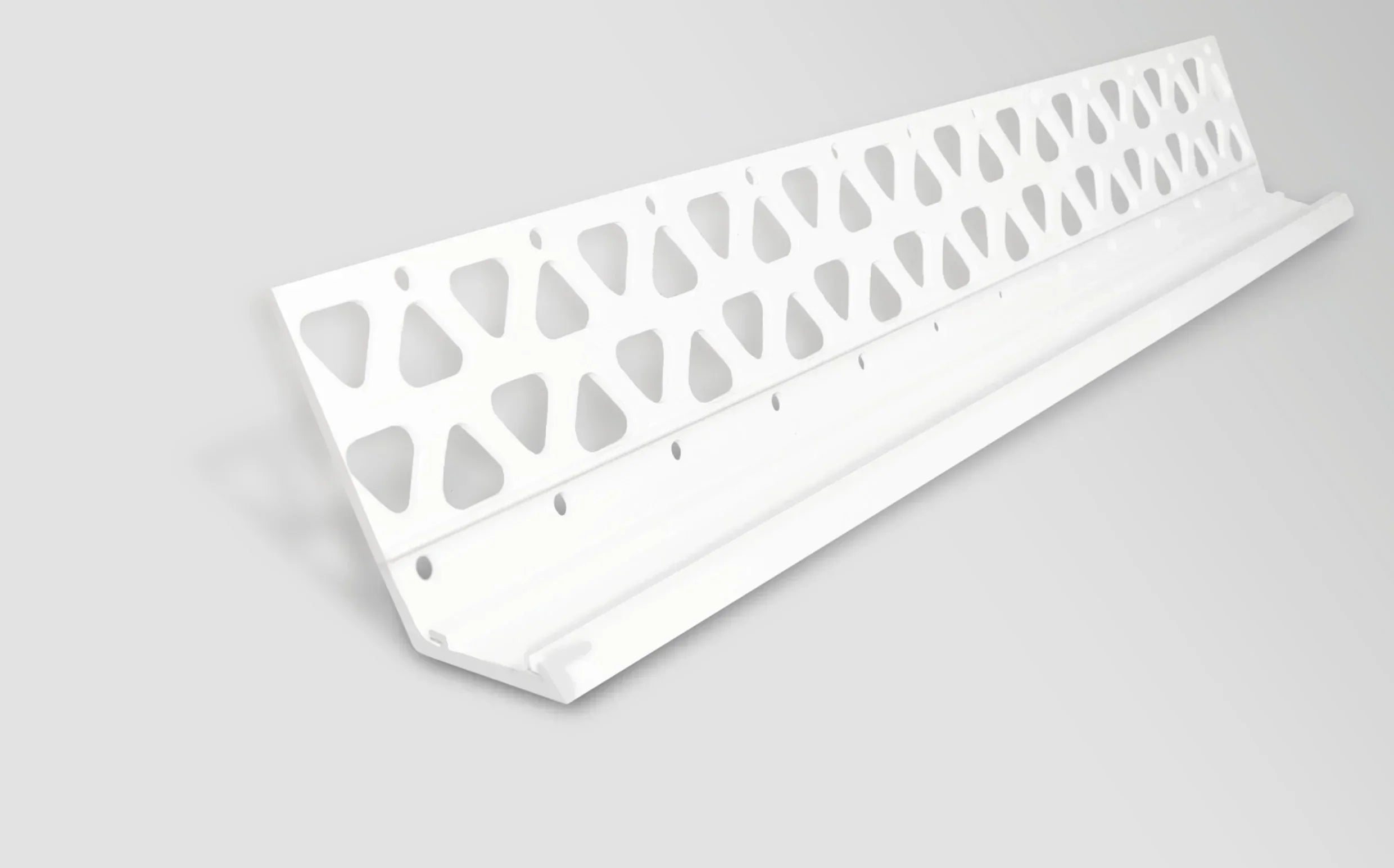
A bellcast bead is a rigid PVC profile with a bell-shaped drip lip angled outward at roughly 115 degrees, forming a capillary break at horizontal render terminations so rainwater falls vertically clear of the wall instead of tracking back along the underside of the render edge. It is the detail — in line with BS EN 13914-1 principles, subject to system confirmation — that separates a weatherproof plinth from one prone to recurring damp. This collection sits within the render beads and mesh hub at Renders World, so the drip profile matches the rest of the detailing set in one pass.
Two depths are matched to render build-up. The 10 mm bead in 3.0 m lengths suits thin-coat silicone, silicate-silicone, and standard EWI topcoats where the render element measures 4–10 mm. The 15 mm bead in 2.5 m lengths is sized for machine-applied monocouche at 12–15 mm and traditional sand-cement at 14–18 mm, where the deeper nose finishes flush — and the simpler the finished base-of-wall looks, the more carefully the bead behind it was chosen.
What Makes Bellcast Beads Worth Specifying
- Active rainwater deflection at the base of the wall: the curved drip lip throws water clear of the substrate, protecting plinths and lower masonry from splash-back and the algae growth that takes hold on unprotected base-of-wall zones through wet UK winters.
- Capillary break that holds for decades: the bell-shaped nose interrupts the surface-tension pathway that lets water track horizontally beneath an unprotected edge, closing the primary route by which moisture reaches the insulation or masonry behind.
- Non-corrosive PVC construction: UV-stabilised PVC produces no oxide staining beneath light-coloured silicone or acrylic finishes, where galvanised steel alternatives can bleed rust through the topcoat after several wet seasons.
- Integrated depth gauge: the upper wing doubles as a screed reference at the base of the wall, holding the render coat flush with the drip nose for a clean horizontal line across the elevation.
Selection Guide — Find Your Bellcast Profile in 30 Seconds
Identify the render build-up depth at the termination edge, read across to the matching profile, and select in seconds. The 10 mm bead is the default for modern EWI and thin-coat work; the 15 mm bead answers monocouche and traditional sand-cement.
| Your Project | Best Bellcast Bead | Standout Spec |
|---|---|---|
| Thin-coat silicone, silicate-silicone, EWI topcoat (4–10 mm) | Bellcast Bead White 10 mm 3 m | 10 mm · 3.0 m · UV-stable PVC |
| Monocouche, sand-cement, thick mineral (12–18 mm) | Bellcast Bead White 15 mm 2.5 m | 15 mm · 2.5 m · UV-stable PVC |
How Bellcast Beads Install in a Render or EWI System
Bellcast beads are positioned a minimum of 150 mm above finished ground level — or at DPC level, whichever is higher — and above window and door heads on exposed elevations where active water deflection is needed. The upper wing is embedded into a continuous bed of basecoat or EWI adhesive, with any mesh wings overlapping the main fibreglass reinforcement sheet by at least 100 mm to keep the tensile network continuous across the termination.
On EWI systems the bellcast forms the moisture break between the rendered facade above and the below-DPC plinth zone most exposed to ground-contact wetting. For the complete method — adhesive bed preparation, alignment to a level datum, mechanical fixing on awkward substrates, and movement-joint detailing on multi-storey runs — the bellcast bead installation and water protection guide sets out the full trade process with worked site examples, so the base-of-wall detail goes on right first time.
What UK Installers Do Differently With Bellcast Beads
Most bellcast issues on UK sites are not product defects — they are render overshooting the drip lip, or profile sequencing handled in the wrong order. A handful of trade habits consistently keep both off the elevation.
- Fix bellcasts first on every elevation: they establish the lower datum from which stop beads and corner beads sequence upward, so setting them after adjacent profiles creates a cold joint at the horizontal-vertical junction that opens during the first winter thermal cycle.
- Run a blade along the drip lip before full cure: even 2–3 mm of render creeping past the bell-shaped edge bridges the capillary break, so a 30-second blade pass per linear metre after the final coat firms preserves years of facade performance.
- Position 150 mm minimum above ground: below this height the drip throws water onto hard landscaping that splashes straight back onto the lower wall, so keeping the datum high preserves the deflection the bead was installed to provide.
- Leave 5 mm between bellcast and vertical stop beads: where a vertical stop lands above the bellcast, finish it 5 mm above the nose and seal the gap, since two rigid PVC profiles bearing together crack the render at the junction under thermal movement.
Is a Bellcast Bead Right for Your Project?
- DPC-level drip protection: both the 10 mm and 15 mm profiles deliver active rainwater deflection at the base of the wall, preserving the plinth zone from damp, staining, and biological growth across the facade lifespan.
- Drip detail above openings: on exposed elevations, a bellcast above each window and door head prevents water running into frame seals, extending the service life of both render and window unit.
- Flat termination instead of a drip: where the render ends in a straight edge at jambs, soffits, and material transitions, a render stop bead provides the flat-nosed profile for that junction.
- External corner protection instead: where a vertical arris needs reinforcing against impact rather than water deflection, a render corner bead gives the 90-degree profile for external angles.
- Need depth advice? match bead depth to measured finish thickness rather than headline specification, and the Renders World technical desk can confirm the right profile against elevation drawings on request.
FAQ — Bellcast Bead Installation and Compatibility
Where should bellcast beads be installed on a rendered wall?
At every horizontal point where the render terminates and rainwater must be actively deflected. The primary position is DPC level — a minimum of 150 mm above finished ground — where the rendered facade meets the plinth. They are also specified above window heads and door frames on exposed elevations to keep water out of frame seals, and at horizontal transitions between render and adjacent cladding such as timber boarding or composite panels.
Which depth do I need — 10 mm or 15 mm?
Match bead depth to render build-up at the termination edge. The 10 mm profile suits thin-coat silicone, silicate-silicone, and standard EWI topcoats where the render measures 4–10 mm. The 15 mm profile is sized for heavier work — monocouche at 12–15 mm and sand-cement at 14–18 mm. A bead shallower than the render buries the drip nose and loses its function; a deeper bead leaves the nose exposed to mechanical damage at ground level.
How many bellcast beads does a typical house need?
Measure the total horizontal run at DPC level plus any window and door heads needing a drip, divide by 3.0 m for the 10 mm profile or 2.5 m for the 15 mm, round up, and add 10% for cuts and waste. A typical three-bedroom semi usually needs 15–20 linear metres across all elevations — one of the lowest-cost components in the render system relative to the moisture problems it prevents.
Can bellcast beads be painted to match a coloured render?
Yes. The PVC accepts exterior silicone masonry paint after light preparation with a suitable plastic primer. On most projects the upper wing is concealed beneath the topcoat during application, so a separate painting step is only needed where a deliberately exposed drip edge forms part of the architectural detail, or where a white nose line would be visually prominent on a dark-coloured facade.
What is the difference between a bellcast bead and a stop bead?
A bellcast bead includes a curved drip lip that actively throws rainwater clear of the wall, giving capillary-break protection at the base of the render and above openings. A stop bead creates a flat, straight termination edge with no water-shedding feature, suited to frame junctions, soffits, and material transitions where run-off is managed by the adjacent detail. The two are complementary rather than interchangeable, and most elevations use both in combination.