
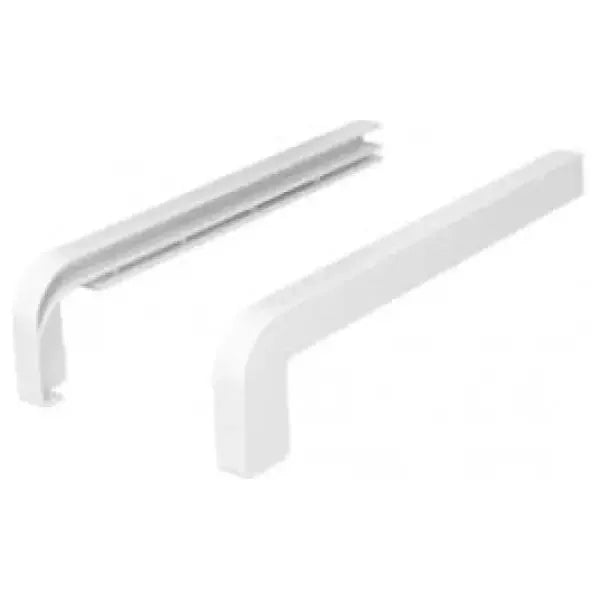
VERGE + SILL END CAP WHITE (PAIR)


Price:
Sale price£5.90

Shipping calculated at checkout

Stock:
In stock

Pickup available at Renders World Southampton

Usually ready in 2 hours

Description

Closing the open profile end of a white oversill cleanly — without leaving the visible step that exposed cut sections create — is the role of the Verge + Sill End Cap White (Pair). Supplied through our window sill extensions and oversills collection, this PVC end-cap pair is engineered specifically for the white oversill family, sealing both ends of the run against wind-driven rain ingress while delivering the visual termination that finishes a window detail properly. Each cap is 30 cm long and trims down with a fine-tooth saw to suit any oversill depth in the white range. Trade collection from our Southampton counter or next-working-day UK delivery.

What White End Caps Do at an Oversill or Verge Termination

The Verge + Sill End Cap White (Pair) is a colour-matched uPVC closure that fits the open profile section at each end of a white oversill or verge trim, sealing the termination against weather ingress and delivering the clean visual finish that completes the window detail. Each pair contains a left and a right cap at 30 cm length, trimmed down on site to suit the installed oversill depth from 110 mm through 220 mm. White remains the prevailing specification on UK traditional and conservation-zone facades, where the fascia, rainwater goods and architectural character call for a consistent white trim line throughout.

End caps perform a function easy to overlook until they are missing. They close the open profile section against wind-driven rain, dust and insect entry behind the trim, and they deliver the finished line at the most prominent point of the window detail — the corners — where any unfinished edge draws the eye first.

Why Trade Specifiers Choose Matched White End Caps

  • Matched to the white oversill range: colour-coordinated with the white oversill family from 110 mm through 220 mm depth, eliminating the visual mismatch that mixed-colour caps create at the reveal.
  • Sealed termination: closes the open profile end against wind-driven rain ingress, dust accumulation and insect entry behind the oversill, preserving the moisture management of the wider render system.
  • Trim-to-fit length: at 30 cm each cap trims down with a fine-tooth saw or score-and-snap utility knife to match any oversill depth in the white range without leaving overhang.
  • Supplied as matched pair: left and right caps shipped together, eliminating the on-site sorting that separate-sided supply creates.
  • Through-coloured rigid PVC: the white pigment is integral to the material rather than surface paint, holding colour stability through prolonged UK exterior exposure subject to manufacturer guidance.
  • Specified for traditional and conservation work: the default termination colour for properties where existing fascia, rainwater goods and trim system follow a white scheme — the most-ordered cap across UK refurbishment projects.

Technical Specifications — White End Cap Pair Data Sheet

Property Value
Product type End cap pair (left + right) for oversill and verge profiles
Material Rigid unplasticised PVC (uPVC), exterior grade
Colour White
Pigment Through-coloured, not surface paint
Cap length 30 cm — trim to suit oversill depth
Pack quantity 1 pair (2 caps — left and right)
Compatibility White over-sill profiles 110–220 mm depth; white verge trim 140 mm
Application Window oversill terminations and verge profile ends on white facade schemes
Storage Flat, dry, away from prolonged direct sunlight prior to install

How to Fit White End Caps — Trim, Bed, Seal at the Reveal

The white end-cap pair fits the full white oversill range across all four depth options, terminating each end of the installed profile cleanly. The most common pairing on UK refurbishment work is with the 140 mm white oversill for the shallow EWI builds typical of conservation-zone and partial-fill retrofit specifications, scaling up to the 220 mm white oversill on full-system EWI work. For verge applications the same caps close the open ends of the white verge trim upstand (2.5 m, 140 mm) where it meets fascia or gable edge.

Install the caps as the final step after the oversill is fixed and the surrounding render has cured to taping-clean. Measure the depth of the installed oversill at the cap location, mark the cap, and cut with a fine-tooth saw or sharp utility knife; score-and-snap on PVC of this thickness gives a cleaner edge than a single full cut. Bed each cap onto the oversill end with a bead of neutral-cure white silicone, press into position, and tool the visible joint to a clean line. For the full installation sequence — oversill, verge trim, end-cap closure and basecoat integration — the window sill extensions installation guide for UK projects walks through the order of work with worked examples.

Installation Notes — Cleaning Discipline, Sealant Selection, Render-Stage Care

White surfaces show cementitious render runoff and efflorescence-style staining more readily than any other colour, so the cleaning step matters here more than on darker trim. Wipe the cap face clean of any wet basecoat splatter immediately — once cement starts to set on PVC, removal becomes far harder and the residue can leave a permanent shadow on the white surface. A damp microfibre cloth carried in the installer's apron through the final basecoat and topcoat passes is the simplest preventive measure.

Neutral-cure white silicone is the right bedding choice — it bonds reliably to PVC, remains flexible through thermal cycling, and the colour-matched bead disappears at the cap-to-oversill junction. Avoid grey or anthracite sealants on white trim, and avoid acid-cure silicones on PVC of any colour, as the curing chemistry is unsuitable for this substrate. End-cap detailing sits within the broader window reveal treatment that also includes stop beads at jamb terminations and corner beads at external arris points; the render detailing around windows and doors pillar guide covers the full junction-by-junction coordination of profiles around openings.

Pro Tips From UK Installers Using White End Caps

White trim demands a slightly different discipline to darker alternatives — less about tonal precision, more about cleaning vigilance and material specification at order stage. The list below is what experienced UK applicators consistently get right on conservation and traditional facade work.

  • Carry a damp microfibre on the final render passes: immediate wipe of any basecoat or topcoat splash prevents the cement set that turns into a permanent shadow on white PVC after twenty-four hours.
  • Check the cap is through-coloured at order stage: ask the supplier explicitly; cheaper painted-white alternatives chip at the cut edge and yellow at a different rate to the surrounding profile, producing visible mismatch by year two of service.
  • Bed with white silicone, never grey: grey or anthracite sealants on white trim read as a contrasting joint line under raking sunlight; colour-matched white silicone disappears at the joint.
  • Plan routine cleaning on north-facing elevations: shaded surfaces stay damper and develop biological growth faster than south-facing equivalents — a yearly soft-wash of the surrounding facade maintains the visual continuity that white trim depends on.
  • Order spare pairs on conservation work: matching replacement caps from a different supply batch later in the service life risks visible tonal drift; one or two spare pairs ordered at install eliminate that risk.

Are White End Caps Right for Your Project?

  • White oversill terminations: the colour-matched closure for any white oversill across the 110–220 mm depth range — one pair closes both ends of one profile run.
  • Conservation, traditional and heritage facades: the right specification where existing fascia, rainwater goods and architectural character call for a continuous white trim line throughout the elevation.
  • Anthracite trim schemes: the matched anthracite end-cap pair is the correct specification for anthracite oversill and verge runs; white caps on anthracite creates an unintended high-contrast termination that draws the eye to the corner.
  • Trade-quantity facade work: calculate one pair per installed oversill or verge profile run; bulk pricing applies on multi-window orders for full-facade refurbishments.

FAQ — White End Caps Coverage, Compatibility, Ordering

How many end-cap pairs do I need per window?
One pair closes both ends of one oversill — left end and right end. For a window with a single horizontal oversill, one pair is sufficient. Bay windows or wraparound installations with multiple oversill sections need one pair per discrete profile run.

Will the white cap yellow over UK exterior exposure?
The pigment is through-coloured rather than surface paint, which significantly improves long-term colour stability compared to painted alternatives. Yellowing on white PVC is generally a UV-driven phenomenon that affects surface-painted material faster than integral-pigment material — performance is best maintained when caps are correctly bedded and the surrounding render is kept clean of the cementitious runoff that can leave permanent staining on white surfaces.

Why is this product self-collection only?
PVC trim accessories suffer disproportionately from courier-transit handling, and surface marks on white finishes show more readily than equivalent damage on darker trim. Self-collection from our Southampton warehouse preserves the factory finish; the small pack size fits comfortably with other oversill components on a single visit, and our team coordinates collection times to suit project schedules.

What sealant works best for bedding the cap on a white scheme?
Neutral-cure white silicone is the standard choice — it bonds reliably to PVC, remains flexible through thermal cycling, and the colour-matched bead minimises visual joint contrast on white trim where any colour mismatch would draw attention. Avoid acid-cure silicones on PVC, and avoid grey or anthracite sealants that would read visibly against the white profile.

Is the cap suitable for shaded or north-facing elevations?
Yes. PVC end caps perform consistently across all elevation orientations on UK facades. North-facing white surfaces can show biological growth — algae and lichens — earlier than south-facing equivalents because shaded surfaces stay damper for longer; this affects the surrounding render more than the cap itself, and a yearly soft-wash of the facade maintains appearance across both orientations.

You may also like

Recently viewed