
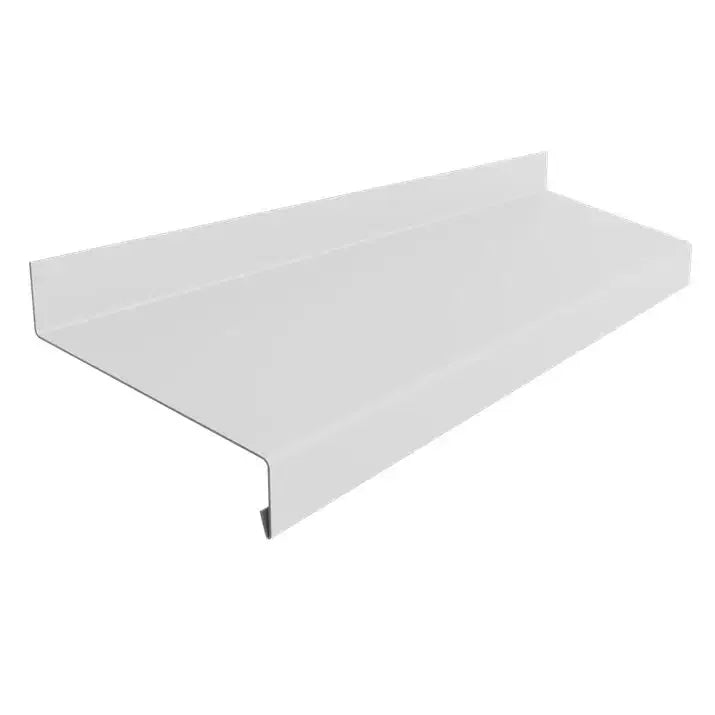
VERGE TRIM- UPSTAND WHITE 2.5m 140mm


Price:
Sale price£29.50

Shipping calculated at checkout

Stock:
In stock

Pickup available at Renders World Southampton

Usually ready in 2 hours

Description

The 140 mm white verge trim upstand is the top-edge termination profile in our window sill extensions and oversills range — the part used where an EWI system meets a flat-roof edge, fascia board, or parapet coping above the insulated wall. Unlike the oversills in the same collection, which shed water downward below window openings, the verge trim works in the opposite direction: its upward return slides behind the adjacent element above and forms a mechanical weather seal without relying on silicone or expanding foam tape. Powder-coated brilliant white aluminium, 2.5 m length, supplied with factory PVC film. Trade self-collection from our Southampton warehouse.

What the 140 mm White Verge Trim Does at Roof and Fascia Junctions

The 140 mm White Verge Trim Upstand caps the top edge of an EWI system where it meets an element above — most commonly a flat-roof edge detail, a timber or uPVC fascia board, or a parapet coping. The profile accommodates insulation builds of 70–120 mm including basecoat and topcoat, and its upward return leg tucks behind the fascia or roof edge with a 15–20 mm overlap, intercepting any water running down the face above and channelling it outward away from the insulation layer below.

This is a different family of detail from the oversill profiles in the same collection. Oversills extend the original window sill outward and direct rainwater downward past the rendered facade; verge trims terminate the insulation at the top edge and form a watertight seal against whatever sits above. The brilliant white powder coat aligns with the standard uPVC fascia colour across most UK housing stock, so the trim reads as a continuation of the fascia line rather than a separate facade element.

Why Installers Choose Verge Trims Over Sealant-Dependent Terminations

  • Mechanical weather seal, not a sealant bead: the upward return slides behind the fascia or roof-edge detail to form a physical overlap that sheds water without relying on silicone — and that is the failure point most likely to degrade first on ageing EWI systems exposed to UV cycling and debris at roof-edge height.
  • 25–30 year service life parity with the EWI system: powder-coated aluminium needs no maintenance over the certified life of the EWI build-up, with no rust, flaking, or discolouration at roof positions where standing water and leaf debris would corrode less robust materials.
  • Specified across BBA-certified EWI systems: profiled aluminium top-edge terminations are increasingly the expected detail in current BBA-certified system documentation, replacing site-fabricated flashings and sealant-dependent details at the roof line.
  • Matches standard uPVC fascia colour: brilliant white aligns with the dominant fascia and soffit specification across UK housing stock, holding a single colour line at the wall-to-roof junction without on-site painting.
  • PVC film protects through overhead work: the factory film stays on through every adjacent trade interface, which matters most at roof-edge height where basecoat splatter and tool drops from overhead scaffold lifts hit the trim face hardest.
  • Sized for the volume insulation band: 70–120 mm covers the EPS and graphite EPS thicknesses specified across most domestic retrofit and new-build EWI work — a single SKU handles the volume of UK projects.

Technical Specifications — 140 mm White Verge Trim Data

Property Value
Profile type Verge trim with upward return — top-edge termination
Material Powder-coated aluminium extrusion, exterior grade
Colour Brilliant white
Length 2.5 m (single unit)
Depth 140 mm
Insulation build accommodated 70–120 mm (with basecoat and topcoat)
Weather seal method Mechanical overlap — return leg behind fascia or roof edge
Recommended overlap depth 15–20 mm minimum behind adjacent element
Fixing centres 300 mm along upstand into substrate
Surface protection Factory-applied PVC film, removed at handover
Compatible end caps White verge sill end-cap pair (sold separately)
Delivery route Self-collection only — Southampton warehouse

The 2.5 m length fits comfortably in a standard panel van and the warehouse team can assist with loading.

How the 140 mm Verge Trim Installs Behind a Fascia or Roof Edge

The verge trim goes on after insulation boards have been bonded and mechanically fixed but before the basecoat and mesh reinforcement layer is applied — that sequence lets the basecoat be worked tight against the trim face afterwards, locking the lower profile edge cleanly into the finished build. Position the trim so the upward return sits behind the fascia board or flat-roof edge with a 15–20 mm overlap, then fix with countersunk screws at 300 mm centres into the substrate behind the insulation. The basecoat and mesh terminate onto the lower face of the trim, encapsulating the fixing line.

Seal each profile end with a colour-matched white verge sill end-cap pair at corners, downpipe positions, or wherever the run terminates against a perpendicular element. The end caps press-fit onto the aluminium and receive a small sealant bead at the cap-to-profile junction — the only sealant point in the entire verge trim run. For the complete installation sequence covering measuring, cutting, end-cap fitting, and coordination with the basecoat layer as a system, our window sill extensions installation guide walks through the worked process across the whole trim family.

Installation Notes — Fascia Condition, Mitre Joints, Mechanical Overlap

For the best result, check the fascia or roof-edge condition before committing to the cut length. On older properties where fascia boards have been replaced or repositioned over the years, the gap between the back face of the fascia and the masonry can vary by 10–15 mm along the same elevation — measure at both ends and centre of each run and confirm the return leg will seat fully behind the fascia at every point. On timber fascias, check that the board is sound and securely fixed, since a loose or partially decayed fascia that moves under wind load will open and close the overlap gap and let wind-driven rain track behind the trim.

Where the verge trim meets an oversill at a corner junction — typically where a flat-roof edge transitions over a window head — mitre both profiles at 45 degrees and seal the mitre joint with a bead of low-modulus facade-grade sealant rated for aluminium-to-aluminium bonding and long-term UV exposure. This mitre joint is one of the very few points in the entire trim system where sealant is structurally necessary, so the product choice matters: a generic silicone will not hold the same service life as the mechanical overlap detail it joins. Keep the PVC film on through every adjacent trade interface and peel it only at scaffold strike.

How the Verge Trim Differs From an Oversill in the Same System

Verge trims and oversills sit in the same collection because they share fixing method, finish, and supply chain — but they perform opposite functions and are not interchangeable. The verge trim handles weather at the top edge of the insulated wall; the oversill handles drainage at the window sill below. On most domestic EWI projects, both are specified together, and the choice between them is dictated by the location of the detail, not by depth or colour.

Detail Family Location on Wall Weather Function
Verge trim upstand (this product) Top edge — meets fascia, flat-roof edge, parapet coping Mechanical overlap behind element above
Oversill 140 mm white Below window — extends original sill outward Downward drip projection past render face

The two profiles share the same end-cap component and the same fixing centres, so once a crew is set up for the trim family the install rhythm carries across both. Where the project specifies anthracite trim rather than white — to match dark frames or contemporary contrast detailing — the matched 140 mm anthracite verge trim covers the same insulation band in RAL 7016 powder coat.

Pro Tips From UK Installers Fitting Verge Trims at Roof-Edge Height

  • Survey the fascia before the EWI programme starts: loose, soft, or partially decayed fascia boards need carpentry attention before the verge trim goes on — fixing the fascia at scaffold-strike height with the trim already installed is the awkward route, and the easy route is a fascia walk-round at the project survey stage.
  • Measure the back-of-fascia gap at three points: ends and centre of every run, because gap variation along the same elevation is the norm rather than the exception on older properties, and a single measurement carried across the run sets up an inconsistent overlap.
  • Plan mitre joints onto a sound substrate behind: the 45-degree mitre where the verge trim meets an oversill needs solid fixing behind both profiles, so check that the insulation board joint underneath has been bonded and fixed properly before committing to the mitre position.
  • Use facade-grade sealant only at the mitre: low-modulus, UV-stable, aluminium-rated — generic silicone in a cartridge gun from the van will fail before the EWI system does, and the mitre joint is the one point in the entire detail where sealant choice matters structurally.
  • Count end-cap pairs by runs, not by metres: one white verge sill end-cap pair closes one continuous run, regardless of whether that run is one 2.5 m profile or three joined together — count by runs on the order sheet.

Is the 140 mm White Verge Trim Right for Your Project?

  • EWI projects with 70–120 mm insulation and a top-edge condition: the correct profile wherever the EWI system meets a flat-roof edge, timber or uPVC fascia, or parapet coping — the mechanical overlap detail that eliminates the sealant-dependent failure point at roof-edge height.
  • White-frame and white-fascia facades: the brilliant white powder coat aligns with the dominant uPVC specification across UK housing stock, holding a clean colour line across the whole wall-to-roof junction.
  • Window sill drainage below openings: verge trims terminate the top of the wall, not the bottom of window openings — for the downward drip-edge that sheds rainwater below windows, the 140 mm white oversill is the correct profile, available in four depths to match different insulation builds.
  • Anthracite or contrast-trim facades: the 140 mm anthracite verge trim covers the same insulation band in RAL 7016, matching dark fascia boards and contemporary facade specifications.

FAQ — 140 mm White Verge Trim Application, Compatibility, Ordering

What is the difference between a verge trim and an oversill?

An oversill has a downward-angled drip edge and fits over the existing window sill to shed rainwater away from the facade below an opening. A verge trim upstand has an upward-facing return that slides behind a fascia board, flat-roof edge, or parapet coping to create a watertight termination at the top of the insulation system. Both are powder-coated aluminium and share fixing method and end caps, but they serve opposite functions — drainage below openings versus weather sealing above the insulated wall.

Does the verge trim require sealant along its length?

The main weather seal is mechanical — the upward return overlaps behind the fascia or roof edge by 15–20 mm, so no sealant is needed along the profile length. The only sealant points are at end-cap junctions and at 45-degree mitre joints where the verge trim meets an oversill at a corner. Use a low-modulus facade-grade sealant rated for aluminium bonding and UV exposure at those localised points.

How do I confirm the fascia gap will accept the return leg?

Measure the gap between the back face of the fascia board and the masonry at a minimum of three points along each run — both ends and centre — before committing to the cut. The return leg needs a 15–20 mm overlap behind the fascia at every position along the run. On older properties where fascias have been replaced over the years, gap variation of 10–15 mm along the same elevation is common, and a tight overlap at one end with a generous one at the other points to a need for fascia adjustment before fitting the trim.

Are end caps included with the verge trim?

End caps are sold separately so each run can be matched precisely to its measured length. Order the white verge sill end-cap pair alongside the verge trim — one pair closes one continuous run, regardless of whether that run is a single 2.5 m profile or multiple profiles joined together along a longer fascia.

Does the verge trim work behind timber fascias as well as uPVC?

The verge trim works behind both, provided the fascia is sound and securely fixed. On timber fascias, confirm that the board is firm and has no soft or decayed sections before sliding the return behind it — a loose or partially decayed timber fascia that moves under wind load will open and close the overlap gap and let wind-driven rain track behind the trim. Fascia repair or replacement is a carpentry task best completed before the EWI programme begins.

Can the verge trim be cut to length on site?

Each 2.5 m profile is designed to be cut to the measured run length on site using a fine-toothed metal-cutting blade. Leave 2–3 mm clearance at each end for the end cap to seat without forcing, then deburr the cut edge with fine-grit abrasive paper so the end-cap seal beds cleanly against the cut aluminium. For runs exceeding 2.5 m, two profiles are joined end-to-end with a manufacturer-approved jointing strip behind the joint position.

Why is this product self-collection only?

2.5 m powder-coated aluminium profiles dent too frequently in courier transit for white trim to remain economic, since any handling marks show clearly against the brilliant white finish. Self-collection from our Southampton warehouse keeps the profile in factory condition through to install — the 2.5 m length fits comfortably in a standard panel van, and the warehouse team can assist with loading.

You may also like

Recently viewed