
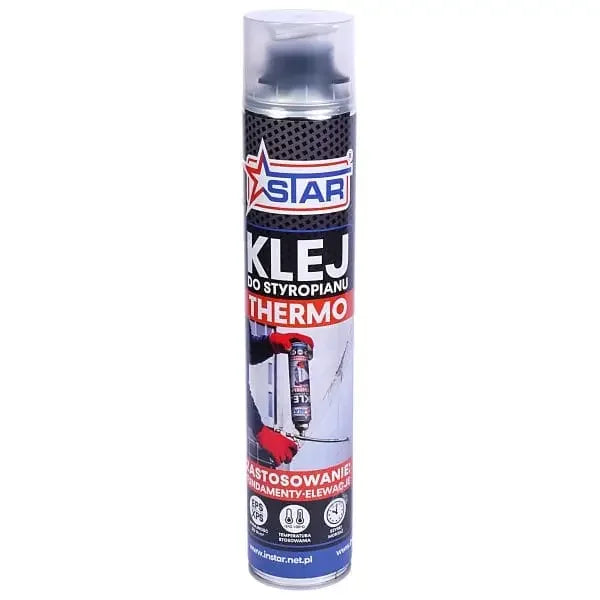

Description
Board adhesive is the one stage of an insulation build-up where the scope printed on the pack matters more than the brand on it. This product sits in the insulation fixing accessories range at Renders World, next to the plugs, discs and base tracks that follow it up the wall.
Where Thermo Star Bonds EPS Boards Best on a UK Wall
Thermo Star Styrofoam Adhesive bonds EPS insulation boards to sound masonry ahead of the mechanical fixings, and it was listed at £12.00 as displayed, in stock, when Renders World was crawled in August 2026. The listing shows no pack size beside that price, so the pack format is worth confirming on the order line rather than assumed from a comparable product.
That one gap shapes everything below it. What a live source can show is published here as a plain figure; what only a manufacturer sheet can settle is named as an order-line check rather than filled in from a similar adhesive.
- Domestic solid-wall retrofit on sound masonry — brick, block, stone or rendered walls that have been cleaned back and tested, where the boards being bonded are polystyrene.
- New-build blockwork and concrete — fresh substrates flat enough for the adhesive to reach full contact across the board face instead of bridging a hollow.
- Polystyrene boards only — the scope recorded for this product is expanded polystyrene, which keeps it clear of the wool-compatible adhesives that look interchangeable on a shelf.
- Sequenced bonding stages — walls prepared course by course, where boards are bonded, left to gain strength, then pinned before the reinforcing layer follows.
Why Installers Order This Board Adhesive Alongside Their Fixings
The value here is a narrow, well-defined job and a stocked supply chain around it, so a bonding day is not held up waiting on one line item.
- Priced openly at £12.00, as displayed in August 2026, which lets a materials schedule be built without a quote request for the bonding line.
- Listed in stock at the time of the crawl, alongside the plugs and countersinking tools that finish the same stage, so one order covers bonding and pinning.
- A single, unambiguous substrate scope — polystyrene boards, not mineral wool — which removes the most common substitution error on a mixed-material site.
- Bonded and pinned from one supplier — the graphite EPS insulation boards this adhesive is scoped to are stocked on the same site as the fixings that anchor them.
- Independent of the fixing pattern — the anchor layout is a system and manufacturer figure rather than a property of the adhesive, so it is specified separately and never inherited from the tin.
Specification Status and What to Confirm Before Ordering
No manufacturer data sheet, declaration or distributor mirror for this adhesive could be retrieved in this session, and a search of the technical-document hosts returned nothing for it. That is the honest position, and it is more useful to a specifier than a plausible figure would be.
- Published here from a live source — the price and the stock state shown on the product listing, each dated to the month it was read.
- Not published here — yield per pack, application temperature range, time to anchorage, shelf life and coverage per square metre, none of which any retrieved document supports.
- Confirmed at the pack — the label and any leaflet supplied with the goods carry the working temperatures, the cure window and the date marking, and they govern on site.
- Confirmed at order — pack format and unit, since the listing gives a price without a size and the two are read together on a materials schedule.
Where a specification clause names a documented adhesive, that is a reason to work from a product whose sheet is in hand. The decision route for that sits in the EPS adhesive selection guide, which works through substrate, programme and documentation together.
How to Install EPS Boards With Thermo Star Styrofoam Adhesive
The method below is ordinary board-bonding practice and carries no figures, because the figures that govern it belong on the pack. Read the label first, then work the wall in this order.
- Prove the substrate — brush down, remove loose material and friable paint, and satisfy yourself the face is load-bearing before any board goes up.
- Set the datum — establish the base line and the first course off a levelled base track, since every board above inherits that line.
- Apply to the board — a continuous run around the perimeter with a further run through the centre face, keeping the pattern identical board to board so the course sits flat.
- Place and adjust — press each board home with a long float and slide it into final position while the adhesive is still workable, checking across two boards rather than one.
- Pin, then reinforce — fit the mechanical fixings once the adhesive has reached the strength its label states, and take the layout from the fixing pattern and spacing guide.
Bonding and pinning are two stages that answer to different documents, which is why they are planned as two. The EWI fixings installation guide covers the pinning stage in full, including how the anchor sits relative to the bond line.
Installation Notes for Cold, Damp and Uneven Substrates
Cold and damp conditions are workable when the day is planned around them. Start on the shaded elevation in the morning, move to the sunlit face as it falls into shadow, and keep the bonding stage ahead of the weather rather than racing it — a rhythm the UK weather window planner sets out month by month.
- Test before committing — on anything other than plain masonry, bond a small off-cut, leave it to cure, then pull it by hand; the board tearing rather than lifting cleanly is the result worth having.
- Level, do not bridge — where a wall runs out badly, a trowelled cementitious adhesive fills what a bead cannot, and packing that decision into the right product early keeps the finished plane true.
- Keep stock indoors overnight — adhesive left in a cold van dispenses unevenly on the first run of the morning, and a warm start recovers full output.
Choosing Between Board Adhesive Routes on One Elevation
Three questions decide the route, and none of them is brand preference: what the boards are made of, what the wall surface is doing, and whether the specification asks for documentation. This page owns the first of those; the other two route onward.
| Your Situation | Where the Answer Sits | What Decides It |
|---|---|---|
| Polystyrene boards, sound flat masonry | This product line | Scope and stocked availability |
| Uneven wall, or documentation named in the spec | Adhesive selection guide for EPS | Substrate tolerance and paperwork |
| Whole build-up not yet fixed | EWI layer build-up explained | Layer compatibility, front to back |
Settling the route before the scaffold goes up is a step worth getting right, because the bonding product and the reinforcing layer above it are chosen together on any wall that has to perform for decades.
Is Thermo Star Styrofoam Adhesive Right for Your Build-Up?
- Choose it for polystyrene board bonding on sound masonry — a domestic retrofit or new-build elevation where the substrate is prepared, the boards are EPS, and an openly priced, stocked adhesive suits the programme.
- For mineral wool slabs, change adhesive — slabs from the mineral wool insulation range take a wool-compatible product, and that is a different order line rather than a substitution.
- For the plinth and below-DPC zone — the boards themselves sit in the XPS foundation and plinth boards collection, where adhesive choice is confirmed against that board's own documentation.
- Order the boards with it — the graphite boards in the EPS insulation boards range arrive on the same delivery, which is how a bonding day starts on time.
Renders World lists the price and the stock state openly on the product page, and the specification questions this page leaves open are the ones a supplier should be asked directly rather than answered by inference.
FAQ: Ordering, Compatibility and Site Conditions
How many packs does one elevation need?
Work it in two steps. Take the board count from the elevation area divided by the face area of the board on its own listing, then apply the yield printed on the adhesive pack, which is the only figure that governs it. No yield is published on this page because no document supporting one was retrieved, so the pack label and a spare allowance for test patches and corrections carry the calculation.
Does it bond mineral wool slabs as well as polystyrene boards?
Its recorded scope is polystyrene boards, so wool takes a wool-compatible adhesive instead. Slabs in the mineral wool insulation range are ordered with that adhesive alongside them, and keeping the two product lines separate on the schedule is the simplest way to prevent a mix-up on a site running both materials.
Can it be used in cold or damp UK conditions?
Plan it around the limits on the pack, which state the temperature range and the extended cure this product allows; those figures are not published here because no sheet was available to read them from. Practically, morning starts, shaded elevations first and indoor overnight storage give the widest usable window, and the seasonal planning guide maps the workable months.
How should unopened stock be stored on site?
Keep it inside, dry, off the ground and away from direct heat, and check the date marking before it goes on the wall. Rotating stock so the oldest is used first protects yield, and anything that dispenses unevenly or inconsistently is set aside rather than stretched across a course of boards.