
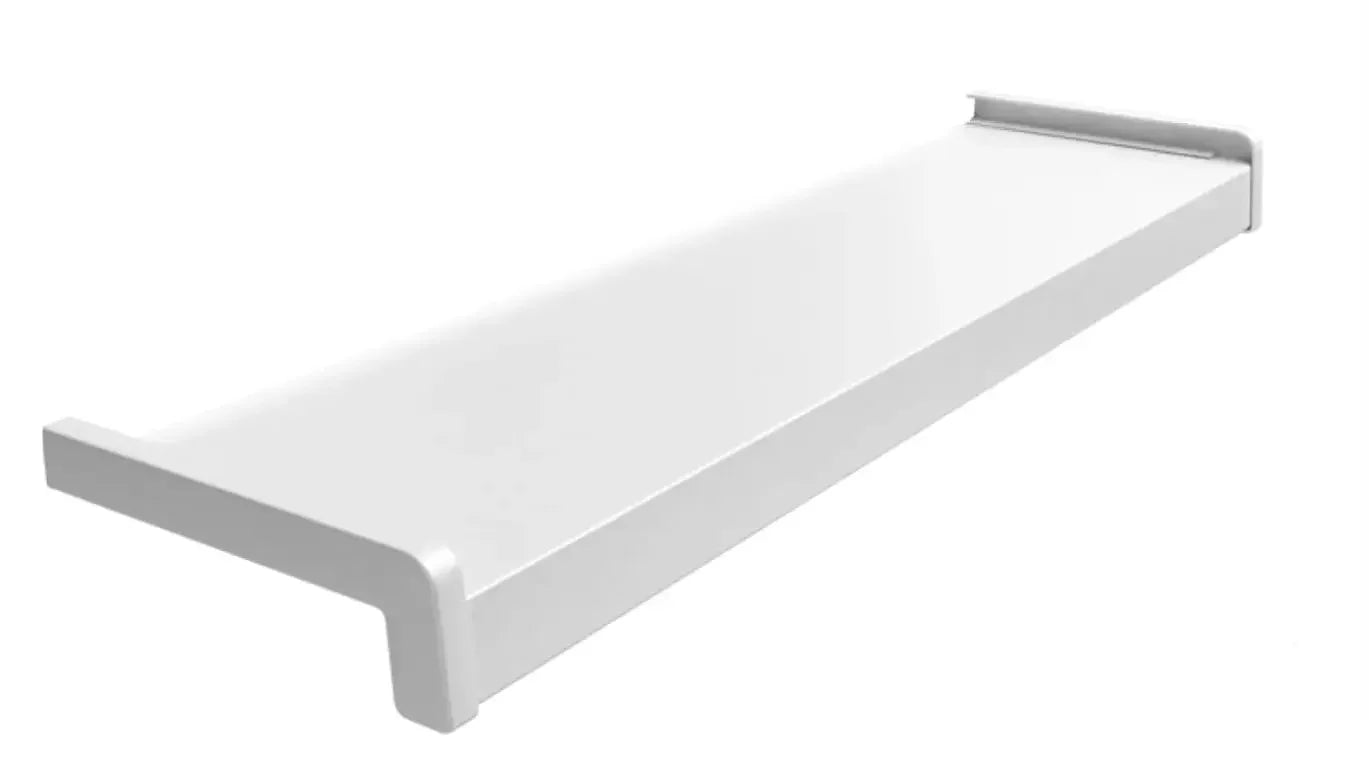
OVER SILL WHITE 2.5m 220mm DEPTH


Price:
Sale price£30.40

Shipping calculated at checkout

Stock:
In stock

Pickup available at Renders World Southampton

Usually ready in 2 hours

Description

The 220 mm white oversill is the deepest profile in our window sill extensions range and sits across mainstream UK deep-build EWI work — solid-wall retrofits where 140–200 mm of insulation has pushed the finished facade well past the original sill projection. Powder-coated brilliant white aluminium at 2.5 m length, supplied with factory PVC protective film, the profile restores a clean drip-edge overhang in the colour that aligns with the uPVC window frames installed across most UK housing stock. Trade self-collection from our Southampton warehouse.

What the 220 mm White Oversill Does on Deep EWI Builds

The 220 mm White Oversill carries the original window sill outward over EWI insulation builds of 140–200 mm, delivering the 30–40 mm drip projection past the finished render face that BBA-certified EWI specifications expect. At 2.5 m unit length in brilliant white powder coat, the profile handles the broad mid-to-deep band of UK insulation work — from 140 mm graphite EPS through 170 mm mineral wool and on to dual-layer 200 mm builds on demanding solid-wall retrofits.

White is the volume specification across UK EWI because most uPVC window frames installed since the 1990s are white, and a matched sill line reads as a single architectural element rather than a contrasting band across the elevation. On local-authority and housing-association programmes that account for much of the deep-retrofit pipeline, white trim is the default — and at 220 mm depth the profile addresses the deepest insulation builds those programmes specify when targeting whole-wall U-values below 0.22 W/m²K.

Why UK Installers Specify White for Mainstream Deep-Build Projects

  • Matches the dominant uPVC frame colour: the brilliant white powder coat aligns with the standard frame specification on the majority of UK housing stock, holding a single colour line across the window detail without on-site touching-in.
  • Sized for the volume deep-build band: the 220 mm projection covers 140–200 mm insulation in a single SKU — wider than the anthracite equivalent because white is the volume colour and absorbs a broader range of project depths in practice.
  • Specified across local-authority and HA programmes: the colour and depth combination is the workhorse choice on social-housing retrofit work where solid 225 mm brick receives 150–170 mm of mineral wool to hit Part L compliance targets.
  • UV-stable powder coat: the brilliant white finish resists yellowing over the 25–30 year service life of a certified EWI system, holding colour parity with the frames and any neighbouring elevations across a phased retrofit programme.
  • Factory PVC film through long programmes: deep-build EWI runs longer programmes than shallower work, and the film protects the white face through extended scaffold time, mortar splatter, and multi-trade interfaces around the window detail.
  • Part of a four-depth family: the 220 mm sits at the top of a graded range — the 110 mm, 140 mm and 170 mm white oversills below it cover shallower builds, so a mixed-depth elevation can be detailed in one colour family across every opening.

Technical Specifications — 220 mm White Oversill Data

Property Value
Profile type Window oversill extension — deepest projection
Material Powder-coated aluminium extrusion, exterior grade
Colour Brilliant white
Length 2.5 m (single unit)
Projection (depth) 220 mm
Insulation build accommodated 140–200 mm (with basecoat and topcoat)
Drip-edge projection past render 30–40 mm typical at correct build depth
Recommended fixing centres 300 mm along rear upstand
Surface protection Factory-applied PVC film, removed at handover
Compatible end caps White verge sill end-cap pair (sold separately)
Delivery route Self-collection only — Southampton warehouse
Storage Flat, dry, protective film retained until install

Courier transit is excluded for this product because 2.5 m powder-coated profiles dent too frequently in transport for white trim to arrive in factory condition.

How the 220 mm White Oversill Fits Into the EWI Sequence

The oversill goes on after the insulation boards have been bonded and mechanically fixed but before the basecoat and mesh reinforcement layer is applied — this sequence lets the basecoat be worked tight against the trim edge afterwards, locking the profile into the finished build. Bed the rear upstand into a continuous low-modulus silicone or hybrid sealant bead against the original masonry sill, then fix mechanically at 300 mm centres along the upstand with countersunk screws.

The trim should be set with a slight outward fall — typically 5–10 degrees — so rainwater drains clear of the wall rather than tracking back behind the profile onto the insulation layer. At 220 mm projection the structural loading is meaningfully greater than at shallower depths, so verify wind-uplift capacity against the project exposure category, particularly on south-westerly elevations. For the full installation sequence covering measuring, cutting, sealing, and end-cap integration as a complete system, our window sill extensions installation guide walks through the worked process across the whole trim family.

Installation Notes — Cutting, Sealing, Film Removal

For the best result, measure every opening individually. On solid-wall retrofits where the 220 mm depth is most often specified, original reveals vary by 15–20 mm between openings on the same elevation because of historical settlement and brick irregularity. Cut each profile to width with a fine-toothed metal-cutting blade, leaving 2–3 mm clearance at each end for the end cap to seat without forcing, then deburr the cut edge with fine-grit abrasive so the end-cap seal sits cleanly.

Use a low-modulus silicone or hybrid sealant along the rear upstand — high-modulus products can crack as the aluminium cycles with temperature, and any break in the sealant line behind a 220 mm profile lets water track directly onto the insulation. Leave the PVC protective film intact through the basecoat, mesh, and topcoat applications. Peel it only once the topcoat has fully cured and scaffolding is being struck, so the white face arrives at handover without remedial cleaning marks.

How the 220 mm Depth Compares to Shallower White Oversills

The white oversill family runs across four projections to cover the full UK insulation depth band in a single colour. Selecting the right depth is a measurement exercise: total finished build from the original masonry face outward (insulation plus adhesive, basecoat, and topcoat) should sit roughly 30–40 mm short of the oversill projection so the drip edge clears the render face properly.

White Oversill Insulation Band Typical Project Type
140 mm depth 60–100 mm Standard cavity-wall and mid-range EWI
170 mm depth 100–140 mm Workhorse solid-wall retrofit builds
220 mm depth (this product) 140–200 mm Deep solid-wall retrofit, LA and HA programmes, high-performance new build

If the project specifies dark trim rather than white — to match anthracite window frames or a contemporary contrast-trim facade — the matched 220 mm anthracite oversill covers the same projection in RAL 7016 powder coat. For builds below 140 mm finished insulation, the 170 mm white oversill is the correct workhorse depth and avoids the unnecessary architectural step that an over-specified 220 mm projection would create at the window detail.

Pro Tips From UK Renderers Fitting the 220 mm White Oversill

  • Check van load space before collecting: at 2.5 m length the profile is the largest oversill in the range, and on multi-window jobs the run can easily reach a dozen profiles plus end-cap packs — confirm load capacity before the trip rather than at the counter.
  • Order end caps in matched batches: the white verge sill end-cap pair is sold separately and one pair closes one oversill run, so count end-cap pairs against window openings, not against linear metres of profile.
  • Watch for bowing on tight cuts: the deeper the profile, the more a tight-cut length will visibly bow if forced into a reveal that is 1–2 mm narrower than the cut dimension — the 2–3 mm clearance at each end is the rule that protects the visible trim line on a 220 mm depth.
  • Plan the 30–40 mm overhang calculation upfront: add insulation thickness plus 12–15 mm basecoat-and-topcoat to project finished build, then check that the 220 mm projection delivers the 30–40 mm clearance past that figure — if it doesn't, the wrong depth has been ordered.
  • Keep the PVC film on through the full programme: on long deep-build jobs the film's UV resistance keeps the powder coat unmarked even after extended scaffold periods, and pulling it early is the single most common cause of remedial cleaning at handover.

Is the 220 mm White Oversill Right for Your Project?

  • Deep solid-wall retrofit EWI: the correct projection for 140–200 mm insulation builds typical of Victorian, Edwardian and inter-war masonry receiving thick graphite EPS or mineral wool to meet whole-wall U-value targets.
  • Local-authority and housing-association programmes: the workhorse depth and colour combination on social-housing retrofit, where matched white trim aligns with the standard uPVC frame specification across blocks of dwellings.
  • High-performance new build: a sound choice on developer programmes anticipating Future Homes Standard performance levels, where insulation depth is forward-specified to 150–180 mm and the trim depth needs to track.
  • Standard EWI at 100–140 mm insulation: the 170 mm white oversill is the workhorse depth — the 220 mm projection would project past the render face and add unnecessary architectural mass to the window detail.
  • Anthracite or contrast-trim facades: the 220 mm anthracite oversill covers the same insulation band in RAL 7016, matching dark frames and contemporary facade specifications.

FAQ — 220 mm White Oversill Coverage, Compatibility, Ordering

What insulation thickness suits the 220 mm white oversill?

The 220 mm depth accommodates insulation build-ups of 140–200 mm plus the basecoat and topcoat layer (typically 10–15 mm combined). For a 170 mm mineral wool slab with 12 mm of basecoat and topcoat, total added wall thickness is approximately 182 mm — the 220 mm profile then provides around 38 mm of drip-edge projection, sitting within the 30–40 mm range expected by BBA-certified EWI system guidance.

How many profiles do I need for a typical window opening?

One 2.5 m profile covers most domestic window widths in a single length, which matters at 220 mm projection because any intermediate joint becomes visible as a line on the deep trim face. Measure the opening width and add 30–50 mm overhang each side past the reveal. For openings wider than 2.5 m clear, two profiles are joined with a manufacturer-approved jointing strip — plan the joint position to fall away from the visual centre of the opening.

Do end caps come included?

End caps are sold separately as a matched pair, allowing precise pairing with the cut profile width. Order the white verge sill end-cap pair alongside the oversill so the matched components arrive together — one pair closes both ends of a single oversill run.

Can the 220 mm oversill be cut to length on site?

Each 2.5 m profile is designed to be cut to the measured window width on site using a fine-toothed metal-cutting blade. Leave 2–3 mm clearance at each end for the end cap to seat without forcing, then deburr the cut edge with fine-grit abrasive paper so the end-cap seal beds cleanly against the cut aluminium rather than catching on a rough edge.

What sealant should be used at the rear upstand?

A low-modulus silicone or hybrid sealant rated for facade movement is the right choice. High-modulus products can crack as the aluminium expands and contracts with temperature cycling, and any break in the sealant line behind a 220 mm profile lets water track directly onto the insulation layer behind. Run a continuous bead along the full upstand length and tool it cleanly before the basecoat is applied.

Are there fixing implications at this projection depth?

At 220 mm projection the trim is structurally working harder than shallower alternatives, and wind-uplift loading on south-westerly elevations facing prevailing UK weather should be verified against the project's exposure category. Standard 300 mm fixing centres along the upstand suit most sheltered and moderate-exposure sites; supplementary mechanical fixings may be advisable on high-exposure facades — confirm against the project specification and any system-supplier guidance.

Why is this product self-collection only?

2.5 m powder-coated aluminium profiles dent too frequently in courier transit to remain economic on visible white trim, where any handling marks show clearly against the brilliant white finish. Self-collection from our Southampton warehouse keeps the profile in factory condition through to install — which is the outcome that matters most on facade detailing that will be visible for the 25–30 year service life of the EWI system.

You may also like

Recently viewed